
A commercial plumber service contract is a formal agreement that defines the scope of maintenance, repair services, pricing, and performance expectations between your business and a licensed plumbing provider. Selecting the right one protects your facility from unplanned failures, controls costs, and gives you priority access to skilled technicians when emergencies hit. The industry term for the most structured version of this agreement is a facilities management service level agreement, or FM SLA. Whether you manage a single property in Bullhead City or a multi-site portfolio across Mohave County, knowing how to evaluate these contracts separates reactive, expensive plumbing management from a reliable, predictable system.
What essential elements should you look for in a commercial plumber service contract?
A well-structured commercial plumbing maintenance contract covers six core components: scope of work, service frequency, pricing terms, warranty and liability, termination clauses, and licensed provider verification. Plumbing contracts require a defined process: gather client information, define scope, set frequency and duration, establish pricing, address warranty and liability, include termination terms, and close with signatures and dates. Missing any one of these components creates gaps that cost you money or leave you locked into a bad agreement.
Here is what to verify before signing any plumbing service agreement:
- Scope of work: Confirm the contract lists specific services, including preventive maintenance visits, drain inspections, water heater checks, and emergency repair coverage. Vague language like "general plumbing services" is unenforceable.
- Service frequency and duration: The contract should state how many scheduled visits occur per year and the expected duration of each visit. Annual plumbing checkups covering preventive tasks like flushing water heater tanks and measuring gas and water pressure are standard in quality agreements.
- Pricing and discount terms: Look for a fixed labor rate and a stated discount on parts, typically between 10% and 20% off standard retail pricing. This is one of the primary financial benefits of commercial plumbing contracts.
- Warranty and liability provisions: The contract must specify who bears liability for damage caused during a service visit and what warranty applies to completed repairs.
- Renewal and termination clauses: Written notification is required to avoid automatic renewal, and early termination rarely entitles you to a partial refund. Read these terms before you sign, not after.
- Priority response commitments: Emergency response time should be stated explicitly, not implied. A contract that says "prompt service" is meaningless without a defined timeframe.
- License and insurance verification: Confirm the provider holds a current state plumbing license and carries general liability plus workers' compensation insurance. This protects your business from third-party claims.
Pro Tip: Ask for a sample inspection report before signing. If the provider cannot show you what a completed visit looks like on paper, their documentation practices are likely inadequate.
How do service level agreements (SLAs) enhance commercial plumbing contracts?

An SLA is a documented agreement that defines minimum service delivery standards, covering responsibilities, response speeds, and quality benchmarks. SLAs move performance evaluation from opinion to measurable fact, which is exactly what facility managers need when holding vendors accountable. Without an SLA embedded in your plumbing service agreement, you have no legal basis to dispute slow response times or missed maintenance visits.
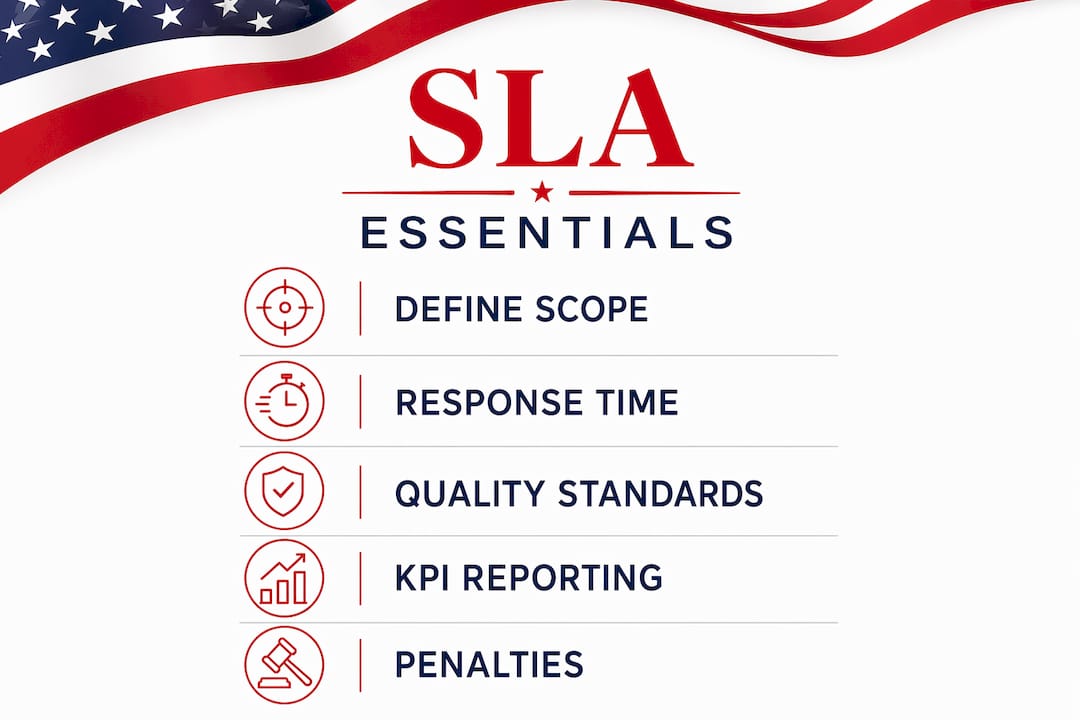
The most useful SLA metrics for commercial plumbing contracts fall into two categories: response metrics and quality metrics.
| SLA Metric | Definition | Example Target |
|---|---|---|
| Acknowledgment time | Time from service request to vendor confirmation | Within 5 minutes for P1 emergencies |
| Dispatch time | Time from acknowledgment to technician dispatched | Within 15 minutes for P1 emergencies |
| Onsite arrival time | Time from dispatch to technician on premises | Within 2 hours for P1 emergencies |
| Restore time | Time from arrival to system restored | Within 4 hours for P1 emergencies |
| PM schedule adherence | Percentage of scheduled maintenance visits completed on time | Minimum 95% |
| First-time fix rate | Percentage of repairs resolved without a return visit | Minimum 85% |
These targets come directly from FM SLA best practices for facilities management programs. The P1 emergency example, acknowledging in 5 minutes, dispatching in 15, arriving onsite in 2 hours, and restoring in 4 hours, represents a realistic and enforceable standard for critical plumbing failures like burst pipes or sewer backups.
One distinction that most business owners miss: response time has two components, the time to acknowledge and dispatch, and the time to arrive and restore. Separating these metrics in your contract lets you identify exactly where a vendor is underperforming. A provider might dispatch quickly but consistently arrive late due to poor routing or understaffing.
Enforceable SLAs specify when the clock starts, when it stops, what penalties apply for breach, and how often KPI reports are delivered. A PM schedule adherence target of 95% and a first-time fix rate of 85% are concrete, auditable numbers. Vague SLAs generate vendor disputes. Specific SLAs generate accountability.
Pro Tip: Require monthly KPI reports as a contract deliverable. If a vendor resists this requirement, that resistance tells you everything you need to know about their confidence in their own performance.
What tools and processes help you evaluate plumbing contracts effectively?
Evaluating a commercial plumbing service agreement is easier when you follow a structured process rather than reviewing contracts line by line without a framework. The most reliable approach borrows from facilities management procurement: use a Request for Proposal template to collect comparable bids from multiple vendors before selecting one.
A structured RFP process for plumbing contracts works in five steps:
- Define your asset inventory. List every plumbing asset at your facility: water heaters, sewer lines, backflow preventers, grease traps, and fixtures. This list becomes the scope baseline that every vendor must price against.
- Draft measurable scope language. Write specific service descriptions rather than general ones. "Inspect and flush one 50-gallon commercial water heater annually" is auditable. "Water heater service" is not.
- Request SLA commitments in writing. Ask each vendor to state their emergency response times, PM adherence targets, and first-time fix rates. Multi-site contracts benefit from FM SLA-style scope definitions with measurable KPIs and asset-specific schedules.
- Compare pricing structures side by side. Some vendors offer flat-rate annual contracts. Others bill time and materials with a discounted labor rate for contract holders. A comparison table with total estimated annual cost, emergency call coverage, and parts discount percentage makes the decision objective.
- Verify credentials before shortlisting. Confirm state plumbing license numbers through your state licensing board, request certificates of insurance, and check references from at least two current commercial clients.
The three most common contract types you will encounter are a basic service agreement covering scheduled maintenance only, a full maintenance plan that includes both preventive visits and repair labor, and a financing-inclusive plan that bundles equipment replacement into monthly payments. Most facility managers find the full maintenance plan delivers the best balance of cost predictability and coverage depth.
How can you avoid common mistakes when managing plumbing service contracts?
The most expensive mistake in commercial plumbing contract management is signing an agreement with vague inspection deliverables. Writing inspection deliverables into the maintenance scope creates auditable contract terms that support compliance records, maintenance logs, and budget controls. Without documented deliverables, you cannot prove a visit occurred, and you cannot dispute a vendor's billing.
Four additional mistakes consistently cost business owners money:
- Ignoring termination and renewal terms at signing. Most contracts auto-renew unless you provide written notice 30 to 60 days before the renewal date. Missing this window locks you in for another full term.
- Accepting verbal emergency response commitments. If the response time is not in the written contract, it does not exist as an enforceable obligation.
- Skipping vendor license verification. An unlicensed plumber performing work at your facility creates liability exposure that your insurance carrier may not cover.
- Failing to track SLA performance. Connecting plumbing vendor performance to measurable outcomes like uptime, safety, and cost control aligns service delivery with your operational goals. Without tracking, you cannot identify underperformance until a failure occurs.
"Service agreements reduce disputes by legally protecting both sides on prices and services while ensuring preventive maintenance and emergency priority." — Angi, Plumbing Service Contracts
When a dispute does arise, start with the written contract and your KPI reports. If the vendor has missed SLA targets documented in monthly reports, you have a factual basis for negotiation or termination. For complex multi-site disputes or contracts above $50,000 annually, consulting a facilities management attorney before sending a termination notice is worth the cost. You can also review quick tips for plumbing emergencies to understand what constitutes a genuine P1 event versus a routine service call, which directly affects how you apply SLA response time clauses.
Key takeaways
Selecting the right commercial plumber service contract requires defined scope, enforceable SLA metrics, and verified vendor credentials before you sign anything.
| Point | Details |
|---|---|
| Define scope precisely | List every plumbing asset and require specific service descriptions, not general terms. |
| Embed SLA metrics | Require stated response times, PM adherence targets, and first-time fix rates in writing. |
| Verify credentials | Confirm state license numbers and certificates of insurance before shortlisting any vendor. |
| Review termination terms early | Understand auto-renewal windows and written notice requirements before signing. |
| Track KPI performance monthly | Require monthly SLA reports to identify underperformance before a failure occurs. |
What I have learned from years of commercial plumbing contracts
The single biggest gap I see between businesses that manage plumbing costs well and those that do not is documentation. Facility managers who demand written inspection reports after every visit, track PM adherence monthly, and review SLA performance quarterly almost never face surprise repair bills above their budget. Those who rely on a handshake and a general service description spend twice as much over a three-year period.
The other lesson that took time to learn: read the termination clause on day one, not when you want to leave. I have seen businesses trapped in underperforming contracts for an extra year because they missed a 45-day written notice window. That is a preventable cost. Review renewal and cancellation terms the same day you review pricing.
Vendor vetting also matters more than most buyers realize. A low bid from an unlicensed contractor is not a discount. It is a liability. Verifying a state plumbing license takes five minutes online and protects you from claims your insurance will not cover. The benefits of preventive commercial plumbing programs are real, but only when the provider delivering them is qualified and accountable.
— JOHN
How Usaplumbingseptic supports your commercial plumbing needs
Usaplumbingseptic delivers tailored commercial plumbing maintenance contracts for businesses across Bullhead City, Fort Mohave, Mohave Valley, and Laughlin. Our licensed plumber teams provide priority scheduling, documented preventive maintenance visits, and 24/7 emergency response with defined response time commitments. We go the extra mile to make sure your facility stays operational and your contract terms are clear from day one.
If you are ready to protect your facility with a reliable maintenance plan, start with our Mohave County plumbing essentials guide to understand what services your property needs. Then contact Usaplumbingseptic directly for a personalized consultation and a contract proposal built around your specific assets and operational requirements. Call now or book online. We are ready.
FAQ
What is a commercial plumber service contract?
A commercial plumber service contract is a formal written agreement between a business and a licensed plumbing provider that defines scheduled maintenance, repair coverage, pricing, and emergency response terms. It protects both parties and ensures predictable plumbing system management.
What SLA response times should I expect for plumbing emergencies?
For P1 priority emergencies, a well-structured FM SLA targets acknowledgment within 5 minutes, dispatch within 15 minutes, onsite arrival within 2 hours, and system restoration within 4 hours. These targets should appear in writing in your contract.
How do I avoid automatic renewal in a plumbing service agreement?
Most contracts require written notice 30 to 60 days before the renewal date to cancel without penalty. Review the termination clause at signing and calendar the notice deadline immediately to avoid being locked into an unwanted renewal term.
What KPIs should I track in a commercial plumbing maintenance contract?
The two most important KPIs are PM schedule adherence, with a minimum target of 95%, and first-time fix rate, with a minimum target of 85%. Require monthly KPI reports as a contract deliverable so you can identify underperformance before it becomes a system failure.
Why does license verification matter when hiring a commercial plumber?
An unlicensed plumber performing work at your facility creates liability exposure that your general liability insurance may not cover. Verifying a state plumbing license through your state licensing board takes minutes and protects your business from third-party claims.