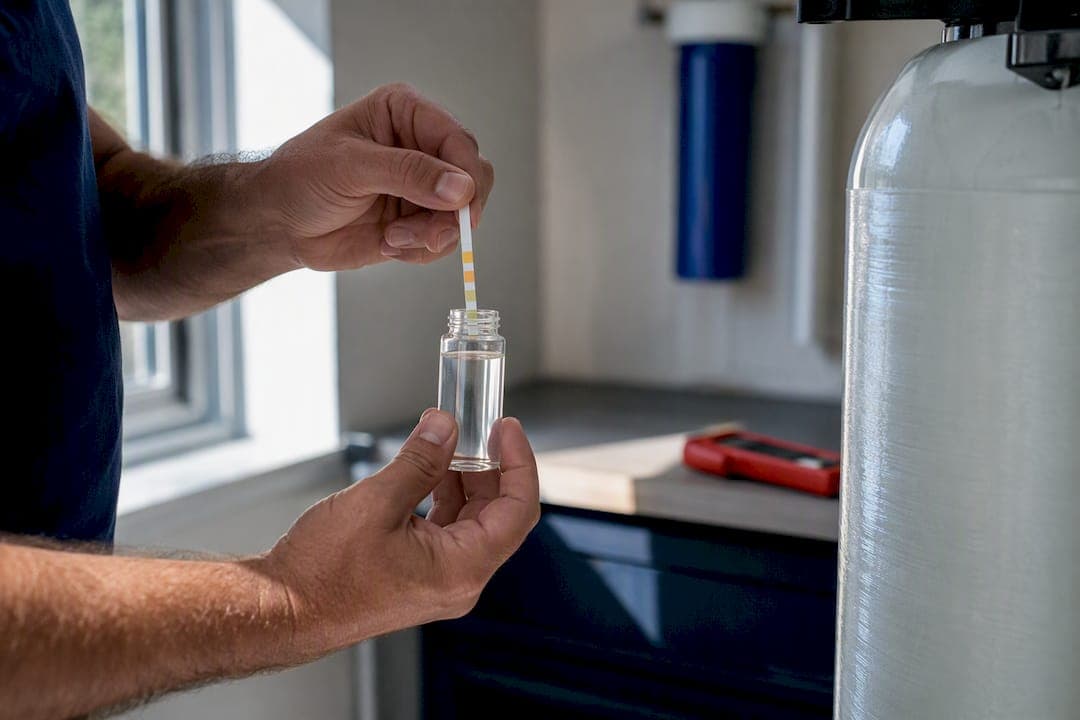
To size a water softener correctly, calculate your daily softening need in grains (gallons per day multiplied by hardness in grains per gallon), then multiply that number by 7 to 10 days to find the working capacity you should buy toward. This 7 to 10 day regeneration window matches EPA WaterSense and WQA guidance, and it works best paired with demand-initiated regeneration rather than a timer.
TL;DR:
- A water softener's size depends on household water use, hardness levels, and a 7 to 10 day regeneration cycle for optimal efficiency.
- Accurate water hardness measurements should be obtained through municipal reports, lab testing, or home test kits, with each grain per gallon equaling 17.1 mg/L.
- A typical family of four using 240 gallons daily at around 9.94 grains per gallon requires a softener capacity of roughly 19,000 grains for a 7 to 10 day cycle.
- Oversized systems waste salt and water, while undersized units let hardness slip through; proper sizing is essential to avoid scale buildup or excessive regeneration.
- Professional assessment is recommended when facing high iron, TDS, low water flow, or complex plumbing to ensure correct sizing, installation, and system performance.
Table of Contents
- How to calculate your household daily water use
- How to measure water hardness and convert the units
- Sizing math: computing grains per day and choosing a working capacity
- Tank size, flow rate, and regeneration design: what fits your plumbing
- Adjustments for iron, high TDS, and realistic salt use
- Signs you chose the wrong size and quick troubleshooting
- When to call a pro for sizing and installation
- Author's perspective on efficiency vs convenience
- How USA Plumbing and Septic LLC can help with sizing and installation
- Sources
- FAQ
How to calculate your household daily water use
Getting your daily gallons right matters more than any other number in this formula, because every later step multiplies off it.
The simplest method uses a per-person estimate:
- Count the people living in the home full time.
- Multiply by 60 gallons per day for conservative or water-conscious households.
- Multiply by 75 gallons per day for heavy-use homes with long showers, frequent laundry, or older fixtures.
A household of four at 60 gallons per day comes out to 240 gallons per day, a reasonable starting point for a typical family that hasn't audited its water habits.
Homes with unusual fixture counts, such as a house with five bathrooms for two people, do better with a fixture-based tally: add up shower minutes, laundry loads, and dishwasher cycles for a typical week and divide by seven. Skip irrigation and outdoor spigots entirely; those should run on unsoftened water regardless of household size.
How to measure water hardness and convert the units
Your daily gallons number means nothing without an accurate hardness reading, since grains per day is the product of the two.
You have three practical ways to get that number:
- Check your municipal water quality report, which most utilities publish annually with hardness listed in milligrams per liter.
- Send a sample to a certified lab for a precise reading, especially useful for well water.
- Use a home test kit as a reasonable estimate, understanding it's less precise than a lab result.
One grain per gallon equals 17.1 milligrams per liter, according to USGS and EPA hardness guidance. So a water report showing 170 mg/L converts to 170 divided by 17.1, or roughly 9.94 grains per gallon. If your test also shows iron, add roughly 3 to 5 grains per gallon of compensation for every part per million of iron present, or consider pretreatment before the softener when iron runs above 1 to 2 ppm.
Sizing math: computing grains per day and choosing a working capacity
With daily gallons and hardness in hand, the math runs in two clean steps.
- Multiply daily gallons by hardness in grains per gallon to get grains removed per day.
- Multiply grains per day by your chosen regeneration interval, 7 to 10 days, to get the working capacity target.
Take that household of four using 240 gallons per day at 9.94 grains per gallon: 240 times 9.94 equals about 2,386 grains per day. Multiply by 8 days (a middle point in the recommended window) and you get roughly 19,088 grains of working capacity needed.
Here's where nameplate capacity trips people up. A softener advertised as "48,000 grains" usually reaches that number only at a high salt dose, often 15 pounds of salt per cubic foot of resin. WQA best-practice guidance recommends sizing to working capacity at an efficient salt dose of around 6 pounds per cubic foot instead, which produces a lower but far more water- and salt-efficient number.

Tank size, flow rate, and regeneration design: what fits your plumbing
The grain number tells you what capacity to look for. The physical tank has to be able to deliver it.
- Resin volume and grain capacity move together in fairly predictable ranges, but always confirm against the manufacturer's own specification sheet rather than assuming a standard ratio.
- Tank diameter affects backwash flow, and a narrow tank on a low-yield well can struggle to backwash a large resin bed properly.
- Homes with weak sustained well flow sometimes do better with a twin-tank system or two smaller-diameter tanks running in parallel instead of one large unit.
WQA's residential design guidance also favors demand-initiated regeneration controllers over time-clock models, since DIR triggers a regen cycle based on actual water use rather than a fixed calendar schedule. Before buying, verify your drain line can handle the backwash volume the unit will discharge, a detail that trips up more installations than people expect. Fixture demand and flow basics are covered in our guide to how residential plumbing systems work.
Adjustments for iron, high TDS, and realistic salt use
Iron and high total dissolved solids change the math you just ran, and skipping this step is a common reason softeners underperform.
- When iron tests above roughly 1 to 2 ppm, plan for pretreatment rather than asking the softener resin to handle it alone.
- EPA WaterSense benchmarks target softeners that use 5 gallons or less per 1,000 grains removed, with some high-efficiency demand-initiated models using as little as 1.5 to 4 gallons.
- Estimate monthly salt cost by multiplying the pounds of salt used per regeneration cycle by the number of cycles per month: a unit using 8 pounds per cycle over 4 cycles a month runs 32 pounds monthly.
Getting these adjustments right keeps both your water bill and your salt bag budget predictable.
Signs you chose the wrong size and quick troubleshooting
Your softener will tell you when the sizing is off, often before you notice hard water symptoms directly.
- An undersized system regenerates far more often than the 7 to 10 day target and lets hardness slip through between cycles, showing up as spotting, scale, or stiff laundry.
- An oversized system regenerates rarely, uses more salt for the water actually softened, and can let resin sit long enough between cycles to foul over time.
- A quick troubleshooting pass covers programming settings, a fresh hardness test at the tap, an iron check, and a look at backwash flow before assuming the unit itself is the problem.
Persistent scale can also point to plumbing already carrying mineral buildup, covered in our piece on hard water plumbing problems.
Pro Tip: Before replacing a softener that seems undersized, check the salt reserve and dose setting first: a low salt level mimics undersizing almost perfectly.

When to call a pro for sizing and installation
Some situations are worth handing to a licensed plumber rather than working through with a calculator and a test strip.
Low sustained well flow, high iron or TDS readings, multi-zone plumbing, or uncertainty about your drain's backwash capacity are all good reasons to bring in a professional before buying equipment. On a sizing visit, an installer typically runs a measured flow and backwash test, checks static and dynamic pressure, verifies resin volume against your actual grain target, programs the demand-initiated controller, sets up the drain line and brine tank correctly, and follows up with a water quality check after installation, as recommended by Water Softener Installation in San Antonio, TX | Proud Pops. This article was put together by John, drawing on experience with on-site sizing work related to water softening and filtration services.
Author's perspective on efficiency vs convenience
The 7 to 10 day regeneration window isn't a compromise; it is the sweet spot between resin efficiency and daily convenience. I'd rather see a homeowner add modest headroom for the occasional heavy-use week than buy two sizes up "to be safe." Oversizing wastes salt and water on every single cycle, and less chloride going down the drain is a small but real benefit for the water leaving your home.
— JOHN
How USA Plumbing and Septic LLC can help with sizing and installation
Getting the math right on paper is one thing. Getting a system that actually performs at that capacity in your home is another, and that's where an on-site visit earns its keep.

Water softener testing, sizing, installation, programming, and repair services are available for homes and commercial properties in the Bullhead City area.
- A service visit may include a measured flow and backwash check plus a water hardness test at your tap.
- Clients receive a recommended working capacity based on actual usage and hardness.
- Installation quotes and programming assistance can be provided once the unit is set.
Reach out through our main service page to book an on-site water softener sizing visit, or check our Kingman area page if you're nearby.
Sources
- Soften water without wasting it: Guide to selecting and maintaining a water-efficient water softener (EPA)
- Best practices for industry professionals (WQA)
- USGS — water hardness guidance
FAQ
Is it better to oversize a water softener?
No, oversizing wastes salt and water on every regeneration cycle without meaningfully improving softening.
What is the average size water softener for a family of four?
There's no single "average" size because it depends on your local water hardness. For example, a family of four using 240 gallons per day at moderately hard water may need around 19,000 grains of working capacity within a 7 to 10 day regeneration window. Your own number depends on the hardness reading from your water report or test kit.
How many people can use a 48,000 grain water softener?
That depends heavily on water hardness and salt dose, since 48,000 grains is typically a nameplate figure rather than a working capacity number. At an efficient salt dose closer to 6 pounds per cubic foot, the real working capacity is lower, so check your specific unit's efficiency rating rather than relying on the nameplate alone.
How long does a 40 lb bag of salt last in a water softener?
It varies by household size, water hardness, and how often the unit regenerates, since salt use scales directly with grains removed and regeneration frequency. A household regenerating every 8 days at a modest salt dose per cycle might get several weeks out of a typical salt bag, while harder water or more frequent cycles will use it faster.