
Yes, hard water causes real plumbing damage. Scale buildup inside pipes and appliances is the primary culprit, leading to clogs, reduced water pressure, water heater failure, and accelerated pipe corrosion. Hard water is common in many U.S. homes, which makes this one of the most common and most underestimated sources of plumbing repair costs.
The plumbing problems hard water causes tend to develop quietly over months or years before they become expensive emergencies. Here is what to do right now:
- Test your water hardness using a $10–$15 test strip kit or request a report from your utility.
- Remove and inspect your faucet aerators for white, chalky deposits.
- Run your hot tap for 30 seconds and check for discoloration or reduced pressure compared to cold.
- Save a plumber's number if you spot any red flags listed below.
Table of Contents
- What hard water is and how mineral scale forms inside your pipes
- How hard water damages plumbing: four mechanisms and the worst hotspots
- What are the signs of hard-water plumbing problems in your home?
- Which plumbing parts fail first and realistic time-to-failure ranges
- How to fix existing hard-water plumbing problems
- Prevention and treatment options: what actually works
- Why hard-water damage is often hidden until it is too late
- When should you call a plumber about hard water?
- Key Takeaways
- Hard water and your plumbing: a straight assessment
- Usaplumbingseptic handles hard-water plumbing from test to fix
- Sources and further reading
- FAQ
What hard water is and how mineral scale forms inside your pipes
Hard water is simply water that carries elevated concentrations of dissolved calcium and magnesium ions. The U.S. Geological Survey classifies water as hard at 7 grains per gallon (GPG) and very hard above 10.5 GPG. Many Bullhead City-area homes pull from groundwater sources that regularly exceed those thresholds.
Scale forms through a straightforward physical process. Calcium and magnesium stay dissolved in cold water under normal pressure. When that water is heated or experiences a pressure drop, the minerals precipitate out of solution and crystallize on any available surface: pipe walls, heating elements, valve seats, and tank interiors. The deposits bond to metal and ceramic surfaces, building layer by layer with each heating cycle.
The practical consequence: A thin layer of scale inside a standard 3/4-inch copper supply line can significantly cut effective flow area, producing measurable pressure loss at every fixture downstream.
Hot-water lines accumulate scale far faster than cold lines because heat is the primary trigger for precipitation. That is why hot-only pressure loss is one of the earliest and most reliable warning signs.
Pro Tip: Unscrew a faucet aerator and hold it up to the light. A white, gritty crust on the mesh screen is a direct sample of what is coating the inside of your supply lines.
How hard water damages plumbing: four mechanisms and the worst hotspots
Hard water does not damage plumbing in just one way. Four distinct mechanisms work together, and understanding them helps you prioritize repairs.
1. Mechanical flow restriction. Scale narrows pipe interiors progressively. The narrowing is worst in hot supply runs and at any fitting, elbow, or valve where flow slows and minerals have more time to deposit.
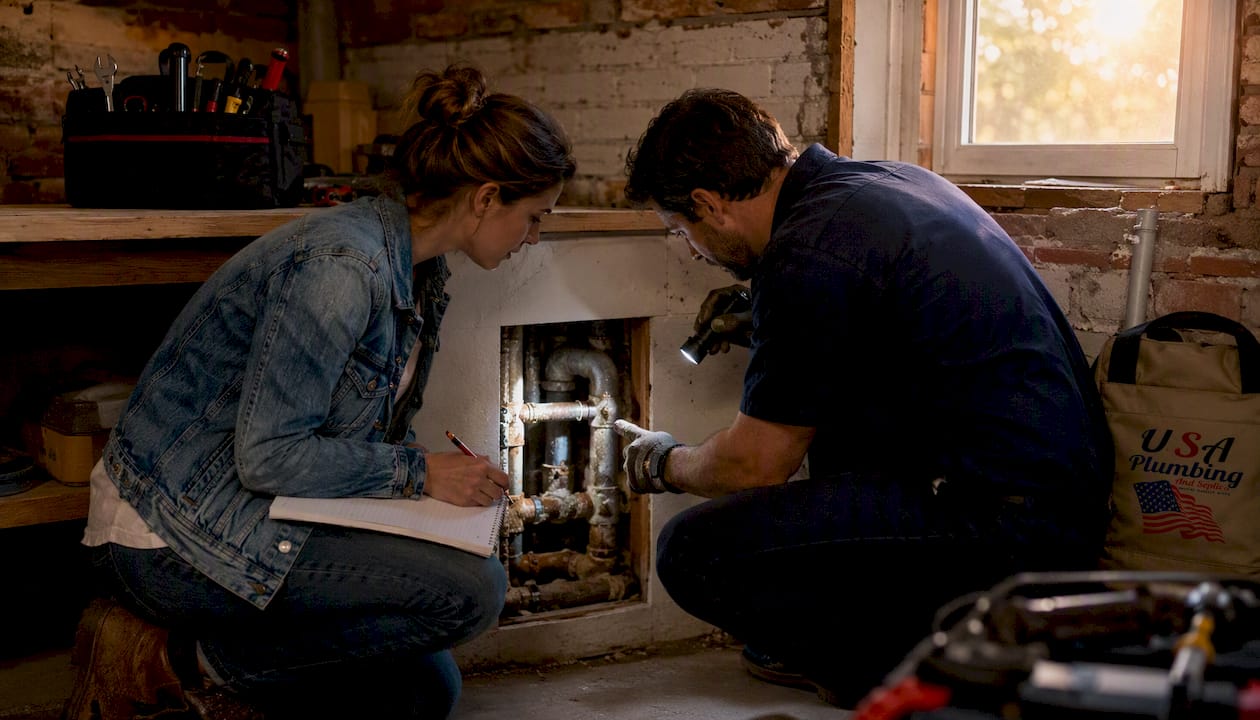
2. Thermal insulation of heating surfaces. Scale is a poor conductor of heat. On a water heater's electric element or the heat exchanger in a tankless unit, even a thin layer forces the element to run longer and hotter to transfer the same energy. According to a PNNL technical report, scale can reduce heater efficiency significantly in severe cases and shorten expected tank life considerably.
3. Electrochemical (patchy-scale) corrosion. This is the mechanism most homeowners never hear about, and it is the most destructive. Scale deposits are not uniform; they form in patches. Those patches create micro-environments where oxygen concentration differs between the covered and uncovered metal, triggering electrochemical corrosion cells that eat through pipe walls from the inside out. Pinhole leaks can appear years before you would expect them based on pipe age alone.
4. Debris accumulation and clogging. Flaking scale particles travel downstream and lodge in cartridge valves, solenoid screens, and appliance inlets, causing recurring clogs and premature valve failure.
The hotspots to watch: Tank and tankless water heaters, hot-water trunk lines, faucet cartridges, aerators and showerheads, dishwasher and washing machine inlet valves, and older galvanized steel supply lines. Galvanized pipe is especially vulnerable because its rough interior surface gives scale an easy grip.
What are the signs of hard-water plumbing problems in your home?
Most hard-water damage announces itself through visible and performance clues before it becomes a structural failure. Run through this checklist:
Visible signs:
- White or greenish-white crust around faucet bases, showerheads, and drain edges
- Chalky mineral rings inside the toilet bowl at the waterline
- Cloudy film on glass shower doors that does not wipe off with a damp cloth
- Orange or rust-brown staining in the toilet or tub (often iron alongside hardness)
Performance signs:
- Hot water pressure noticeably lower than cold at the same fixture
- Showerhead flow that weakens over weeks even after cleaning
- A rumbling, popping, or kettling sound from the water heater (sediment boiling under scale)
- Energy bills creeping up without a change in usage habits
- Faucet drips returning within 2–3 years of a cartridge replacement — a reliable indicator in markets above roughly 12 GPG, because mineral deposits prevent full seat contact inside the cartridge mechanism
DIY confirmation checks:
- Remove an aerator and soak it in white vinegar for 30 minutes. If it dissolves a thick crust, your hardness is significant.
- Use a WQA-certified test strip or a basic home kit to get a GPG reading. Above 7 GPG, start monitoring closely. Above 10 GPG, act.
- Check your utility's annual water quality report, which lists hardness in mg/L (divide by 17.1 to convert to GPG).
Which plumbing parts fail first and realistic time-to-failure ranges
Hardness level and pipe material together determine how fast damage accumulates. This table gives realistic service-life guidance based on industry data.
| Component | Moderate (7–10 GPG) | Hard (10–14 GPG) | Very Hard (14+ GPG) | Typical Repair/Replace Cost |
|---|---|---|---|---|
| Tank water heater | 10–12 years | 7–10 years | 5–7 years | — |
| Tankless water heater | 15 years | 5–10 years | 2–5 years without annual descaling | — |
| Copper hot supply runs | 30–40 years | 15–25 years | 10–15 years (pitting risk) | — |
| Galvanized supply lines | 15–20 years | 10–15 years | Under 10 years | — |
| Faucet cartridges | 5–8 years | 3–5 years | 1–3 years | — |
| Aerators/showerheads | Months to years | Weeks to months | Weeks | $5–$40 DIY replacement |
Urgency guidance:
- Monitor (7–8 GPG): Standard annual maintenance usually keeps damage in check. Flush the water heater yearly, clean aerators quarterly.
- Repair and protect (8–12 GPG): Inspect the anode rod annually, consider a point-of-entry softener, and schedule a plumber assessment if you have a tankless unit.
- Call a plumber now (12+ GPG or any red-flag symptom): At this level, equipment damage accelerates faster than maintenance can offset. A professional assessment is the right first move.
How to fix existing hard-water plumbing problems
Some fixes are safe for homeowners. Others require a licensed plumber. Here is how to tell the difference.
DIY fixes you can do safely
- Clean aerators and showerheads. Unscrew the aerator, disassemble it, and soak all parts in undiluted white vinegar for 30–60 minutes. Rinse, reassemble, and reinstall. Repeat every 3–6 months in hard-water areas.
- Descale a showerhead in place. Fill a plastic bag with white vinegar, secure it around the showerhead with a rubber band so the head is submerged, and leave it overnight.
- Flush your tank water heater annually. Turn off the cold-water supply and the heater's power (or gas). Connect a garden hose to the drain valve, run it to a floor drain or outside, and open the valve until the water runs clear. Always let the tank cool for at least two hours before draining to avoid scalding. This removes loose sediment but will not dissolve fused scale bonded to the tank walls or heating elements.
- Replace a faucet cartridge. Shut off the supply stop under the sink, remove the handle, and swap the cartridge. A $15–$40 part and 20 minutes of work.
Pro Tip: Never attempt to drain a gas water heater without first turning the gas valve to "pilot." Draining with the burner active can overheat the tank and damage the thermocouple.
When you need a licensed plumber
- Descaling a tankless unit's heat exchanger (requires a pump, descaling solution, and proper isolation of the unit)
- Replacing a tank water heater (electrical disconnect, gas line work, or both)
- Camera inspection of supply lines to assess internal scale and corrosion
- Partial or whole-house repipe when galvanized or heavily scaled copper lines are failing
- Installing a whole-house water softener or filtration system
For water heater repairs and replacements, a licensed plumber handles the full scope safely and to code.
Prevention and treatment options: what actually works
Treating the water before it reaches your pipes is the only way to stop scale from forming in the first place. The four main categories each protect different parts of your system.
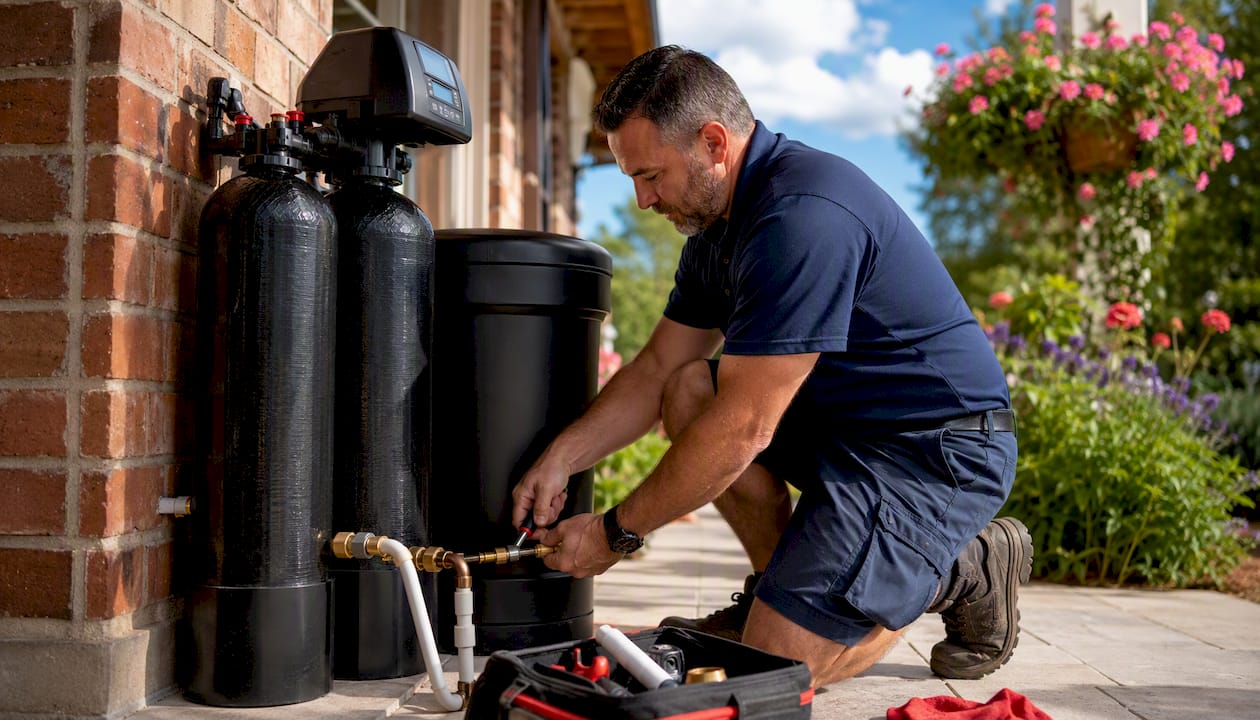
Ion-exchange water softeners replace calcium and magnesium ions with sodium ions before water enters the house. They are the most proven whole-house solution and the only treatment type that becomes clearly cost-effective above roughly 10 GPG. Maintenance involves adding salt every 4–8 weeks and a resin cleaning once or twice a year. Footprint is roughly the size of a tall trash can.
Salt-free conditioners (template-assisted crystallization) change the structure of calcium and magnesium so they stay suspended rather than adhering to surfaces. They do not remove minerals, so water technically remains "hard," but scale adhesion is significantly reduced. No salt, no wastewater discharge, minimal maintenance. Best for moderate hardness (7–12 GPG) and for households that want to avoid added sodium.
Reverse osmosis (point-of-use) removes virtually all dissolved minerals at a single tap, typically the kitchen sink. Excellent for drinking water quality but does not protect pipes or appliances.
Magnetic and electronic descalers are marketed as no-maintenance alternatives. Independent testing has not consistently confirmed their effectiveness at preventing scale inside pipes and heaters. We do not recommend them as a primary protection strategy.
Maintenance checklist for treated and untreated systems:
- Add softener salt and check brine tank monthly
- Flush tank water heater annually; inspect the anode rod every 2–3 years
- Descale tankless units annually if hardness exceeds 10 GPG (every 6 months above 14 GPG)
- Clean aerators and showerheads every 3–6 months
- Replace faucet cartridges proactively at the shorter end of the expected range for your hardness level
- Schedule a professional water softener and filtration system check every 2–3 years
Pro Tip: The PNNL research notes that soft water can be more corrosive to some tank materials than hard water. If you install a softener, ask your plumber whether your water heater needs a powered anode rod to compensate.
Why hard-water damage is often hidden until it is too late
The most dangerous aspect of hard-water pipe damage is not the scale you can see. It is the corrosion happening behind walls and under slabs where no one is looking.
| Stat | Detail |
|---|---|
| U.S. homes affected | 85% of U.S. homes are affected by hard water |
| Practical damage threshold | ~7 GPG; damage accelerates above 10–14 GPG |
| Heater efficiency loss | 10–40% in severe scale cases |
| Tank lifespan reduction | 25–40% shorter in hard-water conditions |
| Flow area can be reduced significantly in a 3/4-inch line with scale buildup |
The patchy-scale mechanism explains why copper pipe in hard, chloraminated water can develop pinhole leaks at 15–20 years instead of the 50+ years the material is rated for. Scale patches cover parts of the pipe wall while leaving adjacent metal exposed. The difference in oxygen availability between covered and uncovered zones creates a galvanic-style electrochemical cell. The exposed metal corrodes preferentially, and the pipe wall thins from the inside without any visible exterior sign.
A common scenario: A homeowner notices a small damp patch on a ceiling. A plumber opens the drywall and finds a pinhole leak in a copper hot-water line that looks perfectly fine from the outside. The pipe interior tells a different story: patchy scale, pitting corrosion, and a wall thickness reduced to near zero at the leak point. The homeowner had been losing hot-water pressure slowly for two years and attributed it to the city main.
This is why hidden leak detection is a standard part of a professional hard-water assessment, not an optional add-on.
When should you call a plumber about hard water?
Some symptoms are DIY territory. These are not.
Call a plumber if you notice any of the following:
- Hot-water pressure that is consistently and noticeably lower than cold at multiple fixtures
- Rumbling, popping, or steam sounds from the water heater tank
- Rust-tinted or discolored water from the hot tap only
- A faucet cartridge that has failed twice within three years
- Any damp patch, stain, or soft drywall near a supply line or water heater
- A tankless unit throwing error codes related to flow or temperature
What a plumber will do during a hard-water assessment:
- Conduct an on-site water hardness test and review your utility report
- Perform a camera inspection of accessible supply lines
- Inspect the water heater: anode rod condition, sediment level, element or heat exchanger scale, and pressure relief valve function
- Measure flow rates at multiple fixtures to map pressure loss
- Provide a written repipe or treatment recommendation with scope, parts, timeline, and warranty
Questions to ask before you approve any scope of work:
- What hardness level did you measure, and what does that mean for my specific pipe material?
- Is flushing the heater sufficient, or is the scale fused to the element?
- If you recommend a repipe, what material are you using and why?
- Does the softener installation include a bypass valve and a post-install hardness check?
- What warranty covers parts and labor on this job?
For water heater problems that show up alongside hard-water symptoms, a licensed plumber can tell you in one visit whether a flush will fix it or whether replacement is the better investment.
Key Takeaways
Hard water damages plumbing through scale buildup, thermal insulation of heating surfaces, and electrochemical corrosion, affecting 85% of U.S. homes and causing damage that accelerates above 10 GPG.
| Point | Details |
|---|---|
| Scale starts early | Practical damage begins at ~7 GPG; above 10–14 GPG, equipment lifespans shorten noticeably. |
| Heater efficiency drops fast | Scale reduces water heater efficiency by 10–40% and can cut tank lifespan by 25–40%. |
| Hidden corrosion is the real risk | Patchy scale creates electrochemical cells that cause pinhole leaks years before pipe age would predict. |
| DIY has limits | Annual flushing removes loose sediment but cannot dissolve fused scale on elements or tank walls. |
| Usaplumbingseptic covers the full scope | From hardness testing and descaling to softener installs and repipe, Usaplumbingseptic serves Bullhead City and surrounding areas 24/7. |
Hard water and your plumbing: a straight assessment
Most homeowners in the Bullhead City area do not find out they have a hard-water problem until a water heater fails early or a pinhole leak shows up in a wall. By that point, the repair bill is three to five times what a proactive assessment and softener installation would have cost.
The mistake is treating visible scale as a cosmetic issue. Cleaning the showerhead with vinegar is useful maintenance, but it tells you nothing about what is happening inside the hot-water trunk line running through your wall. The fixture scale is the symptom. The pipe interior is the problem.
What I consistently see in homes above 12 GPG is a pattern: the homeowner has been replacing cartridges every couple of years, the water heater is running noticeably longer than it used to, and hot-water pressure at the far end of the house is weak. None of those things alone triggers a service call. Together, they are a clear picture of a system under stress. A hardness test and a camera scope would have caught it two or three years earlier.
The economics are straightforward. A whole-house softener installation is a defined cost. A repipe is not. Test first, treat early, and schedule a professional inspection before the symptoms become emergencies.
Usaplumbingseptic handles hard-water plumbing from test to fix
If you are seeing white scale on fixtures, losing hot-water pressure, or hearing your water heater rumble, those are signals worth acting on today. Usaplumbingseptic provides the full range of hard-water plumbing services for homeowners and property managers across Bullhead City, Fort Mohave, Mohave Valley, and Laughlin, available 24/7.

Our team starts with an on-site hardness test and a water heater inspection, then gives you a written scope covering exactly what needs to happen and what it will cost. From there, we handle water softener and filtration system installation, annual descaling for tankless units, anode rod replacement, full water heater replacement, and repipe work when supply lines are past saving. We also offer preventive maintenance plans so you are not caught off guard by a failure that was building for years.
Ready to know exactly where your plumbing stands? Schedule an inspection in Mohave County and we will give you a clear, honest assessment with no pressure and no guesswork.
Sources and further reading
The claims in this article are grounded in primary technical research and industry guidance. Key sources:
PNNL Technical Report: Impacts of Water Quality on Residential Water Heating Equipment — The primary source for efficiency loss (10–40%) and lifespan reduction (25–40%) figures cited throughout this article. Published by Pacific Northwest National Laboratory.
- Hard Water Problems in Your Home: Signs, Effects, and Treatment Solutions — Source for the 85% U.S. homes figure, the 40% flow-area reduction stat, and the 10 GPG softener economics threshold.
- Hard Water Damage to Pipes and Water Heaters | AlertPlumber — Source for hardness thresholds (7 GPG, 10–14 GPG), tankless descaling requirements, and the fused-scale limitation of DIY flushing.
- Why Some Tap Water Destroys Pipes 3x Faster Than Other Areas | Repipe Solutions — Source for the patchy-scale electrochemical corrosion mechanism.
- Water Quality Association: Scale Deposits — Industry guidance on scale formation and treatment classification.
- U.S. Department of Energy: How Does Hard Water Impact Energy Use — Supporting context for energy efficiency impacts of scale on water heating.
FAQ
Can hard water actually cause serious plumbing damage?
Yes. Hard water causes scale buildup that restricts flow, reduces water heater efficiency by up to 40%, and triggers electrochemical corrosion that can produce pinhole leaks years ahead of a pipe's expected lifespan.
How do you fix pipes clogged by hard water scale?
Aerators and showerheads respond well to a white vinegar soak. Internal pipe scale and fused tank scale cannot be removed by flushing alone and typically require professional descaling or, in severe cases, pipe or equipment replacement.
What is the plumber's method for removing limescale from pipes?
Licensed plumbers use a circulating pump with a food-grade descaling solution (commonly citric or phosphoric acid) to dissolve scale from tankless heat exchangers and supply lines. For tank water heaters with fused scale on elements, element replacement is usually more practical than chemical treatment.
How long does it take for hard water to damage plumbing?
At 7–10 GPG, noticeable damage typically develops over 5–10 years. Above 14 GPG, tankless water heaters can fail in as little as 2–5 years without annual descaling, and cartridge valves may need replacement every 1–3 years.
At what hardness level should I install a water softener?
Standard maintenance often manages damage adequately up to about 7–8 GPG. Above 10 GPG, a whole-house ion-exchange softener becomes cost-effective for protecting equipment and extending fixture life.