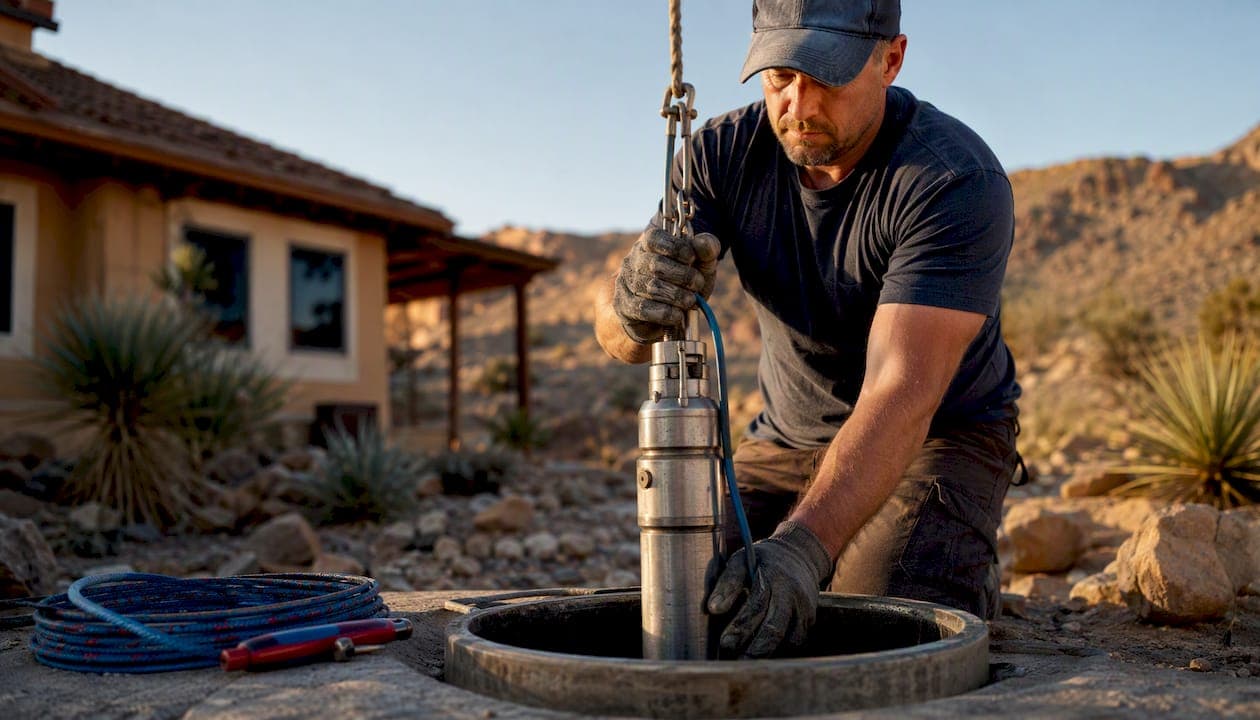
Most homeowners pay between $1,500 and $4,000 for a full well pump replacement on a standard weekday, scheduled job. Well depth, pump type, and labor complexity drive the final number more than anything else. If your water pressure has dropped or your pump has quit, schedule a professional diagnostic first, then collect 2 to 4 itemized quotes before you commit to a number.
TL;DR:
- Pump replacement costs vary significantly with well depth, often adding $500 to $1,000 for every 100 extra feet of well.
- Emergency or after-hours service can increase labor costs by 25 to 50 percent, and regional wage differences further impact the final bill.
- Items like drop pipe, wiring, and control components are best replaced during the initial pump pull to avoid extra labor costs later.
- A typical 300-foot well pump replacement ranges from $2,800 to $5,000, depending on rigging needs and additional equipment.
- Always get a professional diagnostic before purchasing a new pump to avoid unnecessary repairs caused by issues like faulty pressure switches or control boxes.
Table of Contents
- How Much Does Well Pump Replacement Cost Nationally?
- What Factors Drive Well Pump Replacement Cost?
- What Does Replacement Cost by Pump Type and Depth?
- What's on a Typical Well Pump Invoice?
- Should You Attempt Well Pump Repairs Yourself?
- How Do You Get an Accurate, Comparable Quote?
- A Diagnosis-First Approach From USA Plumbing and Septic LLC
- A Field Plumber's Take on Pump Replacement Costs
- Schedule a Well Pump Diagnostic With Usaplumbingseptic
- Where to Learn More About Private Well Ownership
- Sources
- FAQ
How Much Does Well Pump Replacement Cost Nationally?
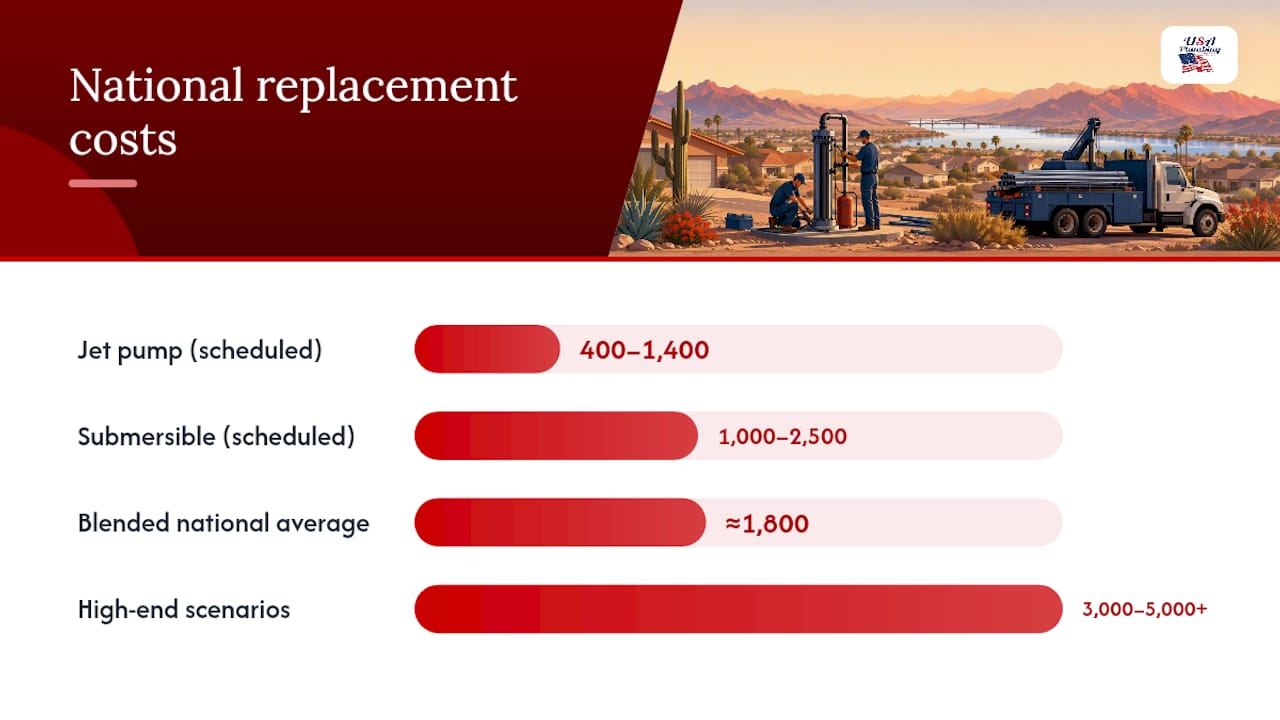
National pricing guides put the average well pump replacement between $1,000 and $2,500 for a submersible unit and $400 to $1,400 for a jet pump, with a blended national average landing near $1,800. That range covers the pump itself plus routine labor, but it assumes a straightforward job: reasonable depth, easy access, and no surprises once the old pump comes out of the casing.
Your actual bill moves a lot based on when and how you schedule the work. A weekend or after-hours emergency call typically adds a 25% to 50% premium on labor because emergency dispatch requires overtime rates and rushed scheduling. Regional labor rates swing the total another 15% to 30% depending on where you live. A rural well in Arizona's Mohave County will price differently than a suburban job in the Midwest, mostly because of local wage rates, permitting fees, and how far a crew has to drive with a rig.
Here's how the ranges typically break down for a scheduled, non-emergency job:
- Low end: $800 to $1,500 for shallow wells with easy access and a jet pump swap
- Average: $1,500 to $2,800 for a mid-depth submersible replacement
- High end: $3,000 to $5,000+ for deep wells, stuck equipment, or added electrical work
National average snapshot: Pricing aggregators consistently cite a national average near $1,800 to $1,900 for a completed installation, though depth and pump type push individual jobs well outside that midpoint in either direction.
Weigh these figures against your own well's depth and access before assuming your quote is out of line. A contractor quoting well above the high end should explain exactly why, whether that's a 400-foot well, a stuck pitless adapter, or a full electrical panel upgrade.
What Factors Drive Well Pump Replacement Cost?
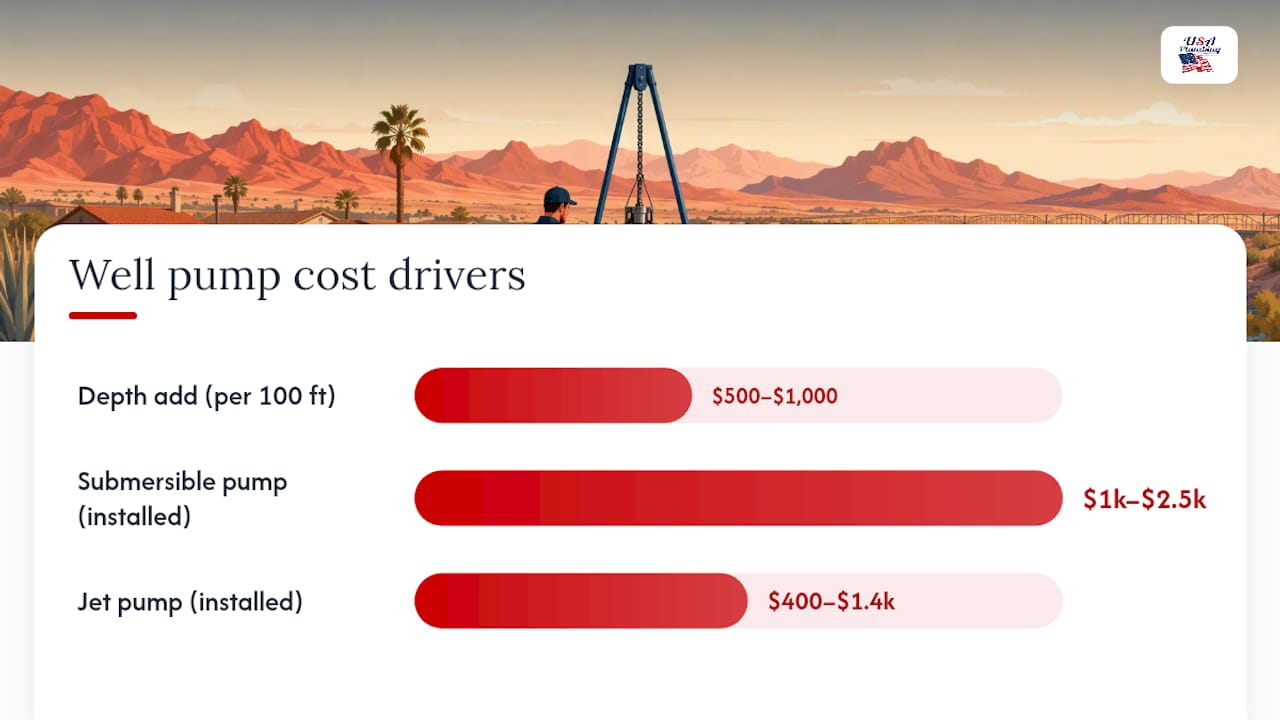
Depth is the single biggest variable in any well pump job. Every additional 100 feet typically adds $500 to $1,000 in pipe, wire, and labor, since a deeper pump needs more drop pipe, more wire, and more time to pull and reinstall. A pump sitting at 150 feet costs meaningfully less to service than one sitting at 350 feet, even if the pumps themselves are identical.
Beyond depth, several other factors shape your final number:
- Pump type and horsepower. Submersible pumps generally run $1,000 to $2,500 installed; jet pumps run $400 to $1,400. Constant-pressure systems with variable-frequency drives cost more upfront but reduce pressure-tank cycling over time.
- Labor complexity. A stuck pump, corroded pitless adapter, or tight wellhead access can add hours to a job that would otherwise take an afternoon.
- Rigging and hoist needs. Wells over roughly 250 feet often require specialized rigging, which increases mobilization costs and labor time.
- Ancillary components. Drop pipe, pump wire, check valves, control boxes, and pressure tanks are frequently replaced alongside the pump, especially when the pump has already been pulled once.
- Permits, disposal, and testing fees. Some jurisdictions require permits for well work, and disposing of an old pump or tank can carry a small fee.
Pro Tip: Ask your contractor to replace drop pipe and pump wire proactively while the pump is already out of the casing. Waiting until they fail later means paying for a second pull job just to replace a $1 to $3 per foot part.
What Does Replacement Cost by Pump Type and Depth?
Matching your well's depth and pump type to a realistic price band is the fastest way to sanity check a quote before you sign anything.
Submersible pumps scale directly with depth:
- 100 to 200 feet: roughly $1,600 to $2,800 installed
- 200 to 300 feet: roughly $2,200 to $4,000 installed
- 300 to 400 feet: roughly $2,800 to $5,000 installed
- 400+ feet: often $4,500 and up, especially with rigging requirements
Jet pumps, used for shallower wells, run cheaper across the board. A shallow jet pump replacement typically lands between $800 and $1,500, and even a deep jet setup rarely exceeds $2,000 installed. Constant-pressure systems add $400 to $1,200 over a standard submersible setup for the variable-frequency drive and controller, but they reduce pump cycling, which can extend equipment life.
Depth drives the number: labor and pipe costs can exceed the price of the pump itself once a well passes 300 feet, since a deeper pull means more wire, more pipe, and more time on site.
Three realistic scenarios illustrate the spread:
- A 120-foot submersible replacement with easy wellhead access: $1,600 to $2,800
- A 300-foot submersible replacement with standard rigging: $2,800 to $5,000
- A shallow jet pump swap with no depth complications: $800 to $1,500
Adding a new pressure tank or a VFD controller onto any of these scenarios increases the total cost, depending on tank size and controller complexity.
What's on a Typical Well Pump Invoice?
A fair, itemized quote breaks costs into distinct line items rather than one lump number. That itemization is exactly what lets you compare bids apples to apples.
- Pump unit: $300 to $1,200 depending on horsepower, brand, and gallons-per-minute rating
- Drop pipe and wire: budget $1 to $3 per foot as a rule of thumb, scaling with well depth
- Control box, check valves, pitless adapter: typically $100 to $400 combined, more if the adapter is corroded or stuck
- Pressure tank: $200 to $800 installed if it needs replacing at the same time
- Labor: hours multiplied by local rate, plus truck or hoist mobilization fees for deeper wells
- Electrician charges and permit fees: vary by jurisdiction, often $100 to $500 combined
Some lowball quotes quietly exclude drop pipe, wire, or disposal fees to look competitive on paper, then add them back as "surprise" charges once the job starts. Reviewing regional labor and parts pricing before you sign helps you catch that pattern early.
Should You Attempt Well Pump Repairs Yourself?
Diagnosis comes before any pump purchase, full stop. A large share of "dead pump" calls turn out to be a failed pressure switch, a waterlogged pressure tank, or a tripped control box, not a burned-out pump motor, and a professional diagnosis catches this before you spend money on a new pump you didn't need.
Homeowners can safely handle a few basic checks: inspecting the pressure switch for obvious damage, checking visible wiring for fraying, and clearing air vents. Leave these to a licensed pro:
- Pulling a submersible pump from a deep casing
- Any wiring or electrical panel work, which should meet NFPA 70 electrical standards
- Freeing a stuck or corroded pitless adapter
Pro Tip: A DIY attempt on a stuck pitless adapter is one of the fastest ways to turn a $2,000 job into a $4,000 one, since a snapped pipe or damaged casing adds emergency labor on top of the original repair.
How Do You Get an Accurate, Comparable Quote?
Insist on an on-site diagnostic and a fully itemized written quote before agreeing to any work. That quote should list the pump model and horsepower, drop pipe and wiring costs, labor hours, mobilization or hoist fees, permit costs, and warranty terms.
- Ask for the pump's brand, horsepower, and GPM rating, not just "a new pump"
- Confirm warranty length and whether it transfers if you sell the home
- Verify the contractor's license and insurance, and ask whether they hold NGWA certification
- Check whether the price includes pressure tank or control box work, or if those are separate
- Get a second opinion if one quote is drastically lower than the others with no clear explanation
A Diagnosis-First Approach From USA Plumbing and Septic LLC
Field experience backs up the national pricing guides on one point: schedule a diagnostic visit before buying a pump. We regularly find that a "dead" well is actually a failed pressure switch, a flat pressure tank, or a tripped control box, not a burned-out motor.
When we do confirm a pump has failed, we often recommend replacing the pressure tank or control box in the same visit if either shows age or wear. It costs less than a second service call down the road. Our well pump maintenance guidance covers the warning signs worth watching between service visits.
A Field Plumber's Take on Pump Replacement Costs
The homeowners who overpay aren't the ones with deep wells. They're the ones who skip the diagnostic and let a nervous guess turn into an unnecessary pump purchase. My priorities stay the same on every job: diagnose first, collect 2 to 4 itemized quotes, and budget with depth in mind rather than a flat number pulled off a website. Licensed work carries warranty protection for a reason. Lean on that instead of guessing.
— JOHN
Schedule a Well Pump Diagnostic With Usaplumbingseptic
Usaplumbingseptic is the direct alternative to guessing your way through a pump replacement: licensed electricians on staff, itemized pricing before any work starts, and 24/7 availability if your well fails at the worst possible time.

We handle the full range of well equipment work throughout Bullhead City, Fort Mohave, Mohave Valley, and Laughlin, from diagnostic visits and pump replacement to pressure tank and control box service. Every quote we write breaks out the pump, labor, wiring, and permit costs separately, so you know exactly what you're paying for before we start. If your pressure has dropped or your pump has stopped running, schedule an on-site diagnostic with our Golden Valley team and get a written, itemized quote before you spend a dollar on a new pump.
Where to Learn More About Private Well Ownership
For ongoing well maintenance and safety guidance beyond replacement costs, a few sources are worth bookmarking. The EPA's private well resources cover testing schedules and water safety, since private wells remain the owner's responsibility. USGS data on domestic wells explains typical groundwater depths by region. The National Ground Water Association offers contractor certification lookups, and NFPA 70 governs the electrical code work tied to pump wiring.
Sources
FAQ
How Much Should It Cost to Replace a Well Pump?
Most scheduled, weekday replacements run $1,500 to $4,000 depending on well depth and pump type, with national averages for the pump and labor combined landing near $1,800.
What Is the Typical Lifespan of a Well Pump?
Submersible well pumps typically last over a decade, though heavy use, sediment, or electrical issues can shorten that lifespan considerably.
How Much Does It Cost to Replace a Submersible Pump in a 300-Foot Well?
Expect roughly $2,800 to $5,000 installed for a 300-foot submersible replacement, since labor and pipe costs climb sharply at that depth and rigging may be required.
How Much Does It Cost to Replace a Pump in a 200-Foot Well?
A 200-foot well typically falls in the $2,200 to $4,000 range for a submersible pump, factoring in the added drop pipe and wire that depth requires.
Should I Get a Diagnostic Before Buying a New Pump?
Yes. Many well failures trace back to a pressure switch, pressure tank, or control box rather than the pump itself, and a professional diagnostic can prevent an unnecessary full replacement.