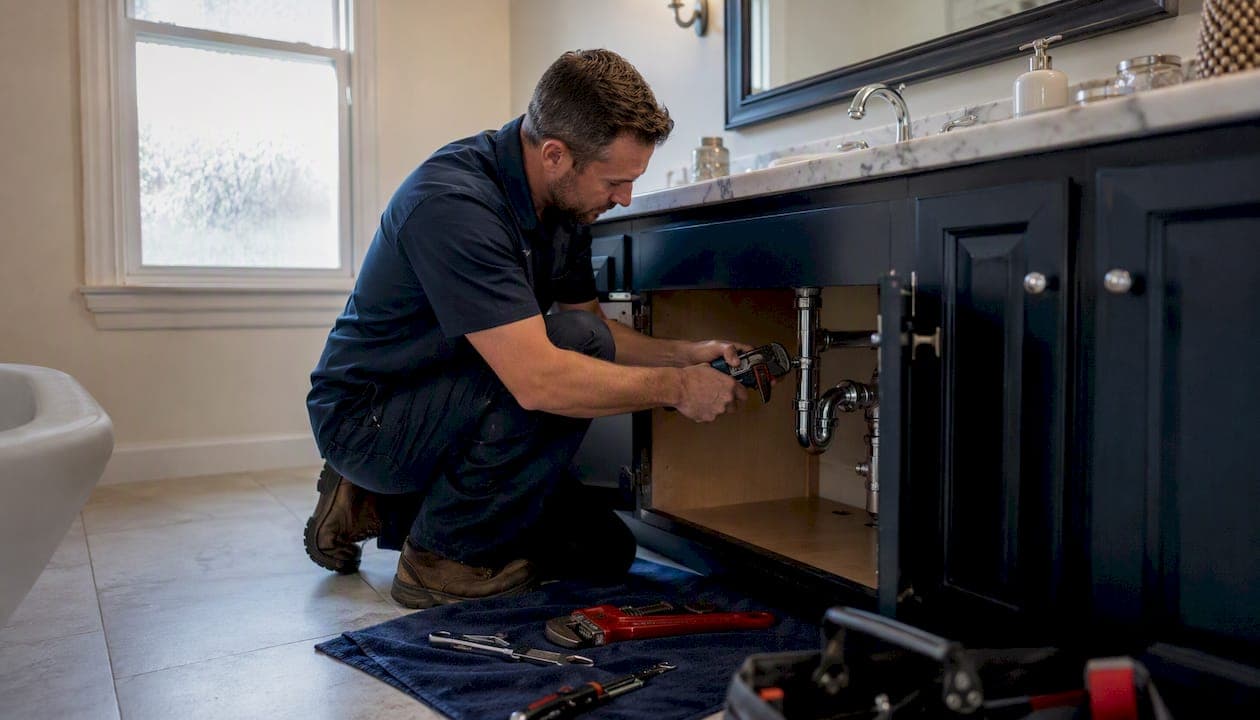
The national average plumbing repair cost is $350, and most single-fixture residential repairs fall between $150 and $700. For anything beyond a dripping faucet or a running toilet, call a licensed plumber — the risk of a DIY mistake on hidden or pressurized lines almost always costs more than the service call.
Before your plumber arrives, take these steps:
- Shut off the water supply valve closest to the problem (or the main shutoff if you can't isolate it)
- Take clear photos or a short video of the issue and any visible damage
- Note when the problem started and whether it's getting worse
- Locate your home's main shutoff valve so you can point the plumber to it immediately
Immediate next steps:
- Call a licensed plumber and describe the symptoms clearly
- Stop using the affected fixture or line
- Move valuables away from any active leak
- Document water damage for insurance purposes
Pro Tip: The single biggest cost driver isn't the repair itself — it's where the problem is. An exposed pipe under a sink costs a fraction of the same repair hidden inside a wall or under a concrete slab. Accessibility can triple your bill.
Key Takeaways
The national average plumbing repair cost is $350, accessibility is the single largest cost driver, and getting a written quote from a licensed local plumber is the most reliable way to know what your specific repair will cost.
| Point | Details |
|---|---|
| National average and range | Most residential repairs cost $150–$700, with a national average of $350 in 2026. |
| Accessibility drives cost | Exposed pipe repairs cost far less than in-wall or under-slab work, which can triple the bill. |
| Emergency premiums are steep | After-hours service-call fees run $150–$300, pushing many urgent repairs to $300–$800+. |
| DIY saves money on simple fixes | Median parts cost for DIY-friendly repairs is $30 vs. a typical pro bill of $225 — but complex or hidden work requires a licensed plumber. |
| Usaplumbingseptic covers Bullhead City 24/7 | For emergency repairs, slab leaks, sewer work, and water heater service in the Bullhead City area, Usaplumbingseptic provides written-scope quotes and around-the-clock availability. |
Table of Contents
- What moves the price: primary plumbing cost drivers
- Common plumbing repair price ranges at a glance
- How location changes price: state and metro differences
- Hourly rates, service-call fees, and emergency pricing explained
- Hidden costs: in-wall repairs, slab leaks, sewer work, and detection
- Which plumbing jobs can you DIY, and which need a licensed pro?
- Practical ways to lower your plumbing bill without sacrificing quality
- How to prepare for and compare local quotes
- How these cost estimates were calculated
- When you should always call a professional plumber
- A local plumber's perspective on what surprises homeowners most
- Usaplumbingseptic is ready when you need a reliable local plumber
- Sources
- FAQ
What moves the price: primary plumbing cost drivers
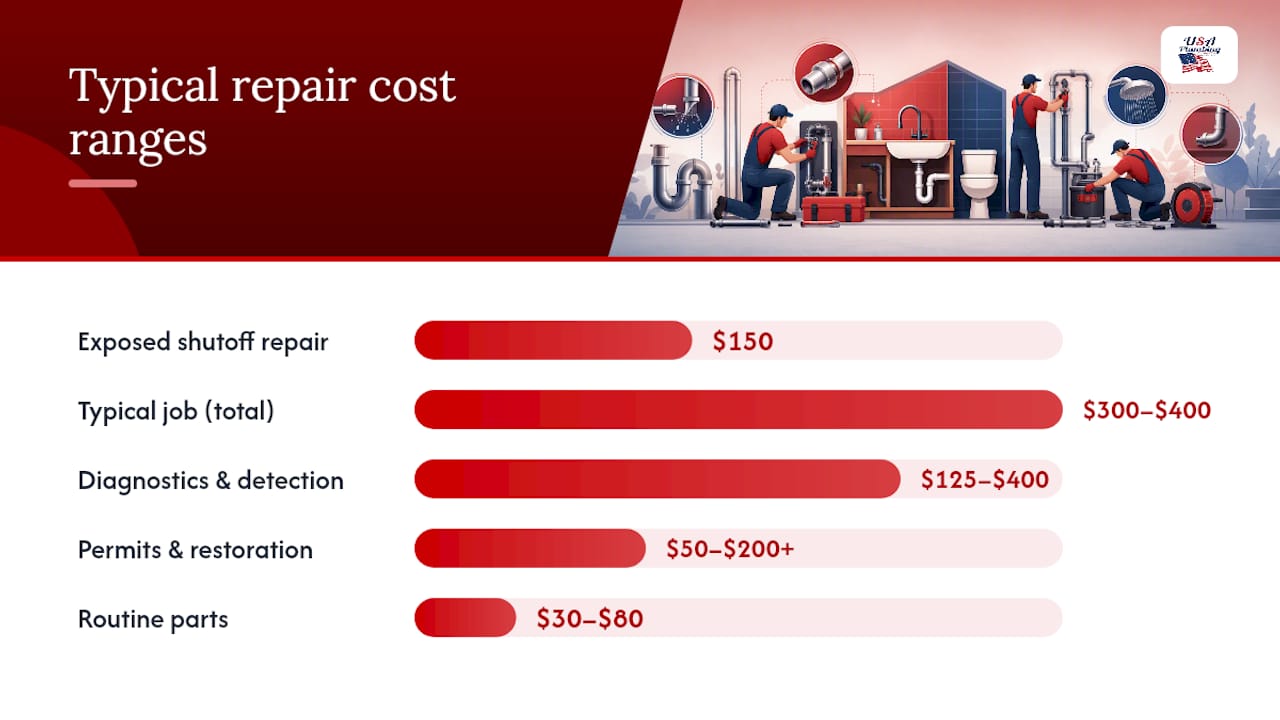
Where the problem sits in your home determines more of the final bill than almost anything else. An exposed shutoff valve repair might run $150. That same repair inside a wall adds demo, patching, and painting — pushing the total past $500 before parts.
The main variables that shift your quote:
- Accessibility: Exposed pipes (under sinks, in utility rooms) are cheapest. In-wall or in-ceiling pipes add demolition and restoration costs. Under-slab work is the most expensive category.
- Labor vs. parts split: On a typical $300–$400 job, labor usually accounts for 60–80% of the total. Parts are often $30–$80 for routine repairs.
- Time of service: Business-hours calls are priced at standard rates. Evening, weekend, and holiday calls carry emergency premiums — often 1.5–3× the standard hourly rate.
- Plumber classification: Apprentice plumbers bill at the low end of the hourly range. Journeymen handle most residential work. Master plumbers command the highest rates and are required for permitted work in many jurisdictions.
- Diagnostics and detection: Leak detection equipment, camera inspections, and pressure tests add $125–$400 before any repair work begins.
- Permits and restoration: Work that opens walls, floors, or concrete often requires a permit ($50–$200+) and a separate restoration quote for drywall, tile, or concrete.
- Housing age and type: Homes built before 1970 with galvanized steel or cast-iron pipes take longer to work on and may require code upgrades during a repair.
Stat: Angi's 2026 data confirms that service-call fees and emergency premiums are among the most common contributors to a final invoice that exceeds the initial estimate.
Pro Tip: Ask your plumber to separate the diagnostic fee from the repair estimate in writing. That way, if the repair scope changes after opening a wall, you're not surprised by a bundled number that no longer reflects the actual work.
Common plumbing repair price ranges at a glance
The table below covers the repairs homeowners call about most often. Ranges reflect national averages for 2026; your local market, accessibility, and emergency timing all shift the final number.
| Repair Type | Typical Range | Restoration Likely? | Typical Timeline |
|---|---|---|---|
| Faucet repair (cartridge, washer) | $100–$250 | No | 1–2 hours |
| Toilet repair (flapper, fill valve, handle) | $100–$200 | No | 1–2 hours |
| Drain clearing (single fixture) | $100–$250 | No | 1–2 hours |
| Accessible pipe leak (exposed) | $150–$400 | Rarely | 1–3 hours |
| Hidden/in-wall pipe leak | $400–$1,500+ | Yes (drywall) | 4–8+ hours |
| Under-slab/slab leak (spot repair) | $600–$4,000 | Yes (concrete, flooring) | 1–3 days |
| Water heater repair | $400–$615 | No | 2–4 hours |
| Garbage disposal repair/replace | $150–$350 | No | 1–2 hours |
| Main sewer line (clearing/jetting) | $300–$600 | Rarely | 2–4 hours |
| Main sewer line (repair/replace) | $1,500–$5,000+ | Sometimes | 1–3 days |
Sources: TheCostIn, HomeAdvisor, Angi water heater guide, HomeGuide.
Water heater repairs average around $400–$615 for common issues like heating elements or thermostats; full replacements run $880–$1,800+ depending on unit type and installation complexity.
Pro Tip: If a plumber quotes a slab or in-wall repair without first performing leak detection, push back. Blind access work dramatically increases restoration costs. Detection first, then repair.
How location changes price: state and metro differences
A $350 national average tells you where the middle is — not where your market sits. TheCostIn's state-by-state data shows that California and Massachusetts run roughly 25–30% above the national average, while many southern and midwestern states come in around 10–15% below.
What drives regional variation:
- Labor market: States with strong union presence and high prevailing wages push hourly rates up.
- Cost of living: High-COL metros (San Francisco, Boston, New York City) carry higher overhead for plumbing businesses, which flows into customer pricing.
- Housing stock age: Older housing in the Northeast and Midwest means more corroded pipes, harder access, and more frequent code-upgrade requirements during repairs.
- Licensing and permit requirements: Some states require permits for work that others treat as routine maintenance, adding $50–$200+ per job.
Simple scaling method: Take the national average ($350) and apply your state's adjustment factor. If you're in a high-cost state like California, budget $440–$455. In a lower-cost southern or midwestern state, $295–$315 is a more realistic baseline for a single-fixture repair.
| State Category | Adjustment vs. National Average | Adjusted Single-Repair Estimate |
|---|---|---|
| High-cost (CA, MA, NY) | +25–30% | $435–$455 |
| Average (most of the Midwest/South) | Baseline | $350 |
| Lower-cost states | -10–15% | $295–$315 |
Pro Tip: Metro location matters as much as state. A plumber in downtown Los Angeles bills differently than one in a rural California county. Always get at least two local quotes rather than relying on state-level averages alone.
Hourly rates, service-call fees, and emergency pricing explained
Most residential plumbers price work one of two ways: a flat rate for defined jobs, or time-and-materials billing. Understanding the structure helps you read an estimate accurately.
Typical hourly rate bands (national, 2026):
- Apprentice plumber: $45–$75/hour
- Journeyman plumber: $75–$125/hour
- Master plumber: $100–$150/hour
CostWhale's national data puts the most common residential range at $75–$150 per hour, with a diagnostic or service-call fee of $50–$200 on top. Many plumbers credit the service-call fee toward the repair if you proceed — always ask before booking.
Trip and flat-rate minimums:
- Trip/mileage fees: $25–$75 for locations outside a plumber's primary service zone
- Flat-rate minimums: Many companies charge a one-hour minimum even for a 20-minute fix
Emergency and after-hours premiums:
- Evening calls (after 5 PM on weekdays): 1.5× standard rate
- Late-night and weekend calls: 2× standard rate
- Holiday calls: 2.5–3× standard rate
AllBetterApp's 2026 emergency plumber data shows after-hours service-call fees running $150–$300, with many common urgent repairs landing in the $300–$800+ range once labor and parts are added.
Example invoice breakdown — after-hours toilet supply line burst:
- Emergency service-call fee: $200
- Labor (1.5 hours at $120/hour emergency rate): $180
- Parts (supply line, shutoff valve): $45
- Total: $425
The same repair during business hours would likely run $175–$250. That gap is the cost of urgency.
Pro Tip: For non-emergency problems — a slow drain, a dripping faucet, a running toilet — scheduling during standard business hours on a weekday can save $100–$200 on a typical job.
Hidden costs: in-wall repairs, slab leaks, sewer work, and detection
The repairs that surprise homeowners most aren't the ones you can see. Hidden leaks, slab leaks, and sewer-line failures carry costs that go well beyond the plumbing work itself.
Why in-wall and under-slab leaks cost more:
- Leak detection equipment (acoustic sensors, thermal imaging) adds $125–$400 before any repair starts, per HomeAdvisor
- Wall or ceiling access requires demolition — drywall repair alone runs $250–$750 as a separate line item
- Concrete slab access requires jackhammering, which adds labor and restoration costs for flooring and concrete
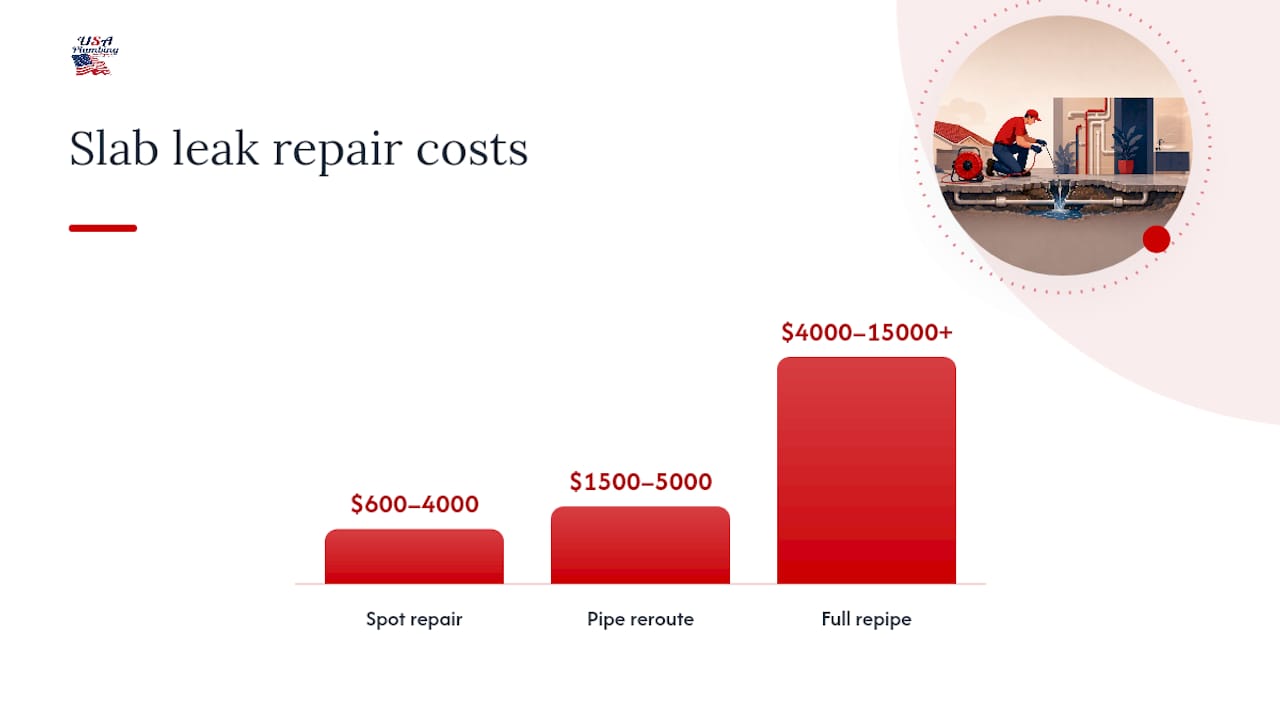
Slab leak repair options and ranges:
- Spot repair (jackhammer, fix the pipe, patch): $600–$4,000
- Pipe reroute (run a new line around the slab): $1,500–$5,000
- Full repipe (replace all supply lines): $4,000–$15,000+ for larger homes
HomeCostLab's 2026 slab leak guide puts detection alone at $150–$600 — money well spent, because blind jackhammering without pinpointing the leak first multiplies restoration costs significantly. Professional detection commonly pays for itself by narrowing the excavation to the smallest possible area.
For a deeper look at diagnosing leaks under concrete or behind drywall, our underground water leaks repair guide walks through the full process.
Sewer and mainline work:
- Camera inspection: $100–$300
- Hydro-jetting (clearing): $300–$600
- Sewer line repair or replacement: $1,500–$5,000+, and water-damage restoration is often a separate, large cost quoted by a different contractor
How to reduce surprise costs:
- Authorize detection and diagnostics as a separate, defined scope before any demolition
- Get the full repair scope in writing, including who handles restoration
- Ask whether permits are required and who pulls them
Pro Tip: If a plumber wants to start jackhammering without running a leak detection test first, that's a red flag. Detection equipment exists precisely to avoid unnecessary demolition.
Which plumbing jobs can you DIY, and which need a licensed pro?
A meta-analysis of 14 common plumbing repairs found that 7 are clearly DIY-friendly, with a median parts cost of just $30 compared to a typical pro bill of $225. The savings are real — but so are the risks on the wrong jobs.
DIY vs. pro by repair category:
When to always hire a licensed plumber:
- Any work involving gas lines
- Main sewer line clogs, repairs, or replacements
- Slab leaks (detection, access, or repair)
- Water heater gas valve or venting issues
- Any repair requiring a permit
Practical DIY guidance:
For toilet flappers, faucet cartridges, and showerhead swaps, the repair is straightforward with basic tools (adjustable wrench, pliers, Teflon tape). The key rule: if you turn off the water, open the fixture, and find corroded threads, cracked supply lines, or anything unexpected, stop and call a pro. A $25 flapper job can become a $400 repair if a corroded shutoff valve breaks during the process.
The DIY home plumbing maintenance tips page covers the most common safe fixes with step-by-step guidance.
Practical ways to lower your plumbing bill without sacrificing quality
Getting a fair price on plumbing work comes down to preparation and timing — not luck.
Cost-saving tactics that actually work:
- Get at least three written quotes for any job over $300. Compare the scope of work, not just the bottom line — a lower quote that excludes restoration or permits will cost more in the end.
- Ask whether the diagnostic fee is credited toward the repair. Most reputable plumbers say yes. If the answer is no, factor that into your comparison.
- Request a fixed-price (flat-rate) option for routine jobs. Flat-rate pricing removes the uncertainty of a running meter and is often better for customers on defined repairs.
- Schedule non-urgent work during business hours. Evening and weekend premiums add $100–$200 to a typical job. A slow drain or dripping faucet can wait until Monday morning.
- Ask what's included and excluded in writing. Restoration (drywall, concrete, tile), permits, and haul-away fees are frequently not included in the initial quote.
- Maintain fixtures proactively. Annual inspections of shutoff valves, supply lines, and water heater anode rods catch small problems before they become emergency calls.
Simple preventive maintenance that reduces repair frequency:
- Replace toilet flappers every 3–5 years before they fail
- Inspect supply lines under sinks and behind toilets annually for bulging or corrosion
- Flush your water heater annually to reduce sediment buildup
- Clean drain stoppers monthly to prevent slow-drain buildup
Pro Tip: Ask your plumber for a written warranty on both parts and labor. Reputable plumbers typically offer 30–90 days on labor and pass through the manufacturer's warranty on parts. If a plumber won't commit to any warranty in writing, that tells you something.
How to prepare for and compare local quotes
Getting an accurate quote starts before the plumber arrives. The more information you provide upfront, the more precise the estimate — and the easier it is to compare bids apples-to-apples.
Information to gather before the visit:
- Photos or video of the problem and any visible damage
- Fixture age and brand (check under the sink or behind the toilet for labels)
- Location of the main water shutoff valve
- Date the problem started and whether it's worsening
- Any recent repairs or work done on the same system
Questions to ask on the call and at the site:
- Are you licensed and insured in this state?
- Is the diagnostic fee credited toward the repair if I proceed?
- Is this a flat-rate quote or time-and-materials?
- What does the quote include — parts, labor, permits, and restoration?
- What brand of parts do you use, and what warranty do you offer?
- If you open the wall and find additional damage, how do you handle change orders?
Red flags on estimates:
- Vague scope ("fix the leak") with no line items
- Oral-only quotes with no written follow-up
- Pressure to approve work immediately without a written estimate
- No mention of permits for work that clearly requires them (slab access, gas lines, water heater replacement in many jurisdictions)
- Unusually low bids that exclude restoration, permits, or haul-away
How to validate credentials:
Most states maintain an online license lookup for plumbing contractors. Search your state's contractor licensing board by company name or license number before booking. Ask to see proof of general liability insurance and, for larger jobs, workers' compensation coverage.
Payment terms to clarify upfront:
- Confirm whether a deposit is required and how much (10–25% is typical for larger jobs; full payment upfront is a red flag)
- Ask when the final invoice is due and what payment methods are accepted
- For jobs over $1,000, request a written contract before work begins
How these cost estimates were calculated
The figures in this guide reflect a meta-analysis of 11 reputable U.S. cost guides and data sources published between 2024 and 2026, including Angi, HomeAdvisor, HomeGuide, TheCostIn, and AllBetterApp.
How national averages were derived:
- Median and mean figures across sources were compared for each repair type
- Where sources disagreed by more than 20%, the range was widened rather than averaged to a false precision
- State adjustments were derived from sources that reported state-level variation, primarily TheCostIn's state-by-state breakdown
- Accessibility (exposed vs. in-wall vs. under-slab) was modeled as a cost multiplier, not a fixed add-on, because its impact varies by job type
Limitations to keep in mind:
- Local labor markets shift prices faster than annual guides update — treat all figures as starting points, not guarantees
- Emergency surcharges vary by company and are not always disclosed upfront
- Restoration costs (drywall, concrete, flooring) are frequently quoted separately and are not included in most plumbing-only estimates
- Older homes with galvanized or cast-iron pipes often require code upgrades during a repair, which adds cost not captured in standard ranges
- Rural and remote locations may carry higher trip fees that push totals above the ranges shown
The checklist in the section above gives you the exact questions to ask to convert a national range into an accurate local number.
When you should always call a professional plumber
Some situations call for an immediate phone call, no matter how handy you are.
Call a plumber right now if you have:
- Active flooding or water you cannot shut off
- A sewage backup in any drain or toilet
- Any smell of gas near water heater, appliances, or pipes
- A burst pipe with water spraying or pooling rapidly
- Water near your electrical panel or any outlet
For step-by-step actions while you wait for help, the 24-hour plumbing emergency checklist covers exactly what to do in the first 15 minutes.
Situations that usually require a licensed pro (schedule soon):
- Main sewer line clog that doesn't clear with a standard plunger
- Any suspected slab leak (rising water bills, warm spots on the floor, cracking)
- Water heater gas valve, venting, or pressure relief valve issues
- Complex repiping or any work that requires opening walls or floors
- Gas line additions, repairs, or relocations
Schedule non-emergency professional help when you notice:
- A leak that keeps coming back after a DIY fix
- Recurring slow drains in multiple fixtures (often a main-line issue)
- A water bill that has risen without an obvious explanation
- Discolored water or a sulfur smell from hot water lines
A local plumber's perspective on what surprises homeowners most
One of the most common surprises we see on jobs in the Bullhead City area is the gap between what a homeowner expects and what's actually behind the wall. A customer calls about a dripping faucet, and when we open the cabinet, we find a supply line that's been weeping for months — the subfloor is soft, and now we're talking about a bigger repair than anyone budgeted for.
The best thing you can do before we arrive is clear the area around the problem. Move items out from under sinks, pull furniture away from walls near the leak, and have your photos ready. That saves time and keeps your quote accurate from the first visit. We also recommend knowing where your main shutoff valve is before you ever need it — in an emergency, that 30 seconds matters.
At Usaplumbingseptic, we work with homeowners and property managers across Bullhead City, Fort Mohave, Mohave Valley, and Laughlin. The jobs we see most often — slab leaks, sewer line issues, water heater failures, and emergency pipe bursts — are exactly the situations where having a trusted, licensed plumber on call makes the difference between a manageable repair and a major restoration project.
Usaplumbingseptic is ready when you need a reliable local plumber
When a leak shows up at 2 AM or a sewer line backs up on a Sunday, you need a plumber who picks up the phone and shows up ready to work. Usaplumbingseptic provides 24/7 emergency plumbing and septic services across Bullhead City, Fort Mohave, Mohave Valley, and Laughlin — covering everything from sewer line repairs and slab leak detection to water heater repair and drain clearing.
We give you a written scope before any work starts, and our team handles the full job — diagnostics, repair, and coordination on restoration when needed. No vague verbal estimates, no surprise line items. For homeowners and property managers in Mohave County, our local plumbing essentials guide covers what to expect from service in this area. Call or message us today to schedule an on-site quote or request emergency service.
Sources
The following sources were used to build the cost ranges, state adjustments, and repair categories in this guide:
- Plumbing repair cost — TheCostIn
- How Much Does Plumbing Repair Cost? 2026 Data — Angi
- Plumbing cost estimates — HomeAdvisor
- Emergency plumber cost 2026 — AllBetterApp
For Bullhead City and Mohave County specifics, visit the Usaplumbingseptic local resources page.
FAQ
What is the average plumbing repair cost for a 2,000 sq ft house?
There's no single figure tied to square footage — cost depends on the repair type, not the home's size. A 2,000 sq ft home with a single leaking faucet might cost $150–$250 to fix; the same home with a slab leak could run $600–$4,000+.
How much does it cost to repipe a 2,500 sq ft house?
Full repiping for a home that size typically runs $4,000–$15,000+, depending on pipe material (PEX vs. copper), accessibility, and local labor rates. Slab homes cost more because concrete access adds demolition and restoration expenses.
How much does it cost to fix major plumbing issues?
Major repairs — slab leaks, main sewer line replacement, full repiping — generally range from $1,500 to $15,000+. The wide range reflects the difference between a simple sewer clearing ($300–$600) and a full sewer line replacement or whole-house repipe.
What is the 135 rule in plumbing?
The "135 rule" is not a standard industry code or regulation in U.S. plumbing. If a plumber or contractor references it, ask them to cite the specific code section (IPC, UPC, or your local amendment) — plumbing standards are governed by the International Plumbing Code or Uniform Plumbing Code, not informal rules.
When should I call an emergency plumber instead of waiting?
Call immediately for active flooding, sewage backup, any gas smell, a burst pipe, or water near your electrical panel. For those situations, the emergency plumbing checklist walks you through what to do while you wait for a plumber to arrive.