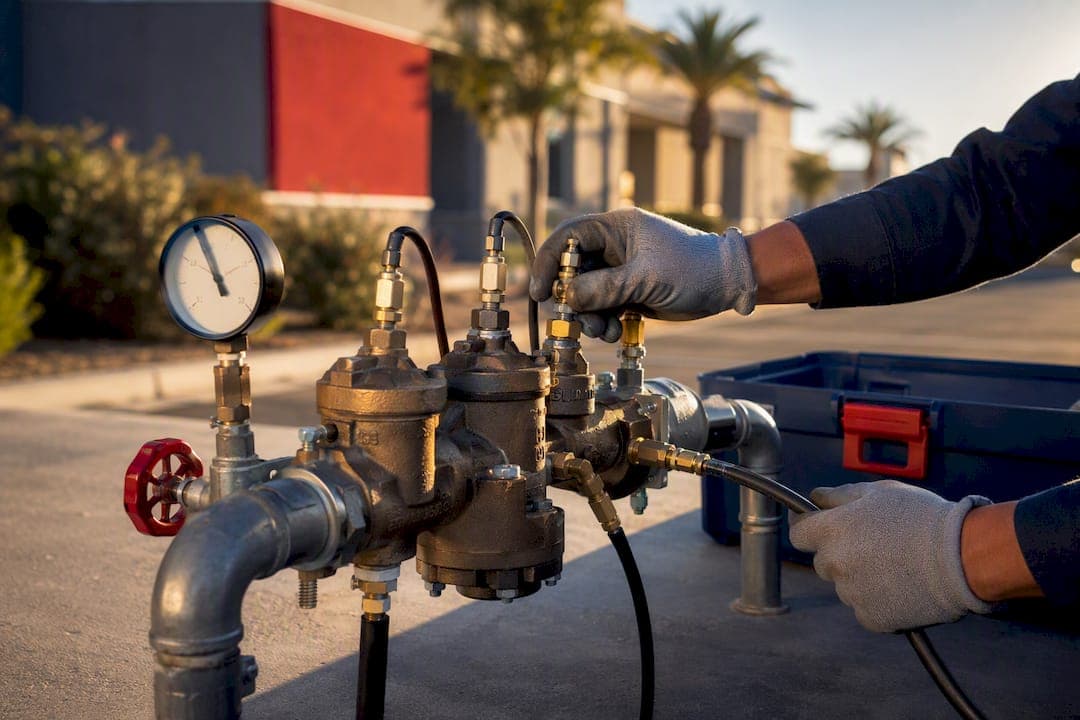
Most property owners pay between $75 and $180 per device for backflow testing, with a national range of roughly $30 to $300 depending on device type and locality. Device type and how accessible the valve is drive most of that spread. Before you accept any quote, ask for an itemized per-device price, a stated repair allowance, the retest fee, and confirmation of who files the results with your water utility.
TL;DR:
- Backflow testing costs vary widely based on device type, with simple PVB devices costing $75 to $180 and complex RPZ assemblies reaching $120 to $250 per test.
- Additional devices tested during the same visit often qualify for discounts, and accessibility issues can significantly increase labor fees.
- A legitimate quote should itemize testing prices, filing fees, repair estimates, retest policies, and certification proof to ensure transparency.
- Repairs for failed valves typically cost between $25 and $2,000, with retests costing an extra $50 to $100, which should be planned for in the budget.
- Testing durations range from 10 to 15 minutes for simple devices to up to 90 minutes or more for complex assemblies, with seasonal demand affecting availability and prices.
Table of Contents
- How Much Does Backflow Testing Cost in Practice?
- What Actually Drives the Price Differences?
- What Should a Legitimate Quote Include?
- Budgeting for Repairs, Retests, and Replacements
- How Long Does a Backflow Test Actually Take?
- How to Get Quotes You Can Actually Compare
- Local Insight From USA Plumbing and Septic LLC
- What Property Owners Get Wrong About Backflow Costs
- Get an Itemized Backflow Testing Quote
- Sources
- FAQ
How Much Does Backflow Testing Cost in Practice?
Backflow testing cost varies more than most property owners expect, and the swing usually comes down to what kind of device sits on your line and how many you own. A single residential PVB (pressure vacuum breaker) on an irrigation line typically lands at the low end of the range, often $75 to $180 for the visit. A commercial RPZ (reduced pressure zone) assembly, which is more complex to disassemble and reassemble, tends to push the total toward the higher end of the $120 to $250 band many testers quote for standard assemblies.
Here's how the math typically plays out across common scenarios:
A few things shift these numbers in either direction:
- Urban markets with dense competition among testers tend to sit near the low end of each band.
- Rural areas or jurisdictions with strict permit requirements often run higher because fewer certified testers serve the area.
- Properties with several device types (say, a fire line detector assembly plus irrigation PVBs) pay a blended rate rather than one flat number.
Multi-device properties rarely pay a straight multiple of the single-device price. Once a tester is already on-site, each additional device usually costs less to test than the first.
What Actually Drives the Price Differences?
Backflow assemblies aren't interchangeable, and neither is the labor needed to test them. A PVB is the simplest device on the market, and a full test can wrap up quickly. A DCVA (double check valve assembly) or RPZ requires more steps, more gauge readings, and more time troubleshooting if a valve sticks. Detector assemblies on fire lines add another layer of complexity because testers have to isolate flow without disrupting fire protection.
Several factors combine to set your final number:
- Device type: RPZ and detector assemblies typically cost more to test than PVBs or DCVAs of the same size.
- Number of devices: Additional devices on the same visit often qualify for a per-device discount once travel and paperwork are already covered.
- Accessibility: Buried valves, locked mechanical rooms, or devices requiring a ladder add labor time and cost.
- Scheduling: Booking during peak spring filing season, when utilities set annual deadlines, often means paying a seasonal surcharge.
It might just mean they're quoting different work.
What Should a Legitimate Quote Include?
A tester who won't break down the price is a tester whose price you can't trust. A legitimate quote should read like a receipt, not a guess. Ask for it in writing, and expect these line items every time:
- Per-device testing price, listed separately for each assembly on your property.
- Travel or service call fee, disclosed upfront rather than buried in the total.
- Filing or permit fee, covering submission of results to your municipality or water utility.
- Parts and repair cost estimates, in case a valve fails during testing.
- Retest fee policy, spelled out separately from the original test.
- Proof of certification and calibration, since an invalid gauge produces an invalid report.
Pro Tip: Ask how long it takes the tester to file your results after the visit. Some utilities give you a grace period, but others start counting toward a fine the day the deadline passes.
Budgeting for Repairs, Retests, and Replacements
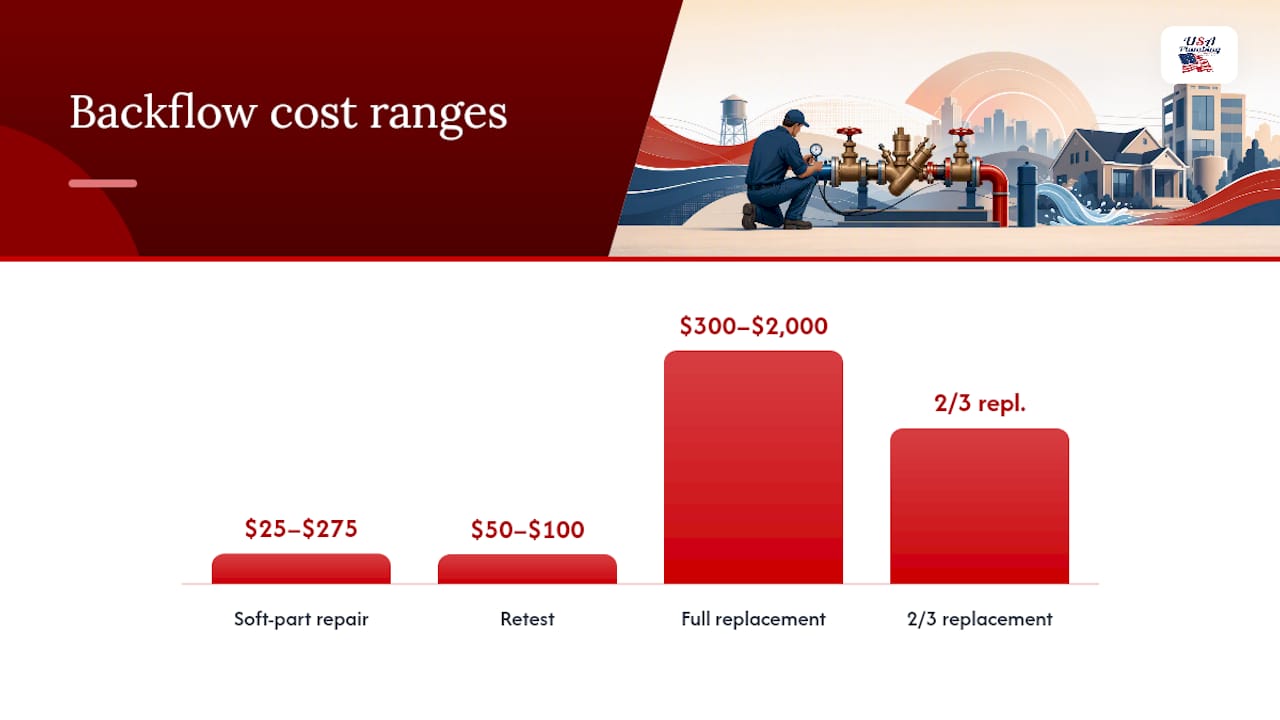
A test that turns up a failed valve isn't rare, and it shouldn't derail your budget if you've planned for it. Soft-part repairs (springs, seals, O-rings) typically run $25 to $275 plus labor. Full assembly replacement, needed when internal components have corroded or the housing has cracked, usually falls between $300 and $2,000 depending on device size.
Retesting after a repair often costs an additional $50 to $100 unless your original contract bundles it in. A simple rule helps here: if a repair quote approaches two-thirds of what a full replacement would cost, replace the unit instead. You'll avoid paying twice within a year. For a broader sense of how these numbers compare to other plumbing work, plumbing repair cost guides offer useful context on labor pricing in general.
How Long Does a Backflow Test Actually Take?
A single PVB test can wrap up in 10 to 15 minutes. DCVA and RPZ assemblies typically take 45 to 90 minutes each because they involve more valves and more gauge checks. Complex commercial sites with several device types can stretch into hours.
Most municipalities set annual filing deadlines, often clustered in early spring, which creates a seasonal crunch. Testers get booked solid in the weeks before that deadline, and prices sometimes climb with demand. Scheduling your test in late summer or fall, well ahead of next year's deadline, usually gets you a better rate and an easier appointment slot.
How to Get Quotes You Can Actually Compare
Two quotes that look similar on paper can represent very different jobs. Ask every tester the same set of questions so you're comparing apples to apples:
- What's the price per device, and does that change with the number of devices on-site?
- Is filing with the utility included, or billed separately?
- Can you show proof of certification and recent gauge calibration?
- What's the retest fee if a device fails?
- Are you licensed and insured for this work?
Watch for a few warning signs. A quote with no itemization, a tester who won't confirm they'll file your results, cash-only payment terms, or a refusal to show credentials are all reasons to keep shopping. If one tester quotes a flat fee and another quotes per-device, ask both for a written breakdown. Flat fees can work fine for a single simple device, but they can hide costs on multi-device commercial jobs where per-device pricing is more transparent.
Local Insight From USA Plumbing and Septic LLC
Property owners across Bullhead City, Fort Mohave, Mohave Valley, and Laughlin call USA Plumbing and Septic LLC when they need straight answers on backflow costs, not a runaround. Our teams quote multi-device commercial jobs the same way every time: one line item per assembly, one clear travel fee, and a stated filing timeline with the local utility. On residential visits, we tell homeowners upfront whether their irrigation PVB will need a retest before we ever pick up a tool.
[Credentials, certifications, and customer testimonials to be added.]
What Property Owners Get Wrong About Backflow Costs
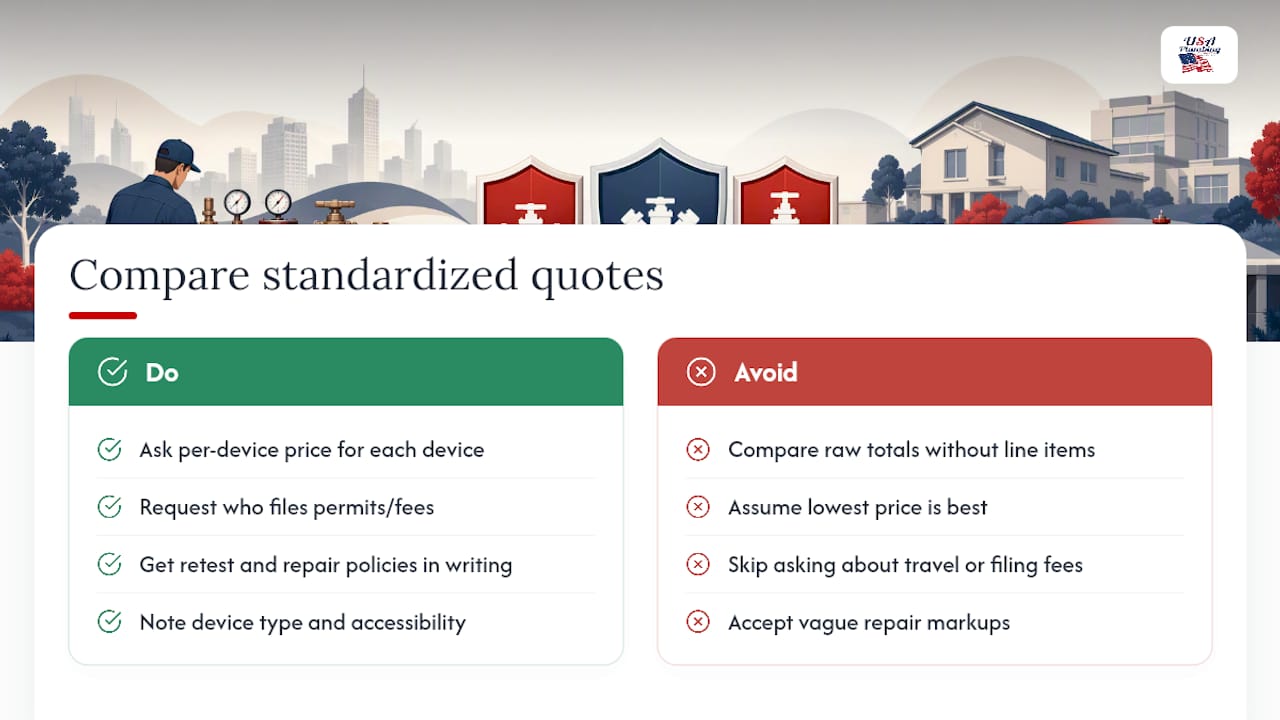
The biggest mistake property owners make isn't overpaying. It's comparing quotes that aren't actually comparable. A $95 flat fee and a $150 per-device quote might be identical once you factor in filing fees and travel, or one might be hiding a repair markup the other discloses upfront. Conventional advice tells you to "shop around," but shopping around without a standardized checklist just means collecting three different guesses dressed up as prices.
What the numbers actually support is simpler: device type and accessibility explain most of the variation you'll see, not the tester's overhead or reputation. A $75 quote and a $250 quote can both be fair, depending on whether you're testing a single irrigation PVB or a commercial RPZ behind a locked gate. Prioritize getting the same line items from every tester before you compare totals. Once you can see per-device price, filing responsibility, and retest policy side by side, the "best" quote usually becomes obvious, and it's rarely the cheapest one on paper.
— JOHN
Get an Itemized Backflow Testing Quote
USA Plumbing and Septic LLC gives you a straight, itemized number instead of a rough estimate over the phone. That's the real difference: you see the per-device price, the filing fee, and the retest policy before we ever schedule a visit, so there's no surprise on the invoice.
Our certified testers handle residential PVBs, commercial RPZ and DCVA assemblies, and detector assemblies on fire lines, and we file the results directly with your local utility once testing wraps up. If a device fails, we quote the repair or replacement cost on the spot rather than leaving you to chase down a second contractor. USA Plumbing and Septic LLC serves Bullhead City, Fort Mohave, Mohave Valley, and Laughlin with 24/7 availability for testing, repairs, and emergency plumbing needs alike. Ready to see your number in writing? Request an itemized quote from USA Plumbing and Septic LLC and get your test scheduled before your next filing deadline.
Sources
- Cost of Backflow Testing: Price Ranges for U.S. Homes and Businesses 2026
- Backflow Test Cost: What U.S. Property Owners Pay in 2026
- Backflow Preventer Inspection Cost 2026 – One and Done Prep
- How Much Does a Backflow Test Cost: Understanding Pricing and Factors Involved
FAQ
Why Is Backflow Testing So Expensive?
It isn't inherently expensive, but the price reflects certified labor, calibrated equipment, and filing paperwork with your utility, and complex devices like RPZ assemblies take significantly longer to test than a simple PVB.
What Is a Backflow Test and How Much Does It Cost?
A backflow test checks whether a device that prevents contaminated water from flowing back into the public supply is functioning correctly, and it typically costs $75 to $180 per device, with a wider national range of $30 to $300 depending on device type and location.
How Long Should a Backflow Test Take?
A simple irrigation PVB can take 10 to 15 minutes, while DCVA and RPZ assemblies usually take 45 to 90 minutes each; complex commercial sites can take several hours total.
What Is the Average Cost of a Backflow Test?
The average per-device cost falls in the $75 to $180 range for standard residential and small-commercial assemblies, with device type and accessibility pushing the price toward the higher end of the national $30 to $300 spread.