
For most homeowners, the Toto Drake (MS776 series) is the single best low-flow toilet to buy right now. It delivers consistent 1.28 GPF gravity-flush performance, carries WaterSense certification, and shows up repeatedly at the top of lab-tested rankings from Consumer Reports and Wirecutter. Two strong alternatives round out the shortlist:
- Best budget pick: Glacier Bay (1.28 GPF models) — WaterSense certified, widely available at Home Depot, and priced for homeowners replacing an old leaky toilet without stretching the budget.
- Best for clog-prone or high-traffic households: Kohler Cimarron/Wellworth with pressure-assist option — broader retail availability and a pressure-assisted variant that handles heavy use better than standard gravity-feed models.
All three are WaterSense certified, meaning they meet EPA efficiency and performance standards at 1.28 GPF or less.
Key Takeaways
The Toto Drake (MS776 series) is the strongest all-around choice for most homeowners: WaterSense certified, MaP Premium listed, and available at every major retailer at a mid-range price.
| Point | Details |
|---|---|
| Best overall pick | Toto Drake (MS776 series): 1.28 GPF, WaterSense certified, MaP Premium listed, widely available. |
| MaP score matters most | Prefer models with a published MaP score of 800+ grams to avoid double-flushing. |
| Match flush type to use | Gravity-feed for most homes; pressure-assisted only for heavy-use or clog-prone bathrooms. |
| Measure rough-in first | Confirm your rough-in distance (10", 12", or 14") before buying any toilet to avoid installation failures. |
| Usaplumbingseptic installs it right | USA Plumbing and Septic LLC handles toilet replacement, flange repair, and leak diagnosis in Bullhead City and surrounding areas. |
Table of Contents
- What are the best low-flow toilet options in 2026?
- How do you choose the right low-flow toilet for your home?
- How do low-flow toilets actually work?
- How were these recommendations selected?
- Installation notes and practical details for each model
- How loud is a low-flow toilet, and does it matter?
- Maintenance and cleaning for low-flow toilets
- Understanding MaP scores and flush performance metrics
- A local installer's perspective on when professional help matters
- Ready to replace your toilet? We can handle the whole job.
- Sources
- FAQ
What are the best low-flow toilet options in 2026?
The six models below cover the range from best-in-class performance to budget-friendly replacement. States including California, Colorado, Georgia, New York, Texas, and Washington restrict toilets averaging more than 1.28 GPF, so confirming WaterSense certification before purchase matters regardless of where you live.
WaterSense saves real water. Research indicates that WaterSense-labeled toilets can cut household toilet water use by roughly 20% or more compared with standard 1.6 GPF models.
Model-by-model notes
Toto Drake (MS776 series) is the most consistently recommended model across major 2026 lab tests. Its Double Cyclone flushing system and CEFIONTECT ceramic glaze reduce buildup without requiring a high-GPF flush. Comfort height suits most adults and meets ADA guidelines. Available at all major retailers; standard 12-inch rough-in.
American Standard VorMax uses a single, high-velocity jet that scrubs the entire bowl surface on every flush. That geometry reduces the rim buildup common in older designs. Good Housekeeping's lab-style tests highlight it for cleaning performance. Pair it with the EverClean surface coating for the lowest maintenance routine.
Kohler Cimarron / Wellworth gives you the widest price range of any brand on this list. The standard gravity model handles everyday residential use well. The pressure-assisted Wellworth variant is the pick for a basement bathroom or a household where clogs are a recurring problem. Parts are widely stocked at hardware stores, which matters for long-term ownership.
Glacier Bay models from Home Depot perform acceptably in independent tests for their price tier. They are a practical choice when the goal is replacing a 3.5 GPF relic and capturing the water savings without spending $400. Verify the specific model carries WaterSense certification, since not every Glacier Bay SKU does.
Project Source (Lowe's house brand) is the most price-accessible option, but performance varies by model. Always check the published MaP score and confirm WaterSense certification on the specific unit before buying. Some models lack published MaP data entirely, which is a red flag for clog-prone households.
Horow HR-E19S fits where standard elongated toilets don't. Its compact footprint makes it the right call for a tight powder room or a small bathroom remodel. Flushing specs are acceptable for a single-user or low-traffic bathroom. Buy through Amazon or specialty online retailers; it is not typically stocked at big-box stores.
How do you choose the right low-flow toilet for your home?
Start with the four criteria that actually affect whether you'll be happy with the toilet five years from now. Everything else is secondary.
Prioritized criteria:
- GPF and WaterSense certification — Choose 1.28 GPF and confirm the WaterSense label. If you're in California, Colorado, Georgia, New York, Texas, or Washington, this is a legal requirement, not just a preference.
- MaP score or lab-tested clearing performance — A published MaP score is the clearest proxy for solid-waste clearing. Prefer models on the MaP Premium list or with documented Consumer Reports lab results. A toilet with no published MaP data is a gamble.
- Flush mechanism — Gravity-feed for most homes; pressure-assisted only for heavy-use or clog-prone locations. BHG's testing confirms gravity-fed models offer the best balance of quiet operation and reliability for residential settings.
- Rough-in measurement — Measure the distance from the wall to the center of the floor flange before you buy anything. Standard is 12 inches, but older homes often use 10-inch or 14-inch rough-ins. Buying the wrong rough-in is the most common installation mistake.
Secondary criteria to check:
- Bowl shape (elongated vs. round) and height (comfort/ADA vs. standard)
- Trapway size: larger trapways reduce clog risk
- Rim design: rimless or directed-jet designs are easier to clean
- Noise tolerance: pressure-assisted units are noticeably louder
- Warranty length and parts availability (avoid proprietary-only replacement parts)
Questions to ask your retailer or plumber before buying:
- What is the MaP score for this specific model?
- Is this model WaterSense certified for my state?
- What is the rough-in measurement this toilet requires?
- Does this model use proprietary replacement parts, or are standard parts available?
- Does my utility offer a rebate for WaterSense-certified toilets?
Utility rebates for WaterSense toilets are available in many areas. Check your local water utility's website or the Alliance for Water Efficiency for rebate programs in your region. Rebates of $50–$100 per toilet are common and can meaningfully offset the cost of a mid-range model.
Red flags to avoid: no published MaP data, a dual-flush model with a weak low-volume setting that requires double-flushing, and toilets that use proprietary flushing cartridges with limited retail availability.
Pro Tip: If your household has four or more people or you're replacing a toilet in a basement bathroom with a long drain run, choose a pressure-assisted model or a gravity model with a documented MaP score above 800 grams. That score range reliably clears solid waste in a single flush.
How do low-flow toilets actually work?
The term "low-flow" covers three distinct flushing technologies, and they perform very differently in real homes.
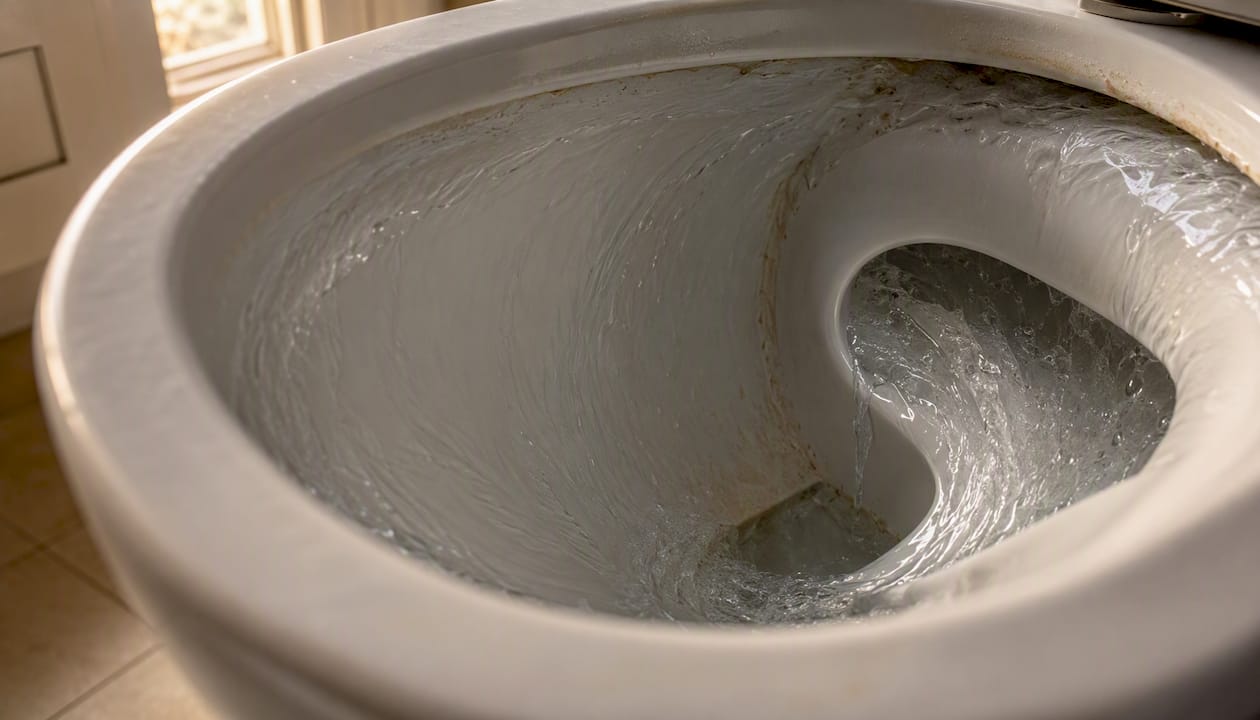
Gravity-feed toilets use the weight of water dropping from the tank to create a siphon that pulls waste through the trapway. They are quiet, simple to repair, and the preferred choice for residential plumbers. The trade-off is that clearing performance depends heavily on bowl geometry, trapway size, and jet configuration. Modern gravity-feed designs have closed that gap considerably.
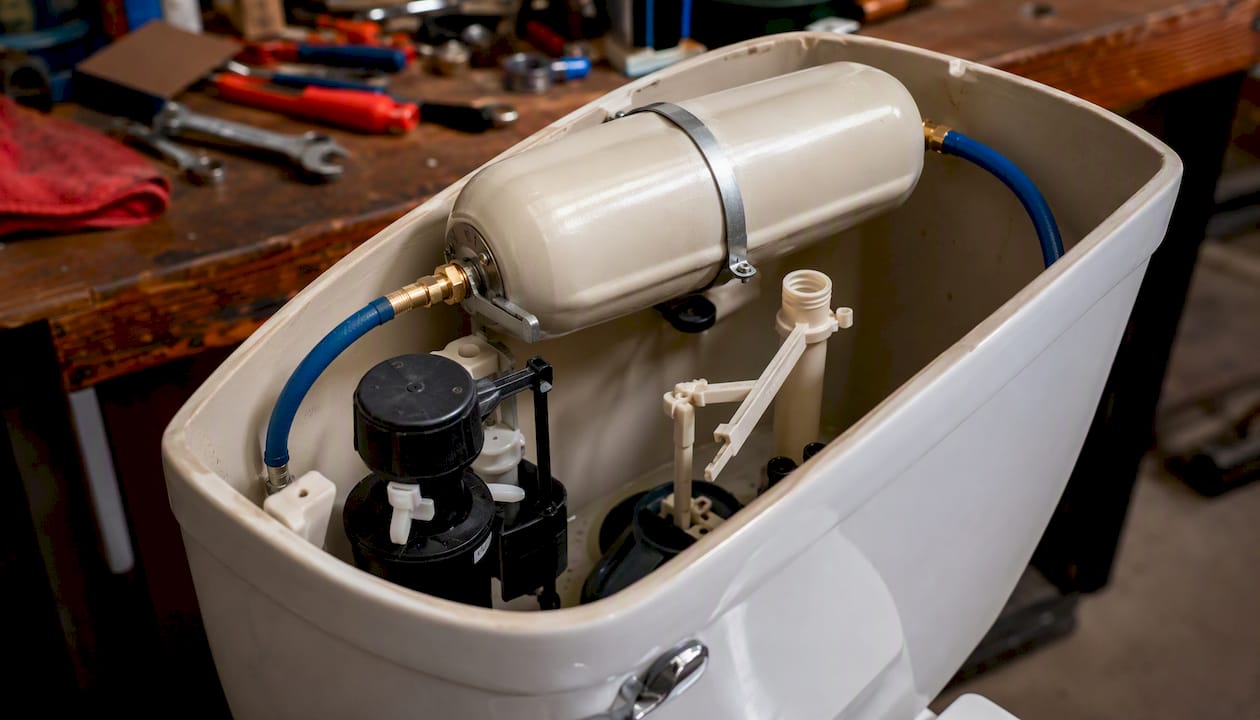
Pressure-assisted toilets use compressed air stored in a sealed vessel inside the tank. When you flush, the air forces water into the bowl at higher velocity than gravity alone can achieve. The result is superior clog resistance and a more forceful clearing action. The cost: they are noticeably louder (a sharp crack rather than a gurgle), and replacement parts are sometimes proprietary. BHG's expert guidance recommends them only for high-traffic or clog-prone environments.
Dual-flush toilets offer two buttons: a low-volume flush (typically 0.8–1.0 GPF) for liquid waste and a full flush (1.28 GPF) for solid waste. They save additional water on paper, but Good Housekeeping's lab testing notes that the low-volume setting on some models clears poorly enough to require a second flush, erasing the savings. Always verify the MaP score for the full-flush setting before buying a dual-flush model.
Bowl design, coatings, and trapway geometry
The engineering details that separate a great 1.28 GPF toilet from a mediocre one are mostly invisible from the showroom floor.
Trapway size determines how much solid waste can pass in a single flush. A larger trapway (2.125 inches or wider) reduces clog risk significantly. Rim jet configuration controls how water enters the bowl: older toilets use a ring of small holes under the rim that accumulate mineral deposits over time. Newer designs like Toto's Tornado Flush, American Standard's VorMax, and rimless European-style bowls direct water in a single powerful arc or vortex, covering more surface area and leaving fewer places for buildup to hide.
Bowl coatings are a real performance differentiator. Toto's CEFIONTECT glaze and American Standard's EverClean surface use hydrophilic or ion-barrier chemistry to reduce the adhesion of waste, bacteria, and mineral deposits. Fewer deposits mean less scrubbing and a lower risk of staining over time.
Modern 1.28 GPF toilets with improved bowl geometry, directed-jet flushing, and ceramic coatings can match or exceed the cleaning performance of older 3.5 GPF models. The Spruce's 2026 testing confirms that GPF alone is not a reliable predictor of bowl-cleaning performance.
How the siphon works: when the flush valve opens, water rushes into the bowl through the jet and rim. The sudden surge fills the trapway, creating a siphon that pulls the bowl contents through. The siphon breaks when air enters the trapway, ending the flush. Pressure-assisted units accelerate this process with stored air; gravity units rely entirely on water volume and velocity. Noise in pressure-assisted models comes from that air release, which is why they sound sharper and louder than gravity models.
How were these recommendations selected?
These picks are grounded in four objective performance signals, not manufacturer marketing.
Trusted signals used:
- MaP (Maximum Performance) scores — MaP tests measure how many grams of solid waste a toilet clears in a single flush. A score of 500 grams is the minimum for WaterSense certification; MaP Premium models clear 1,000 grams or more. Prefer published MaP scores over manufacturer claims.
- Consumer Reports lab testing — CR uses standardized flushing and clog-resistance tests. Their 2026 lab-tested rankings prioritize MaP and WaterSense as complementary signals: MaP tests waste clearing, WaterSense certifies efficiency plus minimum performance.
- BHG and Good Housekeeping testing — Both outlets use obstruction and real-world clearing trials. Their results consistently favor models with larger trapways and directed-jet bowl designs.
- WaterSense certification — The EPA's WaterSense program sets the efficiency threshold at 1.28 GPF and requires independent certification. The program released a revised specification (Version 2.0) in May 2024, then paused the effective date; Version 1.2 remains in effect. Buyers should confirm current certification status on the EPA's WaterSense product search.
MaP and WaterSense answer different questions. WaterSense asks: "Is this toilet efficient and does it meet a minimum performance floor?" MaP asks: "How much solid waste will this toilet actually clear in one flush?" You want both signals pointing in the same direction before you buy.
Retail price checks and plumber input also shaped the final list. A toilet that performs well in a lab but requires a nonstandard rough-in or proprietary parts that are hard to source locally is a practical liability. Models were cross-checked against Home Depot, Lowe's, and Amazon availability to confirm that they are actually purchasable in the U.S. market today.
Installation notes and practical details for each model
Knowing what's in the box and what you'll need to buy separately saves a trip back to the hardware store.
Standard installation parts checklist (applies to all models):
- Wax ring or wax-free flange seal (not included with most toilets)
- Toilet bolts / closet bolts (sometimes included; verify)
- Supply line (rarely included; buy a braided stainless 12-inch line)
- Toilet seat (not included on most two-piece models; Toto Drake is an exception on some packages)
- Flange repair kit if the existing flange is cracked or sits below the finished floor
Per-model installation notes:
- Toto Drake (MS776 / CST series): Two-piece design; tank ships separately. Standard 12-inch rough-in. CEFIONTECT-coated models require no special tools. Replacement parts (fill valve, flapper, flush valve) are widely available at hardware stores and online. Skirted base versions require a specific mounting kit; confirm before ordering.
- American Standard VorMax: Two-piece; standard 12-inch rough-in. The VorMax flush tower replaces a traditional flapper, so confirm replacement tower availability in your area before buying. EverClean surface requires no special cleaning products.
- Kohler Cimarron / Wellworth: Both one-piece and two-piece options available. Pressure-assisted Wellworth uses a Flushmate vessel; Flushmate replacement units are available at most plumbing supply houses. One-piece models are heavier and may require two people to set.
- Glacier Bay: Standard two-piece; 12-inch rough-in. Parts are Home Depot house-brand; availability outside Home Depot is limited. For DIY maintenance, keep a spare fill valve on hand since proprietary parts can be harder to source at independent plumbing suppliers.
- Project Source: Standard two-piece; 12-inch rough-in. Parts availability varies; confirm before buying if you plan to do your own repairs. Some models use generic Fluidmaster-compatible internals, which is a plus.
- Horow HR-E19S: One-piece skirted design. The skirted base requires a side-mount bolt kit (usually included). Compact elongated bowl fits a 10-inch rough-in in some configurations; verify the spec sheet for your specific unit. Replacement parts are primarily available online.
Typical add-on costs to budget for: wax ring ($5–$15), supply line ($10–$20), toilet seat if not included ($30–$80), flange repair ring if needed ($10–$30). A standard professional installation in the Bullhead City area typically runs 1–2 hours for a straightforward swap on an existing flange.
How loud is a low-flow toilet, and does it matter?
Flush noise is one of the most underrated factors in toilet selection, especially for bathrooms adjacent to bedrooms or shared walls.
Gravity-feed toilets at 1.28 GPF are generally quiet. The sound is a low gurgle lasting 4–6 seconds, similar to older gravity models. The Toto Drake's Double Cyclone system is slightly louder than a basic gravity flush due to the directed water jets, but still well within a comfortable residential range.
Pressure-assisted models are a different story. The Kohler Wellworth pressure-assist variant produces a sharp, loud crack at the start of the flush, followed by a brief roar. It is effective, but it will wake a light sleeper in the next room. For a master bathroom or a bathroom sharing a wall with a bedroom, a gravity-feed model is the better choice regardless of clog-resistance needs.
Dual-flush toilets using a tower-style flush valve (like the American Standard VorMax) tend to be slightly louder on the full-flush setting than a traditional flapper-based gravity model, but quieter than pressure-assist. The low-volume flush on most dual-flush models is nearly silent.
One practical note: hard water accelerates mineral buildup in rim jets and around the flush valve seat, which can increase noise over time as the flush geometry degrades. If you're in a hard-water area like Bullhead City, consider a water softening or filtration system to protect both toilet performance and noise levels long-term.
Maintenance and cleaning for low-flow toilets
Low-flow toilets don't require more maintenance than older high-GPF models, but a few habits make a real difference in keeping them performing well.
Bowl coatings need the right cleaning products. CEFIONTECT and EverClean surfaces are damaged by abrasive scrubbers and bleach-based drop-in tank tablets. Use a soft brush and a non-abrasive liquid cleaner. Drop-in tank tablets that contain bleach will degrade rubber flappers and seals within months, leading to phantom flushing and water waste.
Rim jets need periodic descaling. In hard-water areas, mineral deposits block the small holes under the rim within 12–18 months on traditional designs. Rimless and directed-jet bowls (VorMax, Tornado Flush) have fewer places for deposits to accumulate, which is a genuine maintenance advantage. A white vinegar soak under the rim every few months keeps jets clear on traditional designs.
Check the fill valve and flapper annually. A running toilet wastes far more water than the difference between a 1.28 GPF and a 1.6 GPF model. A worn flapper can waste hundreds of gallons per day. Replacement flappers cost under $10 and take 10 minutes to swap. If you're not comfortable doing it yourself, it's a quick service call.
Dual-flush tower valves require occasional cleaning of the seal at the base of the tower. Mineral buildup on the seal causes slow leaks into the bowl. Lift the tower and wipe the seal with a damp cloth every 6–12 months.
For households dealing with recurring clogs, the issue is often not the toilet itself but the drain line or venting. A toilet that clogs repeatedly after installation may signal a deeper plumbing issue worth having a professional diagnose.
Understanding MaP scores and flush performance metrics
MaP (Maximum Performance) testing is the most reliable independent measure of how well a toilet clears solid waste. The test uses a standardized soybean paste media to simulate real-world waste loads, measured in grams. A score of 500 grams is the minimum threshold for WaterSense certification. MaP Premium designation requires clearing 1,000 grams or more in a single flush.
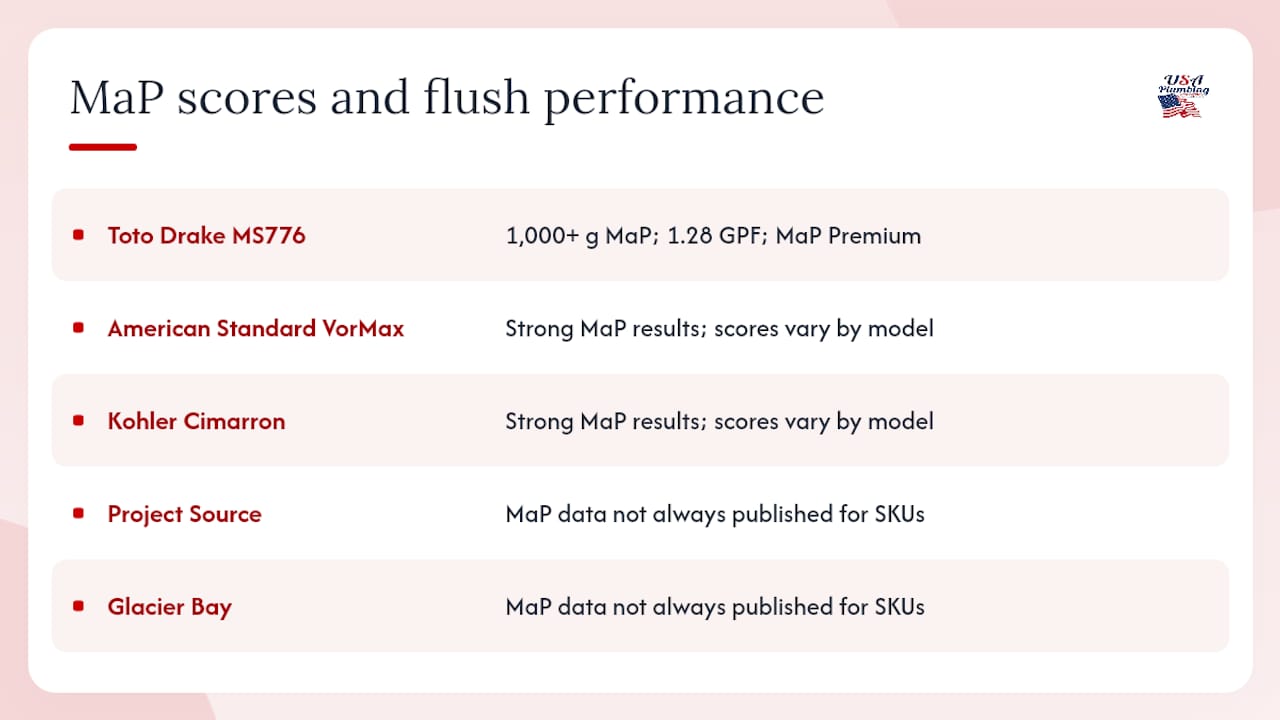
The Toto Drake MS776 series consistently appears on the MaP Premium list, meaning it clears 1,000+ grams per flush at 1.28 GPF. That performance level eliminates double-flushing for the vast majority of households. The American Standard VorMax and Kohler Cimarron also post strong MaP results, though specific scores vary by model configuration.
GPF alone tells you nothing about clearing performance. A 1.28 GPF toilet with a large trapway, a directed-jet bowl, and a published MaP score above 800 grams will outperform a 1.6 GPF toilet with a small trapway and no published performance data. Consumer Reports and Good Housekeeping both emphasize MaP alongside WaterSense as the two signals worth trusting when evaluating any toilet.
For Project Source and Glacier Bay models, MaP data is not always published for every SKU. When it's missing, that's a meaningful gap. A toilet without a published MaP score is harder to evaluate objectively, and budget buyers should factor that uncertainty into their decision.
A local installer's perspective on when professional help matters
Some toilet replacements are straightforward. Others aren't, and the difference usually shows up after you've already committed to a model.
Situations that call for a professional:
- Your rough-in is 10 inches or 14 inches rather than the standard 12 inches. Buying the wrong toilet and discovering it on installation day is an expensive mistake.
- The existing floor flange is cracked, corroded, or sits more than 1/4 inch below the finished floor. A damaged flange causes persistent leaks at the base regardless of how good the toilet is.
- You're converting from a standard toilet to a wall-hung model, or adding ADA-compliant height in a bathroom that requires structural modification.
- The supply valve behind the toilet hasn't been turned in years. Forcing an old valve can cause a leak or a full failure.
What a trustworthy installer should check before setting the new toilet:
- Rough-in measurement confirmed against the new toilet's spec
- Flange condition: no cracks, correct height, bolts seated properly
- Supply valve operation: opens and closes without sticking
- Water pressure at the supply line: low pressure affects gravity-feed performance
- Venting: a gurgling toilet after installation often signals a venting problem, not a toilet defect
A standard toilet swap on an existing, undamaged flange takes an experienced plumber 1–2 hours. A job involving flange repair, a nonstandard rough-in adapter, or a supply valve replacement adds time and parts cost. Get a written estimate that itemizes parts and labor before work begins.
Trustworthy installers, like the team at USA Plumbing and Septic LLC, will also flag whether your new toilet qualifies for a local utility rebate and walk you through what's needed to claim it. That's a detail many installers skip, but it can put $50–$100 back in your pocket on a WaterSense-certified model. For a reliable local plumber in the Bullhead City area, vetting credentials and asking for a written warranty on parts and labor are the two most important steps.
Ready to replace your toilet? We can handle the whole job.
Picking the right toilet is half the work. Getting it installed correctly is the other half, and that's where USA Plumbing and Septic LLC comes in.
We handle residential toilet replacement and installation throughout Bullhead City, Fort Mohave, Mohave Valley, and Laughlin, 24/7. That includes flange inspection and repair, supply valve replacement, rough-in verification, and leak diagnosis on existing fixtures. If your current toilet is running, rocking, or just overdue for replacement, we'll give you a straight answer on what it needs and what it will cost. No guesswork, no surprises on the invoice.
Book a service visit with our team today and get your new low-flow toilet installed right the first time.
Sources
These are the primary references worth bookmarking when you're evaluating specific models or checking rebate eligibility.
- 6 Best Toilets of 2026, Lab-Tested and Reviewed - Consumer Reports
- Residential toilets | WaterSense | US EPA
- About WaterSense | US EPA
- The 6 Best Toilets of 2026, Tested by BHG
- The 8 Best Toilets of 2026, Tested by The Spruce
- 8 Best Toilets of 2026, Tested for Power, Noise, and Maintenance - Good Housekeeping
- The 3 Best Toilets of 2026 | Reviews by Wirecutter
- TOTO WASHLET / NEOREST product catalogue 2026
State restriction note: If you're in California, Colorado, Georgia, New York, Texas, or Washington, confirm WaterSense certification on the exact model SKU before purchasing. Check your local water utility's rebate page at the same time.
FAQ
What is the best low-flow toilet for most homeowners?
The Toto Drake (MS776 series) is the top pick for most homeowners. It flushes at 1.28 GPF, carries WaterSense certification, and consistently earns top scores in independent lab tests including Consumer Reports and Wirecutter.
What toilet do most plumbers recommend?
Most residential plumbers favor gravity-feed models from Toto or Kohler for their reliability, quiet operation, and widely available replacement parts. Pressure-assisted models are recommended only for high-traffic or clog-prone bathrooms.
What is the lowest-flow toilet available?
Dual-flush toilets with a 0.8 GPF low-volume setting offer the lowest per-flush water use for liquid waste. Full-flush settings on WaterSense-certified models max out at 1.28 GPF. Always verify MaP performance on the full-flush setting before buying a dual-flush model.
Is a low-flow toilet worth it?
Yes. WaterSense-certified toilets can reduce household toilet water use by roughly 20% or more compared with standard 1.6 GPF models, according to the EPA. Modern 1.28 GPF designs with improved bowl geometry and coatings clear waste as reliably as older high-GPF toilets.
How do I know if my rough-in is compatible with a new toilet?
Measure from the wall (not the baseboard) to the center of the floor flange bolts. Standard is 12 inches, but 10-inch and 14-inch rough-ins exist in older homes. Buying a toilet without confirming this measurement is the most common installation mistake.