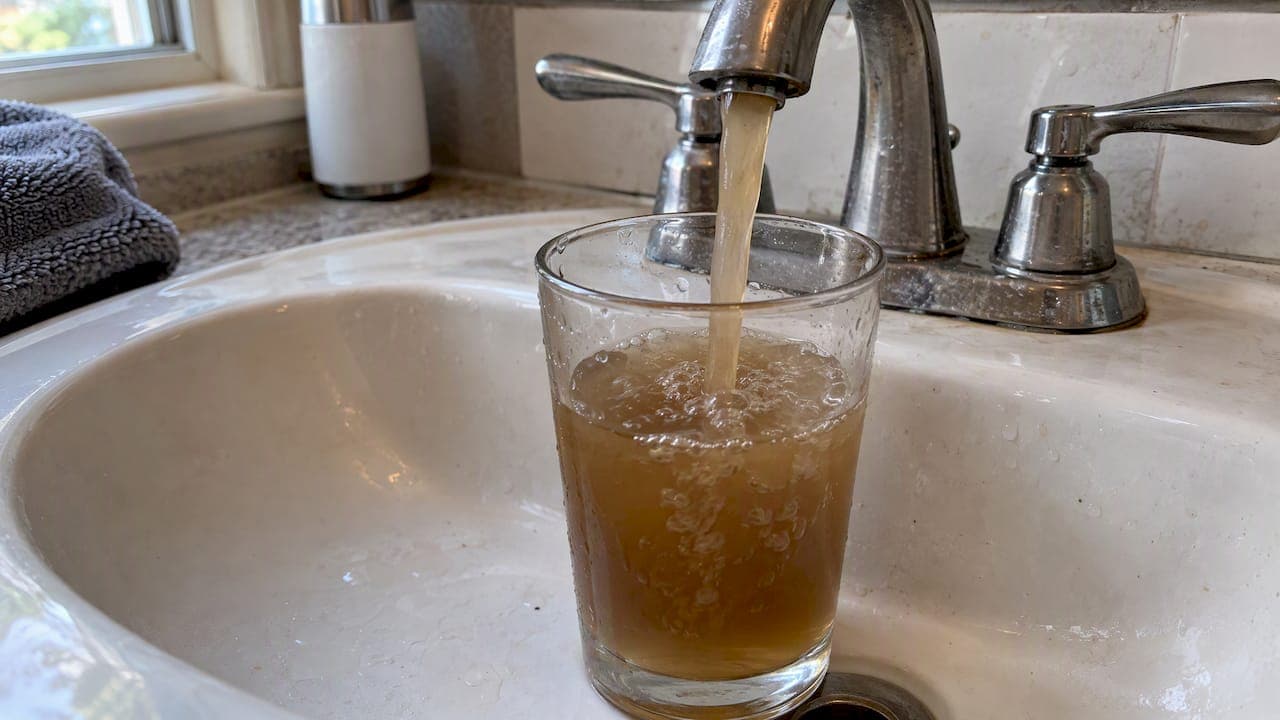
Brown water from a faucet is usually rust or sediment stirred up in the pipes. It is often temporary. The fastest way to find the cause is to check whether the color shows up in cold water, hot water, or both, and whether it clears after a short flush of the cold tap. If it does not clear, or only the hot side is brown, the problem is likely inside your home. That is when you call a plumber.
We are USA Plumbing and Septic LLC. We serve Bullhead City, Fort Mohave, Mohave Valley and Laughlin, and we see this call often. Below is what we tell homeowners, landlords and property managers.
TL;DR
- Brown water is most often rust or sediment disturbed by water main work, hydrant use, or aging pipes. It often is not an emergency.
- Run the cold tap nearest the meter or an outside hose bib for 3 to 5 minutes. If it clears, the cause was likely outside your home or a temporary disturbance.
- Brown water on the hot side only points to sediment in the water heater tank.
- Avoid hot water and bleach laundry until the water runs clear.
- Brown water that lasts more than 24 hours, or comes back again and again, needs a licensed plumber or a call to your water provider.
Table of Contents
- What makes tap water turn brown
- Start with this 10-minute check
- Brown water after a main break, hydrant use or street work
- Brown water only on the hot side
- Brown water from old or corroded pipes
- Brown water after plumbing work
- Is brown tap water safe to drink?
- Protect your laundry, fixtures and appliances
- When to call a plumber
- Our perspective: what we see in the field
- Get it checked in Bullhead City and nearby
- FAQ
- Sources
What makes tap water turn brown
Drinking water leaves the treatment plant clear. Brown, yellow, orange or red water shows up when something along the way adds particles. According to Massachusetts state guidance, brown, red, orange or yellow water is usually caused by rust, and the shade depends on the form of the iron and how much is in the water.
The particles come from one of four places:
- The water main or street. Construction, hydrant flushing and main repairs can shake loose sediment that has settled inside pipes.
- Your service line and home piping. Older steel or galvanized pipe rusts from the inside.
- Your water heater. Sediment and rust collect at the bottom of the tank.
- Recent plumbing work. Cutting into a line or shutting off the water can stir up debris.
Portland's water bureau explains that discoloration can come from your home plumbing, system maintenance in your area, or neighborhood activity such as fire hydrant use. Those are the same buckets we use on a service call.
Start with this 10-minute check
Before you spend money, sort out where the problem starts. You need a clear glass, a timer and about ten minutes.
Step 1: Check the outside hose bib
Fill a clear glass from the outdoor spigot. The City of Bullhead City says that if water is clear at the hose bib, the cause of discoloration could be internal plumbing. If the hose bib water is brown too, the city lists construction work, fire department hydrant exercises and water main repairs as likely causes.
Step 2: Flush the cold line
Open the cold tap closest to the water meter and let it run for three to five minutes. The same city page says that if discoloration persists you may need to repeat the flush, and that it can take several hours for sediment to settle. Use a tub or an outdoor tap if you can. A bathroom sink flushes slowly.
Step 3: Test hot and cold separately
Use a faucet with separate hot and cold handles. Colorado Springs Utilities suggests filling a clear glass and checking whether the color is in the hot water, the cold water or both. Then try the cold tap first.
| What you see | Most likely cause | Next step |
|---|---|---|
| Brown at hose bib and every cold tap, clears within minutes | Main work, hydrant use, or a pressure change nearby | Flush the cold lines, wait a few hours, check with your water provider |
| Brown at hose bib, does not clear after repeated flushes | Provider-side issue | Call your water provider |
| Clear at hose bib, brown inside | Corroded pipe, fixtures or a failing line in the house | Call a licensed plumber |
| Brown on hot only | Sediment or rust in the water heater | Water heater flush or inspection |
| Brown at one fixture only | Dirty aerator, failing valve, or a corroded branch line | Clean the aerator, then call a plumber if it continues |
| Brown right after plumbing work | Debris stirred up, or line not fully flushed | Flush from the lowest point up, call the plumber back if it persists |
Brown water after a main break, hydrant use or street work
This is the most common and least worrying cause. Portland's guidance on discolored water events describes how sediment is disturbed in the pipes, and notes that it settles again over a few hours. The same page says discoloration lasting beyond 24 to 48 hours should be reported to the utility.
In practice, that means:
- Check the street for crews or recently opened hydrants.
- Hold off on laundry and the dishwasher until the water is clear.
- Flush the cold lines only, as described above.
- Check the water once an hour. Do not keep running taps all day.
If you are in the Bullhead City area, your water may come from the city or from a private or regional provider, depending on your address. Look at your water bill, then call that provider to ask about line work or flushing in your neighborhood. They can tell you in one phone call whether it is a known event.
Brown water only on the hot side
If the cold water runs clear and only the hot water is brown, the water heater is the first suspect. Minerals and rust settle at the bottom of the tank over the years. When the tank is disturbed, the heater can pass that sediment into your hot lines.

One point from the San Francisco utility is worth passing on. When brown water appears, avoid using hot water at first, so you do not draw discolored water into the tank. Flush the cold lines first.
Signs the heater is the culprit:
- Brown or rusty water only from hot taps.
- Popping or rumbling noises when the burner runs.
- Hot water that runs out faster than it used to.
- A tank that is many years old, or rust around the base.
A flush can clear a tank with moderate buildup. A tank that is corroding from the inside needs to be replaced. Our guide on how to clean water heater sediment buildup walks through what the process involves. If your hot water pressure has dropped as well, this overview of common causes of low hot water pressure (in Spanish) covers related problems with heaters and lines.
We repair and install water heaters for homes and commercial properties. If the tank is the problem, we can tell you plainly whether a flush will do or a replacement makes more sense.
Brown water from old or corroded pipes
If the hose bib is clear and the cold water inside is brown, the problem may be in your piping. Steel and galvanized lines rust from the inside. As the pipe wall gets thinner, rust flakes break off and show up at the tap. The Massachusetts guidance linked above points to rust as the usual source of brown and orange water.
Clues that point to the pipes:
- Water runs brown first thing in the morning, then clears after a minute or two.
- Brown water returns every few days or weeks, not just once.
- Only some fixtures are affected.
- Fixtures and tubs show orange or brown staining.
- Pressure has dropped in the same period.
Mixed-metal repairs can also cause trouble. When a section of galvanized steel is joined to copper, corrosion can speed up at the joint. That is a common reason a "patch job" leads to repeat discoloration. Flushing will not fix this. A plumber has to find the corroded section and replace it.
Water that tests clear at the street but is brown inside can also come from a failing service or water line. Our team handles water line leak detection, repair and replacement. We also handle sewer line and gas line repair. Our gas line repair and replacement page covers that side of the work.
Brown water after plumbing work
It is common to see brown water for a short time after a plumber shuts off your water, replaces a valve or cuts into a line. Air and debris move through the pipes when the water comes back on.
What a careful plumber does about it:
- Removes aerators from faucets before turning the water back on.
- Opens the lowest tap in the house first, such as a hose bib or basement sink, then works upward.
- Runs each tap until the water is clear, hot and cold.
- Cleans the aerators and checks appliance inlet screens afterward.
If you still see brown water days after a job, start with the aerators. Unscrew them, rinse out the grit and put them back. Debris in the water heater or in appliance screens can cause low-level discoloration that lingers. If the water has not cleared after a couple of days, call the plumber who did the work. It may mean the line was not flushed fully, or that a new joint is corroding.
Is brown tap water safe to drink?
Often it is a cosmetic issue, but you should not assume that. Portland's water bureau is a good place to read about how utilities treat discoloration. Our practical advice:
- Do not drink or cook with water that is visibly brown. Wait until it runs clear.
- Ask your provider if any advisory is in effect. A boil water notice is a different issue from rust, and your provider is the one to confirm it.
- Take extra care with infants, people with health conditions, and anyone on a private well. If you are unsure, use bottled water and talk with your doctor or local health department.
- Do not wait on persistent discoloration. Brown water that lasts beyond a day should be checked by your provider or a licensed plumber.
If your home runs on a private well, discolored water can mean iron or manganese in the groundwater, or a problem with well equipment such as a pump or tank. We repair and replace water well equipment and service water softening and filtration systems. Our water filtration maintenance checklist explains what to check on those systems, and our piece on hard water plumbing problems covers mineral buildup.
Protect your laundry, fixtures and appliances
While the water is brown:
- Skip the washing machine. Iron particles can stain clothes.
- Do not use bleach on laundry. Massachusetts guidance warns that chlorine bleach can react with iron and set the stain. Use a rust stain remover if clothes are already stained.
- Do not run the dishwasher until a glass of tap water looks clear.
- Keep the ice maker and filter pitcher off until the water clears. Replace filter cartridges if they were in use during the event.
- Clean the aerators. Grit collects there and keeps discoloring the flow.
When to call a plumber
Call us if any of these apply:
- Brown water has lasted more than 24 hours.
- The hose bib is clear but your indoor water is brown.
- Only the hot water is brown.
- Brown water keeps coming back.
- You see rust-colored water along with low pressure, leaks, wet spots or higher water bills.
- Brown water follows plumbing work and does not clear.
- You manage a rental or commercial building and several tenants report the same problem.
Do not wait if you see water pooling, hear hissing from a wall, or smell gas. Those are emergencies, not discoloration. For a gas smell, leave the building and call your gas utility or 911 from outside. Then call us for the repair.
Our perspective: what we see in the field
Most brown-water calls we get fall into two groups. The first is a short disturbance from outside the home. The customer flushes, waits and the water clears. We are glad to say that over the phone and save you the visit.

The second group is the call where the problem is inside the house: a tired water heater, old steel pipe, a bad joint from an earlier repair, or well equipment. Those do not fix themselves. The earlier someone looks, the smaller the repair tends to be.
Our advice is simple. Do the hose bib and hot-versus-cold test first. Write down what you find and when it started. That information helps us find the cause faster, and it saves you money. We are available 24/7 for emergencies, and our licensed plumbers go the extra mile to explain what they found before any work starts.
— JOHN
Get it checked in Bullhead City and nearby
If your test points to the water heater, the pipes or a line in your yard, we can help. USA Plumbing and Septic LLC handles water heater repair and installation, water line leak detection and repair, sewer line work, drain cleaning, water well equipment and water softening and filtration repair for residential and commercial customers. We serve Bullhead City, Fort Mohave, Mohave Valley and Laughlin, and our pages for Mohave Valley and Kingman show more of the area we cover.
Ready to book? See all our plumbing services or visit our Bullhead City plumbers page. Not sure whether to hire us or someone else? Our guide to hiring a licensed plumber lists what to ask before anyone touches your pipes.
Call Now or Book Now for brown water that will not clear.
FAQ
Why is my tap water suddenly brown?
The usual cause is sediment stirred up by water main work, a hydrant being opened, or a pressure change. Check the hose bib and run the cold tap for three to five minutes. If it clears, you were likely seeing a short disturbance.
How long does it take for brown water to go away?
Sediment from a local event usually settles within a few hours, according to Portland's water bureau. If it lasts longer than 24 to 48 hours, report it to your water provider. If it is clear outside and brown inside, call a plumber.
Is brown water from the tap safe to drink?
Do not drink it while it is brown. Rust itself is mainly an appearance issue, but you should wait until the water runs clear and confirm with your provider that no advisory is in effect. If you are on a private well, or the water stays brown, have it checked.
Why is the water brown only on the hot side?
That points to sediment or rust inside the water heater tank. Turn off hot water use, flush the cold lines, and have the heater inspected. A flush may solve it, but a corroded tank needs to be replaced.
Can plumbing work cause brown water?
Yes. Work on pipes can stir up debris and leave air and grit in the lines. A good plumber flushes the system from the lowest tap upward and cleans the aerators. If the water stays brown for days, call the plumber back to check the lines and joints.
Sources
- City of Bullhead City, Utilities Customer Service
- Portland Water Bureau, Troubleshooting discolored drinking water
- Portland Water Bureau, What to do during a discolored water event
- Massachusetts, Color, Taste and Odor: What You Should Know
- Colorado Springs Utilities, Water Discoloration
- San Francisco Public Utilities Commission, Dirty and Discolored Water Facts