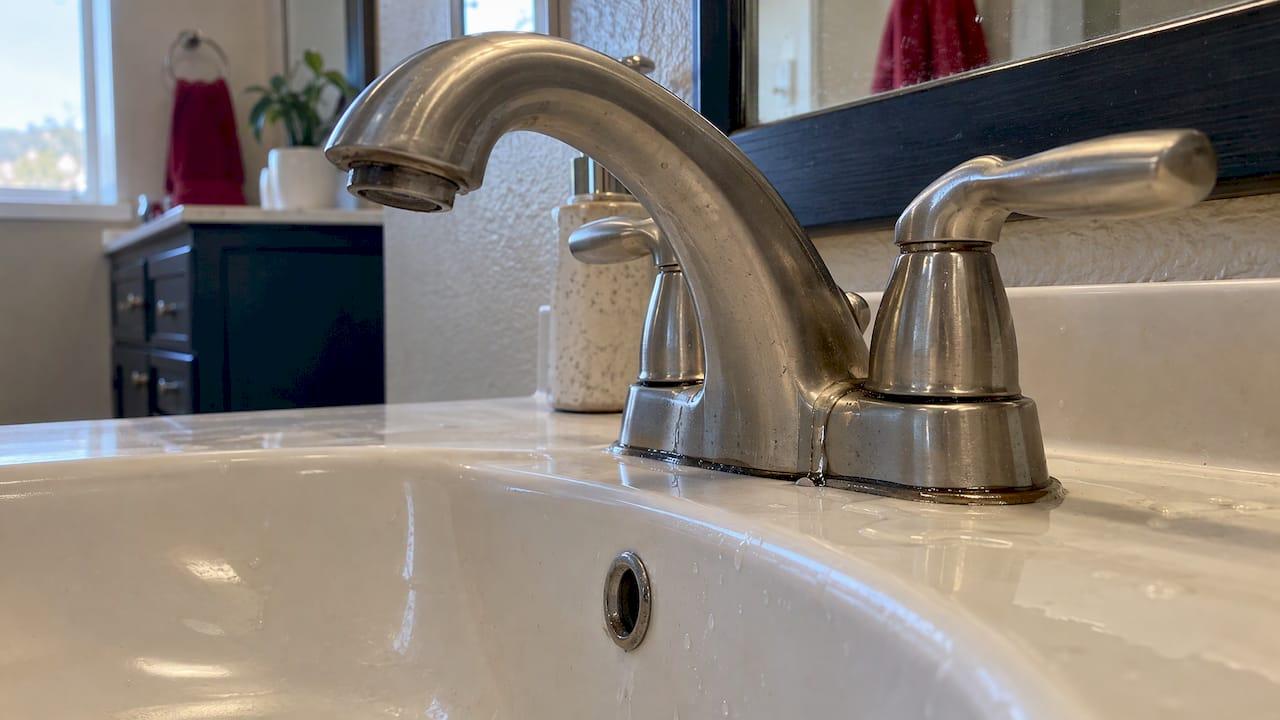
A faucet that leaks at the base is usually leaking from the inside. Worn O-rings, a tired valve seal or a worn cartridge let water escape past the faucet body when the water is running. Caulk or putty on the outside will not fix that. The fix is to confirm where the water really comes from, then replace the worn part. If you would rather not take your faucet apart, our licensed plumbers in Bullhead City, Fort Mohave, Mohave Valley and Laughlin handle faucet and fixture repair and replacement, and we are available 24/7 for emergencies.
TL;DR
- Dry the sink, run the faucet and watch the base. A leak that shows up only while the water runs points to worn O-rings, seals or a cartridge inside the faucet body.
- Rule out the handle first. Water running down from the handle can look exactly like a base leak.
- Kitchen and bathroom faucets are fixed differently. Pull-down kitchen faucets add a hose connection to check, and widespread bathroom faucets usually need new O-rings.
- Putty and sealant do not stop an internal leak. They only matter when the faucet is being set back down on the sink.
- Call a plumber for a cracked body, a seized cartridge, shutoff valves that will not close, or any sign of water damage in the cabinet.
Table of Contents
- Why a faucet leaks at the base
- Step 1: Confirm the leak is really at the base
- Step 2: Shut off the water and prepare the sink
- Step 3: Take the faucet apart
- Step 4: Replace the worn parts
- Step 5: Reassemble and test
- Does sealing the base help?
- When to call a plumber
- Residential and commercial properties
- Promo: faucet repair in Bullhead City and nearby
- Our perspective
- FAQ
- Sources
Why a faucet leaks at the base
The base of a faucet is where the faucet body meets the sink or countertop. Inside that body sit rubber O-rings, valve seals and, on most modern faucets, a cartridge that controls the flow. When water runs, it is under pressure. If any of those parts has dried out, cracked or collected grit, water can slip past it, run down the faucet body and come out at the bottom.
The manufacturers' own support pages agree on the usual suspects. American Standard says kitchen faucet base leaks are usually caused by O-rings, valve seals or the cartridge, and that corrosion can leave the valve seat uneven so it cannot seal properly. Kohler's support page adds that dirt and debris collected on seals, O-rings or bearings can stop them from making the faucet watertight.
A dried or cracked O-ring under the outer housing is the most common cause, according to The Spruce's faucet leak guide. A worn inner cartridge is the less common cause. That ordering helps you decide what to inspect first.

Temporary leak or continuous leak
How the leak behaves tells you a lot. Kohler describes a base leak as either temporary, meaning it happens while the faucet is running, or continuous, meaning it keeps going after you shut the faucet off.
| What you see | Likely cause | Usual fix |
|---|---|---|
| Water at the base only while the faucet runs | Worn or dirty seals, O-rings or bearings | Replace the O-rings and seals |
| Water at the base even when the faucet is off | Worn valve or cartridge, sometimes a check valve or spacer, depending on the model | Replace the cartridge or valve |
| Water under the sink at the connections | Loose underbody connections or spray hose fittings | Tighten the connections, then retest |
| Water running down from the handle onto the base plate | A handle leak, not a base leak | Treat it as a handle repair |
The reasoning is simple. With the water off, there is no pressure pushing against the rings, so a tired ring can still hold. Turn the water on and the pressure forces water past it.
Step 1: Confirm the leak is really at the base
Splashing makes base leaks hard to read. Water from the spout lands on the sink deck, runs to the faucet and looks like a leak. The Spruce suggests you dry any standing water, turn on the faucet and look for water seeping around the base. A real base leak shows up only when the faucet is on.
Then rule out the handle. Moen's support page says to wrap a paper towel around the handle and turn the faucet on. If the towel gets wet, the leak is coming from the handle and puddling onto the base plate, called the escutcheon. If the towel stays dry and water still appears at the base, you have a true base leak.

Where it goes wrong: people buy parts for the wrong leak. Handle leaks and base leaks involve different parts, and a guess can cost you a second trip to the hardware store and a second afternoon without a working faucet. When we look at a faucet, finding the true source is the first job, and it is part of our faucet repair and replacement service.
Step 2: Shut off the water and prepare the sink
Under the sink, find the two shutoff valves, usually called angle stops, one for hot and one for cold. Turn them clockwise until they stop. Open the faucet to release the pressure and confirm the flow has stopped. Plug the drain so small screws and parts cannot fall in.
The City of Portland Water Bureau lists the basic kit for a faucet leak repair: flat head and Phillips screwdrivers, an adjustable wrench, petroleum jelly, replacement O-rings or washers, Teflon tape, masking tape and a hand towel. Masking tape on the wrench jaws protects the finish on chrome parts.
Where it goes wrong: shutoff valves that will not turn, or that drip once closed. Forcing an old valve can break it and turn a small leak into a flood. If a valve will not close, stop there and call a plumber. If it happens after hours, our emergency plumbing service runs 24/7.
Step 3: Take the faucet apart
The disassembly depends on the faucet type.
- Single-handle faucets: pry off the decorative cap on the handle, remove the screw under it, lift the handle off, then remove the cap or housing to expose the cartridge or O-rings.
- Two-handle faucets: each handle comes off the same way, usually with a screw under a hot or cold cap, and the stem underneath holds the seals.
- Pull-down or pull-out kitchen faucets: before taking anything apart, check the spray wand and hose connection. Moen says to make sure the wand and hose connection is tight first. Pfister makes a similar point: on kitchen faucets, check that the underbody connections to the countertop are tight and secure, including the spray hose and diverter hose connections.
Lay the parts out in the order they came off, or take a photo at each stage. Faucet brands differ, and the order matters when you put it back.
Where it goes wrong: a seized cartridge. Mineral buildup can lock a cartridge in place. Pulling with pliers can crack the body. A seized cartridge is a job for a plumber with the right puller.
Step 4: Replace the worn parts
This is the step that fixes the leak, and it differs by faucet type.
Kitchen faucets
Moen's guidance by type:
- A single-handle faucet with a side spray needs new O-rings and a new diverter.
- A single-handle faucet without a side spray needs new O-rings.
- A two-handle faucet needs new O-rings.
Source: Moen's kitchen faucet page. For a continuous leak, Kohler's fix is to replace the valve or cartridge, and on some models the check valve or spacer.
Bathroom faucets
For single-handle and two-handle centerset bathroom faucets, Moen says to clean and rethread the aerator, and replace the cartridge if the leak continues. For two-handle mini-widespread and widespread faucets, it says to replace the faucet O-rings.
Getting the right part
Take the old O-ring or cartridge with you. Sizes look alike but are not interchangeable, and a ring that is slightly off will leak again within days. Danco, a plumbing parts maker, recommends identifying the source of the leak before ordering parts. Coat new O-rings lightly with petroleum jelly before seating them.
Where it goes wrong: matching the part by guesswork, replacing only the visible O-ring while the cartridge is the real culprit, or fitting a part meant for a different model. Our plumbers handle faucet and fixture repair and replacement, so the right part goes in on the first visit.
Step 5: Reassemble and test
Put everything back in reverse order. Remove the aerator, which is the small screen at the spout tip, so debris flushes out. Open the faucet, then slowly turn the shutoff valves back on. Natural Handyman advises that if a leak appears, shut the water off and tighten the connection only a quarter to a half turn, repeating until full pressure produces no leaks. Overtightening cracks fittings and crushes the new seals.
Then run the faucet for a few minutes, hot and cold, and dry the base with a towel. Check again after an hour and again the next morning. Look under the sink too, with a dry paper towel against the supply lines.
Does sealing the base help?
Sealing matters in one situation: when the faucet is set down on the sink. Plumber's putty makes a compressive seal under the base and lets the fixture come off later. But putty can stain porous stone such as granite and marble, and can damage some plastics, so silicone is the better choice there. Putty is not an adhesive and does not belong on threaded or pressurized joints.
What sealant cannot do is fix a leak coming from inside the faucet. Water that is forced past a worn O-ring or cartridge will find its way out around any bead you lay on the outside. Epoxy over a cracked body buys a few days at most. If the body is cracked, the faucet needs replacing. Our faucet replacement cost guide explains how to judge when a replacement makes more sense than another repair.
When to call a plumber
A base leak is a manageable repair for a handy homeowner. These are the signs that it has gone past that:
- The faucet body is cracked or corroded.
- The shutoff valves will not close or are leaking themselves.
- The cartridge will not budge.
- The faucet still leaks after you replaced the seals.
- The cabinet floor is soft, swollen, stained or smells musty.
The City of Portland puts it plainly: call a plumber if you have any concerns about how to make a repair. Water that has been getting into a cabinet for weeks can damage the cabinet, flooring and subfloor, and that costs far more than the faucet.
Water under the sink may not come from the faucet at all. Our guide to leaking under the sink shows how to tell supply lines, drain connections and the faucet apart. If the faucet is also slow, see low water pressure at one faucet. If you are replacing the faucet, our walkthrough on installing a bathroom faucet covers the basics.
Residential and commercial properties
A leaking faucet in a rental or a business matters beyond the drip. In a rental, water in a cabinet becomes a damage claim. In a restaurant, shop or office, a failing faucet in a kitchen or restroom can put a fixture out of service. We serve residential and commercial customers alike, so a property manager with several units can have faucet leaks handled by the same team that handles the rest of the building's plumbing.
Promo: faucet repair in Bullhead City and nearby
If the leak is beyond a quick fix, or you would rather have it done right the first time, we are ready. USA Plumbing and Septic LLC repairs and replaces faucets and fixtures for homes and businesses in Bullhead City, Fort Mohave, Mohave Valley and Laughlin. Our licensed plumbers are available 24/7 for emergencies, including a faucet leak that will not stop. Book a faucet repair with USA Plumbing and Septic.

We also work in Kingman, Lake Havasu City and Golden Valley, so you can find your area on our Kingman plumbing page or our Lake Havasu plumbing page.
Our perspective
A faucet leak at the base is a small problem that gets big when it is ignored. The water hides in the cabinet, and the repair that would have taken one visit turns into a cabinet and flooring job.
What we want every customer to know is that the leak you can see is the symptom. The cause is inside the faucet: a worn O-ring, a tired seal or a cartridge that has reached the end of its life. Our job is to find which one it is, fix that part, and make sure the shutoff valves and connections under the sink are sound too.
That is why we handle faucet and fixture repair and replacement for homes and businesses across Bullhead City and the surrounding area. We are a trusted partner for the quick repair and for the replacement when an older faucet is past saving, and we are here around the clock when a leak cannot wait.
JOHN
FAQ
Why is my kitchen faucet leaking at the base but not the spout?
The seals that hold water inside the faucet body have usually worn out, so water runs down the body and out at the base. On kitchen faucets with a pull-down or pull-out spray, a loose hose connection can do the same. Dry the sink, run the faucet and check the base and the connections under the sink.
How do you seal the base of a faucet?
Plumber's putty or silicone goes under the base when the faucet is set on the sink. Use silicone on stone countertops and plastic parts, because putty can stain or damage them. Sealing the outside will not stop a leak that comes from inside a worn faucet.
Do I need a plumber to fix a leaky faucet?
Not always, but call one if the body is cracked, the shutoff valves will not close, the cartridge is stuck or the faucet leaks after new seals. Call one as well if the cabinet shows water damage. We handle faucet repair and replacement across Bullhead City and nearby towns.
Why is my bathroom faucet leaking at the base?
On two-handle widespread bathroom faucets, worn O-rings are the usual cause. On single-handle and centerset models, a clogged aerator or a worn cartridge is more likely. Check that the water is not coming from the handle first.
Why does my faucet leak only when the water is on?
The parts are worn but still hold when there is no pressure. With the water running, pressure pushes water past them. That pattern points to worn O-rings or seals, which need replacing.
Sources
- Diagnosing Faucet Leaks, The Spruce
- Kitchen Faucet: Leaking Around The Base, Moen
- Bathroom Faucet: Leaking Around the Base of the Faucet, Moen
- Leaking at Base of Faucet Spout, Kohler Assist
- Kitchen faucet leaking at the base, American Standard
- I Have a Leak (kitchen), Pfister
- How to fix a faucet leak, Portland.gov
- Drip Tip: Fix Your Leak, Danco
- When to Use Plumber's Putty vs Silicone Sealant, Plumbing Guider
- How to Install a Faucet, Natural Handyman