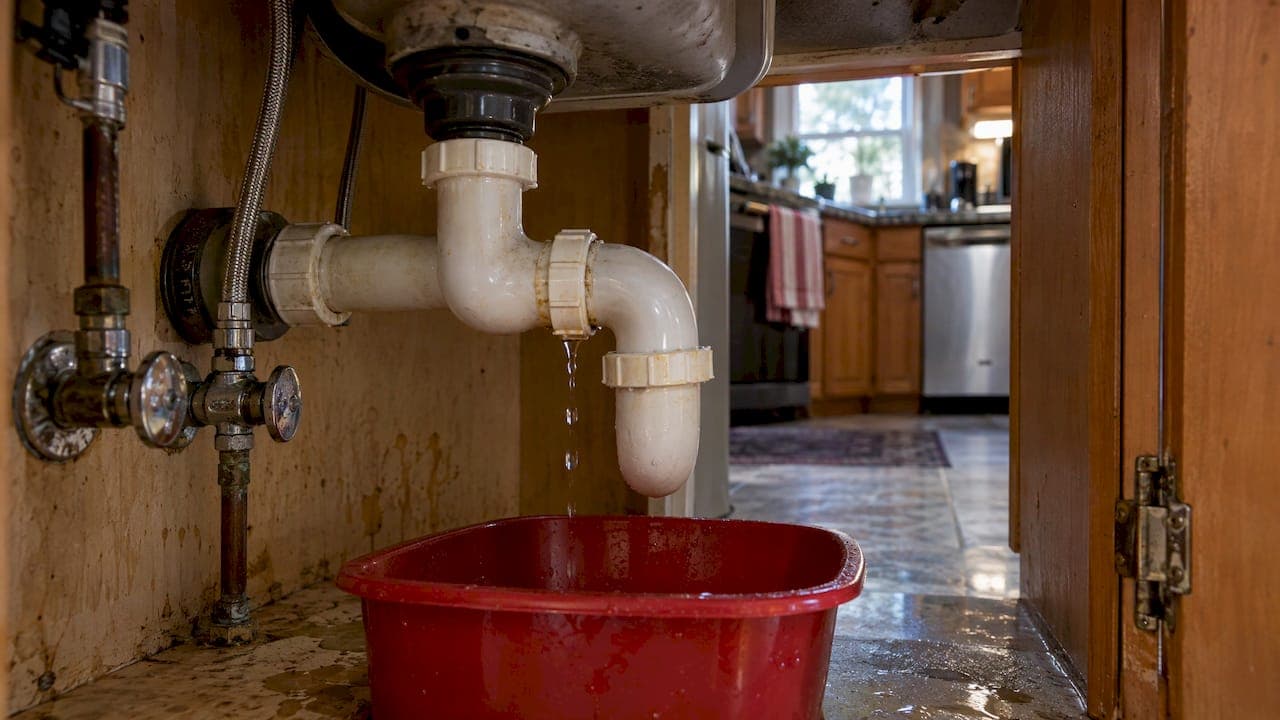
Water under the sink almost always comes from one of four places: a loose or worn drain joint, the P-trap, a supply line or shutoff valve, or the faucet itself. Close the shutoff valves under the sink, dry everything, then use a paper towel to find the exact wet spot. Tighten what is simply loose. Call a licensed plumber for anything corroded, cracked, or hiding behind the wall. If you are in Bullhead City, Fort Mohave, Mohave Valley or Laughlin, we answer emergency calls 24/7.
This guide walks you through the order we would work in: stop the water, find the source, understand the cause, protect the cabinet, and decide when it is time to hand it off.
TL;DR
- Shut the water off first: the under-sink shutoff valves, or the home's main valve if those will not close.
- Dry every pipe, then dab each joint with a dry tissue or paper towel. The first spot that gets wet is your leak.
- A loose slip nut on a drain or P-trap is a simple fix. Corroded pipe, a failed shutoff valve, or a leak in the wall is a plumber's job.
- A wet cabinet base should be dried fast. Swollen particleboard and mold can follow a slow leak.
- Sealant spray and tape are not a repair for a leaking pipe joint. Replace the failed part.
Table of Contents
- What to Do in the First Five Minutes
- How to Find Exactly Where the Leak Is Coming From
- What Causes a Pipe Under the Sink to Leak
- When the P-Trap Is the Problem
- Supply Lines and Shutoff Valves
- The Faucet Itself
- Your Cabinet Is Wet: Protect It Now
- Will Flex Seal or Tape Stop a Leaking Pipe?
- When to Stop and Call a Plumber
- Our Perspective
- Need a Plumber for the Leak? We Can Be There
- FAQ
- Sources
What to Do in the First Five Minutes
Do not start by hunting for the leak. Start by stopping the water.
- Close the shutoff valves under the sink. There is usually one for hot and one for cold. Turn them clockwise until they stop. This Old House's sink guide tells homeowners to close the under-sink shutoff valves, open the faucet briefly to relieve pressure, and put a bucket underneath before touching any plumbing.
- If the valves are stuck, leaking, or will not close, shut off the main. This Old House says that closing the home's main shutoff valve removes pressure and should stop the leak. Know where yours is before you need it. Most Bullhead City area homes have it near the water meter or where the line enters the house.
- Put a bucket or bowl under the leak and pull out everything stored in the cabinet.
- Mop up and dry the cabinet. Standing water is what ruins the cabinet base and starts mold.
- Take a photo of the wet area before you clean up fully. It helps if you later file an insurance claim or describe the problem to a plumber.
If water is spraying, soaking a ceiling below, or you cannot get any valve to close, call us right away. Our 24 hour plumbing emergency checklist covers what to do while you wait for help.
How to Find Exactly Where the Leak Is Coming From
Water runs. It follows a pipe, drips off the lowest point, and pools somewhere else. The drip you see at the bottom of the cabinet is often not where the leak starts. That is why a dry tissue beats your eyes.
Family Handyman recommends testing suspected supply leaks by dabbing each shutoff and connection with a dry tissue or paper towel, because small leaks can be hard to feel. For drains, the same source suggests filling the sink bowls and checking the drain joints with a dry tissue as the water runs out. It also suggests running the dishwasher if it shares the cabinet's plumbing.
Here is the order we use:
- Dry everything. Wipe every pipe, valve, and fitting with a towel.
- Check the supply side first (water under pressure). Open the shutoff valves again and wipe each connection with a dry paper towel: the valve stem, the valve outlet, the nut at each end of the braided hose, and the faucet connections above. Pressurized leaks tend to show up fast.
- Then check the drain side (water only when you use the sink). Plug the sink, fill it, and release the water while you hold a dry tissue under each joint, from the basket strainer down through the trap to the wall.
- Run the dishwasher and garbage disposal if you have them. Their hoses connect into the same area.
- Look up. Check the underside of the sink and faucet base for drips running down from above.
The U.S. EPA's WaterSense leak checklist tells homeowners to check beneath bathroom and kitchen sinks for pooling water under pipes or pipe connections and for rust around joints and edges. This Old House adds that you should run a finger beneath drain connections and look for discoloration or bubbling around fittings.
A Quick Guide to What You Find
| Where the water shows up | When it leaks | Likely cause | Who fixes it |
|---|---|---|---|
| Drips from a nut on the U-shaped pipe (P-trap) | When the sink drains | Loose or worn slip nut or washer | You, if it is just loose |
| Water at the top of the trap, under the sink basket | When the sink drains | Failed strainer seal | You or a plumber |
| Wet braided hose or a drip at the hose nut | All the time | Worn hose or loose connection | You (replace the hose) or a plumber |
| Water at the shutoff valve stem or body | All the time | Worn packing or failed valve | Plumber if the valve is old or stuck |
| Drip from the faucet base into the cabinet | When the faucet runs | Worn faucet seals or cartridge | Plumber or faucet replacement |
| Pinhole spray or green crust on a metal pipe | All the time | Corrosion | Plumber |
| Wet only after the dishwasher runs | During the cycle | Hose or drain connection | Plumber |
What Causes a Pipe Under the Sink to Leak
Understanding the cause tells you whether tightening will hold or whether you are looking at a part that has reached the end of its life.
Loose or worn connections. Slip nuts and compression fittings loosen with vibration and use. Washers dry out and flatten. This is the most common and cheapest cause.

Corrosion. Penn State Extension explains that corrosive water can dissolve metal plumbing components, causing pinhole leaks and bluish-green staining. If you see green or blue crust on copper, or tiny weeping holes, a tightened nut will not solve it. We cover this in detail in our guide on pinhole leaks in copper pipes, including when repair makes sense and when repiping is the better call.
Water pressure. This Old House lists excessive water pressure among the common reasons pipes and fittings leak. If you hear banging when a valve closes, that is a related symptom, and our article on fixing water hammer explains the common fixes.
Freeze and thaw. Utah State University Extension says that freezing water expands and can crack or split waterlines, and the thaw can release substantial water. That explains a leak that seems to appear out of nowhere after a cold night warms up. Freezing is less common in Bullhead City than in northern Arizona, but sinks on exterior walls, in garages, and in unheated spaces can still be exposed.
Over-tightening. More force is not better. This Old House says supply-line connections should be hand-tightened and then given only about a quarter turn with pliers, and that over-tightening can damage fittings. A cracked plastic nut or a crushed washer leaks worse than a slightly loose one.
When the P-Trap Is the Problem
The P-trap is the curved section of drain pipe under the sink. This Old House describes it as installed between the sink strainer and the wall drain. It holds a small plug of water that blocks sewer gas from coming up the drain, so it needs to be watertight and in place.
The usual causes of a leaking trap:
- A slip nut that has worked loose. Snug it by hand. A quarter turn more is plenty.
- A misaligned trap. If the pipe sits at a strain or angle, the joint will not seal. Loosen both nuts, line the trap up, and retighten.
- A flattened or missing washer. Take the joint apart and check that the washer is seated the right way.
- A cracked trap or nut. Plastic gets brittle with age and with harsh drain chemicals. Replace the part.
- Wear from a past clog. A trap that has been taken apart many times may no longer seal well.
Place a bucket under the trap before loosening anything. Once the repair is done, This Old House advises that you reopen the shutoffs slowly and inspect every connection while water runs. Watch for at least a few minutes and feel each joint with a dry tissue again.
If the trap keeps dripping after you reseat it, or if the drain is also slow or gurgling, the problem may be further down the line. A repeat clog can be behind it, and that is where professional drain cleaning helps.
Supply Lines and Shutoff Valves
The braided hoses that connect the shutoff valve to the faucet are common failure points. They live under constant pressure, so they leak whenever the valve is open. If you find a wet crimp or a bulging, rusty hose, replacing the hose is the correct fix. Tightening a damaged hose only delays the next failure.

The shutoff valve is a bigger decision. Family Handyman advises replacing failed under-sink shutoffs with quarter-turn ball valves, shutting off the main supply before you start, and hiring a plumber when the installation involves older galvanized pipe. That last point matters. Old galvanized pipe can snap or crumble when you turn a valve on it, and a small repair becomes a flooded kitchen.
If a pipe itself is leaking, the repair is a step up. This Old House describes a compression repair as shutting off and draining the pipe, cutting out the damaged section, installing a coupling with ferrules, and tightening with two wrenches, and treats it as more advanced than a simple trap adjustment. Without the right tools and some experience, this is where most homeowners should call us.
The Faucet Itself
If the water appears only when the faucet runs and traces back to the base or handle, the cause is inside the faucet: worn O-rings, washers, a valve seat, or a cartridge. Replacing worn parts can work on a newer faucet. On an older or heavily scaled faucet, replacement is often the cleaner, longer-lasting answer. We repair and replace faucets and fixtures for homes and businesses throughout the area, and we can tell you quickly which route makes sense for yours.
Hard water is a real factor in our region. Mineral buildup wears seals and clogs fixtures. A water softening and filtration system can help protect faucets, valves, and water heaters from scale.
Your Cabinet Is Wet: Protect It Now
The leak is only half the problem. A wet cabinet can become a mold and rot problem within days if you leave it.
The EPA notes that mold can grow with little water and lists areas around sinks and slow plumbing leaks among the common indoor mold locations. Dry the cabinet quickly.
- Remove everything and throw out anything soaked, especially cardboard boxes and sponges.
- Dry the cabinet floor and walls with towels, then a fan pointed into the cabinet. Leave the doors open.
- Check for swelling. Family Handyman reports that sink-base particleboard floors commonly swell and grow mold after leaks, and once swollen, the damaged section may need replacement.
- Look for a musty smell, dark spots, or soft wood. These mean the water has been there a while.
- Do not close the cabinet over damp wood. Keep it open and ventilated until it is fully dry.
If the water has gone into the wall, under the flooring, or you see widespread mold, stop. That is a job for a plumber to find the source and a restoration professional to dry it out. If you are unsure whether your homeowner's policy covers the damage, call your insurance company before repairs and keep your photos and receipts.
Will Flex Seal or Tape Stop a Leaking Pipe?
This is one of the most common questions we hear. Our answer: treat sprays, wraps, and putties as a short-term way to slow a drip, never as a repair. Under a sink, the leaking joint moves, gets wet constantly, and sits under pressure on the supply side. Coatings tend to struggle in exactly those conditions. The real fix is almost always cheap: a new washer, a new nut, a new hose, a new trap, or a new valve.
If you need to buy time on a pipe you cannot shut off, our guide on fixing a burst pipe temporarily at home lays out emergency steps. Then book the proper repair.
When to Stop and Call a Plumber
The EPA identifies a loose pipe connection as an example of a potentially simple fix, while advising homeowners to consult a licensed plumber for a malfunctioning water supply line. That is a good line to draw.
Call a licensed plumber when:
- The shutoff valves will not close or leak when you turn them.
- You see corrosion, green crust, or pinholes on a pipe.
- The pipe is old galvanized steel or you are not sure what it is.
- The leak returns after you tightened or replaced a part.
- You cannot find the source. A hidden leak in the wall or slab keeps costing you.
- Your water bill climbs with no change in use. Our explainer on how leak detection works shows what a professional can find without tearing out walls.
- Water is coming from more than one place, or from the floor, ceiling, or wall.
- The leak is on a line outside the house. The San Francisco Public Utilities Commission states that repairs to an underground water service line should be made only by licensed professionals. Our guide to underground water leak repair explains what that involves.
If you smell gas anywhere near the sink or the water heater, leave the house and call your gas utility or 911 from outside. Do not turn on lights or appliances. For repairs afterward, see who fixes gas leaks and how to vet them.
Our Perspective
A leak under the sink is the plumbing call we get most. Most of the time it is a small thing: a worn washer, a loose nut, an old hose. Homeowners can handle some of that, and we are glad when they shut the water off and take good photos first.
What we see too often is the second visit. A leak gets patched with a coating or over-tightened, the cabinet stays damp, and a month later the fix has failed and the base is swollen. A part that is already worn is cheaper to replace once than to nurse along.
Our plumbers are licensed and trained to find the real source, not just the wet spot. We check the whole sink: drain, trap, supply lines, shutoff valves, and faucet. If the cause is the water itself, such as scale or corrosion, we say so and talk through options, including water softening and filtration. If the cause is deeper in the system, such as a drain line or a leak in the wall, we handle that too, or tell you how to get it done.
We serve Bullhead City, Fort Mohave, Mohave Valley and Laughlin, for homes and commercial properties. Property managers and landlords especially benefit from fixing small leaks fast, before a tenant's cabinet or the unit below pays the price. We are here 24/7 because water does not wait for business hours.
JOHN
Need a Plumber for the Leak? We Can Be There
USA Plumbing and Septic LLC repairs and replaces faucets, fixtures and toilets, clears drains, fixes water lines and sewer lines, and handles emergency calls around the clock for homeowners, landlords and commercial property managers in Bullhead City, Fort Mohave, Mohave Valley and Laughlin. If your sink is leaking and you want it fixed right the first time, call or book through our site.

Book Now, or Call Now for emergency service. Tell us what you found under the sink: where the water is, when it leaks, and whether the shutoff valves close. That helps our plumber arrive with the right parts.
FAQ
What should I do if my sink is leaking right now?
Close the shutoff valves under the sink, or the main valve if those will not close. Put a bucket under the leak, empty the cabinet, and dry it. Then use a dry paper towel to find which joint is wet. If you cannot stop the water or find the source, call a plumber.
Does homeowner's insurance cover a leak under the sink?
That depends on your policy and on how the damage happened. Policies often treat sudden water damage differently from a long-term, slow leak. Call your insurer before repairs, take photos of the damage, and keep the plumber's invoice. Your policy language is the only reliable answer.
Will Flex Seal stop a leaking pipe under a sink?
It may slow a drip for a short time, but a coating is not a repair for a joint that moves and sits wet or under pressure. The dependable fix is replacing the failed part: a washer, a nut, a hose, a trap, or a valve. If you cannot do that safely, book a plumber.
Why is my bathroom faucet leaking even when it is off?
A faucet that drips or leaks when it is off usually has worn internal parts, such as O-rings, washers, a valve seat, or a cartridge, or a connection beneath it that has loosened. If the water shows up in the cabinet, check the supply connections with a dry tissue first. If the faucet is old, replacement is often the better long-term answer.
Why is my P-trap leaking after I tightened it?
The washer may be flattened or seated wrong, the trap may be misaligned, or the plastic nut or pipe may be cracked. Take the joint apart, check the washer and threads, line up the pipes, and retighten by hand plus about a quarter turn. If it still leaks, replace the trap or have a plumber check the drain.
Sources
- Easy DIY Plumbing Repairs for Common Household Issues, This Old House
- How To Install a New Sink and Faucet, This Old House
- How To Find and Repair Hidden Plumbing Leaks, Family Handyman
- How to Replace a Shutoff Valve, Family Handyman
- Replace Cabinet Floor Under Sink, Family Handyman
- Detect and Chase Down Leaks Checklist, U.S. EPA WaterSense
- Mold Course Chapter 1, U.S. EPA
- Corrosive Water Problems, Penn State Extension
- Advice to Prevent Frozen Pipes, Utah State University Extension
- Leak Guide: Finding and Fixing Leaks at Home, San Francisco Public Utilities Commission