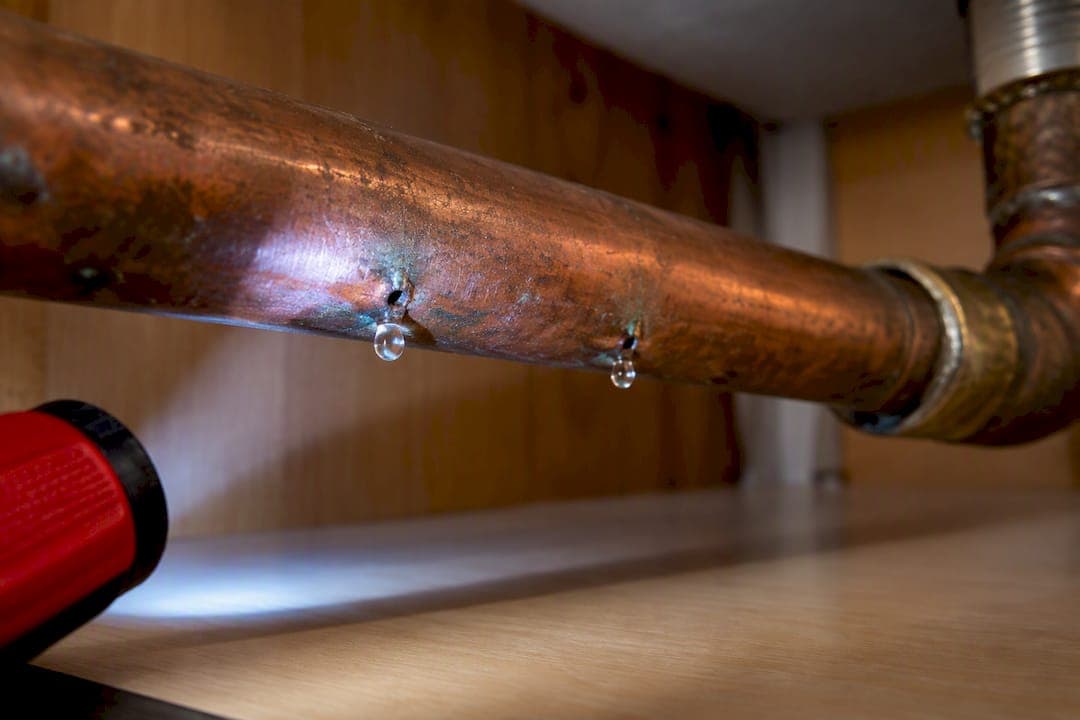
A pinhole leak is a tiny perforation caused by internal pitting corrosion eating through the copper wall from the inside out. Even a hole smaller than a grain of rice can spray pressurized water and soak drywall, insulation, and framing before anyone notices. If you spot one, shut off the branch line or main water supply immediately, then use temporary containment only until a licensed plumber can make a permanent repair.
TL;DR:
- Pinhole leaks are caused by localized corrosion driven by water chemistry, often worsening in homes with acidic or chloramine-treated water.
- Signs include green stains, damp patches, musty odors, and a water meter that continues to spin when all fixtures are off.
- Temporary repairs involve shutting off water, drying the pipe, and sealing the hole with epoxy or a repair clamp; permanent solutions require replacing the damaged pipe section.
- Repair costs vary from $150 to $900 for initial fixes, but systemic corrosion often warrants full repiping, which can cost up to $15,000.
- Addressing underlying water chemistry issues and electrical grounding can prevent future pinholes and extend pipe lifespan.
Table of Contents
- What Causes Pinhole Leaks in Copper Pipes
- How to Spot a Pinhole Leak Before It Spreads
- Emergency and Temporary Fixes for a Copper Pinhole Leak
- Permanent Repair Options and the Repair vs. Repipe Decision
- Reducing Future Risk: Water Treatment and Plumbing Practices
- When to Call a Licensed Plumber
- The Real Math Behind Repair vs. Repipe
- How USA Plumbing and Septic LLC Can Help
- Sources
- FAQ
What Causes Pinhole Leaks in Copper Pipes
Pinhole leaks come from pitting corrosion, not the slow, even wear you'd expect from normal aging. Uniform corrosion thins a pipe evenly over decades. Pitting attacks one small spot with intense, localized aggression, and it can punch through a wall in a fraction of that time.
Water chemistry drives most cases. Low pH, high chloride content, and dissolved oxygen accelerate the reaction, and plumbers often reference the Langelier Saturation Index to judge whether water is corrosive or scale-forming. Municipal shifts from chlorine to chloramine disinfection have also been linked to higher pinhole rates in some communities, since the chemistry change can trigger new pitting activity in pipes that had been stable for years.
Installation quality matters just as much. A municipal utilities report lists leftover soldering flux, poor workmanship, erosion from turbulent flow, and concentration-cell corrosion behind mineral deposits as recurring culprits. Thin-wall Type M copper is more vulnerable than heavier-wall Type L.
A few other drivers worth flagging:
- Galvanic corrosion, where dissimilar metals in contact create a small battery effect
- Stray electrical current, sometimes introduced when plumbing gets accidentally bonded during electrical or renovation work
- High water velocity and repeated thermal cycling, which erode protective mineral coatings inside the pipe
Pro Tip: If you've had more than one pinhole leak in the past year, ask your water utility for a recent water quality report before you spend another dollar on spot repairs.
How to Spot a Pinhole Leak Before It Spreads
Most pinhole leaks announce themselves quietly. You're looking for a slow seep more often than a dramatic spray, and the classic locations are cold-water lines, pipes hidden under slabs, and runs buried behind drywall.
Watch for these signals:
- Green or blue-green stains (verdigris) on or near copper fittings
- Damp patches on walls, ceilings, or flooring that reappear after drying
- Musty odors or unexplained mold growth in a wall cavity
- A water bill that jumps with no change in usage
- A water meter that keeps spinning after every fixture in the house is off
That last check is the easiest DIY test: shut off every faucet and appliance, then watch the meter. If it still moves, water is going somewhere it shouldn't. Walking exposed pipe runs in the basement or utility room with a flashlight, checking for the telltale green crust, takes five minutes and often catches a problem early.
Emergency and Temporary Fixes for a Copper Pinhole Leak
A temporary fix buys you time. It does not solve the corrosion causing the leak, and it can fail without warning, so treat every one of these as a stopgap, not a solution.
- Shut off the water. Close the isolation valve for that branch, or the main if there's no local shutoff, and drain the line before touching it.
- Dry the pipe completely. Epoxy putty and rubber patches will not bond to a wet or actively leaking surface.
- Apply epoxy putty. Knead it, press it firmly around the hole, and let it cure fully per the product instructions before restoring pressure.
- Use a repair clamp instead. Choose one sized to the pipe diameter, center the rubber gasket directly over the hole, and tighten the bolts evenly so the seal doesn't shift.
- In a pinch, wrap a section of rubber (an old bicycle tube works) over the hole and secure it with hose clamps as a short-term seal until parts or a plumber arrive.
Never apply heat or attempt to solder over an active leak. Trapped moisture can flash to steam, and a pinhole often signals thinner, weaker copper nearby that won't tolerate the heat anyway.
Permanent Repair Options and the Repair vs. Repipe Decision
Professionals fix pinhole leaks one of three ways: cutting out the damaged section and sweat-soldering in new copper, using a push-fit or press-fit coupling for a faster no-flame repair, or replacing the run entirely with PEX. Epoxy pipe lining exists as a partial remediation for some situations, but it demands a clean, dry pipe interior and skilled application, and many plumbers still favor cut-and-replace or PEX substitution for anything meant to last.

Access changes everything about cost and timeline. Repairs on exposed pipe typically run $150 to $400, while cutting into drywall pushes that to $400 to $900. A full repipe, depending on home size and material, generally falls between $2,000 and $15,000.
Here's the decision framework worth remembering:
- One isolated pinhole in otherwise healthy piping: a spot repair is usually reasonable.
- Two or more pinholes appearing within months of each other, especially on separate runs: treat it as systemic corrosion, not bad luck.
- Older homes with Type M copper, or a history of aggressive water chemistry: repiping earlier often saves money over years of emergency calls.
Fixing the leak without addressing the underlying water chemistry or an electrical grounding problem just guarantees the next pinhole is already forming somewhere else in the system.
Reducing Future Risk: Water Treatment and Plumbing Practices
Stopping the next leak means addressing what caused this one. A water chemistry test checking pH, chloride, chloramine levels, and the Langelier Saturation Index gives you and your plumber an actual target instead of a guess.
Practical steps that make a real difference:
- Install a neutralizing filter or a sacrificial anode system if testing shows acidic or aggressive water
- Understand that water softeners and reverse osmosis units can change water chemistry too, sometimes making it more corrosive to copper
- Use dielectric unions anywhere copper connects to a dissimilar metal
- Install a pressure-reducing valve (PRV) if incoming pressure runs high, since excess velocity erodes copper's protective interior coating
- Have an electrician check for stray current or improper bonding, especially after any renovation work
Pro Tip: If you're replacing a run of pipe anyway, ask about PEX. It resists pitting corrosion entirely, though it isn't rated for outdoor UV exposure or extremely high water temperatures the way copper is.
When to Call a Licensed Plumber
Call a professional the moment a leak is inaccessible, when you find more than one pinhole, when the leak is under a slab, or when you already see structural dampness or mold. These situations need diagnostic tools you don't have at home.
A qualified plumber typically runs:
- Acoustic or thermal detection to pinpoint hidden leaks inside walls or under slabs
- Water chemistry testing to check pH, chloride, and chloramine levels
- Ultrasonic wall-thickness testing to see how much copper is left before recommending repair or repipe
- A pressure test after any repair to confirm the fix holds
Expect a written estimate and a clear repair-versus-repipe recommendation, along with guidance on permits or inspections where local code requires them. A licensed plumber can provide diagnostic and repair service for these situations in the local area.
The Real Math Behind Repair vs. Repipe
It's a warning that recurring repair bills are usually a symptom of untreated water chemistry or an ungrounded electrical fault, not bad luck. Ignoring that pattern doesn't just cost you in plumber visits. It raises insurance risk and can quietly erode a home's resale value once buyers see a leak history.
— JOHN
How USA Plumbing and Septic LLC Can Help
If you're staring at a green-crusted fitting or a mystery damp spot right now, you don't need to diagnose it alone. Plumbing professionals offer emergency pinhole repairs, acoustic leak detection, full repiping, and water treatment installations for homeowners in the local region, with 24/7 availability when a leak can't wait for business hours.

A licensed plumber typically diagnoses the actual cause, not just the symptom, and provides a transparent estimate before any work starts, so you know upfront whether you're looking at a repair or a repipe. That's the difference between patching the same wall twice and fixing it once. Schedule a diagnostic visit today and get a straight answer about what your copper pipes actually need.
Sources
- The Mystery behind pinhole leaks in Copper Piping (Indian River County utilities PDF)
- EPA project summary on impact of water chemistry on localized corrosion of copper pitting
- Plumbingpriceguide
FAQ
How Can I Fix a Pinhole Leak in My Copper Pipes?
Shut off the water, dry the pipe, and apply an epoxy putty or repair clamp as a temporary seal. For a permanent fix, a licensed plumber will cut out and replace the damaged section with new copper, a push-fit coupling, or PEX.
How Common Are Pinhole Leaks in Copper Pipes?
Pinhole leaks are common enough that most water utilities publish guidance on them, and they cluster in homes with aggressive water chemistry, older Type M copper, or municipal chloramine disinfection. A municipal utilities report lists flux residue, erosion, and stray current among the recurring causes.
How Can I Temporarily Fix a Pinhole Leak in a Copper Pipe?
After shutting off and draining the line, dry the pipe surface completely and apply epoxy putty or a properly sized repair clamp directly over the hole. These fixes only hold on a clean, dry surface and are meant to last days, not years, until a plumber completes a permanent repair.
How Much Does It Cost to Fix a Pinhole Leak?
An accessible pinhole repair typically runs $150 to $400, while a leak behind drywall usually costs $400 to $900 due to the extra access work. If multiple pinholes point to systemic corrosion, a full repipe generally falls between $2,000 and $15,000 depending on home size and materials.