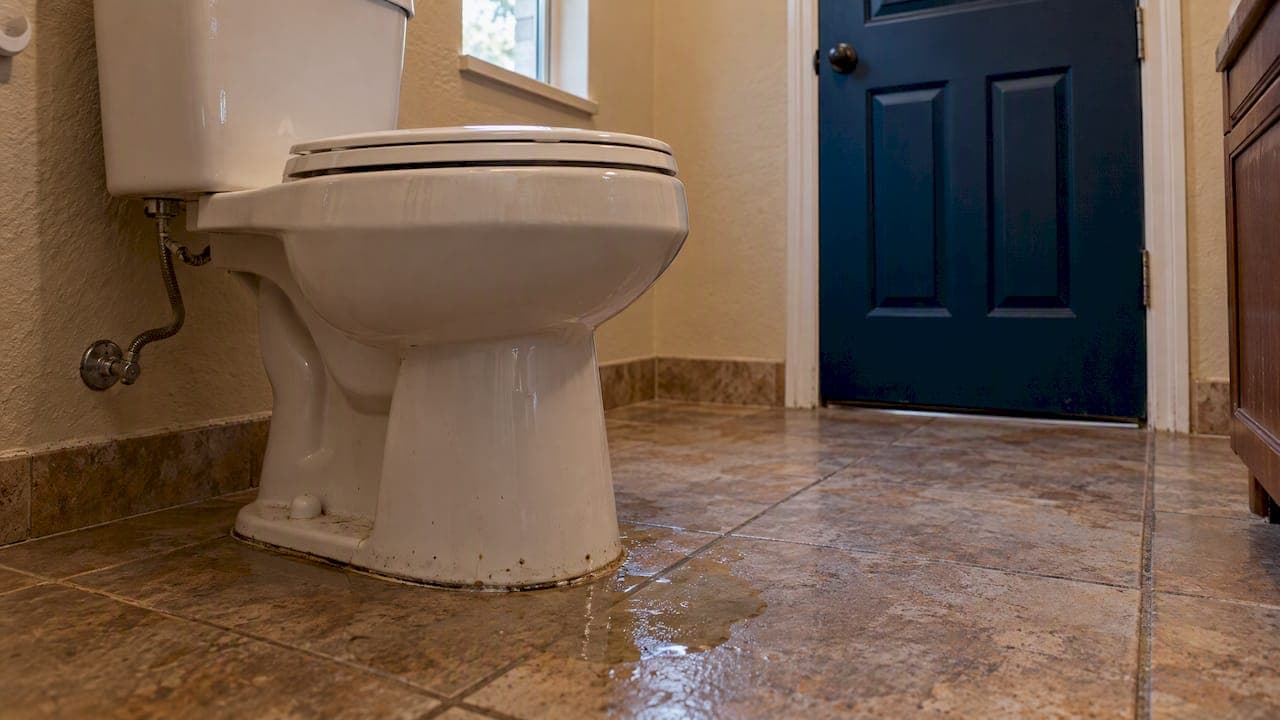
Water around the bottom of your toilet most often means the wax ring has failed. That is the seal between the toilet and the drain flange in the floor. Other causes are a loose bolt, a damaged flange, a cracked bowl, or water that dripped down from a connection higher up. Some of these are a small job. Others mean the toilet has to come off the floor. Here is how to tell which one you have, what to do in the next ten minutes, and when to hand it to a licensed plumber.
TL;DR
- Dry the floor and toilet, then watch for new water. That tells you whether the leak is at the base or higher up.
- A failed wax ring is the usual cause. The fix is to pull the toilet, replace the ring and reset the bowl level.
- A hairline crack in the porcelain means a new toilet, not a repair.
- Do not caulk around the base to hide the leak. It traps water under the toilet.
- Soft floor, ceiling stains below, or a home with only one toilet: call a plumber the same day.
Table of Contents
- First, make sure the water is really coming from the base
- What causes a toilet to leak at the base
- What to do right now
- How the repair works for each cause
- Why a base leak should not wait
- When to stop and call a plumber
- Need the toilet fixed this week?
- FAQ
- Sources
First, make sure the water is really coming from the base
Water on the floor does not always come from under the toilet. Condensation, a loose supply connection and a leaking tank can all end up as a puddle at the base. If you guess wrong, you can pull a toilet and replace a perfectly good seal.
The method This Old House describes is simple. Dry the floor and the toilet completely, then wait for a new puddle and see where it starts. Their plumbing expert, Richard Trethewey, recommends the same approach: dry everything, use a flashlight, and watch after several flushes, because water can run down from a higher connection and only show up at the floor.
Use this location guide to narrow it down:
| Where the water appears | Likely source |
|---|---|
| At the supply line, supply nut or fill valve nut | A connection leak, not the base |
| Between the tank and the bowl | Tank bolts or the tank-to-bowl gasket |
| Beaded on the outside of the tank or bowl, no drip point | Condensation |
| Seeping from under the bowl, only after flushing | Wax ring, flange or bolts |
| Seeping from under the bowl all the time | Cracked bowl or a badly failed seal |
The location breakdown comes from American Standard's guidance: a supply line or nut points to a connection leak, water between tank and bowl points to tank hardware or the gasket, and an intact base with no visible crack points to the wax ring.
The food coloring test
If you suspect the wax seal, put a few drops of food coloring in the bowl, flush once and look for colored water at the base. This Old House notes that this can confirm a failed wax seal. Clear water from a supply tube or the tank will not show color, which is exactly why the test is useful.
Check for condensation
In a hot climate like ours, a cold tank in a warm bathroom can sweat. Condensation shows up as even moisture on the outside of the tank and bowl, with no single drip point. If the floor stays dry after you wipe everything and wait, condensation is the likely answer. Willowbrook Water and Sanitation District lists condensation alongside a failed wax ring, a cracked bowl and leaking connections under the tank as common reasons for water on a bathroom floor.
What causes a toilet to leak at the base
Once you have confirmed the water is coming from under the bowl, these are the usual suspects.
A failed wax ring
The wax ring sits between the toilet outlet and the drain flange. It keeps water and sewer gas inside the pipe. It can loosen, crack or degrade over time, and a drain stoppage can force water past it, according to This Old House. Plumbing forum veterans often point to the same pattern: a seal that was never seated correctly, or one blown out by a major backup.
A rocking toilet
A toilet that moves when you sit on it keeps working against its own seal. Family Handyman explains that a rocking toilet can push the wax seal out of alignment. An unstable or poorly leveled installation stresses the seal again and again. If your toilet wobbles, the ring may be the symptom and the movement the cause.
Loose or damaged closet bolts
The two bolts at the base hold the toilet to the floor. If they loosen, the toilet shifts and the seal breaks. Tightening them can stop a leak, but go slowly. This Old House advises tightening them alternately, a little at a time, because overtightening can crack the porcelain.
A damaged or low flange
The flange is the ring on top of the drain pipe that the toilet bolts to. American Standard lists an unlevel floor flange, an improperly sealed wax ring and a hairline fracture in the bowl as causes of leaks around the base. Family Handyman adds that broken flanges and flanges set too low are common causes near the seal. This often shows up after a floor has been retiled, which raises the floor and leaves the flange sitting below it.

A cracked bowl or tank
A hairline crack in the ceramic cannot be patched. It also can look like a base leak when it is really a leak from the bowl itself. A cracked tank can drip down the outside and pool at the floor.
Leaks from higher up
A worn supply line, a bad shutoff valve or loose tank bolts can all send water down to the floor. Lowe's suggests replacing a supply line that is damaged or more than five years old. This Old House lists example part prices of about $6 for a braided supply line or a shutoff valve, so this is the cheap end of the problem when it applies.
What to do right now
Do these in order. They take about ten minutes and limit the damage while you decide on a fix.
- Stop the water. Turn the shutoff valve on the wall or floor behind the toilet clockwise. Flush once to empty the tank.
- Protect yourself. Treat water from a failed wax seal as unsanitary. This Old House recommends wearing gloves if possible, soaking up the water, drying the floor and toilet, disinfecting the area and washing wet towels on a hot setting.
- Dry everything. A dry floor is the only way to see where new water starts.
- Stop using the toilet. Every flush pushes more water past a bad seal and into the floor.
- Look below. If the toilet is on an upper floor, check the ceiling underneath. Lowe's notes that water stains on a ceiling below can point to the same problem. Our guide on whether to call a plumber or a roofer for a ceiling leak helps you sort out the source.
If water is spreading fast or you cannot shut it off, our 24 hour plumbing emergency checklist walks through the first steps.
How the repair works for each cause
The right fix depends on what failed. Here is what each one involves.
Wax ring replacement
If the wax ring did not seal, the toilet comes off, the old wax is scraped away and a new ring goes in. American Standard's instructions call for setting the bowl level with even pressure. Pressing down on one side is how many seals fail the second time. Always inspect the flange while the toilet is off.
Flange repair
A damaged flange has to be repaired or replaced before the toilet goes back on. Family Handyman recommends a reinforcement ring for a broken flange and a flange extender when the flange sits more than 1/4 inch below the finished floor. A new wax ring and a stable, non-rocking toilet complete the job.
Bolt adjustment
If the only problem is a loose toilet, snugging the bolts gently may be enough. Stop as soon as the toilet no longer rocks. If the leak returns, the seal has failed and the toilet needs to come up.
Cracked porcelain
A crack means replacement. American Standard says a hairline fracture requires toilet replacement, and Lowe's says a cracked tank may need a new tank or the whole toilet.
Why caulk is not a fix
It is tempting to run a bead of caulk around the base and call it done. Don't. This Old House warns that caulking can mask an active leak and trap water under the toilet, which leads to hidden subfloor or joist damage. The leak keeps going, and you just stop seeing it.
Why a base leak should not wait

A slow seep seems harmless. It isn't. Water under the toilet soaks the subfloor, and a soft or stained floor is a sign it has been going on a while. Lowe's frames it as damage prevention: stopping water early limits harm to flooring and the subfloor. A smell near the toilet can mean sewer gas is escaping through the seal as well.
A toilet that leaks every time it flushes also tends to be one that someone has already tried to fix with more bolt tightening. If that is where you are, the seal is done. If your toilet also runs on its own, our piece on ghost flushing explains why that wastes water too. If it overflows or gurgles, see our guides on why toilets overflow and toilet gurgling. A partial clog downstream can be the reason the seal let go in the first place.
Our view: a base leak is a sealing and floor problem
Most calls we get about water at the base of a toilet start the same way. The homeowner has already tightened the bolts, added caulk, or both. The water is still there, and now the floor is damp.
We treat the base leak as two jobs. The first is the seal: a new wax ring set on a flange that is solid, level with the floor and in good shape. The second is everything around it: the subfloor, the supply line, the shutoff valve and the drain line. If the toilet is coming up anyway, that is the cheapest time to check them.
We would rather find a soft spot in the floor on day one than have you find it in a year. Our licensed plumbers carry the parts for toilet repair and replacement on the truck, and we answer emergency calls around the clock across Bullhead City, Fort Mohave, Mohave Valley and Laughlin.
JOHN
When to stop and call a plumber
Plenty of handy homeowners can swap a wax ring. Some situations are better handled by a pro. Family Handyman says to call a plumber if the pipe is cracked, if the toilet is your home's only one and needs fast repair, or if the subfloor or joists are rotten and need carpentry.
In practice, call when:
- The floor around the toilet feels soft, spongy or looks dark and stained.
- There is a stain on the ceiling below the bathroom.
- The flange is cracked, corroded or well below the floor, and you are not set up to repair it.
- The leak came back after a new wax ring.
- Water is backing up in the toilet, tub or sink as well. That points to the drain line, not just the seal.
- You are a landlord or property manager and the unit needs the toilet back in service quickly.
- The toilet is cracked and needs to be replaced.
A plumber also checks what you cannot see: whether the drain line is moving water properly, whether the shutoff valve holds, and how far the water has traveled. If the leak seems to come from the pipe under the slab or yard rather than the toilet, our guide on underground water leaks covers that next step.
Need the toilet fixed this week?
We repair and replace toilets for homes and businesses in Bullhead City, Fort Mohave, Mohave Valley and Laughlin, and we take emergency calls 24/7. Our licensed plumbers find the true source, replace the seal or flange, and reset the toilet level. We also handle supply lines, shutoff valves and drain problems in the same visit. Call now or book a plumbing visit with USA Plumbing and Septic.

We publish no flat toilet repair price because the job depends on what we find under the bowl. We will explain the work before we start.
FAQ
What would make a toilet leak around the base?
The most common cause is a failed wax ring. A loose or rocking toilet, damaged closet bolts, a low or broken flange, or a cracked bowl can also do it. Water from a loose supply line or the tank can run down and look like a base leak too.
How much does it cost to fix a toilet leak at the base?
It depends on the cause. A loose supply line or shutoff valve is a low-cost part, with example parts listed at about $6. A wax ring job, flange repair or full toilet replacement involves more labor and materials, and a rotten subfloor adds carpentry. Call us for a quote based on what your toilet and floor actually need.
Do plumbers replace the subfloor under the toilet?
Plumbers handle the plumbing side: the toilet, seal, flange and pipes. When the subfloor or joists are rotten, Family Handyman says the job needs carpentry. Tell us about any soft spots when you call so we can plan the visit.
Can I keep using the toilet if it only leaks a little?
We advise against it. Each flush sends more water under the toilet, where it soaks the floor and can carry waste. Shut off the supply, dry the area and have the seal checked as soon as you can. If it is your only toilet, call and ask for the earliest visit.
Is a toilet leaking at the base an emergency?
It is when water is spreading, the floor is soft, there is a ceiling stain below, or you cannot shut the water off. A slow seep can wait until the next available appointment, as long as the toilet stays out of use and the water stays shut off.
Sources
- How to Fix a Leaking Toilet, This Old House
- How to Repair a Leaking Toilet, This Old House
- Fixing a Leaky Toilet, This Old House
- How to Fix a Leaking Toilet, Family Handyman
- Testing a Toilet for Leaks, Willowbrook Water & Sanitation District
- Toilet leaking after installation, American Standard
- What should I do if my toilet leaks water onto the floor? American Standard
- Common Toilet Problems and How to Fix Them, Lowe's