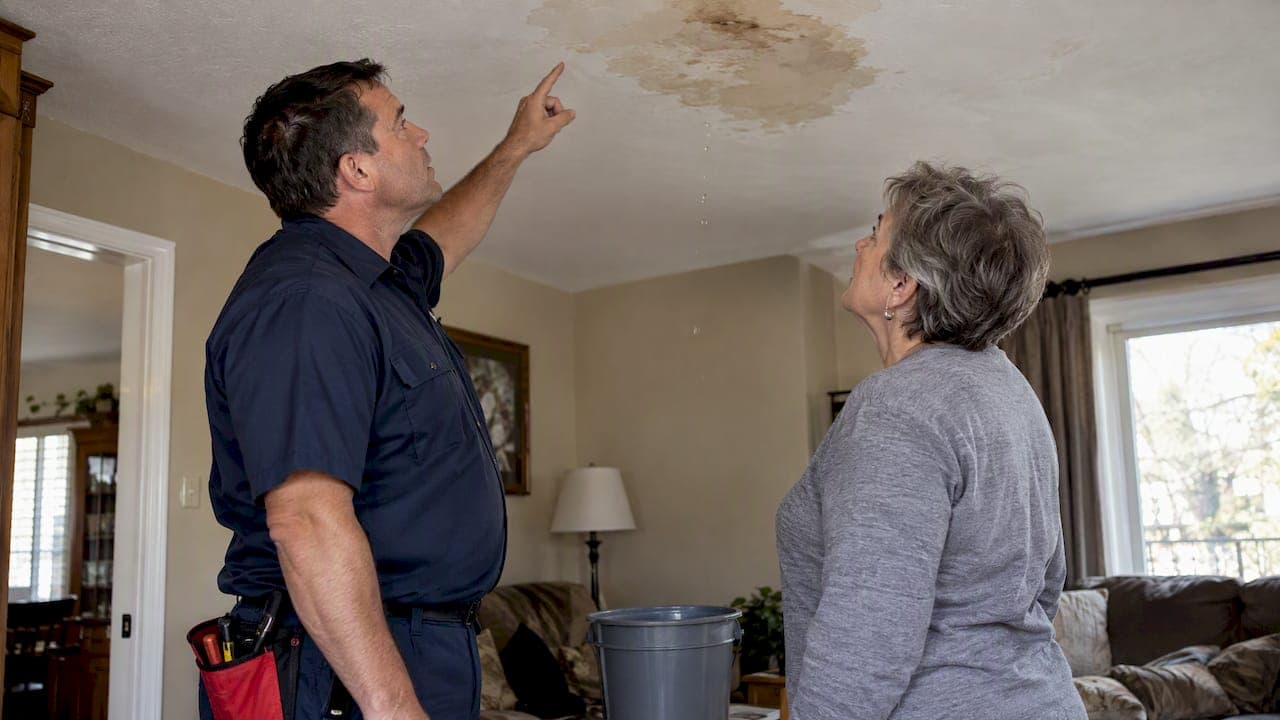
Call a plumber if the water shows up while a fixture is running, or if the leak is under a bathroom, kitchen or laundry room. Call a roofer if it started during or after rain. Call a water damage restoration contractor if the water has stopped but the drywall and insulation are still wet. Bluebot's guide to ceiling leaks draws the same lines. The rest of this page helps you work out which case you have, what to do while you wait, and what the visit looks like.
We are a plumbing and septic company serving Bullhead City, Fort Mohave, Mohave Valley and Laughlin. We fix the plumbing side of ceiling leaks. We do not do roofing, and we will tell you straight when the problem is above the attic and not in the pipes.
TL;DR
- Water that appears when a shower, toilet, washer or dishwasher runs points to a plumber. Water that appears during or after rain points to a roofer.
- Treat any ceiling leak as urgent. Dry wet materials within 24 to 48 hours to cut the risk of mold.
- Shut off the water at the main valve if the leak follows fixture use. Cut power to the area if water is near lights or outlets.
- The wet spot is rarely the source. Ask for non-invasive leak detection before anyone cuts open your ceiling.
- Renters and property managers: notify the owner in writing first, and photograph everything.
Table of Contents
- How to tell a plumbing leak from a roof leak
- What to do in the first hour
- Why the 24 to 48 hour window matters
- What a plumber does about a ceiling leak
- What a roofer does, and when to call one
- Is a ceiling leak an emergency?
- Insurance: who pays for a ceiling leak?
- If you rent or manage a property
- Our perspective: why we start with the plumbing
- Need a plumber for a ceiling leak?
- FAQ
- Sources
How to tell a plumbing leak from a roof leak
Water travels. It runs along a pipe, a rafter or the top of the drywall before it finds a low spot and drips. That is why the stain on your ceiling is often not under the actual problem. Still, a few patterns point the right way.
| What you notice | Most likely source | Who to call first |
|---|---|---|
| Drip starts or gets worse when a shower, toilet, tub or washer runs | Supply line, drain line or fixture seal | Plumber |
| Stain sits under a bathroom, kitchen or laundry room | Plumbing on the floor above | Plumber |
| Water bill jumps with no change in use | Hidden pressurized line leak | Plumber |
| Leak appears during or after rain, or after a storm | Roof or flashing | Roofer |
| Top-floor ceiling, nothing plumbed above it, only after weather | Roof | Roofer |
| Water has stopped, but drywall and insulation stay wet | Finished leak, wet materials | Restoration contractor |
The first three rows follow the guidance in Bluebot's who-to-call guide. Angi's guide agrees that it depends on the source, and that you will usually end up calling a roofer or a plumber, and your insurance company.
Quick tests you can do safely
You do not need a ladder for any of these.
- Run the fixtures. Have someone run the upstairs shower or washer for ten minutes while you watch the ceiling. A new drip is a strong sign of a plumbing leak.
- Think about timing. Did the stain appear after a monsoon storm, or on a dry day? Rain-linked leaks usually stop or slow when the weather clears.
- Check the meter. Turn off every fixture and appliance, then watch your water meter. If it still moves, you have a leak under pressure somewhere. Our 15 to 20 minute meter test walks through it.
- Look at the water. Rusty or brown water can point to an old pipe. Clear water that appears only after rain points up to the roof.
If the tests are inconclusive, that is common. It is also a good reason to call a plumber who offers leak detection, because they can rule plumbing in or out quickly.
What to do in the first hour
A ceiling leak can damage structure, electrical systems and indoor air quality quickly. Bluebot's guidance treats it as an emergency for these reasons. Here is the order we would follow in your house.
- Protect people first. If water is pooling near a light fixture, ceiling fan or outlet, cut power to that area at the breaker panel. Do not stand under a bulging ceiling. A sagging, water-heavy spot can fall.
- Stop the water if it follows fixture use. Close the shutoff valve at the fixture, or the main valve. If you cannot find it, see our guide to finding and closing your main water shutoff.
- Contain the drip. Put a bucket under it. Move furniture and electronics. Lay towels or plastic sheeting on the floor.
- Relieve a bulge carefully. If the ceiling is bulging with trapped water, a small hole at the lowest point lets it drain into a bucket. Only do this if you can stay out from under the bulge, and skip it if power is not off.
- Photograph and film everything. Take wide shots and close-ups of the stain, the room and any damaged belongings. You will want them for an insurance claim. Our bathroom flood checklist explains how to document a claim in the first 60 minutes.
- Call the right professional. Use the table above. If you are unsure, call a plumber first, since a quick check for a plumbing cause is cheaper than waiting.
Stay off the roof. Professionals warn against DIY roof repairs because they are dangerous, and negligent or improper work may also cause trouble with an insurance claim, according to the Bluebot guide.
For a broader list of steps after any plumbing failure, see our 24 hour plumbing emergency checklist.
Why the 24 to 48 hour window matters
The US EPA says it is important to dry water-damaged areas and items within 24 to 48 hours to prevent mold growth. Its guidance on responding to water damage is written to help you avoid the need for mold remediation by acting before growth starts.
That clock starts when the water gets in, not when you schedule a convenient repair. Wet insulation and drywall hold moisture long after the drip stops. Dry air in the Mojave Desert does not remove moisture from inside a ceiling cavity. So even when the surface looks dry, the material above it may not be.
If the water has stopped but the materials are still wet, bring in a restoration contractor for drying. If a plumbing leak caused it, we fix the leak so the drying work does not have to be repeated.
What a plumber does about a ceiling leak
When the water comes from a supply line, drain, fixture or appliance, here is what the visit involves.
- Stop the flow. The first step is usually containment, such as shutting off the water, so damage does not spread.
- Find the real source. The source is often not directly above the stain. Professionals may use tools such as infrared thermal imaging or acoustic listening, which let them locate the leak without guesswork. Our guide to how leak detection works explains the methods.
- Repair or replace. Depending on the cause, that may mean a failed shower valve, a worn drain connection, a split supply line, a toilet seal or a corroded pipe section.
- Advise on the ceiling. Once the leak is fixed, drywall repair, insulation replacement and painting are separate jobs. We will tell you what we see so you can plan them.
Opening a ceiling blindly is slow and expensive. Non-invasive diagnostics are often more cost-effective than exploratory demolition, so ask any plumber you call whether they offer them. Ask us too.
Common plumbing causes we see behind ceiling stains
- Failed seals around a tub, shower pan or toilet on the floor above
- Worn or loose drain connections under a sink or tub
- Pinhole leaks in older copper supply lines. If you have had more than one, read about whether to repair or repipe copper
- Water heater leaks from the tank, relief valve or connections, especially if the heater sits in an attic or upper closet
- Appliance supply hoses on washers, dishwashers and refrigerator ice makers. The Insurance Information Institute recommends checking these hoses every year
- Air conditioning condensate lines that back up and overflow. This one is often mistaken for a roof or plumbing leak
That last item matters in our area, where air conditioners run for much of the year. If the leak is near an air handler or an attic unit, mention it to whoever you call.
What a roofer does, and when to call one
If the leak starts during or after rain, or sits on the top floor with nothing plumbed above it, call a roofing contractor. They inspect shingles, tile, flashing, vents and penetrations, and tarp or patch the roof. Tarping is a common first step to stop further damage while a full repair is scheduled.
Monsoon season is when many local homeowners see this. Bullhead City is dry for long stretches and then gets hard bursts of rain, so small roof defects can show up suddenly. If your leak started right after a storm, a roofer is the right first call.
A plumber cannot repair a roof, and a roofer will not diagnose a pipe. Some leaks involve both: a plumbing vent through the roof can fail at the flashing, for example. When that happens, one trade finds it and the other finishes it. We are glad to work from a roofer's findings, and to give you a written description of what we found so the roofer does not repeat the search.

Is a ceiling leak an emergency?
Usually yes. Treat it as urgent when any of these apply:
- Water is dripping continuously or you cannot stop it
- The ceiling is bulging, sagging or discolored in a spreading ring
- Water is near light fixtures, fans or outlets
- The leak follows the use of a fixture or appliance
- Your water bill has jumped, or the meter moves with everything off
A slow, stable stain that appeared once after a storm and has not changed is less urgent, but still needs a prompt inspection. Waiting for it to get worse is how a small repair becomes a ceiling replacement.
For what an after-hours visit may cost, and when to pay it, read our emergency plumber cost guide. We do not publish fixed prices for ceiling leak work, because the cause decides the job. We give you a clear price before we start.
Insurance: who pays for a ceiling leak?
Coverage depends on your policy and on the cause, so read it or call your agent. As a general reference, the Insurance Information Institute says standard homeowners policies typically cover accidental discharge or overflow of water from within a plumbing, heating or air conditioning system. Its disaster coverage guide lists wear and tear, flood and earthquake among the exclusions of a standard HO-3 form, and sewer or drain backup often needs a separate endorsement.
What that means for you:
- A sudden pipe failure is treated differently from long-term seepage or neglect. Document the date you first noticed it.
- Ask your insurer whether the damage is covered before major repairs, but do not delay stopping the water. Preventing more damage is generally your job.
- Keep the plumber's invoice and written description of the cause. Keep photos of the building damage and of your belongings in separate folders, since they can be separate claims.
- Roof damage from wind, hail or a storm is a different claim type than a plumbing discharge. Tell your agent which one you think it is.
We are plumbers, not insurance advisors. Your agent or adjuster has the final word on what your policy covers.
If you rent or manage a property
Tenants: notify your landlord or property manager in writing, even if you also phone them. Keep a timestamped copy. Under most standard leases, building systems are the owner's responsibility, so you should not hire and pay a contractor on your own without checking first. Your belongings may fall under your renter's policy, which is separate from the owner's coverage of the structure.
Landlords and commercial property managers: a ceiling leak over tenant space is a liability issue as well as a repair. Move quickly, photograph, and call a plumber to rule plumbing in or out the same day. We handle commercial plumbing as well as residential, and we work to get a plumber to the property fast.
Our perspective: why we start with the plumbing
We are a 24/7 plumbing company, and we get ceiling leak calls at all hours. Here is how we think about them.
First, a plumbing leak is the one you can stop right now. You can close a valve. You cannot stop the rain. So if there is any chance water is coming from a fixture or pipe, we would rather check that first and rule it out than have you wait through a long roofing schedule.
Second, we do not guess. Ceiling stains mislead, and the cheapest repair is the one that goes to the right spot the first time. That is why we favor leak detection over opening up your ceiling.

Third, we tell you when it is not us. If we find a dry pipe system and a roof problem, you will hear it plainly, and we will not bill for work you do not need. Our local team serves Bullhead City, Fort Mohave, Mohave Valley and Laughlin, and we know how quickly a leak turns into a bigger problem.
Finally, we want the repair to hold. A ceiling patch over an active leak just hides it. Fix the source, dry the cavity, then repair the finish, in that order.
— JOHN
Need a plumber for a ceiling leak?
If your leak follows fixture use, sits under a bathroom, or you cannot tell, call us. We provide emergency plumbing service, water line leak detection and repair, water heater repair and installation, drain cleaning, and faucet, fixture and toilet repair and replacement for homes and businesses. See our Bullhead City plumbing page or the main site to book now. If water is actively pouring through the ceiling, call now.
FAQ
Do plumbers fix leaks in the roof?
No. Plumbers repair pipes, drains, fixtures and appliances, and roof repair is a roofer's work. A plumber can tell you whether the water is coming from plumbing, which helps you decide whether to call a roofer. The exception is a plumbing vent that passes through the roof, where the two trades may need to coordinate.
Who should I call first if I can't tell what is causing the leak?
Call a plumber first if the leak is under a bathroom, kitchen or laundry room, or if it changes with water use. Call a roofer first if it began with rain. If you really cannot tell, a plumber with leak detection tools can often rule the plumbing in or out quickly. That narrows the search before anyone opens the ceiling.
How do I stop a ceiling leak until help arrives?
Shut off the water at the fixture or the main valve if the leak tracks with use, and cut power to the area if water is near lights or outlets. Put a bucket under the drip and move belongings away. Do not climb onto the roof to patch it yourself.
Should I fix the ceiling before the leak is repaired?
No. Repair the source first, then dry out the cavity, then patch and paint. The EPA advises drying wet materials within 24 to 48 hours to reduce the chance of mold. Covering a wet ceiling with fresh drywall or paint traps moisture and hides the problem.
Is a ceiling leak covered by homeowners insurance?
Sometimes. Standard policies generally cover sudden, accidental discharge of water from plumbing or appliances, but exclude wear and tear, neglect and flood. Your policy and the cause decide the outcome, so call your insurer and keep photos and the plumber's written findings.
Sources
- Who to Call for a Ceiling Water Leak: Full Guide, Bluebot
- Who to Call for a Water Leak in Your Ceiling, Angi
- Mold Information Slideshow, US EPA
- Mold Remediation in Schools and Commercial Buildings Guide: Chapter 4, US EPA
- Which disasters are covered by homeowners insurance?, Triple-I