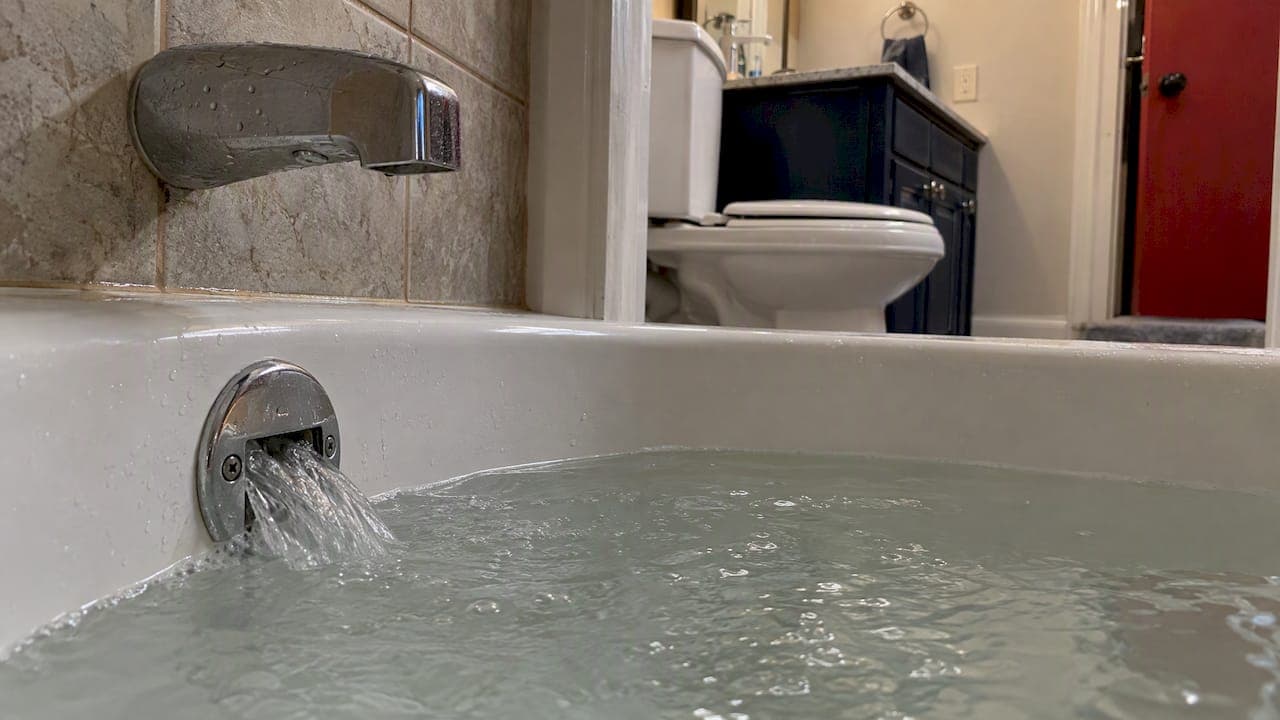
A leaking tub overflow almost always comes down to a worn gasket, loose fittings or a bad connection on the overflow tube behind the faceplate. You can test which one it is in about 15 minutes with a full tub and a flashlight. Some fixes are simple. Others are not, and a slow leak inside a wall costs more every week it runs. This guide shows you how to find the source, what you can safely do yourself, what plumbers typically charge, and when we recommend you call us.
TL;DR
- The overflow drain is a safety opening near the top of the tub. It sends extra water to the main drain. When its gasket or connections fail, water escapes into the wall or ceiling below.
- Fill the tub to the overflow and watch for drips. A leak only at high water points to the overflow gasket. A leak while draining points to the drain shoe or the trap.
- A new gasket and tightened screws are a reasonable DIY job. Corroded or cracked pipe, snapped screws or a stained ceiling below are plumber jobs.
- Published estimates put a drain flange replacement at $150 to $300 and a drain assembly replacement at $300 to $500. Upper-floor tubs without access can cost more.
- Do not wait. Hidden leaks damage drywall, subfloor and framing, and can grow mold.
Table of Contents
- What the tub overflow does and why it leaks
- Signs your overflow is the source
- Test it: is it the overflow, the drain or something else?
- Fixing a leaking overflow gasket yourself
- When to stop and call a plumber
- What it costs to fix a leaking tub overflow
- What happens if you leave it
- Our view: fix the overflow before the wall tells you
- Need a plumber for a leaking tub?
- When the leak is more than the overflow
- FAQ
- Sources
What the tub overflow does and why it leaks
The overflow is the slotted plate or round cover on the wall of the tub, a few inches below the rim. Behind it sits a short tube that runs down to the tub drain and joins the main drain line. According to The Spruce, it is a secondary drainage path that moves excess water into the main drain pipe so it does not spill onto the bathroom floor.
That means the overflow assembly is a sealed joint that sits behind a wall, out of sight. Three parts decide whether it stays watertight:
- The gasket. A ring of rubber, neoprene or sponge sits between the tub wall and the overflow tube fitting. The Spruce notes that this gasket can turn brittle and crack over time, and that loose overflow-tube fittings let water escape.
- The faceplate and screws. Loose screws let the plate and gasket back off the tub wall. Rusted screws can snap when you try to tighten them.
- The tube connection. The overflow tube meets the drain tee below the tub. If gasket replacement does not stop the leak, DG Floors says the problem usually lies at this connection.
The Spruce also points out that leaks are most likely when the tub is filled high or when kids splash, because that is when water actually reaches the overflow opening. That is a useful clue in itself: if the leak shows up only after a deep bath, the overflow is a prime suspect.
Signs your overflow is the source
Most homeowners find out in one of four ways. Aqviz lists these visible signs of an overflow leak:
- A stain on the ceiling of the room below the bathroom
- A dripping sound that happens when the tub is filled or in use
- Rust on the overflow plate
- A musty smell near the tub
We would add a few things we look for on service calls: a soft or discolored spot on the bathroom floor beside the tub, a hollow or spongy feel to the baseboard on the wall behind the tub, and a water bill that creeps up without a clear reason.
One caution. A ceiling stain below a bathroom does not always mean the overflow. It can be the tub drain, the shower valve, a supply line or even a roof leak. If you are not sure whether to call a plumber or a roofer, our guide on a ceiling leak: plumber or roofer first walks through how to tell.
Test it: is it the overflow, the drain or something else?
Do not guess and do not start pulling parts. A short test tells you where the water comes from. Run it in this order.
Step 1: Separate supply leaks from drain leaks
Start by asking when the leak happens. The Spruce explains that a continuous leak when the tub or shower is not in use could be a pressurized water-line leak, while a drain-line leak shows up only when the tub or shower is in use. If water keeps appearing with every fixture off, shut off the water to the bathroom and call us. For more on how to separate leaks that occur during tub or shower use from constant supply leaks, and how fast to act when water is spreading, that guide covers the response steps.
Step 2: Check the connections below the tub
If the tub has an access panel or a basement or crawlspace below it, look at the drain connections while someone runs water. StructureTech recommends opening the access hatch, filling the tub to the overflow and watching the overflow from behind for leaks, then pulling the stopper and checking that the tub drain does not leak.

Step 3: Fill to the overflow
This is the test that matters most. Plug the drain, fill the tub until water just starts to run into the overflow opening, and watch for drips below. DG Floors puts the logic simply: a leak that occurs only when the tub is full and overflowing points to the overflow gasket, while a leak during normal draining points to the drain shoe.
The manufacturer Oatey takes the same approach. Its guidance on testing a bath waste and overflow is a visual inspection with the tub filled to the overflow, because the assembly has to be checked under the condition that activates it.
Step 4: Run the shower separately
If the tub passes, run the shower alone. The Spruce suggests checking for splashing or leaks around the faucet and the escutcheon, the trim ring around the valve stem. A bad caulk line, cracked grout or a failed seal around the shower valve can mimic an overflow leak exactly.
What your results mean
| What you see | Likely source | Next step |
|---|---|---|
| Drips only when water reaches the overflow | Overflow gasket or loose faceplate | Replace gasket, tighten screws |
| Drips while the tub drains | Drain shoe, gasket under the tub or drain pipe | Inspect from below, replace the drain assembly if needed |
| Still leaking after a new overflow gasket | Overflow tube connection | Plumber inspection |
| Drips with everything off | Pressurized supply line | Shut off water, call a plumber |
| Wet only after showers | Caulk, grout, valve trim | Reseal, or have the valve checked |
Fixing a leaking overflow gasket yourself
A gasket swap is within reach for a careful homeowner when you have a clear view of the problem and the screws come out cleanly. Family Handyman lists replacing the gasket and tightening loose screws as DIY-friendly.
Here is the general sequence:
- Empty the tub and dry the area around the overflow plate.
- Remove the faceplate screws. If a stopper linkage is attached to the plate, lift it out slowly with the plate. Note the position of each part so you can put it back.
- Inspect the old gasket. Look for cracks, flattening, hardening or gaps. Also look at the tube and the tub wall for corrosion or cracks.
- Clean the mounting surface so the new gasket seats evenly.
- Install the new gasket in the right direction. The Spruce points out that some gaskets are tapered to match the angle of the tub wall, so follow the manufacturer's instructions on orientation. A gasket installed backward will not seal evenly.
- Reinstall the plate and snug the screws evenly. Do not overtighten. Compressing a gasket too hard is a common reason it fails early.
- Repeat the fill-to-overflow test and check below for drips.
One point from the Spruce is worth repeating. Homeowners often assume a major repair like cutting open the ceiling is needed, when the fix is just tightening the overflow tube or replacing a gasket. Test first. Demolition comes last.
A note on sealing the overflow shut
Some people plug or tape over the overflow to stop the drip so they can fill the tub higher. We advise against it. The overflow exists to stop flooding, as This Old House describes it: a safety feature that keeps water from flooding the home. Blocking it hides the symptom, keeps the failed part in place and removes your backup if the drain clogs while the tub is filling.
When to stop and call a plumber
The DIY route ends where visibility ends. DG Floors says to call a plumber when there is active ceiling water damage, when pipes are corroded or cracked, when the overflow assembly is too rigid for DIY repair, when rusted screws snap off inside the mounting flange, or when the leak is not localized and damage seems to have spread beyond the overflow assembly.
We would call these situations out in plain terms:
- Water is coming through the ceiling below. Stop using the tub. If the drip is near a light fixture or ceiling fan, keep your hands off it and turn off the circuit at the panel. InspectandTest warns that water and electrical equipment together create a potential electrical hazard.
- The gasket is new and it still leaks. That points to the tube connection, which is hidden and often needs a plumber's tools and access.
- The tub is on an upper floor with no access panel. Family Handyman notes that pipe replacement can be more complicated in a second-floor bathroom without access from below.
- You find rot, soft flooring or mold. At that point the plumbing repair is only part of the job. Moisture needs to be found and dried out.
- You cannot tell where the water is coming from. A leak that shows only in the ceiling may involve a supply line, a drain line or a hidden fitting. Our guide on how leak detection works explains what a professional does to pin it down without tearing out the wall.
If the leak turns out to be bigger than a drip, our 24 hour plumbing emergency checklist lists what to shut off and what to document while you wait for us.
What it costs to fix a leaking tub overflow
Cost depends on what failed and how hard it is to reach. Family Handyman's guide to removing a bathtub drain reports that a plumber may charge $150 to $300 to replace a bathtub drain flange and $300 to $500 to replace a leaking or cracked drain assembly. It adds that replacement may cost more for a second-floor tub without access from below.
Those are published ranges from a national home-repair site, not our quotes. Local labor rates, the age of your plumbing and the condition of the surrounding wall all move the number. Here is what pushes a bill up or down:
- Access. A tub backed by a plumbing access panel or open crawlspace is faster to work on than one sealed behind tile.
- Parts. A gasket is cheap. A full drain and overflow kit costs more, and older tubs sometimes need parts that match odd sizes.
- Condition of the pipe. Corroded or cracked pipe means more than a gasket swap.
- Water damage. Repairing drywall, flooring or subfloor is a separate job from fixing the plumbing.
The cheapest repair is almost always the early one. A gasket caught at the first drip is a small job. A gasket ignored for a year can become a subfloor repair.
What happens if you leave it
Overflow leaks tend to be small and intermittent, which is why they get ignored. According to Aqviz, unrepaired leaks can cause hidden wall damage, ceiling staining, mold, fixture deterioration and odors. InspectandTest adds that an overflow leak can damage drywall, flooring, subflooring, framing and nearby finishes, and that prolonged dampness can produce musty odors or visible mold.
The pattern is consistent: the water you see is a fraction of the water that has gone somewhere else. If a ceiling stain is already visible, the wall cavity has probably been wet for a while.
In the meantime:
- Avoid filling the tub past the overflow level.
- Use a shower or a different bathroom if the leak is active.
- Put a towel and bucket below the leak if you can reach it safely.
- Take photos of any damage with dates. You may need them if you file a claim.
- Know where your home's main water shutoff is, in case the leak turns out to be a supply line.
Our view: fix the overflow before the wall tells you
We work on homes and commercial properties across Bullhead City, Fort Mohave, Mohave Valley and Laughlin, and the tub overflow call has a familiar shape. Someone notices a small stain or a drip when they fill the tub, tells themselves it is condensation, and waits. By the time we arrive the question is no longer "which gasket?" but "how far did the water go?"

Our advice is simple. Run the fill-to-overflow test the first time you suspect a leak. If it points to the gasket and the screws come out easily, fix it. If anything about it feels off, such as a stuck screw, a crumbling pipe or a stain you cannot explain, stop and call. A plumber can check the whole path the water takes, not just the part you can see, and that is where the expensive surprises hide.
Landlords and property managers should treat a tub overflow leak as a priority repair, not a cosmetic one. The unit below is where the damage shows up first, and the tenant is the one who reports it.
— JOHN
Need a plumber for a leaking tub?
We repair leaking tub overflows and drains, replace worn gaskets and drain assemblies, track down hidden water and gas line leaks, and handle emergency plumbing around the clock. We serve residential and commercial customers in Bullhead City, Fort Mohave, Mohave Valley and Laughlin. If the leak has already reached your ceiling or you cannot find the source, book a visit with USA Plumbing and Septic and we will find it and fix it.

If water is spreading and you cannot stop it, call now. We offer 24/7 emergency service, and our licensed plumbers will get the leak under control before it becomes a bigger repair.
When the leak is more than the overflow
Sometimes the tub is only where the problem shows up. A few related situations we see:
- Pinhole leaks in copper supply lines can drip inside the wall and mimic a tub leak. If this has happened more than once, read about whether to repair or repipe copper pipes.
- A burst or failing pipe needs fast action. Our steps to fix a burst pipe temporarily can limit the damage until we arrive.
- Slow drains and backups that come with an overflow problem may be a clog in the main line, not just the tub. Water that cannot leave quickly stays near the overflow longer and stresses every seal. Toilets and tubs share the same drain system, so our explanation of why toilets overflow may help you spot a bigger drain issue.
- Properties on septic. If the tub and other fixtures drain slowly or gurgle, the tank may be the issue. See why septic tanks overflow.
FAQ
Why does my tub drain leak?
The usual causes are a worn drain gasket under the tub, loose overflow faceplate screws or cracked drain pipes, according to Family Handyman. Run the fill-to-overflow test to tell the overflow from the drain. If water appears only while the tub empties, the drain shoe and the connection below are the places to look.
How much does it cost to fix a leaking overflow pipe?
Family Handyman reports a plumber may charge $150 to $300 to replace a drain flange and $300 to $500 to replace a leaking or cracked drain assembly. Cost goes up when the tub is on an upper floor with no access from below. A simple gasket swap costs far less, and wall or ceiling repair is priced separately.
How do I find a leak I cannot see?
Start by noting when it happens. A drip only when the tub is in use points to a drain-line leak, and a drip with everything off points to a pressurized supply line. Check below the tub through any access panel, then fill the tub to the overflow and watch. If you still cannot find it, a plumber can use leak detection methods that avoid opening the wall.
What is a tub overflow drain?
It is the opening near the top of the tub that catches water before it spills over the rim. A tube behind it carries the water to the main drain. It also gives water a second route out if the main drain is slow or blocked.
Can I just seal the overflow shut?
We do not recommend it. Sealing it hides the leak without fixing the failed gasket or connection, and it removes the safety backup that prevents the tub from flooding the bathroom. Replace the gasket or have a plumber repair the connection instead.
Sources
- How to Fix a Leaky Bathtub Overflow Tube, The Spruce
- How To Add an Overflow to a Bathtub, This Old House
- Leak Bathtub Overflow Drain: Complete Guide for Homeowners, DG Floors
- Bathtub Overflow Leak: Reasons, Signs, Problems, and How to Fix, Aqviz
- Bathtub Overflow Drains: Gasket Leaks and Waste Kits, InspectandTest
- How to Inspect Your Own House, Part 6: Plumbing, StructureTech
- How is a bath waste/overflow tested for leaks after installation, Oatey
- 10 Common Bathtub Issues and How to Fix Them, Family Handyman
- Guide to Removing a Bathtub Drain, Family Handyman