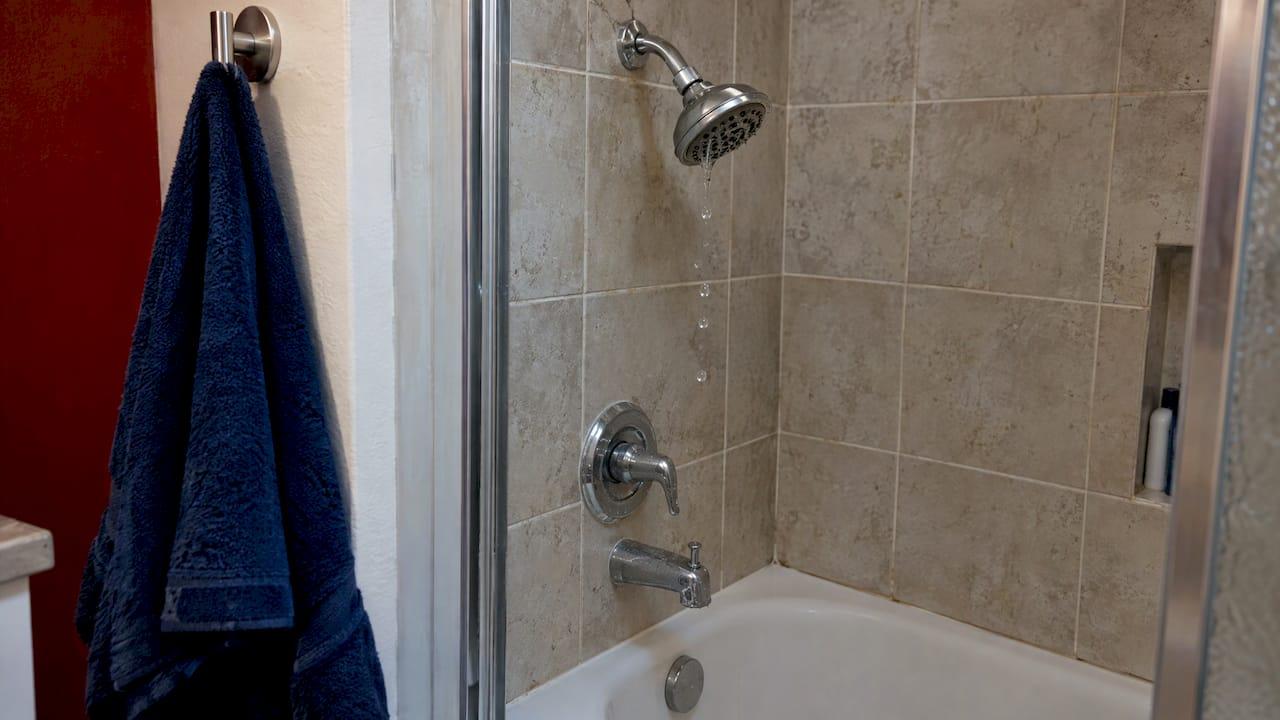
A shower head that drips for a minute or two after you turn it off is normal. One that keeps dripping, or leaks at the joint while the water runs, has a fixable cause. The cause is almost always one of three things: a worn valve cartridge inside the wall, a loose or unsealed connection at the shower arm, or mineral buildup and a tired washer in the shower head itself. Below, we show you how to tell which one you have, what you can try yourself in a few minutes, and when it is time to have a licensed plumber take over.
TL;DR
- Dripping for 1 to 2 minutes after shut-off is normal. Dripping that keeps going for several minutes is a leak.
- Drip after the handle is off: the valve cartridge is the most likely cause. Wetness at the joint while the shower runs: a loose connection or worn washer.
- Vinegar soak, new plumber's tape and a fresh washer or O-ring fix many head and joint leaks.
- Cartridge work means opening the wall valve. If parts will not seat, leave the water off and call a plumber.
- We serve Bullhead City, Fort Mohave, Mohave Valley and Laughlin, with 24/7 emergency plumbing.
Table of Contents
- Is a dripping shower head normal?
- Find the cause in two questions
- Cause 1: a loose connection at the shower arm
- Cause 2: a worn washer or O-ring
- Cause 3: mineral buildup
- Cause 4: a failing valve cartridge
- Water from the shower head while you use the tub spout
- What a small drip costs you
- Before you start any repair
- When to call a plumber
- Get it fixed right with USA Plumbing and Septic
- FAQ
- Sources
Is a dripping shower head normal?
Some dripping is expected. After you shut the water off, the shower head and the short pipe above it still hold water, and that water drains out. GROHE's U.S. support page says residual water can drip for about 1 to 2 minutes after you turn the shower off, and that dripping which continues for more than a few minutes can mean internal parts of the valve need replacing. Kohler's support page gives a similar window of up to 90 seconds, and adds that pressure changes elsewhere in the home can also cause a short drip.
Pipes and fixtures also expand and contract as they cool after a hot shower, which can push out a few last drops. The Spruce lists this, along with lingering water in the head, excess pressure and mineral buildup, as common reasons for a drip that is not an emergency.
Here is a simple rule we use with customers:
- Stops within a couple of minutes: normal. Leave it.
- Keeps dripping long after shut-off: a leak that needs fixing.
- Drips from anywhere other than the spray holes while the shower runs: a leak that needs fixing.
Delta Faucet says the same: a little dripping after you turn the water off isn't a problem, but a head that drips long after shut-off, or leaks from places other than the spray holes, has a leak to repair.
Find the cause in two questions
The fastest way to narrow things down is to ask when the drip happens and where the water comes from. Plumbing by the Book frames it the same way: a drip that continues after the handle is fully off and outlasts the time it takes the head to drain almost always traces to the cartridge in the wall. A drip that shows up only while the shower runs is more likely a loose connection, a worn washer or a shared-flow problem.
Use this table as your starting point.
| What you see | Most likely cause | First thing to try |
|---|---|---|
| Drips from the spray holes for many minutes after the handle is off | Worn or failing valve cartridge | Cartridge cleaning or replacement |
| Water at the joint where the head meets the shower arm, while running | Loose connection or worn washer | Tighten, re-tape the threads, replace washer |
| Water sprays sideways or from odd holes | Mineral buildup clogging nozzles | Vinegar soak |
| Water comes out of the shower head while you are running the tub spout | Stuck tub spout diverter or high pressure | Check the diverter, check pressure |
| Handle is off, but you can hear water trickling in the wall | Cartridge, valve seat or a supply issue | Call a plumber |
A 60-second tissue test
Wrap a dry tissue or paper towel around the threads where the shower head screws onto the arm, then run the shower briefly. Plumbing by the Book describes this as a quick diagnostic: a wet tissue at the joint confirms the connection is the source, while a dry tissue with the drip still coming from the nozzles after shut-off points to the cartridge.
Cause 1: a loose connection at the shower arm
This is the easiest fix. If the head feels loose, try tightening the nut until it is secure. Delta Faucet cautions that overtightening can cause damage or another leak, so snug is the goal, not as hard as you can crank it.
If tightening does not stop it, the threads probably need fresh tape:
- Turn the water off at the shower, and make sure the shower is not running.
- Unscrew the shower head by hand. If it is stuck, wrap a cloth around the nut to protect the finish, then use a wrench.
- Peel off the old tape and wipe the threads clean.
- Wrap new plumber's tape around the shower arm threads three times, clockwise. Bob Vila's guide gives this three-wrap, clockwise method.
- Reattach the head, turn the water on and check the joint.
The EPA says most leaky shower heads can be fixed by ensuring a tight connection with pipe tape and a wrench. If the arm itself wobbles inside the wall or the leak is behind the escutcheon plate, stop there. That is a pipe problem, not a shower head problem.
Cause 2: a worn washer or O-ring
Inside the shower head, or at its connection, sits a small rubber washer or O-ring. Over the years heat and minerals harden it, and it cracks or splits. A hardened washer cannot seal the joint, so water seeps past it even with fresh tape.
To replace it, unscrew the head, look inside the inlet for the rubber ring, and pry it out gently. Take it to a hardware store and match the size. Bob Vila notes that if a washer or O-ring has hardened or split, you disassemble the head and replace it. A dab of silicone plumber's grease on the new ring helps it seat without twisting.

Cause 3: mineral buildup
Our area has hard water, and shower heads show it first. White crust around the nozzles, uneven spray, and water that dribbles out of the face plate are all signs of scale. Scale can also hold the washer open slightly, which keeps the head dripping.
The fix is a vinegar soak:
- Shut off the water and remove the head.
- Soak it overnight in white vinegar, as Bob Vila recommends.
- Scrub the residue off with an old toothbrush or a soft brush.
- Rinse, re-tape the threads and reinstall.
Kohler also points out that cleaning the head with a 50/50 solution of white vinegar and water may reduce the amount of residual dripping. For stubborn deposits on glass and other surfaces around the shower, this guide to hard water stain cleaning explains how mineral deposits behave and when they are past a home remedy.
If you are cleaning scale off your heads every few months, the water is the real issue. A softener or filtration system protects every fixture in the house. We service and replace these systems, and you can read about our water softening and filtration in Bullhead City.
Cause 4: a failing valve cartridge
When the shower head drips while the water is completely off, the shower head is not the problem. The cartridge inside the shower valve is. It is a small, replaceable part that controls on and off and hot and cold mixing. When it wears out, water slips past its seal and trickles up to the head. The Spruce says that if the head leaks with the faucet off, the cartridge is likely old or defective and should be replaced.
This Old House adds that modern valves use a pressure-balanced cartridge that senses changes in water pressure to prevent scalding. If flow is poor, you can soak the cartridge in a 50-50 vinegar and water solution for 24 hours. If the problem persists, replace it.
What a cartridge replacement involves
Delta Faucet publishes a 10-step procedure that shows how much work this is: turn off the hot and cold supply, open the shower control to relieve pressure, remove the handle and face plate, remove the bonnet with a strap wrench, pull the cartridge, flush the system for 30 to 60 seconds, install the new cartridge or seats and springs, reassemble, and check for leaks with the water on and off. You can read the full cartridge replacement steps on their site.

Their advice for anyone working in the shower is worth repeating: cover the drain with a cloth or plug so screws and small parts cannot fall in, and lay a towel on the floor of the tub or shower to protect the surface.
Still dripping after a new cartridge?
This happens, and it is frustrating. The usual reasons are:
- Mineral buildup inside the valve body. Debris stops the new seals from sitting properly.
- A pitted valve seat. Corrosion leaves tiny craters where the rubber should seal.
- A pinched or displaced O-ring. Rubber rings installed dry can twist or tear as they slide over the ports. Silicone plumber's grease helps prevent this.
- The wrong cartridge. Brands and model years differ, and parts that look alike are not always interchangeable.
If the retaining clip will not seat or gets damaged, do not turn the water back on. That is the point where a plumber should take over. A new cartridge in a damaged valve body will keep leaking, and forcing it risks water inside the wall. Sometimes the right answer is replacing the whole valve. Our guide to shower valve replacement cost explains what drives that job.
Water from the shower head while you use the tub spout
If the tub spout is open and water also comes out of the shower head, there are two likely causes, according to This Old House: a stuck or partly blocked diverter gate in the tub spout, often from mineral buildup, or high water pressure creating backpressure that pushes water up through the head.
Kohler adds that only 1/2-inch copper pipe should connect the valve and the tub spout. Other materials can cause backpressure that sends water out of the shower head and tub spout at the same time, a condition often called shower rise. If your bathroom was remodeled and this started afterward, the piping between valve and spout is worth a professional look.
If pressure is the suspect, our low water pressure checks for the whole house walk through how to measure it. A related problem at a single tap is covered in our one-faucet pressure checks.
What a small drip costs you
A slow drip feels harmless, but it adds up. The EPA reports that a shower head leaking at 10 drips per minute wastes more than 500 gallons per year, enough water to wash 60 loads of dishes in a dishwasher. Rapidan Service Authority, citing EPA WaterSense, notes that fixing easily corrected household leaks can save about 10 percent on a water bill.
There is a second cost. A drip you cannot see, from a valve leaking inside the wall, can stain drywall and soften framing over time. If your water bill has crept up with no change in habits, our meter test for high water bill causes takes 15 to 20 minutes and shows whether a leak is running somewhere in the system.
Before you start any repair
Know where your shutoff is. For a shower head or joint, closing the shower's own stops (if it has them) or the main valve is the first step. If you have never located the main shutoff, our guide to finding and closing your main water shutoff takes five steps.
A few other habits save trouble:
- Protect the finish. Wrap a cloth around the nut before using a wrench.
- Do not mix thread tape with a washer joint that is designed to seal without it. Check the head's instructions.
- Keep the old cartridge or part. It is the best way to get the right replacement.
- Run the shower for 30 to 60 seconds after any repair, then watch it with the water on and off.
When to call a plumber
Do what you can with the head and connection. Call us when:
- The drip continues after a cleaned head, new tape and a new washer.
- You suspect the cartridge but the handle will not come off, the bonnet is seized, or the retaining clip will not seat.
- The drip returns after a new cartridge.
- You see water stains on the wall or ceiling near the shower, or the wall feels damp or soft.
- Water comes out of the head while the tub spout runs, especially after a remodel.
- The drip is paired with weak hot water or temperature swings. Our guide on why hot water runs out covers the water heater side of that.
If there is water running inside the wall or you cannot stop it, shut off the main and call right away. Our emergency line is open around the clock.
Our perspective
We replace a lot of shower cartridges and valves, and most of the calls begin the same way: "I changed the shower head and it still drips." The head is rarely the whole story. Our advice is to spend ten minutes on the cheap checks first: tissue test, tight connection, fresh tape, vinegar soak. If the drip survives all that, the problem is behind the wall, and that is where our licensed plumbers earn their keep.
The mistake we see most is a cartridge swap that goes sideways. A pitted valve seat, a damaged clip or a pinched O-ring turns a small job into a wet one, and a bathroom wall is a poor place to learn by trial and error. When we open a valve, we check the cartridge, seats and body together, so the repair holds.
In Bullhead City, Fort Mohave, Mohave Valley and Laughlin, hard water makes all of this show up sooner. That is why we look at the whole picture, from the shower valve to the softener, and tell you plainly what the job needs. We are a local, trusted partner, and we go the extra mile to get you a shower that shuts off when you shut it off.
JOHN
Get it fixed right with USA Plumbing and Septic
If your shower head will not stop dripping, we can find the cause and fix it. We handle faucet and fixture repair and replacement, water line leak detection and repair, water heater repair and installation, and water softening and filtration service for homes and commercial properties in Bullhead City, Fort Mohave, Mohave Valley, Laughlin and the surrounding area.

Our plumbers are licensed and respond quickly, and we are available 24/7 for emergencies. Call now or book your plumbing service and tell us what the shower is doing. Landlords and property managers, we handle commercial plumbing too.
FAQ
How do I get my shower head to stop dripping?
Start with the cheap fixes. Turn off the water, remove the head, soak it in white vinegar overnight, scrub the residue and re-wrap the arm threads with plumber's tape three times, clockwise. If it still drips after shut-off, the cartridge inside the valve is the next suspect, and that repair is best done by a plumber.
Why does my shower head keep dripping after I turn it off?
If it drips for a minute or two, that is leftover water draining. If it continues for longer, the cartridge in the shower valve is probably worn and letting water past its seal. A new cartridge usually solves it, as long as the valve seat and O-rings are in good shape.
Why is my shower head still dripping after I replaced the cartridge?
The usual causes are mineral buildup in the valve body, a pitted valve seat, a pinched or displaced O-ring, or a cartridge that does not match the valve. If the clip will not seat, keep the water off and call a plumber, since the valve body may need repair or replacement.
Is it okay if the shower head leaks a little?
A short drip after shut-off is normal. A steady drip is not. A shower head leaking at 10 drips per minute wastes more than 500 gallons a year according to the EPA, and a hidden valve leak can damage the wall. Fix it sooner rather than later.
Sources
- How to Fix a Leaking Shower Head (Bob Vila)
- How to Fix a Leaky Shower Head (Delta Faucet)
- How to Fix a Showerhead Leak (The Spruce)
- How to Troubleshoot a Leaky Showerhead (This Old House)
- Why Is My Shower Dripping? (Plumbing by the Book)
- Rite-Temp Valve Dripping from Showerhead or Spout (Kohler Assist)
- After I turn off my shower, water drips from my shower head (GROHE)
- Fix a Leak Week (EPA)
- Prevent Water Waste (Rapidan Service Authority)
- Hard water stain cleaning