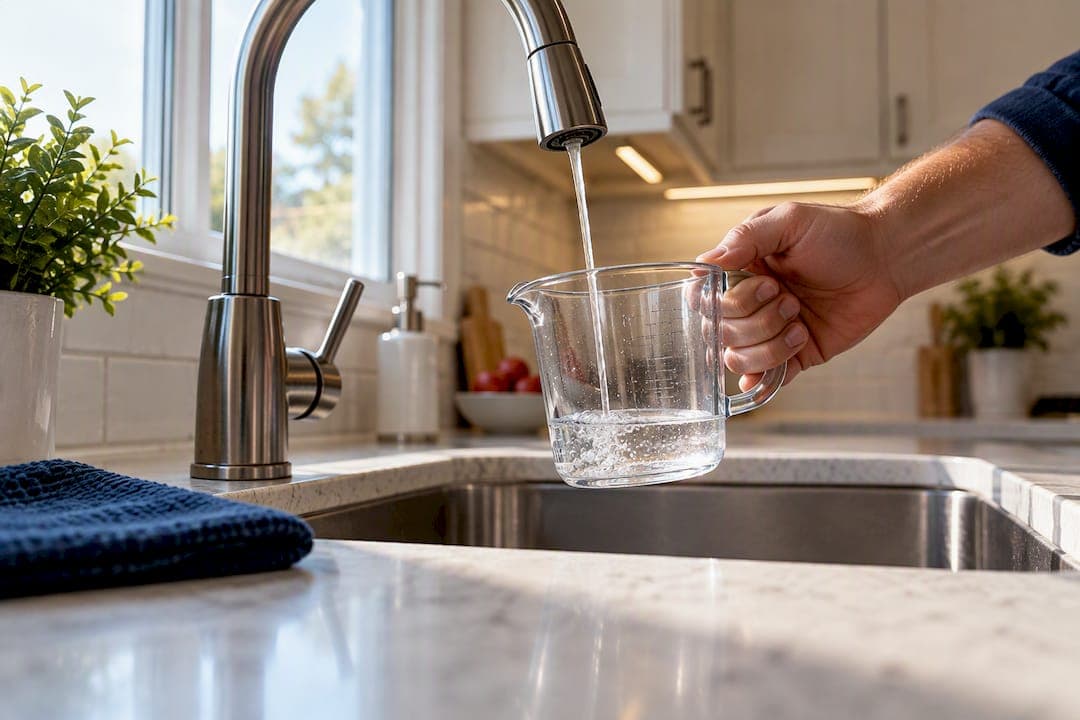
If every faucet in your home runs weak, attach a pressure gauge to an outdoor hose bib and check the reading. Below 40 PSI, you're dealing with a whole-house problem: the main line, the pressure-reducing valve, or the municipal supply. A normal hose bib reading but weak flow at one sink means the trouble is downstream, likely a clogged fixture or a bad supply line.
TL;DR:
- A hose bib pressure reading under 40 PSI indicates a whole-house issue, such as a faulty pressure-reducing valve or municipal supply problem.
- If the pressure is normal at the hose bib but weak inside, the cause is likely a fixture clog or clogged supply line.
- Checking the water meter over two hours can reveal active leaks, especially if the reading changes with no fixtures running.
- Common fixes include cleaning aerators, verifying valve positions, bypassing filters, and replacing failed PRVs or faulty fixtures.
- Urgent issues like continuous meter spinning, persistent pressure drops, or visible leaks require immediate professional plumbing diagnosis and repair.
Table of Contents
- Quick Checklist: 6 Fast Checks to Run in 10 Minutes
- How to Test and Diagnose the Water Pressure Problem
- Common Causes of Low Water Pressure, Room by Room
- Simple DIY Fixes to Try First
- When to Call a Plumber Right Away
- Typical Repair Costs and Timeframes
- Why Trust This Guide
- The Diagnostic Step Most Homeowners Skip
- Get Your Water Pressure Checked by USA Plumbing and Septic LLC
- Authoritative Resources and Tools to Consult
- Sources
- FAQ
Quick Checklist: 6 Fast Checks to Run in 10 Minutes
Before you call anyone, run through this sequence. It takes less time than waiting on hold with your water utility.
- Turn off every faucet, appliance, and irrigation valve, then watch your water meter for movement. Any motion means something is drawing water somewhere in the system.
- Confirm the main shutoff valve and the meter's isolation valve are fully open. A quarter-turn ball valve should sit parallel to the pipe; a gate valve should spin freely with no resistance.
- Thread a pressure gauge onto an outdoor hose bib and record the PSI.
- Text or call two neighbors. If they're seeing the same weak flow, check your water utility's outage map before assuming the problem is yours.
- Unscrew a faucet aerator or showerhead and look for mineral buildup or grit.
- Flip your water softener or whole-house filter to bypass mode for an hour and see if pressure recovers.
How to Test and Diagnose the Water Pressure Problem
The hose bib test is the fastest way to separate a low water pressure house issue from a single stubborn fixture, and it takes about five minutes with a gauge that costs less than $20. Shut off every fixture and appliance inside the house first, since running water anywhere skews the reading. Screw the gauge onto the spigot, open it fully, and read the dial.
- Below 40 PSI: treat it as whole-house. The EPA notes that residential systems typically run 45 to 80 PSI, and anything under 40 usually causes weak showers, slow-filling toilets, and struggling appliances.
- 45 to 80 PSI at the hose bib but weak indoors: the restriction is downstream, likely a clogged aerator, a corroded branch line, or a fouled softener.
- Above 80 PSI: that's its own problem. High water pressure in a house stresses fittings and water heaters and often points to a failed pressure-reducing valve stuck open.
Next, check the meter. Shut off all water for two hours and read the meter dial before and after. If the low-flow indicator has moved or the reading changed with nothing running, you've got an active leak, a method the EPA's leak-detection checklist recommends as a first move before any invasive digging.
Pressure gauge readings, at a glance:
| Reading at hose bib | What it means |
|---|---|
| Under 40 PSI | Whole-house issue: PRV, main valve, leak, or municipal supply |
| 45–80 PSI | Normal range; weak flow indoors points to a fixture or branch problem |
| Over 80 PSI | High pressure; often a failed or missing PRV |
If you can access the plumbing on both sides of your pressure-reducing valve, take a reading upstream and downstream. Normal pressure feeding into the valve but low pressure coming out is close to a confirmed PRV failure.
Common Causes of Low Water Pressure, Room by Room
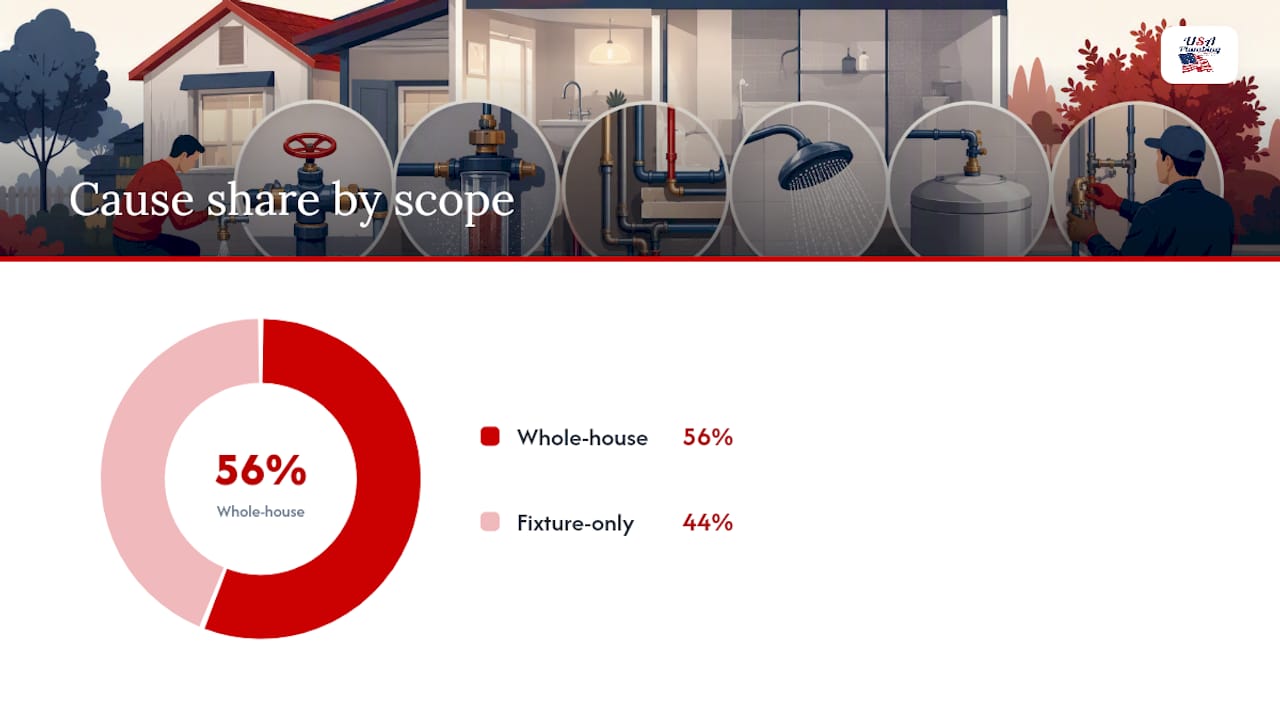
Some causes hit the whole house at once. Others only show up at one sink or shower. Telling them apart saves you from replacing a part that was never broken.
Whole-house culprits:
- A main or meter valve that's not fully open, often left partially closed after a repair
- A failed PRV, which typically lasts 7 to 15 years before it sticks and starves the whole system
- A supply-line leak between the meter and the house
- Low municipal pressure, more common at higher elevations or during peak demand hours
- A clogged whole-house filter or fouled water softener resin bed
Fixture-only culprits:
- A clogged aerator or showerhead caked with mineral scale
- A worn or debris-jammed faucet cartridge
- A kinked flexible supply line under a sink or toilet
- Localized corrosion inside an old branch pipe feeding just that fixture
How the problem started matters almost as much as where it started. A sudden drop across the whole house usually means a PRV gave out or a major leak opened up overnight. A gradual decline over months points to scale buildup or corroding galvanized pipe narrowing the interior diameter year by year. If you notice a water bill that jumped for no clear reason, damp soil near the foundation, or a meter dial that won't sit still, you're looking at a leak, not a valve or a clog.
Simple DIY Fixes to Try First
Most single-fixture pressure complaints and a fair number of whole-house ones get solved without a service call. Work through these in order.
- Clean the aerator or showerhead. Unscrew it, pull out the screen, and soak both in a bowl of white vinegar for 30 to 60 minutes. Scrub with an old toothbrush, rinse, and reassemble.
- Verify your valves are truly open. Find the main shutoff and the meter valve, and make sure neither is partially closed. Gate valves are notorious for looking open while a worn stem lets them creep shut over time; if yours is decades old, a licensed plumber can swap it for a quarter-turn ball valve during a routine visit.
- Bypass the softener or filter. Most systems have a bypass lever right on the control valve. Flip it and run water for a few minutes. If pressure jumps back to normal, the softener or filter needs service or a new cartridge.
- Check a well pump breaker. If you're on a private well, confirm the pump's breaker hasn't tripped and listen for the pressure tank cycling normally. Never open the pressure tank or touch pump wiring without cutting power first.
Pro Tip: Keep a small notebook of your hose bib readings over a few months. A slow year-over-year decline is the earliest warning sign of galvanized pipe scaling up, long before you notice it in the shower.
Leave PRV replacement, slab or underground leak repair, and any repiping to a licensed plumber. Those jobs involve pressurized lines, sometimes buried infrastructure, and mistakes there cost far more to fix than the original problem.
When to Call a Plumber Right Away
Some signs mean stop troubleshooting and pick up the phone.
- The meter spins with every fixture and appliance off
- Pressure drops suddenly and stays down across the entire house
- You spot standing water, a damp patch on a wall, or an unexplained warm spot on the slab floor
- Your water bill spikes with no change in usage
A plumber attending a whole house low water pressure call typically performs pressure checks, PRV inspection, uses leak detection equipment, and may use a camera for inspection if corrosion is suspected. A straightforward PRV swap usually wraps up in an hour or two. A supply-line leak repair can run half a day depending on access. A full repipe often stretches across one to three days.
Typical Repair Costs and Timeframes
Budgeting for this kind of repair is easier once you know the general brackets, since the range depends heavily on what's actually failing.
- Low-cost fixes: aerator cleaning or replacement, angle-stop valve swaps, and a PRV pressure adjustment usually run under a couple hundred dollars in labor.
- Mid-range jobs: PRV replacement runs roughly $200 to $450, while a booster pump installation lands closer to $800 to $1,800.
- Major jobs: a full whole-home repipe, especially replacing scaled galvanized lines, typically falls between $4,500 and $15,000 depending on house size and wall or slab access.
Permits, material choice, and how easily a plumber can reach your pipes all push these numbers up or down. A single-story home with an accessible crawl space costs far less to repipe than a two-story house on a slab foundation.
Why Trust This Guide
A plumbing service with licensed plumbers who respond to emergency calls across Bullhead City, Fort Mohave, Mohave Valley, and Laughlin will have extensive experience with this problem in real homes. For related deep dives, check our guides on water heater sediment buildup and how residential plumbing systems work. PRV swaps, buried leak repairs, and repipe work should always go to a licensed professional.
The Diagnostic Step Most Homeowners Skip
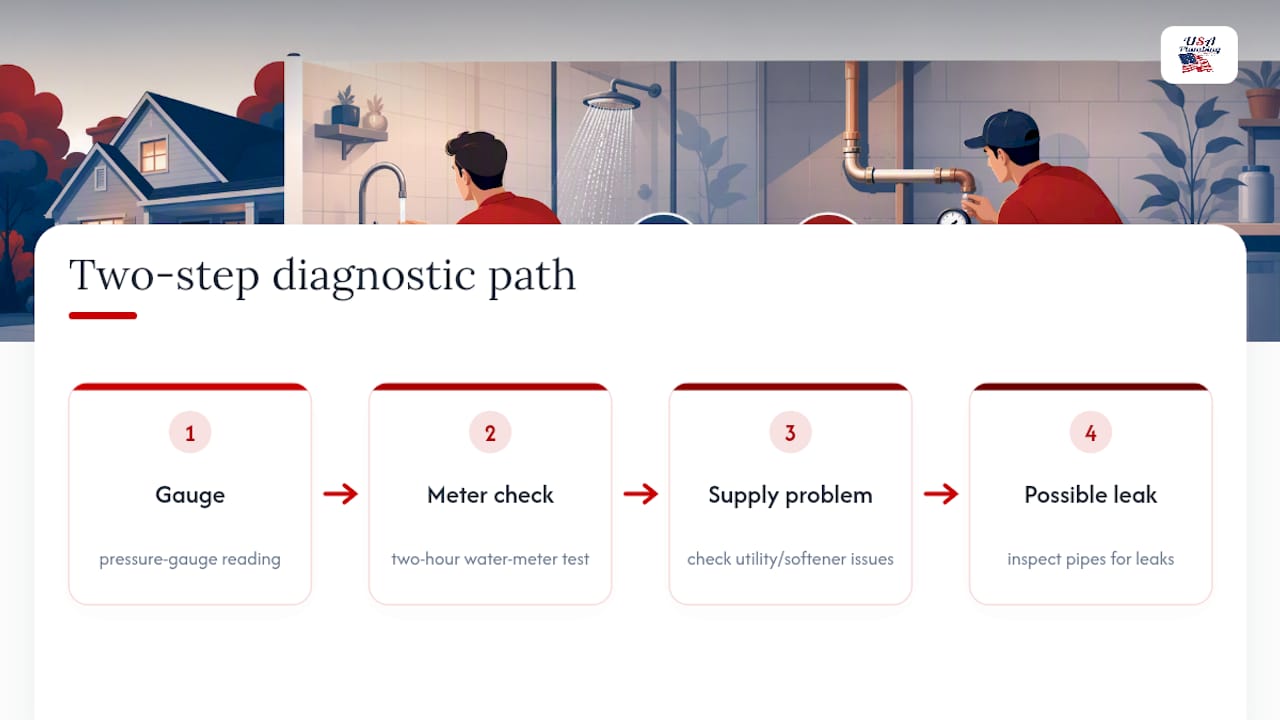
Most advice on this topic jumps straight to a list of ten possible causes and leaves you guessing which one applies. That's backward. The gauge test and the two-hour meter check exist precisely so you don't have to guess: they hand you a number, and the number tells you which half of the problem list to ignore entirely.
The bigger gap in conventional advice is treating every low-pressure complaint as a plumbing failure. Plenty of cases trace back to something boring, like a softener that needs a new resin bed or a utility running lower pressure during a summer demand peak. Homeowners tend to assume the worst and either panic or call for a repipe when a $10 aerator swap would have solved it.
If you take one thing from this guide, prioritize the sequence: gauge first, meter second, then work the cause list from most common to least. Skipping straight to "I probably need new pipes" wastes money and delays the fix that actually matters.
— JOHN
Get Your Water Pressure Checked by USA Plumbing and Septic LLC
Professional plumbing services can provide a definitive diagnosis in one visit. When tests point to more than a simple aerator clean, licensed plumbers can handle pressure testing, PRV replacement, leak detection, repiping, and booster pump installations.

A service visit typically starts with the same diagnostic sequence covered above, gauge readings, meter checks, and a PRV inspection, but backed by acoustic leak detection and camera equipment that finds what a homeowner can't. Because pressure problems don't wait for business hours, some plumbing services offer 24/7 emergency response for sudden drops and active leaks that require immediate attention. If your hose bib reading came back low or your meter kept spinning with everything off, book a service visit today and get it fixed before it turns into a bigger repair.
Authoritative Resources and Tools to Consult
- EPA home maintenance guidance on pressure ranges and testing
- EPA leak detection checklist for meter-based leak checks
- Municipal water pressure troubleshooting guidance for utility-side issues
- Checking for unexplained utility bill spikes as an early leak signal
Sources
- Home Maintenance | US EPA
- Detect and chase down leaks checklist | US EPA
- Troubleshooting drinking water quality: water pressure and flow | Portland Water
FAQ
How Do I Fix Sudden Low Water Pressure in My House?
Start with the hose bib gauge test to confirm whether the drop is whole-house or isolated to one fixture. A sudden whole-house drop usually points to a failed PRV or a new leak, both of which need a licensed plumber rather than a DIY fix.
How Do You Boost Low Water Pressure in a House?
Clean clogged aerators and showerheads first, since mineral buildup is the most common fixable cause. If the hose bib reading itself is under 40 PSI, a booster pump or PRV replacement is usually what restores normal flow.
How Much Does It Cost to Fix Low Water Pressure in a House?
Costs vary widely by cause: an aerator clean or valve swap costs little, while PRV replacement runs about $200 to $450 and a booster pump installation runs $800 to $1,800. A full repipe for badly scaled galvanized lines can reach $4,500 to $15,000 depending on house size and access.
What Are the Signs of Low Water Pressure in a House?
Weak flow from every faucet, a shower that struggles to rinse shampoo, and appliances like washing machines or dishwashers that take longer to fill are the clearest signs. A hose bib reading under 40 PSI confirms it's a whole-house issue rather than one stubborn fixture.
When Should I Call a Plumber Instead of Fixing It Myself?
Call immediately if the water meter keeps spinning with everything off, if pressure drops suddenly across the whole house, or if you notice damp spots or a warm patch on the slab floor. Some plumbing companies offer 24/7 emergency response for situations requiring immediate professional assistance.