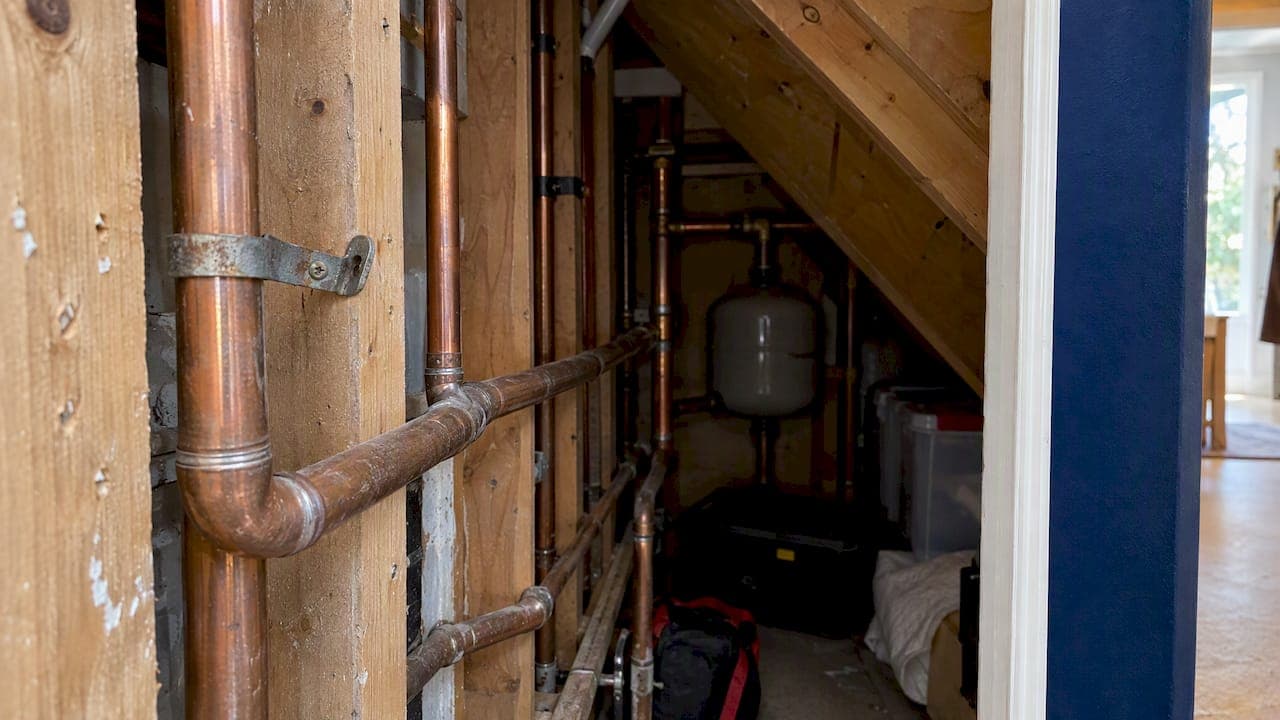
Noisy water pipes usually come from one of four things: a sudden stop in water flow (water hammer), high water pressure, loose or unsupported piping, or worn parts inside a valve or fixture. Some of these are cheap to fix. A few point to real damage or, in one case, a safety hazard. Below, we explain how to tell them apart by sound, what you can safely check yourself, and when it is time to call a licensed plumber in Bullhead City, Fort Mohave, Mohave Valley or Laughlin.
TL;DR
- Banging when a faucet, washing machine or dishwasher shuts off is almost always water hammer. It is a pressure shock, and it can wear on joints over time.
- Rattling or ticking along a wall is often a loose pipe strap, or hot pipes expanding and rubbing against framing.
- Whistling or squealing points to a worn washer, a partly closed valve, or high pressure forcing water through a small opening.
- A gurgling or banging sound near a gas water heater, plus soot or melted parts on top of it, is a different matter. Stop and call a professional about possible backdrafting.
- Persistent banging is not normal. Treat it as an early warning, not background noise.
Table of Contents
- Are water pipes supposed to make noise?
- Match the sound to the cause
- Water hammer: the most common cause
- Loose pipes and thermal expansion
- High water pressure and failing parts
- Air in the lines
- When the noise is near your gas water heater
- What you can safely check yourself
- Why you should not ignore it
- Our perspective: what we see on the job
- When to call a licensed plumber
- Need a plumber for noisy pipes in Bullhead City?
- FAQ
- Sources
Are water pipes supposed to make noise?
A little, yes. Pipes expand when hot water runs through them and contract as they cool, so you may hear a soft tick or creak. That is normal. Loud banging, shaking or repeated hammering is not.
Most plumbing noise is internal to the property's own piping. Utility guidance on pipe noise, such as this Scottish Water factsheet on noise in pipes, says the same: unless there is work on the public network, the cause is usually inside the building. That factsheet is from the UK, but the physics is the same in an Arizona house.
The useful question is not whether your pipes make noise. It is what kind of noise, and when it happens.
Match the sound to the cause
Start by listening. Note which fixture is running, whether it is hot or cold water, and whether the noise comes at the start, the middle or the end of use.
| What you hear | When it happens | Most likely cause |
|---|---|---|
| Single loud bang or thud | The moment a faucet, valve or appliance shuts off | Water hammer |
| Repeated hammering or chattering | While water runs, or when a toilet refills | Loose pipe, failing fill valve, high pressure |
| Ticking, creaking, scraping | Only with hot water, as pipes heat or cool | Thermal expansion against wood or straps |
| Whistling or squealing | While a faucet or valve is open | Worn washer, partly closed valve, high pressure |
| Sputtering, spitting, rushing air | When a faucet first opens | Air trapped in the line |
| Gurgling or banging by a gas water heater | During or after burner operation | Possible backdrafting, or sediment in the tank |
This is a starting point, not a diagnosis. Several causes can overlap in one house.
Water hammer: the most common cause
When you shut off a faucet, the moving water has nowhere to go. It stops suddenly and creates a pressure wave that travels back through the pipe. That wave is the bang you hear.
The force is not small. A HUD design guide for residential water supply plumbing notes that water hammer can produce instantaneous pressure surges of 300 to 400 psi. A 2024 experimental and numerical study of water hammer describes it as a result of rapid valve or pump operation that brings disruptive noise, intense vibration and potential damage to pipes and fittings.
What makes it worse
- Quick-closing valves. Washing machine and dishwasher solenoid valves shut in a fraction of a second. So do single-lever faucets that snap closed.
- High water pressure. The higher the pressure behind the water, the harder the shock when it stops.
- Loose piping. Unsecured pipes behind walls slam against framing when the pressure wave hits.
- Lost air cushion. Older homes may have had air chambers (short vertical pipe stubs) that absorbed shock. They can fill with water over time and stop working.
- Rigid pipe. Copper and galvanized steel do not flex. The HUD guide says properly secured PEX is significantly quieter than rigid systems because it can absorb pressure surges.
If you want to try a basic fix first, our guide to fixing water hammer with DIY repairs under $50 walks through the options. If the banging continues after that, the cause is usually deeper in the system.
Loose pipes and thermal expansion
If the noise is a rattle or a tick rather than a bang, look at how the pipes are held. Pipe straps loosen, and pipes that pass through wood framing can rub as they change length.
A pattern to watch for: noise only when hot water runs. The Scottish Water factsheet points to expansion and contraction of metal pipe rubbing against joists in that case, and says insulation or a cushioning material often solves it. For exposed pipe, a piece of rubber or old garden hose slipped behind a loose strap can quiet a rattle, a trick also described in HowStuffWorks' guide to fixing noisy pipes.
The catch is that most of these pipes are inside walls, floors and crawl spaces. If you cannot see or reach the problem point, a plumber can locate it without tearing out drywall.
High water pressure and failing parts
High pressure is a quiet troublemaker. It makes water hammer louder, makes faucets whistle, and stresses every fixture and appliance supply line in the house. A pressure reducing valve (PRV) at the main line is the usual control. Over the years a PRV can wear out or drift out of adjustment.
The Scottish Water factsheet also notes that a licensed plumber can tell whether a noise is a simple loose fitting or something more involved, such as a PRV adjustment. You can buy a pressure gauge that threads onto an outdoor hose bib, but reading it is the easy part. Deciding what to do about the number is where a plumber earns the visit.
Worn parts matter too. A whistling faucet often has a worn washer or cartridge. A toilet that bangs or shrieks as the tank refills usually has a tired fill valve. These are small repairs, and they are cheaper to do early than after a leak starts.

Air in the lines
Sputtering, spitting or a burst of air when a faucet first opens means air is trapped in the lines. It often shows up after the water has been shut off for work, a repair or a main valve change. Opening the highest faucet in the house and then the lowest, and letting each run until the flow is steady, clears many cases.
If air keeps coming back, something is letting it in, or the problem is not air at all. That is the time to have a plumber look.
When the noise is near your gas water heater
Most pipe noise is a nuisance. This one is a safety issue, so read it carefully.
Backdrafting is when combustion exhaust from a gas water heater spills back into the house instead of going up the flue. The Building America Solution Center lists the signs to look for, including soot residue and melted plastic parts on top of the unit. It also notes that a water heater can backdraft briefly at startup, until the vent connector warms up, but persistent backdrafting is a hazard.

A home inspection company explains that a backdrafting water heater will almost never set off a carbon monoxide alarm, so a quiet alarm is not proof that you are safe.
What causes it
- Blocked vent or chimney. Debris or nests can obstruct the flue. Structure Tech's second guide on backdrafting describes leaves, acorns, squirrels and even a dead bird blocking a draft hood.
- Depressurization. InterNACHI explains that fuel-fired water heaters and boilers often use household air. Exhaust fans, dryers and other equipment can pull more air out of the house than comes in, and draw exhaust back down the vent.
If you see soot, melted washers, a scorched draft hood, or smell exhaust near the heater, turn the heater off at its control, ventilate, and call a professional. Do not wait for a convenient day. If anyone has headaches, nausea or dizziness, get everyone outside and call 911.
Proper testing checks the draft at the hood and often the whole combustion zone of the house, not just the tank. That is work for a qualified technician. If your gas water heater is also popping or rumbling from sediment, read why your water heater pops and how to fix it. For gas piping concerns, see our page on gas line repair and replacement in Bullhead City.
What you can safely check yourself
These steps are low risk and can narrow things down before you call.
- Find the trigger. Run each fixture and appliance one at a time. Write down which one makes the noise and whether it is hot or cold.
- Check the visible pipes. In a garage, basement, crawl space or utility closet, look for pipes touching framing or hanging loose. Gently snug a loose strap.
- Cushion the contact points. Rubber or foam pipe insulation where metal meets wood can stop rattles.
- Open the high and low faucets to clear trapped air.
- Note the timing. Does it start after a new appliance, a repair, or a change in the neighborhood? That detail helps a plumber.
- Leave gas appliances alone. Do not open flue parts or adjust gas controls yourself.
What we do not recommend: cutting into walls, draining the system to "reset" air chambers without knowing your layout, or adjusting a PRV by guesswork. A wrong setting can raise pressure and make things worse.
Why you should not ignore it
Banging is not just annoying. Repeated pressure shocks work on joints, fittings and fasteners over time. A fitting that has been hammered for years can eventually fail, and a failed fitting inside a wall or ceiling becomes water damage fast. In a rental or commercial building, that means tenant claims and downtime.
Noise can also be a neighbor issue. In a condo or HOA community, a pipe that thumps all night can lead to complaints. If that is your situation, it helps to understand how an HOA noise complaint letter works, and then get the plumbing cause fixed, since that is what stops the complaint.
Our perspective: what we see on the job
We are a local plumbing and septic company, and noisy pipes are one of the most common reasons people call us without calling it an emergency. They live with the noise for months. Then it turns into a leak.
Here is how we look at it:
- Noise is information. A bang tells us pressure is spiking. A rattle tells us something is loose. A whistle tells us something is worn or restricted. We start by listening and by asking when it happens.
- We look at the whole system. A hammering washing machine line, a tired PRV and a loose strap can all be in the same house. Fixing one and ignoring the others means the noise comes back.
- Pipe material matters. Rigid copper and steel carry shock. When sections need repair or replacement, we can talk through whether PEX makes sense for that part of the house.
- Gas water heaters get extra care. Persistent backdrafting is a safety question, not a comfort question. We would rather you call early.
- Commercial buildings are no different. Property managers should treat repeated banging as a maintenance flag before it becomes a tenant complaint or a flooded suite.
We are available 24/7 for emergencies, and we serve Bullhead City and the surrounding area. Our goal is simple: find the cause, fix it right, and tell you plainly what we found.
— JOHN
When to call a licensed plumber
Call a plumber if any of these apply:
- Banging continues after you have tried the simple checks above.
- The noise is loud enough to shake pipes or walls.
- You see water stains, damp drywall, or drips near the noisy pipes.
- Water pressure seems high, or fixtures and supply lines keep leaking.
- You cannot reach the pipes causing the noise.
- The noise is near a gas water heater, or you see soot or melted parts.
- You are a landlord or property manager and tenants are complaining.
If you are choosing a plumber, our guide on how to hire a licensed plumber in your local area covers what to ask.
Need a plumber for noisy pipes in Bullhead City?
USA Plumbing and Septic LLC handles residential and commercial plumbing, including water heater repair and installation, faucet and fixture repair, water line leak detection and repair, gas line repair and emergency service. We serve Bullhead City, Fort Mohave, Mohave Valley and Laughlin. See our Bullhead City plumbing page, or visit our main site to reach us. Call now or book now, and we will find out what your pipes are telling you.
FAQ
How do you stop noisy water pipes?
It depends on the cause. Secure loose pipes, cushion places where metal touches wood, clear trapped air, and repair worn washers or fill valves. If the banging is water hammer from high pressure or a quick-closing valve, a plumber may add a water hammer arrestor or adjust or replace the pressure reducing valve.
Why are my water pipes suddenly noisy?
A sudden change usually has a trigger: a new appliance, recent plumbing work that let air in, a failing valve, or a rise in water pressure. Think about what changed just before the noise started. If you cannot find it, have a plumber check pressure and the main valves.
What does an airlock in pipes sound like?
Trapped air tends to sputter, spit or hiss when a faucet first opens, and sometimes causes a brief shudder. Running the highest and lowest faucets until the flow is steady often clears it. If it keeps returning, there may be a leak or a faulty valve letting air in.
Is water hammer dangerous?
It is rarely dangerous the first time, but repeated pressure shocks stress joints, fittings and fasteners. Over time that can lead to leaks. Fixing it early is cheaper than repairing water damage later.
Can a gas water heater make a gurgling or banging noise that is serious?
Yes. Sounds near a gas water heater plus soot, melted plastic parts or an exhaust smell can signal backdrafting, which can bring combustion gases into the house. Turn the heater off, ventilate, and call a professional right away.
Sources
- HUD: Design Guide, Residential PEX Water Supply Plumbing Systems
- Scottish Water: Noise in pipes factsheet
- Unveiling the impact of pipe materials on water hammer in pressure pipelines (PMC)
- Building America Solution Center: Look for Signs of a Gas Water Heater Backdrafting
- Structure Tech: Water heater backdrafting, how to test for proper draft
- Structure Tech: Water Heater Backdrafting, Part 2
- InterNACHI: Backdrafting
- HowStuffWorks: How to Fix Noisy Pipes