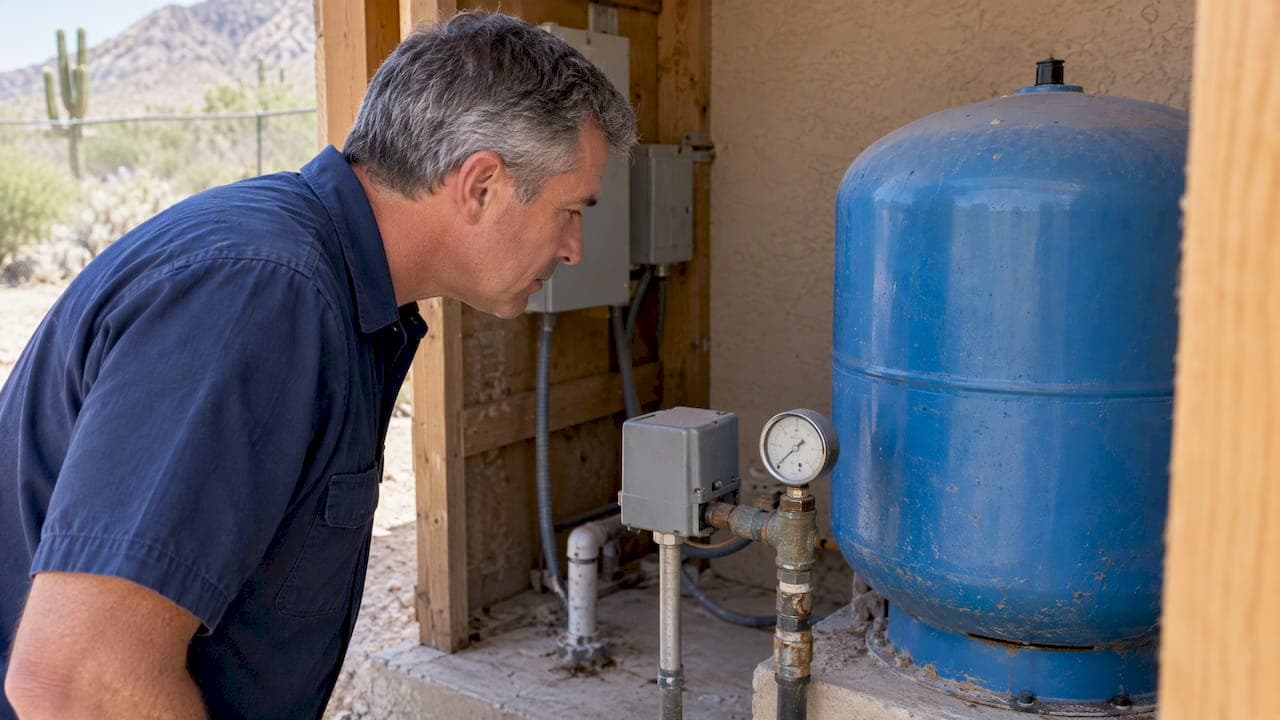
Low well water pressure most often comes from a waterlogged pressure tank, a worn pressure switch, a struggling pump, or a clogged filter. Three safe checks will point you toward the cause: reset the well breaker once, watch the pressure gauge while someone runs a tap, and bypass any whole-house filters to see if pressure returns. If the breaker trips again, the pump hums without starting, or you spot sand in the water, stop testing and call a licensed well technician.
TL;DR:
- At 30/50 or 40/60 psi, rapid cycling points to a tank or switch; a slow, continuous run suggests pump or well yield trouble.
- With power off and pressure relieved, water at the Schrader valve confirms a ruptured bladder; recharge a sound tank to 2 psi below cut-in.
- Many private wells yield 3 to 5 gallons per minute, and pressure that recovers after 20 to 30 minutes of rest suggests demand exceeded supply.
- A second breaker trip after one reset signals an electrical fault; leave pressure switch covers, which carry 240 volts, to a licensed technician.
- If pressure returns when you bypass a whole house filter or softener, the restriction is in that equipment, not the well or pump.
Table of Contents
- Quick 10-Minute Checklist for Homeowners
- Structured Diagnostic Procedure and Decision Points
- Cause-by-Cause Fixes and How to Verify the Repair
- When the Problem Needs a Licensed Well Technician
- What Hiring a Licensed Well Technician Actually Looks Like
- Our Take on Fixing Well Pressure Problems
- Get Your Well Pressure Diagnosed the Right Way
- FAQ
- Sources
Quick 10-Minute Checklist for Homeowners
Before you touch anything mechanical, figure out whether the problem is isolated or system-wide. A weak shower but a strong kitchen tap points to a clogged aerator or fixture valve, not the well. Pressure that's low everywhere points upstream, toward the tank, switch, pump, or the well itself.
Run through this order:
- Check one fixture versus the whole house. Turn on a tap in two different rooms to see if the drop is isolated or universal.
- Reset the well pump breaker once. This is the one electrical action safe for a homeowner, and it's covered in more detail in our guide to diagnosing well pump short cycling.
- Have someone run a tap steadily while you watch the pressure gauge on the tank. Note whether it builds slowly, cycles rapidly, or barely moves.
- Bypass whole-house filters or softeners and recheck pressure at a tap downstream of the bypass.
- Inspect aerators on affected fixtures for mineral buildup, and swap one to see if pressure improves.
- Look at the water itself. Sand, grit, or a sputtering tap during steady use suggests a well-intake problem, not a plumbing fixture.
- Think back on recent activity: new irrigation zones, a filled pool, or well work nearby can all cause a temporary drawdown.
Pro Tip: Write down exact gauge numbers and the time of day pressure drops. A technician diagnoses faster when you can say "45 psi at 7 AM, 15 psi by 7:15" instead of just "it's low."
For a shorter walk-through built for quick reference, our 6 fast checks for diagnosing low water pressure covers the same ground with added detail on fixture-level troubleshooting.
Structured Diagnostic Procedure and Decision Points
A pressure gauge tells most of the story once you know what to look for. Most residential well systems run on a 30/50 or 40/60 psi cycle: the pump kicks on at the lower number (cut-in) and shuts off at the higher number (cut-out). If your gauge never reaches cut-out, or it swings wildly between readings within seconds, you've found your first clue.
Here's the sequence to follow, in order:
- Read the static pressure with no taps running. It should sit near the cut-out number (50 or 60 psi, depending on your system).
- Open a tap and watch the drop rate. A healthy system dips a few psi and holds steady while water runs.
- Time the pump cycle. If the pump kicks on and off every few seconds while a single tap runs, that's short-cycling, almost always a tank or switch problem, not the pump itself.
- If the pump runs continuously and pressure builds slowly over a minute or more, suspect low well yield or a struggling pump rather than the tank.
- Isolate a fixture by closing its shutoff valve and rechecking whole-house pressure. If pressure recovers, the fixture itself (clogged aerator, corroded supply line) is the culprit.
- Bypass filtration equipment and recheck. If pressure jumps back to normal, the restriction is in the filter housing or softener resin bed, not upstream.
- Check the tank's air charge at the Schrader valve, but only with the system powered off and pressure relieved first. This valve looks like a bicycle tire valve, usually on top of the tank.
- Tap-test the tank. A hollow ring near the top means air, a solid thunk near the bottom means water. If water sprays from the Schrader valve itself, the bladder has ruptured.
Short-cycling is the single clearest signal in this whole process. According to Watersystemscouncil's technical guidance on well maintenance, a tank that's lost its air charge forces the pump to start and stop every few seconds because there's no cushion of compressed air left to push water out between cycles. That same resource confirms that water, rather than air, coming from the Schrader valve means the rubber bladder inside the tank has failed and needs replacement, not just a recharge.
Separating pump-related slow builds from supply-related slow builds takes one more test: let the system rest for 20 to 30 minutes, then try again. A well that's simply recovering from heavy demand regains pressure after rest. A failing pump or switch does not. The Well Guide's breakdown of the six common causes of low well pressure notes that this diagnostic pattern, rapid short-cycling pointing to the tank, slow builds with long pump runs pointing to pump or yield issues, reliably sorts most cases before a technician ever arrives.
Write down every reading and observation as you go. The exact numbers (cut-in psi, cut-out psi, time to recover after rest, filter bypass result) are what let a technician skip redundant testing and go straight to the repair.

Cause-by-Cause Fixes and How to Verify the Repair
Once you know the pattern your system is showing, you can match it to a likely cause and a realistic next step.
Pressure tank issues show up as short-cycling and a gauge that never holds steady. After confirming water at the Schrader valve or a dull thunk low on the tank, the fix depends on severity: a tank that's merely low on air charge can sometimes be recharged by draining it and adding air to the correct pre-charge pressure (usually 2 psi below cut-in). A ruptured bladder means replacement. Either way, verify the fix by watching the gauge through a full cycle. It should hold between cut-in and cut-out with no rapid cycling.
Pressure switches fail through worn or pitted electrical contacts, which can cause the pump to run constantly, never start, or cycle erratically even with a healthy tank. Homeowners can safely observe switch behavior from outside the cover, listening for clicking at the expected cut-in and cut-out points, but opening the switch housing or control box is 240V work. The Family Handyman guide to well pump troubleshooting notes that switch replacement is often inexpensive once diagnosed, but testing contacts directly requires a licensed electrician or well technician.
Pump and electrical problems often show up as humming without starting, repeated breaker trips, or a pump that runs but never builds pressure. A failed starting capacitor can mimic a dead pump while costing far less to fix. That same Family Handyman guide points out that a cracked drop pipe or failed check valve can also look like pump failure from the surface. If the breaker trips more than once after a reset, stop testing and call a professional; our guide to well pump replacement costs breaks down what a pump pull typically involves if it comes to that.
Clogged well screens and iron-bacterial fouling announce themselves through sand, grit, or sputtering during steady use. This points to the intake itself, not the plumbing, and usually requires a licensed well driller to clean or rehabilitate the screen.
Low well yield behaves differently from mechanical failure: pressure recovers after the system rests, worsens seasonally, and often coincides with drought or heavy simultaneous use. The Watersystemscouncil's information sheet on low water levels explains that many private wells yield only 3 to 5 gallons per minute, while a household running multiple fixtures at once often needs 5 GPM or more. Short-term fixes include adding storage capacity; long-term solutions range from re-drilling to managed delivery systems designed to even out demand on a low-yield well.
Clogged filters and treatment equipment are easy to overlook. Bypassing a softener or sediment filter and seeing pressure return confirms the restriction is there, not upstream. Fixes range from a new cartridge to resizing the micron rating for your water's sediment load.
| Likely cause | Key symptom | Typical fix | Who handles it |
|---|---|---|---|
| Waterlogged pressure tank | Rapid short-cycling | Recharge air or replace tank | Homeowner check, pro repair |
| Worn pressure switch | Erratic cycling, no cut-off | Switch replacement | Licensed technician |
| Pump or capacitor failure | Humming, repeated breaker trips | Capacitor swap or pump pull | Licensed technician |
| Clogged well screen | Sand or sputtering | Screen cleaning or rehab | Licensed well driller |
| Low well yield | Slow recovery after rest | Storage tank or re-drill | Licensed well contractor |
| Clogged filter or softener | Pressure returns on bypass | Cartridge swap or resize | Homeowner or pro |
When the Problem Needs a Licensed Well Technician
Some checks are safe for any homeowner to run, but it's important to order certified well testing in Maine before closing for private wells to ensure water quality and safety. Others cross into territory where the risk of electrical shock or well damage outweighs any savings from doing it yourself.
- Never open a pressure-switch cover or control box. Both carry 240V and are built for licensed electricians or well technicians.
- A breaker that trips a second time after one reset means an electrical fault, not a simple reset issue, and needs professional diagnosis.
- A pump that runs continuously but never builds pressure, hums without starting, or makes a loud grinding sound needs a technician before you run it any further.
- Any pump pull, well screen cleaning, or other down-hole work always requires a licensed well driller or contractor. This isn't a DIY category under any circumstances.
- Visible damage at the wellhead, cracked casing, or standing water pooling near the well deserves a call regardless of what the gauge shows.
Pro Tip: Bring your gauge readings, cycle timing, and filter bypass result to the call. A technician who already knows "cut-in at 28 psi, cut-out never reached, breaker tripped twice" can often bring the right part on the first visit.
The EPA's guidance on private drinking water wells reinforces this boundary directly: licensed well contractors are the right resource for mechanical or contamination problems, and homeowners who provide precise symptom details ahead of a service call get faster, more accurate repairs.
What Hiring a Licensed Well Technician Actually Looks Like
We've spent years working on wells and pressure systems throughout Bullhead City, Fort Mohave, Mohave Valley, and Laughlin, and the pattern above holds up on nearly every service call: most "dead pump" complaints turn out to be a tank, switch, or filter issue once someone checks the gauge properly. Our licensed plumbers start every well-pressure call the same way, confirming gauge readings, cycle behavior, and filter status before touching any equipment, which keeps unnecessary pump pulls to a minimum and keeps repair costs down.
Response times and repair costs vary by what's actually wrong, which is exactly why the checklist above matters: a switch swap is a different visit than a pump pull, and knowing which one you need before we arrive saves everyone time.
Our Take on Fixing Well Pressure Problems
Most advice on this topic jumps straight to "call a well guy," which wastes a homeowner's time and money on service calls for problems a five-minute gauge check would have caught. The conventional wisdom treats every pressure drop as a pump emergency, when in our experience the tank or a clogged filter is behind the problem far more often than the pump itself.
The part homeowners consistently underestimate is record-keeping. A gauge reading written down at the moment pressure dropped is worth more than a detailed phone description given an hour later. We'd rather see a homeowner run the breaker reset, the gauge test, and the filter bypass, then call with real numbers, than skip straight to guessing over the phone.
What matters most: know your system's cut-in and cut-out numbers before anything goes wrong. A baseline reading from a normal day is the single most useful thing you can hand a technician when something changes.
— JOHN
Get Your Well Pressure Diagnosed the Right Way
Running through gauge checks and filter bypasses gets you most of the way to an answer, but tracking down a ruptured bladder, a failing switch, or a struggling pump still calls for hands-on diagnosis. We handle water well equipment repair and replacement, pressure tank replacement, and filtration servicing, and we're available 24/7 for emergency calls when pressure drops without warning.

Before we arrive, have the following ready:
- Your gauge readings at cut-in and cut-out, plus how long the pump ran during your test.
- Whether pressure returned when you bypassed your filter or softener.
- A quick description of the problem: whole-house or single fixture, sudden or gradual.
- Photos of the pressure tank, gauge, and wellhead if you have them.
Contact us today to get a licensed technician out to diagnose the exact cause and get your pressure back to normal.
FAQ
Is 2 gallons a minute good for a well?
Two gallons per minute is on the low end for a household well. Many private wells yield between 3 and 5 gallons per minute, and a home running multiple fixtures at once typically needs 5 GPM or more to avoid simultaneous-use pressure drops.
How does a water pressure tank work?
A pressure tank stores water under a cushion of compressed air, releasing it through the plumbing system between pump cycles so the pump doesn't have to run every time a tap opens. When the air charge is lost or the internal bladder fails, the tank can't hold that cushion, which causes rapid short-cycling and uneven pressure.
Why is my well pump not able to reach 40 psi?
A pump that can't reach its expected cut-out pressure often points to a failing pressure switch, a worn pump, or a dropping water table rather than the pump motor itself. Checking whether pressure recovers after the system rests for 20 to 30 minutes helps separate a mechanical fault from a supply issue tied to well yield.
How to troubleshoot a pressure tank?
Start by checking the Schrader valve with the system powered off and pressure relieved: air should come out, not water. Then tap the tank near the top and bottom; a hollow ring near the top is normal, but water instead of air at the valve signals a ruptured bladder that needs tank replacement.
Sources
- Well Water Pressure Low: 6 Causes and How to Fix Each One | The Well Guide
- EPA — Private Drinking Water Wells
- Family Handyman — Well pump troubleshooting and DIY repair