A tankless water heater typically runs installed within a range that varies depending on unit type and installation complexity, with most whole-home projects landing between $1,800 and $3,500. Fuel type drives most of the swing: electric units skew cheaper unless your panel needs an upgrade, while gas condensing models cost more upfront but often pay you back through lower energy bills. Tankless makes the most sense if you're replacing an aging tank, want endless hot water, or need to free up floor space.
TL;DR:
- Installing a tankless water heater generally costs between $1,800 and $3,500, depending on fuel type, capacity, and installation complexity.
- Gas condensing units, though more expensive upfront at around $3,100 on average, offer better long-term savings in cold climates and larger households.
- Installation costs can rise significantly if utility work is needed, such as gas line upgrades up to $1,200 or electrical panel upgrades up to $3,000, especially during relocations or fuel switches.
- Proper sizing based on household GPM needs is crucial, with 4 to 6 GPM suitable for small homes and 6 to 10 GPM for larger families with multiple bathrooms.
- Site inspections before quoting can prevent surprise costs, as many variability factors like utility access and venting complexity influence final prices.
Table of Contents
- How Much Does a Tankless Water Heater Cost by Type and Size?
- What Drives Tankless Water Heater Installation Cost?
- How Do You Size a Tankless Water Heater for Your Home?
- Is a Tankless Water Heater Worth the Cost?
- What Does Tankless Water Heater Maintenance Cost Over Time?
- How Do You Get an Accurate Tankless Water Heater Quote?
- What Our Installers See on Tankless Water Heater Jobs
- Why Homeowners Overpay on Tankless Installs
- Get a Straight-Talk Tankless Quote From USA Plumbing and Septic LLC
- Sources
- FAQ
How Much Does a Tankless Water Heater Cost by Type and Size?
The unit itself is only part of the bill. What you actually pay depends heavily on fuel type, flow capacity, and whether your home needs extra plumbing or electrical work to support the new equipment.
Point-of-use units, the small ones installed under a sink or near a single fixture, are the cheapest entry point. Whole-home electric tankless heaters tend to cost less upfront than gas models, but that gap can vanish fast if your electrical panel can't handle the load. Gas condensing units, which recapture exhaust heat for higher efficiency, sit at the top of the price range but often deliver the best long-term value in cold climates.
Here's how the numbers typically break down, based on installed cost data from HVAC Base and This Old House:
- Point-of-use units: $400 to $700 installed, per SolarReviews
- Electric whole-home units: $1,150 to $3,100 installed, averaging around $1,800
- Gas non-condensing whole-home units: roughly $1,600 to $3,000 installed
- Gas condensing whole-home units: national average near $3,100, with some jobs reaching $5,500
| Unit Type | Typical Unit Price | Typical Installed Total | Best For |
|---|---|---|---|
| Point-of-use | $150–$300 | $400–$700 | Single sink, remote bathroom, workshop |
| Electric whole-home | $500–$1,500 | $1,150–$3,100 | Homes with existing 100+ amp panels |
| Gas non-condensing | $700–$1,800 | $1,600–$3,000 | Moderate hot-water demand, existing gas line |
| Gas condensing | $1,000–$2,000 | $2,400–$5,500 | Larger households, cold climates, long-term savings |
Flow rate, measured in gallons per minute (GPM), is the other half of the pricing equation. A unit rated for 2 to 4 GPM handles a single shower or sink comfortably and sits at the lower end of these ranges. Once you climb into 6 to 8 GPM territory, which covers two bathrooms running at once, you're usually looking at a bigger gas condensing unit and a higher installed cost. Homes that need 10 or more GPM, common in larger houses with multiple bathrooms and a dishwasher running simultaneously, often require either a high-capacity commercial-grade unit or two smaller units working together. Industry averages compiled by SolarReviews put the whole-home mid-point around $2,400, which is a useful benchmark when you're comparing quotes and want to know if you're in the normal range or getting quoted for extra work you don't need.
What Drives Tankless Water Heater Installation Cost?
The unit is rarely the expensive part. What turns a $1,500 job into a $4,000 job is almost always the supporting work: venting, gas lines, electrical capacity, and permits.
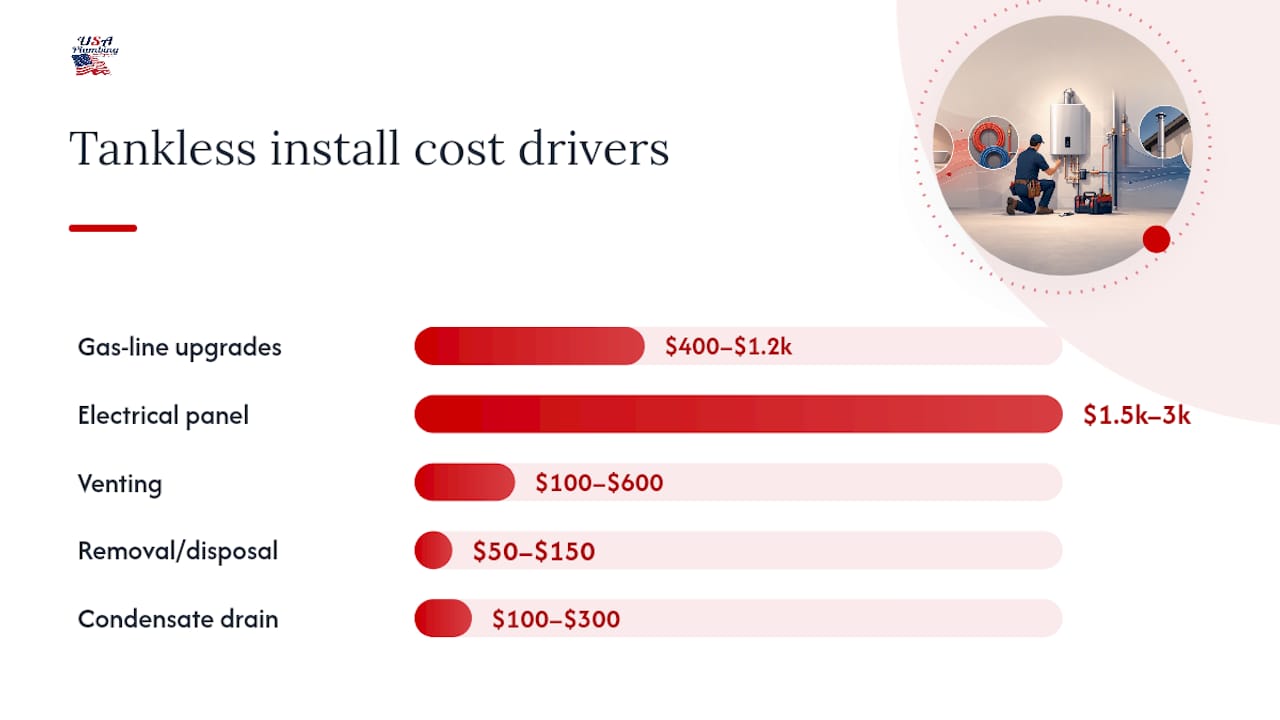
Labor for a straightforward swap typically runs a few hundred dollars, but permit fees, required in most jurisdictions for water heater replacements, add another layer. Here's where the real budget risk lives:
- Gas line upgrades or extensions: $400 to $1,200, especially if your existing line is undersized for the new unit's BTU demand
- Electrical panel upgrades: $1,500 to $3,000 when an electric tankless unit needs more amperage than your current panel provides
- Venting (condensing vs. non-condensing): $100 to $600, with condensing units using cheaper PVC venting and non-condensing units requiring pricier stainless steel
- Old unit removal and disposal: usually bundled into labor, but can run $50 to $150 separately
- Condensate drain or neutralizer: required for condensing gas units, typically $100 to $300
These figures come from detailed line-item breakdowns compiled by HVAC Base, and they explain why two quotes for "the same" installation can differ by thousands of dollars.
The scenario matters as much as the parts list. A like-for-like retrofit, swapping a tankless unit for another tankless unit in the same spot, is the cheapest and most predictable option because the venting and utility connections already exist. New construction installs cost less than retrofits per unit because the plumber can rough in exactly what's needed before drywall goes up. The expensive scenarios are relocation (moving the unit to a new spot in the house) and fuel switching (going from electric to gas or vice versa), because both typically require new venting and new utility runs at the same time. If your installer proposes moving your water heater from the garage to a closet on the other side of the house, expect the quote to reflect that.
Electrical work is worth calling out on its own. A panel upgrade for a whole-home electric tankless unit can add $1,500 to $3,000, and that single line item is often what flips the "cheaper" fuel choice into the pricier one once everything is totaled.
How Do You Size a Tankless Water Heater for Your Home?
Getting the size right matters more with tankless than with tank systems, because an undersized unit can't keep up when two showers run at once, and an oversized one wastes money on capacity you'll never use.
GPM measures how many gallons the unit can heat per minute. Each fixture in your house pulls a certain amount: a shower typically needs 1.5 to 2.5 GPM, a kitchen faucet around 1.5 GPM, and a dishwasher roughly 1 to 2 GPM. To size correctly, add up the GPM of fixtures you might realistically run at the same time, not every fixture in the house.
Here's how that plays out across common household sizes:
- 1 to 2 bedroom home, one bathroom: 2 to 4 GPM covers a single shower and sink running together. Expect the point-of-use or smaller electric whole-home tier, typically $1,150 to $2,000 installed.
- 2 to 3 bedroom home, two bathrooms: 4 to 6 GPM handles a shower plus a dishwasher or washing machine simultaneously. This usually lands in gas non-condensing territory, $1,600 to $3,000 installed.
- 4+ bedroom family home, multiple bathrooms: 6 to 10 GPM is common for households where two showers might run at once alongside laundry. Gas condensing units in the $2,400 to $5,500 range fit this demand level.
- Large homes or homes with soaking tubs/multiple simultaneous demands: Beyond 10 GPM, a single unit often can't keep up, and two units installed in parallel becomes the more reliable (and sometimes cheaper) path than one oversized commercial unit.
Pro Tip: If your household only struggles with hot water at one distant fixture, like a bathroom at the far end of the house, a small point-of-use booster near that fixture is usually far cheaper than upsizing your whole-home unit. This is also the fix for the 3 to 5 second delay tankless units have before hot water reaches the tap, since This Old House notes that instant hot water at every fixture requires a recirculation system, not just a bigger heater.
Is a Tankless Water Heater Worth the Cost?
The honest answer depends on your usage pattern and how long you plan to stay in the house. Energy confirms that demand-type water heaters can be more efficient than storage tanks, but the savings scale with how much hot water your household actually uses, not just the equipment itself.
The math that matters: A new-construction gas condensing install running $2,400 to $3,100 with strong, steady hot-water demand can offset its higher upfront cost through lower monthly energy use faster than a retrofit fighting extra venting and gas-line charges.
Retrofits carry a longer payback window simply because the installed cost starts higher once you add venting and line work on top of the unit itself. A household replacing a failing 40-gallon tank with a comparable electric tankless unit, minimal retrofit work, sits at the fast end of the payback spectrum. A household switching fuel types or relocating the unit will take longer to recoup the difference, even with identical energy savings.
Incentives change the math further, and 2026 is a transition year worth knowing about:
- Federal 25C tax credits for many water heater types expired December 31, 2025, so don't assume the credit you read about last year still applies.
- Utility rebates often matter more than federal programs now. Many require pre-approval before you buy, so check with your utility before signing a contract.
- DSIRE and your state energy office are the most reliable places to confirm what's currently active in your area, since programs shift year to year.
Tankless tends to deliver the best value for households with steady, moderate hot-water use or a strong preference for endless hot water and reclaimed closet space. If your household regularly demands more hot water than a single unit can deliver, the best water heater options for your home may include a hybrid approach rather than tankless alone.
What Does Tankless Water Heater Maintenance Cost Over Time?
A well-maintained tankless unit typically lasts 15 to 20 years, roughly double the 8 to 12 years you'd get from a standard tank, and most manufacturers back that with warranties covering the heat exchanger for 10 to 15 years and parts for 5 years.
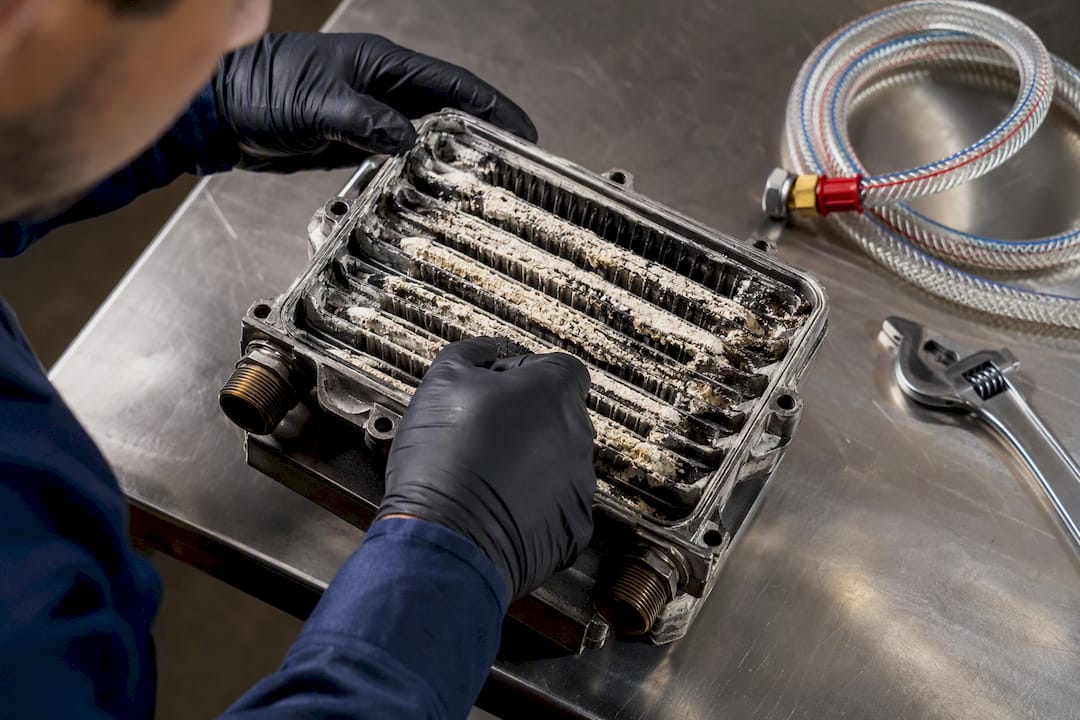
That lifespan isn't automatic, though. Mineral buildup inside the heat exchanger is the single biggest threat to both efficiency and longevity, and hard-water regions accelerate the problem considerably.
- Annual descaling and inspection: roughly $80 to $250 per year depending on water hardness and whether you're on a service plan
- Professional descaling frequency: every 1 to 3 years in hard-water areas; less often with soft water
- Filter changes and inline screen checks: usually part of a standard maintenance visit
- Common repair costs: igniter or sensor replacement typically runs $150 to $400; full heat exchanger replacement can run $500 to $1,000
Pro Tip: If you're in a hard-water area, ask about pairing your tankless heater with a water softening or filtration system. It costs more upfront but stretches out your descaling intervals and protects the heat exchanger, which is the most expensive part to replace.
Skipping maintenance doesn't just risk a bigger repair bill. It also quietly kills efficiency, since scale buildup makes the unit work harder to hit the same water temperature. If your existing unit is already acting up, our guide to common water heater problems walks through the signs that a repair, not a full replacement, might solve your issue.
How Do You Get an Accurate Tankless Water Heater Quote?
Quotes for "the same job" can vary by thousands of dollars because installers scope the work differently. Use this checklist before you compare bids:
- Confirm the exact unit model and efficiency rating the quote is based on, not just "gas tankless" or "electric tankless."
- Get the full scope of work in writing, including venting type, any gas line or electrical panel upgrades, permit fees, and old-unit haul-away.
- Ask what happens if hidden issues surface once work starts, like an undersized gas line discovered mid-install, and get that pricing in advance.
- Have your panel rating, gas meter size, and current unit location photos ready before the visit so the installer can quote accurately on the first try.
- Confirm warranty terms for both the manufacturer's coverage and the installer's labor warranty separately.
- Watch for vague line items like "miscellaneous materials" or "additional labor as needed" with no cap, since these are where surprise overcharges hide.
What Our Installers See on Tankless Water Heater Jobs
USA Plumbing and Septic LLC has run into plenty of surprises on tankless installs across Bullhead City and the surrounding area: undersized gas lines that need upsizing, tight closet installs with no real venting access, and hard-water buildup that shortens a unit's life fast. A typical job runs from same-day assessment to a finished install within a day or two once permits clear. We're available 24/7 for emergency plumbing and full installations alike.
Why Homeowners Overpay on Tankless Installs
Most cost guides treat tankless pricing like a single number, and that's exactly what gets homeowners into trouble. The real story is that two nearly identical houses can get wildly different quotes because one has a gas line rated for the new unit's BTU demand and the other doesn't.
Conventional advice tells you to "get three quotes." Fine advice, but it misses the point if you don't know what should be in those quotes. A contractor who quotes $1,800 and one who quotes $3,400 for the same electric whole-home unit aren't necessarily overcharging or underbidding each other. One probably found a panel that needs upgrading and the other didn't look closely enough to catch it yet.
If there's one thing worth prioritizing before anything else, it's this: ask your installer to physically inspect your panel, gas line, and install location before quoting, not after signing. That single step prevents most of the surprise change orders that turn a $2,000 budget into a $3,500 bill. The incentive landscape shifting in 2026 makes this even more urgent, since the rebate money that used to soften a bad estimate is no longer as reliable as it was.
— JOHN
Get a Straight-Talk Tankless Quote From USA Plumbing and Septic LLC
Big-box retailers and online calculators can give you a ballpark, but they can't see your gas line, your panel, or the tight closet you're hoping to fit a new unit into. USA Plumbing and Septic LLC inspects the actual site before quoting, so the number you get is the number you pay, not a low estimate that grows once work starts.

Our team serves Bullhead City, Fort Mohave, Mohave Valley, and Laughlin with residential and commercial plumbing, including tankless water heater installation, gas line work, and panel coordination when your electric unit needs it. A site visit includes a full inspection of your current setup, an honest read on whether tankless is the right call for your household size, and a written quote that covers unit, labor, venting, and any upgrades up front, no vague line items. If your current tank is failing or you're ready to plan a tankless upgrade, request a quote from our plumbing team and get a realistic number before you commit to anything.
Sources
- How Much Does a Tankless Water Heater Cost in 2026? (Unit + Installation) | HVAC Base
- How Much Does Tankless Water Heater Installation Cost? | This Old House
- How much does a tankless water heater cost? | SolarReviews
FAQ
How much does it cost to install a tankless hot water heater?
Most installations run $1,200 to $5,500 total, with whole-home electric units averaging around $1,800 and gas condensing units averaging closer to $3,100. Point-of-use units are the cheapest option at $400 to $700 installed.
Can I replace my 40-gallon water heater with a tankless water heater?
Yes, and it's one of the most common tankless upgrades, but the swap often requires venting changes and sometimes a gas line or electrical upgrade depending on your home's setup. A like-for-like retrofit in the same location is typically the most affordable version of this switch.
Is it worth switching to a tankless water heater?
It's usually worth it if you have steady, moderate hot-water demand, want endless hot water, or need the space back that a tank takes up, especially since tankless units commonly last 15 to 20 years versus 8 to 12 for a tank. It's a tougher call financially if your household needs very high simultaneous flow, since that may require multiple units and a bigger upfront investment.
What size tankless water heater do I need?
Add up the GPM of fixtures you'd realistically run at the same time. A 1 to 2 bathroom home usually needs 4 to 6 GPM, while a larger household with multiple bathrooms often needs 6 to 10 GPM or a two-unit setup.
Are there rebates available for tankless water heaters in 2026?
Federal 25C tax credits for many water heater types expired at the end of 2025, but utility rebates and state programs are often still active and sometimes more valuable. Check DSIRE and your local utility before purchasing, since some rebates require pre-approval.