
A point-of-use (POU) water heater is a compact unit installed directly at or immediately next to a single fixture — a sink, a shower, or a hand-wash station — to heat water on the spot rather than pulling it from a distant central tank. The industry term is "point-of-use water heater," and it solves one specific problem: hot water that takes too long to arrive or loses too much heat traveling through long pipe runs. ENERGY STAR recommends POU heaters for fixtures that are far from the main water heater and for households or businesses with low daily hot-water demand at that fixture. Manufacturers like A. O. Smith build both mini-tank and tankless POU models designed for exactly these situations.
Table of Contents
- How does a point-of-use heater work?
- Where do homeowners actually use POU heaters?
- Pros and cons of installing a POU heater
- What does point-of-use heater installation involve?
- When does a POU heater actually save energy?
- How to choose the right POU heater: a quick checklist
- Key Takeaways
- The case for getting the sizing right before you buy anything
- Reliable POU heater installation in Bullhead City and surrounding areas
- Useful sources
- FAQ
How does a point-of-use heater work?
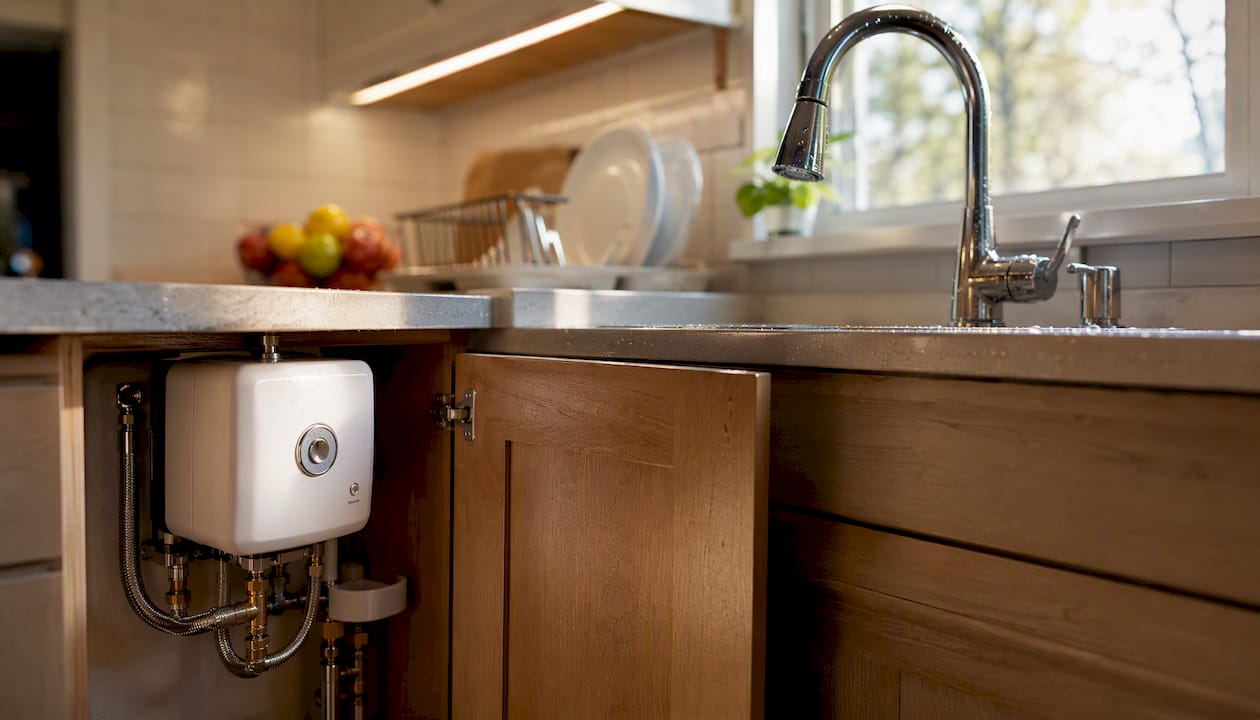
POU heaters heat water locally using one of two approaches. The first is a mini-tank unit, which stores a small volume of pre-heated water in an insulated tank right under the sink or in a nearby cabinet. The second is a tankless (on-demand) unit, which heats water only when the tap opens, passing cold water across electric resistance coils with no storage at all.
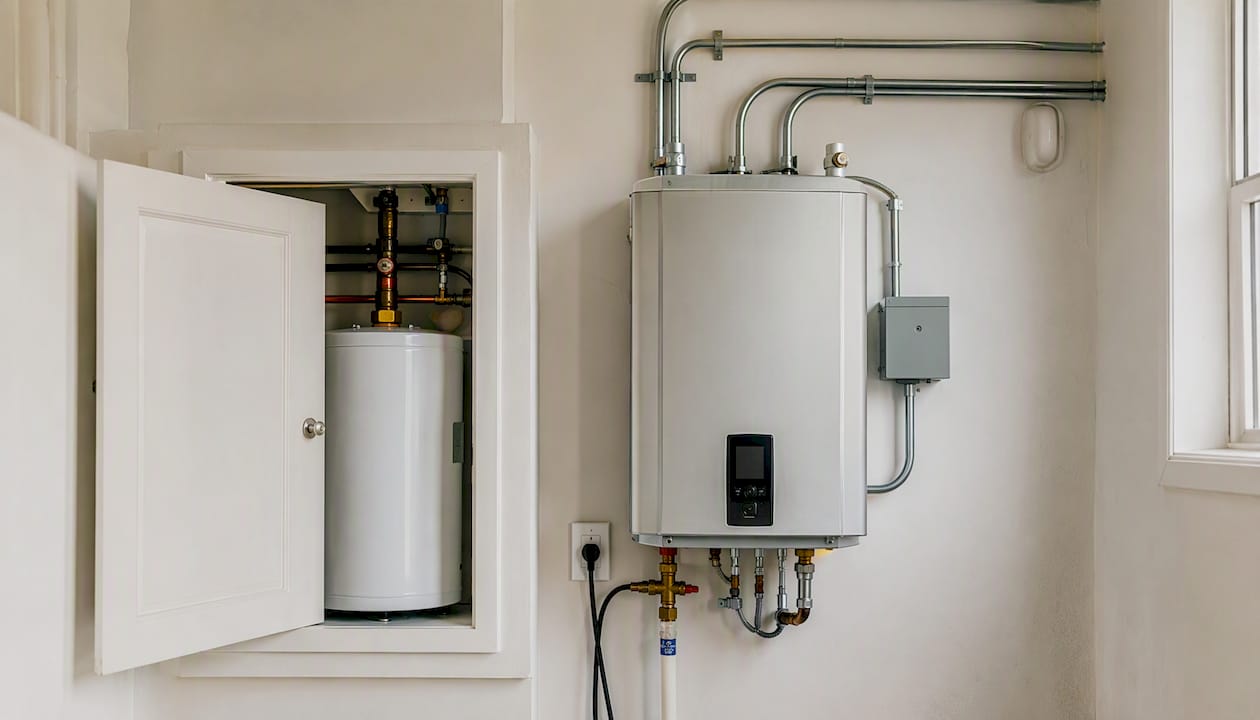
Both types are almost always electric at the point-of-use scale. Gas-powered POU units exist but are uncommon in residential settings because they require venting and a gas line close to the fixture. A. O. Smith's electric POU tankless line illustrates the typical form factor: wall-mounted, no venting required, sized for one or two outlets.
Mini-tank vs. tankless POU: quick comparison
| Feature | Mini-tank | Tankless (electric) |
|---|---|---|
| Hot water response | Immediate (stored) | Slight delay while coils heat |
| Capacity | 2–20 gallons, then waits to reheat | Unlimited, limited by flow rate |
| Size | Larger, needs cabinet or floor space | Very compact, wall-mounted |
| Best for | Sinks with moderate burst demand | Single low-flow fixtures |
| Electrical draw | Lower, steady | Higher, intermittent |
Key differences between point-of-use and whole-house tankless systems come down to scale: whole-house units are larger, often gas-powered, and sized for multiple simultaneous outlets. POU models are sized for one or two.
Where do homeowners actually use POU heaters?
The most common scenario is a kitchen or bathroom sink at the far end of the house. You turn on the tap, wait 45 seconds or more, and a cup of water goes down the drain before anything warm arrives. A POU unit under that sink eliminates the wait entirely.
Other practical applications include:
- Garage utility sinks — where running a hot-water line from the main heater would require significant re-piping
- Guest bathrooms — used infrequently, where keeping a long pipe run warm all day wastes energy
Pro Tip: Before assuming re-piping is the only fix for a slow-to-heat remote sink, ask your plumber to measure the actual pipe run length. Runs over 50 feet are prime candidates for a POU unit rather than a recirculation pump, which adds ongoing pump energy costs.
One limitation worth knowing: a single POU unit is not a whole-house solution. If your household runs the dishwasher, a shower, and a sink simultaneously, a POU at one fixture won't change what happens at the others. For whole-house demand issues, see why hot water runs out and whether a different approach fits better.
Pros and cons of installing a POU heater
Benefits of point-of-use heaters are real and measurable at the fixture level:
- Reduced water waste. No more running the tap waiting for warm water. The EPA's WaterSense program identifies reducing lag time to hot water as a direct path to lower household water consumption.
- Lower distribution heat loss. Long pipe runs bleed heat even when insulated. Installing a POU at the fixture cuts that loss entirely for that outlet.
- Space flexibility. Mini-tank units fit under most standard sinks. Tankless units mount on the wall in a cabinet or utility space.
- Lower standby energy use at the fixture. A POU unit heats only what you need, when you need it, rather than maintaining a large tank at temperature all day.
Limitations to weigh honestly:
- Flow rate caps mean a single tankless POU unit may not keep up with a high-flow showerhead or simultaneous demand.
- Upfront cost includes the unit plus labor, and sometimes an electrical panel upgrade for high-draw tankless models.
- Mini-tank units have a finite capacity. Once the stored volume is depleted, you wait for the tank to reheat.
- Not every fixture location has a nearby electrical outlet or adequate circuit capacity.
Pro Tip: Check your electrical panel before shopping. A 120V outlet under the sink can power a small mini-tank unit. A high-capacity tankless POU may need a dedicated 240V circuit, which changes the installation cost significantly.
What does point-of-use heater installation involve?
Installation is not a DIY project for most homeowners. Here's what a professional will typically address:
- Plumbing connections — The unit taps into the existing cold-water supply line and connects to the fixture's hot-water outlet. Shutoff valves on both sides are standard practice.
Typical cost drivers: unit price, labor hours, electrical upgrade scope, and permit fees. A straightforward under-sink mini-tank installation with an existing 120V outlet nearby is the least expensive scenario. A tankless unit requiring a new 240V circuit and a panel upgrade is the most expensive. Get itemized quotes that separate unit cost, labor, electrical work, and permit fees so you can compare accurately.
For commercial applications, commercial kitchen plumbing requirements add code considerations that a licensed plumber should review before installation.
When does a POU heater actually save energy?
A POU unit reduces energy use at a specific fixture by eliminating distribution heat loss through long pipe runs, which even insulated pipes experience over extended distances. That's a real, targeted saving. ENERGY STAR and the DOE both frame localized water heating as one of the most practical strategies for reducing hot-water energy consumption at problem fixtures.
POU makes the most sense when:
- Hot-water demand at that fixture is low and intermittent
- You're comparing it to raising the main tank's setpoint, which wastes energy at every other fixture too
- A hot-water recirculation system isn't practical due to layout or cost.
POU won't save much energy when:
- The home uses a solar or geothermal water-heating system that already minimizes standby losses
The DOE's energy-saving guidance puts POU in context alongside insulation, behavioral changes, and recirculation as complementary strategies, not competing ones. The right answer depends on your specific layout and usage pattern.
How to choose the right POU heater: a quick checklist
Before you buy a unit or book an installer, work through these questions:
- What is the fixture's flow rate (GPM)? Check the aerator label.
- What is the required temperature rise at your location?
- Does your electrical panel have capacity for the unit's circuit requirement?
- Is the installation location within reach of both a water line and an electrical source?
- Does the manufacturer's spec sheet confirm the unit meets your GPM-at-temperature-rise requirement?
- Is professional installation required to keep the warranty valid?
- Does the installer's quote include permits, electrical work, and a drain pan?
Red flags on a quote: vague language about "electrical as needed" with no circuit specification, no mention of permits, or a flat price that doesn't separate labor from materials. A reliable contractor itemizes every line.
When multiple POU units beat one larger unit: if you have two remote fixtures in different parts of the house, two smaller POU units placed at each fixture are often more efficient and less expensive than one large unit trying to serve both through extended pipe runs. For a broader look at types of water heaters and how POU fits into the full range of options, that resource covers the selection factors clearly.
Key Takeaways
A point-of-use water heater is the most targeted fix for a remote or low-demand fixture, and ENERGY STAR recommends it specifically for distant fixtures where distribution heat loss makes a central tank inefficient.
| Point | Details |
|---|---|
| Definition | A POU heater installs at a single fixture to deliver hot water locally, cutting wait time and pipe heat loss. |
| Best-fit scenarios | Use a POU for fixtures more than 50 feet from the main heater or with low, intermittent hot-water demand. |
| Sizing essentials | Match the unit's rated GPM at your required temperature rise to the fixture's actual flow rate before purchasing. |
| ENERGY STAR guidance | ENERGY STAR recommends POU units for distant, low-volume fixtures as a targeted energy-saving measure. |
| Usaplumbingseptic | For installation, sizing, and code compliance in Bullhead City and surrounding areas, call Usaplumbingseptic. |
The case for getting the sizing right before you buy anything
Most homeowners who end up disappointed with a POU heater bought the wrong unit for the fixture. Not the wrong brand. The wrong capacity. They saw a compact tankless unit on a shelf, assumed it would handle a shower, and found out after installation that it couldn't keep up at their inlet temperature. The sizing math in this article isn't optional reading. It's the difference between a fix that works and one that gets replaced in 18 months.
There's also a persistent myth that POU units are a DIY install. For a mini-tank unit with an existing 120V outlet right under the sink, a capable homeowner can manage the plumbing connections. The moment a new circuit is involved, that changes. Electrical work without a permit creates problems at resale and voids most manufacturer warranties. The cost of a licensed installation is almost always less than the cost of correcting unpermitted work later.
One more thing worth saying plainly: a POU heater is not always the answer. If your whole house runs out of hot water during a morning routine, a POU at one sink won't fix that. The right diagnostic starts with understanding where the demand problem actually lives, which is what a good plumber does before recommending any equipment.
Reliable POU heater installation in Bullhead City and surrounding areas
When you're ready to move from research to installation, Usaplumbingseptic is the local team to call. We handle plumbing services across Mohave County including POU water heater installation, electrical coordination, permit management, and manufacturer warranty compliance. Our licensed technicians serve Bullhead City, Fort Mohave, Mohave Valley, and Laughlin, and we're available 24/7 for both scheduled installs and emergency calls.
We'll assess your fixture's flow rate, check your panel capacity, and recommend the right unit for your specific situation before any work begins. No guesswork, no vague quotes. Call Usaplumbingseptic today to schedule your installation or get a straight answer about whether a POU unit is the right fix for your home or business.
Useful sources
- Point of Use (POU) Water Heaters | ENERGY STAR
- Water Heating | Energy Saver (energy.gov)
- Reduce hot water use | Energy Saver (energy.gov)
- Point-of-Use Electric Tankless Water Heaters | A. O. Smith
- How Tankless Water Heaters Work | HowStuffWorks
- Building America Report (DOE / EERE)
- WaterSense for homes | EPA
FAQ
What are the pros and cons of a point-of-use water heater?
The main benefits are faster hot water at the fixture, reduced water waste from long pipe runs, and lower distribution heat loss. The trade-offs are limited flow capacity, potential electrical upgrade costs, and the fact that a single POU unit won't address whole-house demand.
Can you take a shower with a point-of-use water heater?
A standard POU tankless unit typically handles 0.5–1.5 GPM, which falls short of most showerheads. A high-capacity mini-tank unit (15–20 gallons) or two units plumbed in parallel can supply a short, low-flow shower, but a plumber should confirm the temperature-rise math for your specific inlet conditions first.
What is a point-of-use heater for a shower?
For shower use, a POU heater needs to be rated for at least 2.0 GPM at your required temperature rise. Most single electric POU units are undersized for this; a mini-tank model with a 15–20 gallon capacity or a high-output tankless unit designed specifically for shower applications is the more realistic choice.
How long do point-of-use water heaters last?
Mini-tank POU units typically last several years with annual flushing and anode rod maintenance. Tankless electric POU units often reach 15–20 years because they have fewer components exposed to sediment buildup. Manufacturer warranty terms vary by model, so confirm coverage before purchasing.