Commercial water heaters are defined as high-capacity systems that heat large volumes of water rapidly using gas burners or electric elements sized for continuous business operation. Unlike residential units, commercial systems must meet the Uniform Plumbing Code and sustain output through peak demand periods without recovery delays. Understanding how commercial water heaters work is the difference between a facility that runs smoothly and one that fails during its busiest hour. Property managers who grasp the core mechanics make better decisions on sizing, maintenance, and energy costs.
How do commercial water heaters work?
Commercial water heaters function by drawing cold water into an insulated tank or heat exchanger, applying a high-BTU heat source, and delivering hot water at a controlled temperature to the distribution system. Gas-fired models use standing pilots or electronic ignition to fire burners rated from 75,000 BTU to over 1,000,000 BTU. Electric models use resistance elements or heat pump technology. The key performance standard is the First Hour Rating (FHR), which measures how many gallons a unit delivers in the first hour of operation starting with a full tank. FHR, not tank size alone, tells you whether a system can actually meet your peak load.
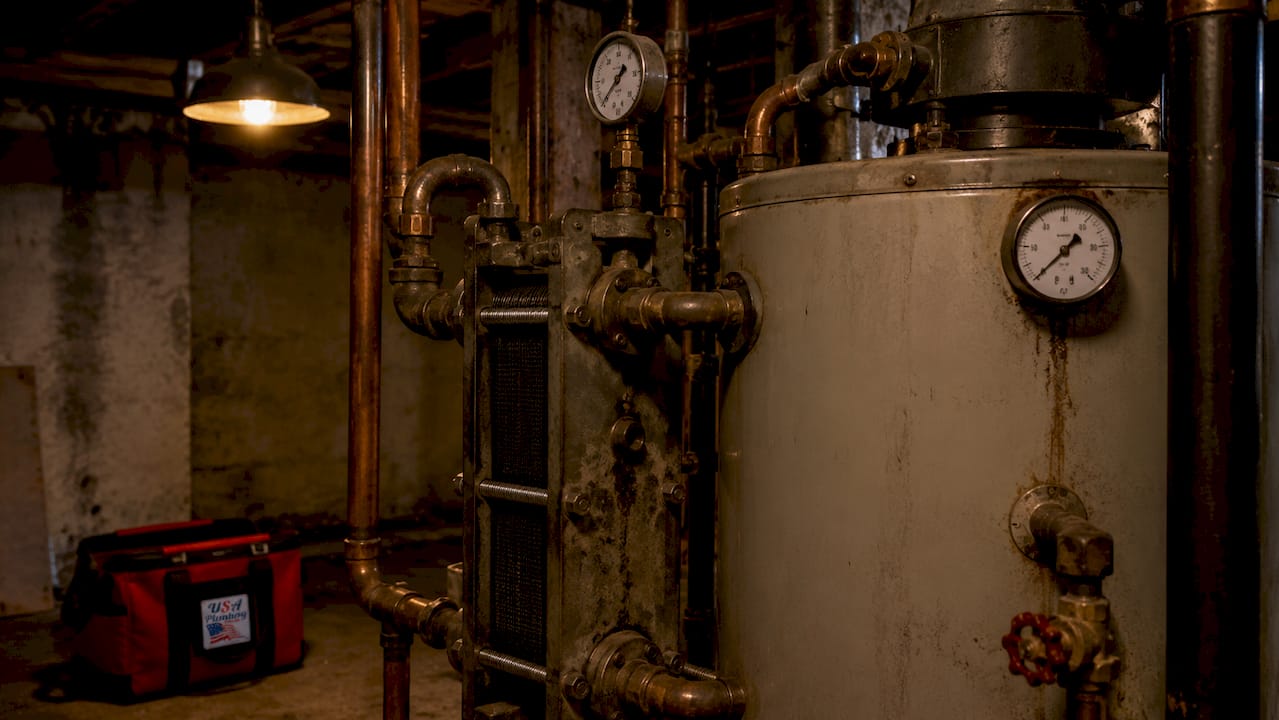
Recovery rate is the other critical metric. A unit with a large tank but a slow recovery rate will run out of hot water during a lunch rush or a hotel checkout surge. Commercial systems are engineered for fast recovery, which is why they carry significantly higher BTU ratings than residential units of similar tank volume. The Uniform Plumbing Code requires temperature and pressure (T&P) relief valves on every system, a non-negotiable safety device that prevents catastrophic failure if pressure or temperature exceeds safe limits.
What are the main types of commercial water heaters?
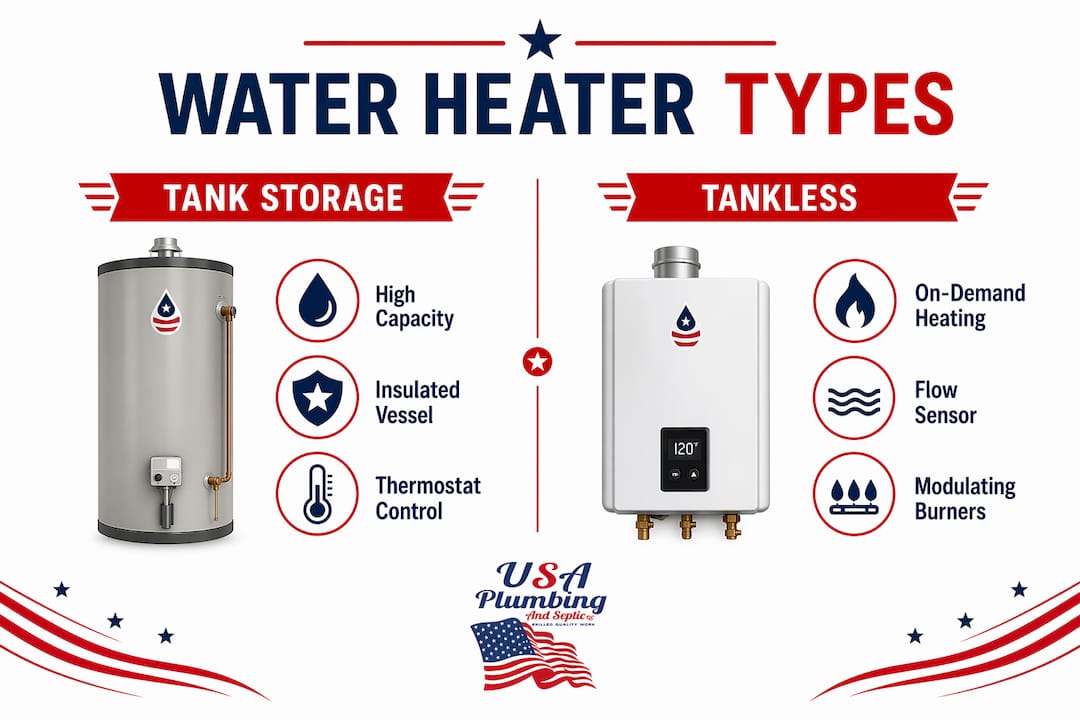
Three primary system types cover the majority of commercial applications: tank storage, tankless (also called on-demand), and heat pump water heaters. Each operates on a different principle and suits different facility profiles.
Tank storage systems
Tank storage units hold a pre-heated water reserve in an insulated vessel. A thermostat monitors water temperature and fires the burner or element when temperature drops below the setpoint. These systems excel at meeting sudden high-volume demand because the stored supply is immediately available. The trade-off is standby heat loss: the unit burns energy to keep water hot even when no one is drawing from it.
Tankless systems
Tankless commercial water heaters heat water only when a flow sensor detects demand, modulating burner output between 30% and 100% of rated BTU to match the flow rate. This on-demand approach reduces energy consumption by 24–34% compared to tank storage systems. The catch is simultaneous demand. A single tankless unit has a maximum flow rate, typically 5 to 20+ gallons per minute. Modular arrays or condensing configurations are required at commercial scale to handle multiple simultaneous draw points without a temperature drop.
Heat pump water heaters
Heat pump water heaters move ambient heat from the surrounding air into the water rather than generating heat directly. This process achieves a Coefficient of Performance between 3.0 and 4.5, meaning the system delivers 3 to 4.5 units of heat energy for every unit of electricity consumed. That translates to 60–75% less energy use compared to standard electric resistance heaters. Heat pump units perform best in warm climates or mechanical rooms where ambient air temperature stays above 50°F year-round.
| System type | Best application | Key metric | Energy profile |
|---|---|---|---|
| Tank storage | High simultaneous demand | First Hour Rating | Moderate; standby loss present |
| Tankless | Variable or intermittent demand | GPM flow rate | Low; no standby loss |
| Heat pump | Warm climates, energy-focused facilities | COP 3.0–4.5 | Lowest operating cost |
How is sizing a commercial water heater determined?
Sizing a commercial water heater on average daily use is the most common and costly mistake property managers make. The correct method uses Peak Hour Demand, the maximum volume of hot water your facility needs in any single hour of operation.
A 100-seat restaurant, for example, requires 200–300 gallons per hour during peak service, with dishwashing accounting for roughly 60% of that load. A unit sized for average daily consumption will fail every lunch and dinner service. The calculation works like this:
- List every hot water fixture and appliance in the facility.
- Assign each a peak-hour gallon demand based on usage frequency and flow rate.
- Total the simultaneous peak demand across all fixtures.
- Match that number to a unit's FHR, not its tank capacity alone.
- Add a 10–15% buffer for unexpected demand spikes or future expansion.
First Hour Rating and Peak Hour Demand are more reliable sizing benchmarks than tank volume. A 100-gallon tank with a slow burner can underperform a 75-gallon tank with a high-BTU input. Piping also matters. Undersizing supply lines, particularly failing to use 1-inch or larger diameter pipe, throttles flow regardless of how large the tank is. For commercial kitchen plumbing specifics, the kitchen plumbing requirements guide covers fixture-by-fixture demand in detail.
Pro Tip: Size for your busiest hour, not your average day. Pull your utility bills and identify the three highest-demand days of the year. Use those numbers as your sizing baseline.
What maintenance does a commercial water heater need?
Routine maintenance is the single biggest factor in system longevity and efficiency. Sediment buildup is the leading cause of premature commercial water heater failure. Minerals settle at the bottom of tank units, insulating the heat exchanger from the water above it and forcing the burner to run longer to reach setpoint. Tankless models face a different version of the same problem: mineral deposits clog the heat exchanger passages and reduce flow.
Key maintenance tasks for commercial systems include:
- Flushing the tank quarterly in hard water areas, annually in soft water regions, to clear sediment before it hardens into scale.
- Replacing anode rods every 2–3 years. Regular flushing and anode rod replacement can extend a tank unit's lifespan from 8–10 years to 12–15 years in hard water conditions.
- Descaling tankless heat exchangers annually using a food-grade descaling solution circulated through the unit.
- Inspecting T&P relief valves every six months to confirm they open and reseat correctly.
- Checking expansion tanks for correct pre-charge pressure. Undersized expansion tanks cause continuous T&P valve discharge and chronic leaks, a problem frequently overlooked during installation.
For a structured approach to scheduling these tasks, the commercial plumbing maintenance schedule guide provides a ready-to-use framework. If you are troubleshooting an existing unit, the common water heater problems resource covers the most frequent failure points and their fixes.
Pro Tip: In areas with hard water, like Bullhead City and the Tri-State region, flush tank units every 90 days. Hard water deposits scale faster than the annual schedule assumes, and a single neglected flush cycle can cut heat exchanger life in half.
How do installation and configuration affect efficiency and safety?
Installation decisions made on day one affect energy bills and safety for the life of the system. Gas-fired commercial units require correctly sized gas lines to deliver full BTU input at peak demand. An undersized gas line starves the burner and causes the unit to run at partial capacity, which extends recovery time and increases operating cost.
Venting is equally critical. Direct vent systems pull combustion air from outside and exhaust directly through a sealed flue, making them suitable for tight mechanical rooms. Forced exhaust (power vent) systems use a blower to push exhaust gases out, offering more flexible installation locations. Both must comply with local code and manufacturer clearance requirements.
Distributed hot water systems reduce energy-wasting pipe runs and lower Legionella risk by keeping water at consistent temperatures throughout large buildings. Centralized systems are simpler to maintain but require longer pipe runs that lose heat and create warm stagnant zones where Legionella bacteria can grow. The right choice depends on building size and layout.
| Configuration | Energy efficiency | Legionella risk | Best for |
|---|---|---|---|
| Centralized | Moderate | Higher in long runs | Compact buildings |
| Distributed | Higher | Lower | Large or multi-floor facilities |
| Recirculation loop | Highest | Lowest with proper temp | Hotels, hospitals, large commercial |
Temperature settings must match the application. Sanitizing dishwashers require 180°F at the machine. Handwashing stations operate safely at 110–120°F. Mixing valves at point of use allow the storage tank to hold water at 140°F (the threshold that kills Legionella) while delivering safe temperatures at fixtures. For large commercial pool facilities where water heating intersects with plumbing systems, commercial pool builders often coordinate directly with plumbing contractors on heating load calculations.
What I've learned about commercial water heater decisions
After years of working with commercial properties across the Bullhead City and Tri-State area, the pattern I see most often is this: property managers choose a water heater based on purchase price and tank size, then spend twice the savings on service calls within three years.
The tankless versus storage debate is real, but the answer is almost never one or the other. High-volume facilities with consistent peak demand, like full-service restaurants, almost always benefit from tank storage with a high BTU input. Facilities with variable demand, like office buildings or medical clinics, often do better with tankless or hybrid configurations. The facility's usage pattern decides the system, not the other way around.
The factor I see overlooked most often is peak hour demand calculation. Owners estimate it. They should measure it. Pull actual flow data from your facility during your three busiest hours of the week. That number is your sizing floor, not your average.
Warm climates like ours make heat pump water heaters genuinely attractive for the right application. A COP of 3.0 to 4.5 means real money saved monthly. But they need adequate air volume in the mechanical room and ambient temperatures that stay above 50°F. Install one in a cold, cramped room and the efficiency gains disappear.
Maintenance frequency should match your water quality, not a generic calendar. Hard water areas need more frequent attention. A commercial plumber service contract that includes scheduled flushing and inspection is worth the cost. It is far cheaper than an emergency replacement during your busiest season.
— JOHN
Usaplumbingseptic: your commercial water heater partner
Commercial water heater systems require professional installation, correct sizing, and consistent maintenance to perform reliably. Usaplumbingseptic serves commercial properties across Bullhead City, Fort Mohave, Mohave Valley, and Laughlin with 24/7 availability and a team experienced in commercial system installation and service.

We handle everything from initial sizing calculations and gas line work to annual maintenance contracts and emergency repairs. Our commercial plumbing services cover water heater installation, expansion tank sizing, T&P valve inspection, and full system diagnostics. Call us today to schedule a commercial water heater assessment and keep your facility running without interruption.
FAQ
What is the difference between FHR and tank size?
First Hour Rating measures how many gallons a unit delivers in the first hour of peak use, making it a more accurate performance indicator than tank capacity alone. A large tank with a low BTU input can have a lower FHR than a smaller, high-BTU unit.
How often should a commercial water heater be flushed?
Tank units in hard water areas should be flushed every 90 days. Soft water installations can follow an annual schedule. Regular flushing prevents sediment buildup, which is the leading cause of premature system failure.
Can a tankless system handle a full commercial kitchen?
A single tankless unit typically cannot meet the simultaneous demand of a full commercial kitchen. Modular arrays of tankless units or a condensing configuration are required to handle the 5 to 20+ gallons per minute that commercial kitchens demand at peak service.
What temperature should a commercial water heater be set to?
Storage tanks should be set to 140°F to prevent Legionella growth. Point-of-use mixing valves then blend the water down to 110–120°F for handwashing stations, while sanitizing dishwashers receive water at 180°F.
When does a commercial water heater need to be replaced?
A well-maintained tank unit lasts 12–15 years in hard water conditions with proper anode rod replacement and flushing. Units showing chronic T&P valve discharge, persistent sediment issues, or heat exchanger corrosion should be evaluated for replacement before they fail during peak operation.