A commercial plumbing maintenance schedule is a documented, recurring plan that assigns specific inspection and service tasks to every plumbing asset in your building. Facility managers and business owners who build this plan correctly avoid costly emergency repairs, pass compliance audits, and protect occupants from health risks like Legionella. The industry term for this practice is preventive maintenance planning, and it covers everything from monthly visual checks to annual backflow preventer certification. This guide walks you through the exact steps to create commercial plumbing maintenance schedule documentation that holds up under regulatory scrutiny.
What do you need before creating a commercial plumbing maintenance schedule?
The foundation of any effective plumbing maintenance plan is a complete asset inventory. Before you assign a single task or date, you need to know exactly what plumbing components exist in your building, where they are, and what condition they are in. Skipping this step produces a schedule full of gaps.
Start with these preparatory steps:
- Full system audit. Walk every floor and mechanical room. Catalog water heaters, backflow preventers, thermostatic mixing valves (TMVs), shutoff valves, drain lines, and P-traps. Record the make, model, installation date, and last service date for each asset.
- Building use and risk profile. A healthcare clinic carries far more risk than a retail store. Your risk profile determines how aggressive your inspection frequency needs to be. High-occupancy or water-intensive buildings require tighter intervals.
- Manufacturer specifications. Pull the service manuals for water heaters, TMVs, and backflow devices. Manufacturers specify minimum service intervals, and those intervals often set the floor for your schedule.
- Local compliance rules. Most jurisdictions require annual backflow testing by a state-certified Backflow Prevention Assembly Tester (BPAT), with records submitted to the water utility. Know your local requirements before you write a single task.
- Asset register and scheduling platform. Tools like SimPRO or a well-structured spreadsheet can hold your asset list, assign tasks, and send reminders when due dates approach. Digital compliance records reduce missed intervals and cut regulatory risk significantly.
Pro Tip: Start your asset register from the compliance-critical components first: backflow preventers, water heaters, and TMVs. These carry the highest regulatory and safety consequences if missed.
How often should you schedule inspections for each plumbing component?

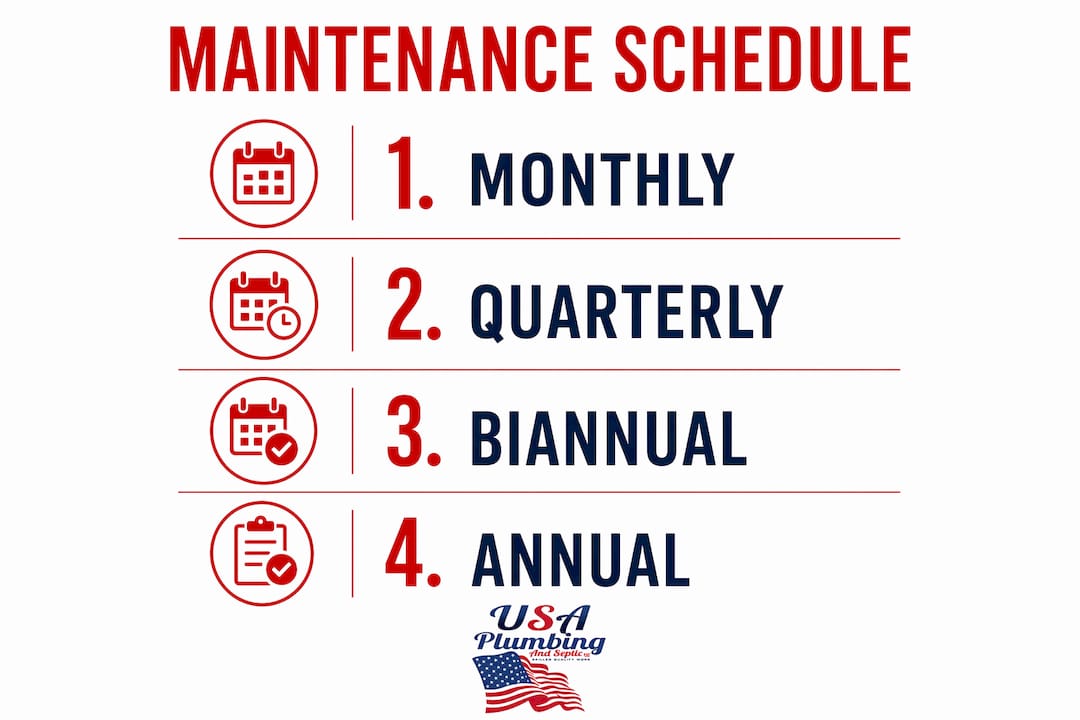
Frequency is the most misunderstood part of building a commercial plumbing schedule. The right interval depends on asset type, building occupancy, and risk level. A baseline maintenance cadence for most commercial facilities looks like this:
| Interval | Tasks |
|---|---|
| Monthly | Visual leak checks, emergency shutoff valve inspection, P-trap condition, T&P valve observation |
| Quarterly | Hydro-jetting high-use drain lines, camera inspections of main sewer lines, professional plumber walkthrough |
| Semi-annual | TMV servicing in healthcare and childcare facilities, T&P valve manual operation per manufacturer guidance |
| Annual | Backflow preventer certification, water heater flushing, full system audit, camera diagnostics for corrosion and root intrusion |
Monthly tasks are fast and low-cost. They catch small leaks before they become structural problems. Quarterly drain cleaning matters most in restaurants and food service buildings where grease accumulation is constant. Annual certification tasks like backflow testing are non-negotiable. Missing them puts your operating license at risk.
Pro Tip: Adjust your quarterly drain cleaning to monthly if your building houses a commercial kitchen. Grease and food debris build up far faster than in office or retail environments.
Which plumbing components must be on every commercial maintenance schedule?
Certain plumbing assets carry compliance and safety obligations that make them non-negotiable inclusions on any schedule. Leaving them out is not a documentation gap. It is a liability.
- Backflow prevention devices. These must be tested annually by a certified tester and records submitted to your water utility. Lack of backflow preventer certification is one of the most frequent compliance failures during audits.
- Commercial water heaters. Schedule monthly T&P valve observation, semi-annual manual valve operation, and annual flushing. Maintain water temperature above 140°F at the heater to reduce Legionella risk while managing scald hazards with mixing valves downstream. Review common water heater problems to know what warning signs to watch for between scheduled visits.
- Drainage and sewer lines. Quarterly hydro-jetting and annual camera inspections identify pipe corrosion, root intrusion, and joint failures before they cause costly disruptions. Learn more about commercial drain maintenance to understand what these inspections involve.
- Emergency shutoff valves. Check accessibility and confirm they operate freely every month. A shutoff valve that seizes during an emergency turns a minor leak into a flood.
- Thermostatic mixing valves (TMVs). These require semi-annual servicing in healthcare, childcare, and aged care facilities. TMVs control scald risk and are often subject to specific state health codes.
- Asset condition documentation. After every inspection, record the component condition, findings, and the next scheduled service date. This documentation is what protects you during a regulatory audit.
How to implement your schedule and stay compliance-ready
Building the schedule is only half the work. Execution and documentation determine whether your maintenance plan actually protects your business. Recurring documented inspections tied to assets are the single most impactful improvement a facility manager can make.
Follow these steps to put your schedule into practice:
- Load every asset into your register. Include the asset name, location, last service date, and next due date. This is your audit trail.
- Assign responsibility. Name a specific person or team for each task category. Unassigned tasks do not get done.
- Set automated reminders. Use scheduling software or calendar alerts to flag tasks 30 days before they are due. This prevents deadline surprises for annual certifications.
- Engage licensed professionals for compliance tasks. Backflow testing requires a state-certified BPAT. Water heater T&P valve verification requires confirming that discharge pipes route safely to prevent property damage. Do not assign these to general maintenance staff.
- Maintain audit-ready service reports. Every completed task should generate a report with the date, technician name, findings, and photos where applicable. Store these digitally so they are retrievable within minutes during an inspection. Review how to pass a plumbing health inspection for a detailed look at what inspectors check.
- Review and adjust the schedule annually. Building changes, new equipment, or occupancy shifts all affect maintenance needs. Treat your schedule as a living document.
Pro Tip: The two most common pitfalls are ad-hoc checks with no documentation and missed annual certification deadlines. Both are avoidable with a digital asset register that sends automatic reminders.
How should high-risk facilities adapt their maintenance schedule?
Standard intervals work for low-risk commercial buildings. Restaurants, healthcare facilities, childcare centers, and food processing plants need a different approach. High-risk facilities require semi-annual or more frequent inspections and specialized Legionella control measures.
Here is how to adapt your commercial plumbing upkeep schedule for sensitive environments:
- Restaurants and food service. Increase drain cleaning to monthly. Grease trap servicing should align with local health department requirements, often every 30–90 days. Check for common restaurant kitchen plumbing issues that accelerate between scheduled visits.
- Healthcare and childcare facilities. TMV servicing moves to semi-annual at minimum. Water heater temperature monitoring becomes a weekly task. ASHRAE Standard 188 requires a formal Water Management Program that includes mapping dead legs and low-use outlets as Legionella control points. Documented corrective actions must trigger when temperature thresholds are breached.
- Seasonal and occupancy-driven adjustments. A restaurant that doubles its covers during summer tourist season should increase drain inspections in may and june, before peak demand hits. A school building that sits empty for two months needs a full flush and temperature check before students return.
- Legionella risk management. Temperature monitoring alone is not enough. Your schedule must include mapping of dead legs, low-flow outlets, and infrequently used fixtures. Each control point needs a documented action trigger, not just a temperature reading. A well-structured HVAC preventive maintenance workflow for restaurants shows how other building systems handle this same risk-based scheduling logic.
The core principle is simple. Higher risk means shorter intervals and more documentation. Pair your plumbing schedule with a commercial HVAC checklist to cover all building system risks in one coordinated plan.
Key Takeaways
A well-built commercial plumbing maintenance schedule starts from your asset register, assigns frequency based on risk, and produces audit-ready documentation for every completed task.
| Point | Details |
|---|---|
| Start with an asset register | Catalog every plumbing component with its location, last service date, and next due date before scheduling anything. |
| Match frequency to risk | High-risk facilities like restaurants and healthcare buildings need shorter intervals than standard commercial properties. |
| Never skip backflow certification | Annual testing by a state-certified BPAT is a legal requirement, and missing it is a top compliance failure. |
| Document every completed task | Service reports with dates, findings, and photos are your protection during regulatory audits. |
| Use software for reminders | Digital scheduling tools prevent missed deadlines and keep your compliance records organized and retrievable. |
What I have learned managing plumbing schedules across building types
Starting from the asset register outward is not just good advice. It is the only approach that survives an audit. Every time I have seen a facility fail an inspection, the root cause was the same: tasks were being done, but they were not tied to specific assets with documented next-due dates. The inspector does not care that you "check the water heater regularly." They want a date, a technician name, and a result.
The other lesson that took time to learn is that building usage intensity should drive your schedule, not just asset type. Facility managers often underestimate how much a high-occupancy building accelerates wear on drains and water heaters. A water heater in a 50-room hotel works three times as hard as one in a small office. The maintenance interval should reflect that reality.
Technology makes this manageable. A platform like SimPRO or even a well-maintained spreadsheet with conditional formatting for overdue dates removes the mental load of tracking dozens of assets manually. The goal is a system that flags problems before they become emergencies, not one that records emergencies after the fact. Pair your schedule with a solid commercial plumber service contract so licensed professionals are already on call when certification deadlines arrive.
— JOHN
Professional commercial plumbing maintenance from Usaplumbingseptic
Usaplumbingseptic provides licensed commercial plumbing services across Bullhead City, Fort Mohave, Mohave Valley, and Laughlin. Our experienced team handles everything your maintenance schedule requires, from backflow preventer certification and water heater flushing to camera drain inspections and TMV servicing.
We keep your documentation audit-ready and your systems running without interruption. Our commercial plumbing services include compliance inspections, preventive maintenance programs, and 24/7 emergency response. When your schedule calls for a licensed professional, we are ready. Call us today or book online to get your maintenance plan started.
FAQ
What is a commercial plumbing maintenance schedule?
A commercial plumbing maintenance schedule is a documented plan that assigns recurring inspection and service tasks to every plumbing asset in a building. It covers monthly visual checks, quarterly drain cleaning, and annual compliance certifications like backflow preventer testing.
How often does a backflow preventer need to be tested?
Backflow prevention devices must be tested annually by a state-certified Backflow Prevention Assembly Tester, with results submitted to the local water utility. Missing this deadline is one of the most common commercial plumbing compliance failures.
What temperature should a commercial water heater be set to?
Maintain water temperature above 140°F at the heater to reduce Legionella risk. Use thermostatic mixing valves downstream to bring delivery temperature down to safe levels and prevent scalding at fixtures.
How do I adapt my maintenance schedule for a restaurant?
Restaurants need monthly drain cleaning instead of quarterly, given constant grease accumulation. Grease trap servicing frequency should match your local health department requirements, and drain camera inspections should run before peak seasonal periods.
What records do I need to keep for a plumbing compliance audit?
Auditors expect service reports for every completed task, including the date, technician name, findings, and test results. Audit-ready documentation tied to a named asset and a next-due date is the standard that regulators look for.