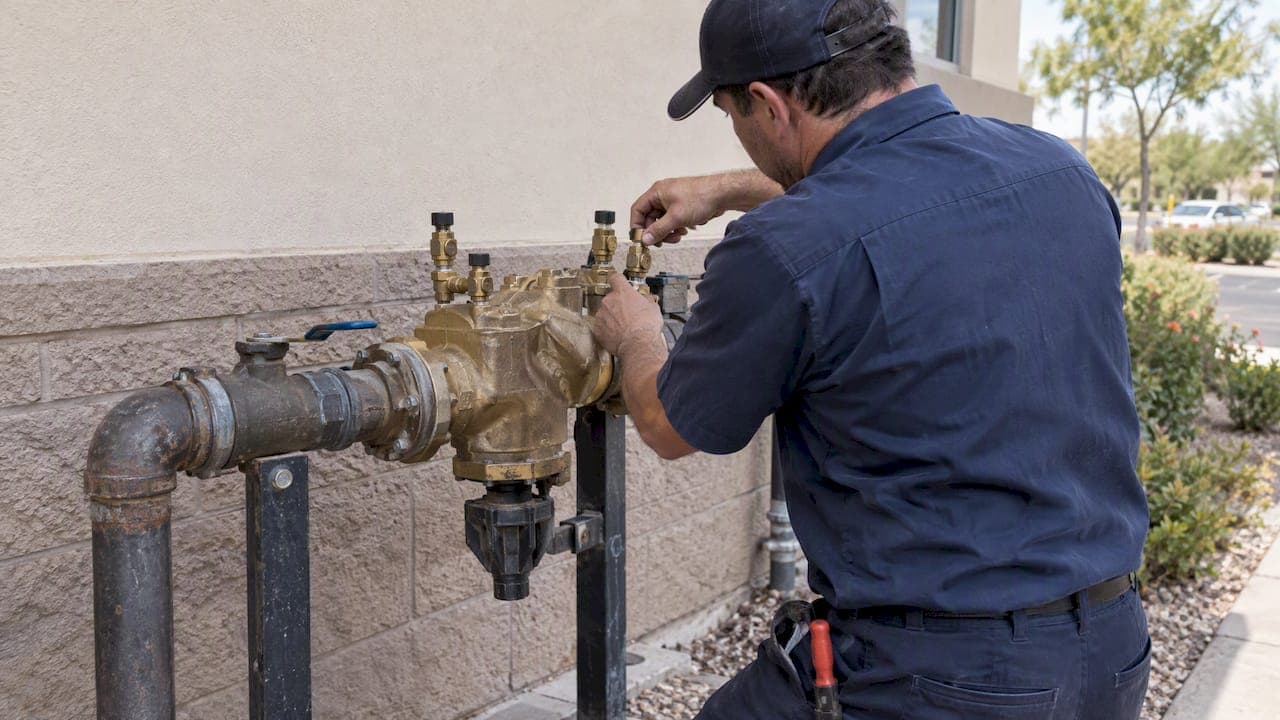
The main backflow preventer types are the air gap, reduced pressure zone assembly (RPZ), double-check valve assembly (DCVA), pressure vacuum breaker (PVB), atmospheric vacuum breaker (AVB), spill-resistant vacuum breaker (SVB), and hose-bibb vacuum breaker. An air gap delivers the highest level of protection against both backpressure and back-siphonage, while RPZ and DCVA assemblies are the mechanical devices used most often for health and non-health hazards. The right choice depends on your hazard level and what your local water utility requires.
TL;DR:
- Health hazard connections, including chemical feeds and boiler systems, typically need an RPZ or air gap; local utility rules determine the approved device.
- Connections without health hazards, such as irrigation or fire lines without chemical additives, use DCVAs, which tolerate continuous pressure but lack an RPZ relief valve.
- Irrigation lines without backpressure risk can use a PVB, SVB, or AVB, but only PVBs and SVBs can remain under continuous pressure.
- RPZ and DCVA assemblies require annual testing, which typically costs $75 to $180 per device, and both need accessible test ports for inspection and repair.
- Place assemblies where testers can reach them; blocked test cocks, inadequate elevation, or reversed installation can lead to rejected inspections.
Table of Contents
- 1. What each backflow preventer type does and where it belongs
- 2. How to choose the backflow preventer your property needs
- 3. Field notes from our plumbers on backflow installation mistakes
- 4. Plastic or brass: material differences that affect durability
- 5. Weighing the tradeoffs between device types
- 6. Which codes and regulations shape your installation
- 7. Spotting common failures before they become compliance problems
- 8. How long these devices last and what's typically covered
- 9. Warning signs that mean your device needs attention
- 10. Why hazard assessment matters more than brand or price
- Installation, testing, and repair when you're ready to move forward
- FAQ
- Sources
1. What each backflow preventer type does and where it belongs
Every property with a sprinkler system, fire line, or auxiliary water source has a cross-connection risk somewhere, and each device on this list handles that risk differently. We walk through these every week on service calls, so here is what each one actually does.
Air gap. An air gap is a physical separation, open to the atmosphere, between a water supply outlet and the flood level of a receiving fixture. It protects against both back-siphonage and backpressure, and it is considered the maximum level of protection available because there is no mechanical part that can fail under pressure. The separation has to measure at least twice the pipe's inner diameter and never less than 1 inch, which works fine for a kitchen faucet but becomes impractical for a pressurized irrigation line or a fire suppression system.
Reduced pressure zone assembly (RPZ). An RPZ uses two independently acting check valves with a relief valve in between that vents to the atmosphere if either check fails. This design protects against both backpressure and back-siphonage, which is why municipal cross-connection programs require it for health hazard connections such as boiler feeds, chemical injection systems, and commercial dishwashers. RPZs need annual testing by a certified tester and require accessible test cocks, typically with 12 to 36 inches of clearance above grade for inspection and repair.
Double-check valve assembly (DCVA). A DCVA also uses two check valves in series but has no relief valve, so it only protects against backflow when the check valves themselves hold. Utilities assign DCVAs to non-health hazard connections, things like irrigation systems on potable-only properties or fire sprinkler lines without chemical additives. Like the RPZ, a DCVA requires annual testing and accessible test ports, but it tolerates continuous pressure without the periodic discharge an RPZ produces.
PVB and SVB. Pressure vacuum breakers and spill-resistant vacuum breakers protect against back-siphonage only, not backpressure, which makes them a fit for irrigation and sprinkler systems rather than fire lines or health hazard connections. Both must be installed at least 12 inches above the highest downstream outlet, and both can remain under continuous pressure, unlike their atmospheric cousin. The SVB adds a feature that reduces the water discharge during testing, which matters indoors or anywhere spillover would cause damage.
AVB and hose-bibb vacuum breakers. Atmospheric vacuum breakers are simple, non-testable devices that protect against back-siphonage only, and they cannot sit under continuous pressure or have a shutoff valve downstream. Installation requires a minimum of 6 inches of clearance above the highest downstream outlet. Hose-bibb vacuum breakers are the small attachments that thread onto an outdoor spigot, cheap, effective for that single connection, and not a substitute for a tested assembly on a larger system.
- Air gap: maximum protection, no moving parts, needs physical clearance that many setups cannot spare.
- RPZ: protects against backpressure and back-siphonage, required for health hazards, needs annual testing.
- DCVA: protects non-health hazard connections, annual testing required, no relief valve.
- PVB/SVB: back-siphonage protection for irrigation, 12-inch clearance, continuous pressure rated.
- AVB/hose-bibb breaker: back-siphonage protection only, 6-inch clearance, not for continuous pressure.
Where a device sits also matters. Exterior assemblies on irrigation lines need to be accessible for a tester without digging or disassembling a fence line, while interior assemblies on boiler feeds or fire systems need clear access panels so a technician is not working blind. For more on where these connections typically live in a home's plumbing, our guide on how residential plumbing systems work walks through typical layouts.
Pro Tip: Check your assembly's test cocks before you call for service. If they are buried under mulch or boxed in by a fence panel, your technician will need extra time just to reach them, and that adds to the visit.

2. How to choose the backflow preventer your property needs
Picking the right device starts with identifying what kind of connection you have and what it could contaminate if backflow occurred. A sprinkler system, a fire line, a boiler feed, and an auxiliary well connection all carry different risk profiles, and your local water utility will have already classified most of them.
- Identify the connection type: irrigation, fire protection, auxiliary water source, or an internal hazard like a chemical feed.
- Assess the hazard level: a health hazard (chemicals, boiler additives) requires a higher level of protection than a non-health pollutant (plain irrigation water).
- Determine whether backpressure is possible, meaning a pump, boiler, or elevated system could push water back into the supply.
- Match the hazard to the device: health hazards typically call for an RPZ or an air gap, non-health hazards usually require a DCVA, and irrigation-only connections often work with a PVB, SVB, or AVB depending on pressure demands.
- Confirm clearance, test-cock access, and elevation requirements with your installer before the work begins.
- Contact your local cross-connection control program to confirm what your property specifically requires, since local rules can exceed general code minimums.
Annual testing commonly costs $75 to $180 per device, and most jurisdictions require that testing every year to keep your assembly certified. Budgeting for this upfront avoids surprises when your utility sends a compliance notice.
When you get quotes, ask the plumber to confirm elevation requirements, test-cock accessibility, and whether the existing plumbing supports the clearances the device needs. A mismatch here is one of the most common reasons inspections get rejected.
3. Field notes from our plumbers on backflow installation mistakes
Backflow installation, troubleshooting, and annual testing coordination services are available around the clock for residential and commercial customers. The most common issue we see in the field is a device mismatched to its hazard, an AVB installed where continuous pressure is needed, or a DCVA used where an RPZ was required. Insufficient clearance and reversed orientation cause the rest of the rejected inspections.
Before your plumber arrives, clear away any debris, mulch, or fencing blocking the assembly, and note whether the device has visible corrosion or standing water underneath it. An air gap works well for fixtures with easy physical separation, like a mop sink, but a pressurized irrigation or fire line almost always needs a mechanical assembly instead.
Pro Tip: If your assembly discharges water periodically from the relief valve, that is often normal RPZ operation, not necessarily a failure, but it is worth having a technician confirm.
— JOHN
4. Plastic or brass: material differences that affect durability
Most residential vacuum breakers and hose-bibb attachments use molded plastic housings, which keep costs down and resist corrosion from fertilizer or chemical residue common on irrigation lines. Plastic components handle light-duty, intermittent-use connections well, but they are more prone to UV degradation and cracking in freeze-thaw climates over time.
RPZ and DCVA assemblies, by contrast, are almost always bronze or brass-bodied, since these devices sit under continuous pressure and need to withstand repeated testing cycles without warping. Brass resists the internal wear that comes from check valves opening and closing thousands of times a year, and it holds up better against the mineral content found in many municipal water supplies. The tradeoff is weight and cost: a brass RPZ assembly is heavier to mount and pricier than a plastic AVB, but it is built for a job the plastic version was never meant to do.
Some commercial-grade assemblies now use epoxy-coated internals or stainless-steel springs to extend service life in corrosive environments, a detail worth asking about if your property has well water or high mineral content.
5. Weighing the tradeoffs between device types
An air gap offers the strongest protection with the fewest moving parts to fail, but the physical clearance it requires makes it impractical for pressurized lines, irrigation systems, and most fire protection setups. RPZ assemblies close that gap for pressurized connections, protecting against both backpressure and back-siphonage, though they require annual testing and periodic relief-valve discharge that can surprise an unprepared homeowner.
DCVAs cost less to install and maintain than RPZs and tolerate continuous pressure without discharging water, but they offer no backpressure protection and are not approved for health hazard connections. PVBs and SVBs handle irrigation systems well and allow continuous pressure, yet they only guard against back-siphonage, leaving them unsuitable for anywhere backpressure is a risk.

AVBs and hose-bibb breakers are the least expensive and simplest to install, requiring no annual test in most jurisdictions, but their restriction against continuous pressure and downstream shutoffs limits where they can legally go. Choosing among these always comes back to the hazard assessment and what your connection actually demands, not which device costs least upfront.
6. Which codes and regulations shape your installation
Backflow installation requirements trace back to the EPA's cross-connection control guidance, which sets the framework that device selection depends on hazard degree and the specific risk of back-siphonage versus backpressure. Individual states and municipalities then build their own cross-connection control programs on top of that framework, and those local rules are what actually govern your property.
Design and performance standards for the devices themselves come from ANSI/ASSE, where ASSE 1013 covers reduced pressure principle assemblies, ASSE 1015 covers double-check assemblies, and ASSE 1056 covers vacuum breaker assemblies. These standards define how a device has to perform under testing, not just how it is built.
Local water utilities and plumbing codes layer additional requirements on top, including which devices are approved for which hazard categories, how often testing is required, and who is authorized to perform it. Portland Water's guidance, for example, spells out specific elevation and access rules that inspectors enforce before signing off. Always confirm with your local cross-connection control program before installing or replacing an assembly, since local requirements can be stricter than the general code baseline.
7. Spotting common failures before they become compliance problems
The most frequent failure mode across all mechanical assemblies is a worn check valve seat, which lets water seep past when it should hold. On an RPZ, this often shows up as continuous or more frequent discharge from the relief valve, since the device is doing its job by venting pressure that should not be there. On a DCVA, a failing check valve is harder to spot without a test, since there is no relief valve to signal trouble.
Debris lodged in a valve seat is another common culprit, especially on properties with older galvanized piping or well water with sediment. A technician flushing the lines and cleaning the seats during annual testing often resolves this before it causes a failed test.
Freeze damage cracks housings on exterior assemblies that were not winterized, particularly plastic AVBs and PVBs left exposed through a cold snap. If you notice a crack, corrosion, or a device that will not hold pressure during a routine check, the fix is almost always a seat kit replacement or, for older assemblies, a full unit swap rather than a patch repair.
8. How long these devices last and what's typically covered
A well-maintained RPZ or DCVA assembly commonly lasts 10 to 15 years before internal components wear enough to need full replacement, though individual check valve seats and springs often get rebuilt well before that through routine testing and repair. Plastic AVBs and hose-bibb breakers have a shorter practical lifespan, especially in climates with hard freezes, and many homeowners replace them every few years rather than repair them.
Manufacturer warranties on backflow assemblies vary by brand and typically cover manufacturing defects in the body casting or internal components for a limited period after installation, not wear from normal testing cycles or water quality issues. Because warranty terms differ significantly between manufacturers, it is worth asking your installer for the specific coverage on the assembly going into your property rather than assuming a standard term applies.
Routine annual testing extends service life by catching worn seats and springs early, before they fail outright and force an emergency replacement instead of a planned repair.
9. Warning signs that mean your device needs attention
A handful of signs tell you a backflow preventer needs a look before its next scheduled test. Discolored or cloudy water coming from a connected fixture can indicate backflow has already occurred, and it warrants an immediate call rather than waiting for the annual test date.
Visible water pooling around the base of an RPZ outside of its normal testing discharge suggests a relief valve stuck open or a check valve that has failed. Reduced water pressure at fixtures downstream of the assembly can point to a clogged or partially closed valve inside the unit. Audible humming, chattering, or banging near the device when water is running often means a check valve is vibrating against a worn seat.
Visible corrosion, cracking, or rust streaking on the housing, especially on an exterior assembly that has been through a few winters, is a sign the unit is nearing the end of its service life even if it is still passing tests. If you notice cross-connection symptoms anywhere in your plumbing, our breakdown of cross-connection risk at home covers what else to check before calling a technician.
10. Why hazard assessment matters more than brand or price
Many property owners shop for a backflow preventer the way they would shop for a faucet, comparing price tags instead of starting with the hazard assessment. That backward approach is the single biggest reason we get called out to fix a device that passed inspection on paper but was wrong for the connection from day one.
The conventional advice tends to stop at "install a backflow preventer" without walking through which type the connection actually demands, leaving homeowners to guess or defer entirely to whatever a contractor had on the truck. What actually protects a property is matching the device to the hazard first, pressure behavior second, and budget a distant third.
If you take one thing from this guide, let it be this: call your local cross-connection control program before you call a plumber for a quote. Knowing your required protection level going in saves a failed inspection and a second service visit later.
— JOHN
Installation, testing, and repair when you're ready to move forward
We install, troubleshoot, and coordinate annual testing for backflow preventers on residential and commercial properties, and our team is available 24/7 when something needs attention outside business hours.
Whether you need a new assembly installed, a failed test diagnosed, or an annual certification scheduled, reach out through our main service page to request a site visit and get a quote. If you are in the Kingman area, our local plumbing page has direct scheduling options as well.
FAQ
What is a type 2 backflow preventer?
A type 2 designation typically refers to protection against back-siphonage only, which describes devices like PVBs, SVBs, and AVBs rather than assemblies rated for backpressure. Terminology varies by jurisdiction, so always confirm the local classification with your water utility before assuming which devices qualify.
What are the different types of backflow valves?
The common valve types are the air gap, reduced pressure zone assembly (RPZ), double-check valve assembly (DCVA), pressure vacuum breaker (PVB), spill-resistant vacuum breaker (SVB), atmospheric vacuum breaker (AVB), and hose-bibb vacuum breaker. Each one is rated for a different combination of hazard level and backpressure versus back-siphonage risk.
What is the most effective backflow preventer?
The air gap provides the highest level of protection against both backpressure and back-siphonage since it has no mechanical parts that can fail under pressure. It is often impractical for pressurized systems, though, which is why RPZ assemblies are the standard mechanical choice for health hazard connections instead.
What is the main difference between an RPZ and a double-check backflow preventer?
An RPZ includes a relief valve between its two check valves that vents to the atmosphere if either check fails, giving it protection against both backpressure and back-siphonage. A double-check assembly has no relief valve and only protects against back-siphonage and backpressure through the check valves themselves, which limits it to non-health hazard connections.
Sources
- EPA Cross-Connection Control manual
- Description of backflow preventers and their applications (JVWCD)
- Required levels of backflow protection (San Francisco Public Utilities Commission)
- Portland Water - Backflow assemblies guidance