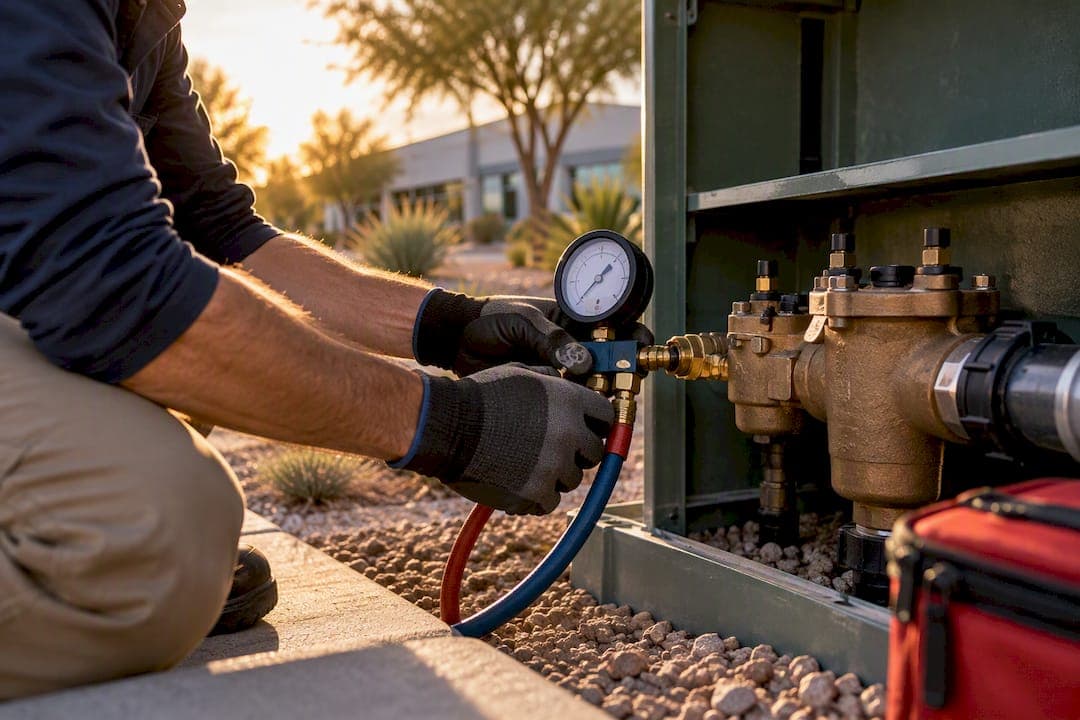
Backflow testing is legally required in most U.S. jurisdictions for any property with a testable backflow prevention assembly, and the burden falls on the owner, not the water utility. Most cities and utilities require testing at installation and then at least annually. If your municipality doesn't send you a reminder, you're still on the hook for scheduling a certified tester and getting the results filed on time.
TL;DR:
- Most U.S. jurisdictions require property owners to schedule certified backflow testing at installation and annually, regardless of utility reminders.
- Testing must be performed by a Certified Backflow Assembly Tester whose certification number and gauge calibration date are verified on-site before testing.
- The most common devices, including RP, DCVA, and PVB/SVB, require annual testing, with additional retests triggered by repairs, relocations, or depressurization events.
- Proper filing of test results via approved portals is crucial; missed deadlines often lead to violations, even if the test was successful.
- Costs generally range from $75 to $180 per device, with testing durations from 20 to 45 minutes, and scheduling earlier in the year can help avoid delays.
Table of Contents
- What Counts as Backflow, and Why Your Property Might Be at Risk
- Who Actually Sets the Rules: Federal, State, and Local Layers
- Who's Legally Allowed to Test Your Device
- Which Devices Need Testing, and How Often
- How the Test Actually Works, and What Pass or Fail Looks Like
- Filing Results, Deadlines, and What Happens if You Miss One
- What Backflow Testing Actually Costs and How Long It Takes
- A Practical Checklist Before, During, and After the Test
- Where Compliance Actually Breaks Down in the Field
- Get Certified Backflow Testing Done Right the First Time
- Where to Verify Your Local Requirements
- Sources
- FAQ
What Counts as Backflow, and Why Your Property Might Be at Risk
Backflow happens when water flows the wrong direction through a pipe. Instead of moving from the public main into your building, pressure changes push water (and whatever's mixed into it) back toward the drinking water supply. A cross-connection is any point where your plumbing links to a non-potable source. That's where the danger lives.
Most homes and businesses have more of these connections than owners realize. If your property has any of the following, you almost certainly need a testable backflow prevention assembly and a testing schedule to match:
- Irrigation or sprinkler systems tied into the potable water line
- Swimming pools or hot tubs with auto-fill connections
- Boilers, chillers, or hydronic heating systems
- Commercial cooling towers
- Car washes or industrial rinse systems
- Fire sprinkler systems
The public health rationale is straightforward: a contaminated cross-connection can pull fertilizer, pool chemicals, or bacteria into the municipal water main, putting an entire block's water supply at risk. That's the exact scenario cross-connection control programs exist to prevent.
Who Actually Sets the Rules: Federal, State, and Local Layers
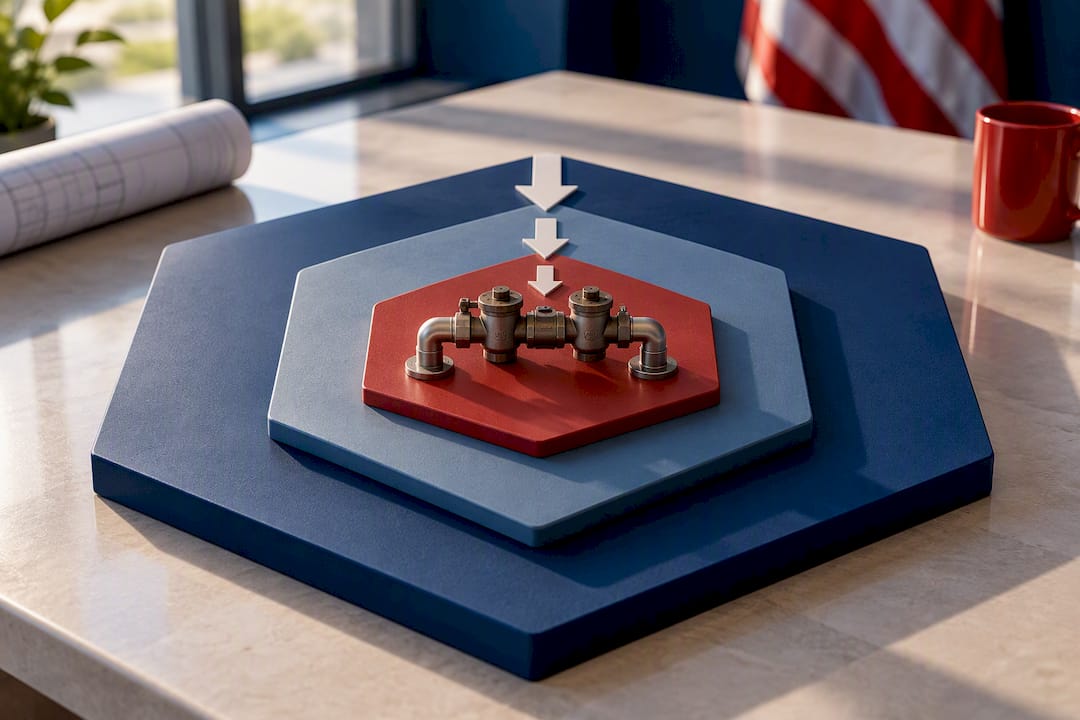
There's no single national backflow law. What you have instead is a layered system, and understanding the layers helps explain why requirements vary from one city limit to the next.
The Safe Drinking Water Act gives the EPA authority to set national standards for public water systems, and it's the reason cross-connection control exists as a regulatory category at all. From there, states adopt plumbing codes, often built on International Code Council model language, and hand enforcement down to individual utilities and municipal water departments.
That's why the specifics differ by address:
- Testing frequency (annual versus biennial for certain low-hazard devices)
- Which reporting portal or form the utility accepts
- Fee structures and enforcement timelines
- Which device types require registration at all
The federal layer sets the "why." Your city or water utility sets the "how often" and "through which form." As the property owner or manager, you're responsible for scheduling the test itself and confirming the results reach the utility, even though a licensed tester performs the physical work. The utility's job is enforcement and recordkeeping, not chasing you down before a deadline.
Who's Legally Allowed to Test Your Device
A general plumbing license doesn't automatically qualify someone to test backflow assemblies. Municipalities require a separate, specific credential, and skipping this step is one of the fastest ways to get a report rejected.
- Confirm the tester holds a Certified Backflow Assembly Tester (BAT) credential. Recognition typically comes through programs tied to organizations like the American Water Works Association or the American Backflow Prevention Association, or a state/municipal-approved equivalent.
- Ask to see the certification number before the test, not after. SAWS requires that number to appear directly on the Test & Maintenance report, and utilities elsewhere follow the same pattern.
- Check the gauge calibration date. A tester using an out-of-date differential pressure gauge can produce results your municipality won't accept, no matter how skilled the tester is.
- Cross-reference your utility's approved-tester list. Most municipal cross-connection programs publish one online, and using a name off that list avoids a rejected filing later.
Which Devices Need Testing, and How Often
Not every backflow device gets tested on the same clock. The device type and the hazard level of the connection both drive the schedule.
The three assemblies you'll run into most often:
- Reduced Pressure Zone assemblies (RP/RPZ): used on high-hazard connections like fire systems, boilers, and commercial equipment
- Double Check Valve Assemblies (DCVA): used on moderate-hazard connections, common in irrigation and some commercial applications
- Pressure Vacuum Breakers and Spill-Resistant Vacuum Breakers (PVB/SVB): common on residential irrigation systems
Most jurisdictions require testing at installation, then annually after that for RP and DCVA assemblies. Some municipalities allow less frequent testing on specific low-hazard residential irrigation devices, but that's the exception, not the default, so verify it locally rather than assuming it applies to you.
Outside the annual cycle, certain events trigger an immediate retest regardless of when your last test happened:
- New installation or replacement of the device
- Any repair to the assembly, even a minor seal replacement
- A depressurization event on the water main
- Physical relocation of the device
Skip one of these triggers and you're technically out of compliance even if your last annual test passed with no issues.
How the Test Actually Works, and What Pass or Fail Looks Like
A certified tester isolates the assembly from the water system, attaches a calibrated differential pressure gauge, bleeds the air from the lines, and reads the values in a specific sequence dictated by the device type. This isn't guesswork; it follows standardized field procedures that municipal programs across the country recognize.
Pro Tip: Ask your tester to walk you through the actual gauge readings during the test, not just hand you a pass slip afterward. Owners who understand their own numbers catch calibration or paperwork problems faster the next time around.
Common benchmarks testers check against include:
- RP relief valve opening at roughly 2.0 psid
- Double check valves holding a differential of roughly 1.0 psid
- Confirmation of the exact threshold your local authority having jurisdiction (AHJ) requires, since numbers can shift slightly by program
A passing field reading only counts once it's documented correctly. Every test needs a completed Test & Maintenance (T&M) report listing the tester's certification number and the gauge's calibration date. Keep your own copy, and separately confirm the utility received and accepted it. A test that passes in the field but never gets filed properly still leaves you out of compliance.
Filing Results, Deadlines, and What Happens if You Miss One
Once the test is done, someone has to get the paperwork to the utility, and increasingly that happens through a third-party portal rather than a paper form handed across a counter.
- Many municipal programs, including Fort Lauderdale's cross-connection control program, route submissions through BSI Online, a centralized platform used by cities nationwide.
- Other utilities run their own internal systems and expect the tester or owner to upload results directly.
- Reminder timelines usually follow a pattern: a courtesy notice well ahead of the due date, a final notice if nothing's filed, and a termination warning if the account stays non-compliant.
Here's the part owners get wrong most often: not receiving a reminder doesn't excuse a missed deadline. Municipal systems are built around the device's testing anniversary, not a calendar year, and enforcement runs on autopilot whether or not the notice reached your inbox.
Pro Tip: If you receive a violation notice, don't wait for a second one. Call your utility's cross-connection division directly, confirm exactly what's missing from your file, and get a corrected test scheduled before the next enforcement step, which is often a written fine followed by water service termination.
What Backflow Testing Actually Costs and How Long It Takes
Pricing depends on device size, how accessible it is, and whether repairs come up mid-test. In the United States, expect to budget roughly $75 to $180 per device for a standard test, with commercial-grade or hard-to-reach assemblies running toward the higher end.
Scheduling notes worth building into your annual budget:
- A single-device test typically takes 20 to 45 minutes on-site
- Multi-device commercial properties should plan for a longer visit and possibly a follow-up trip
- Booking during spring, right as irrigation systems get reactivated, means longer lead times, so scheduling in late winter often gets you a faster appointment
- If a device fails, a repair (worn seal, stuck relief valve, faulty check) usually means a mandatory retest, adding both time and cost before your filing is accepted
A Practical Checklist Before, During, and After the Test
Getting this right isn't complicated, but it does require a bit of organization ahead of your appointment.
- Before the test: Confirm your device ID, check your local AHJ's specific requirements, and verify the tester's certification covers your device type. Arrange site access and any building permits the visit requires.
- During the test: Ask to see the gauge's calibration date in person. Request your copy of the completed T&M report on the spot, and confirm the tester's certification number is printed on it.
- After the test: File your copy somewhere you can find it next year, and separately confirm with your utility that the report was received and accepted, not just submitted.
Pro Tip: A T&M report missing either the certification number or the gauge calibration date is the single most common reason municipalities reject a filing. Check both before the tester leaves your property, not after you get a rejection notice.
Where Compliance Actually Breaks Down in the Field
Most backflow compliance failures aren't caused by a bad test. They're caused by bad paperwork attached to a perfectly good test. An uncalibrated gauge, a tester whose certification doesn't match the device type, or a T&M report missing the calibration date will get a filing bounced back just as fast as an actual failed assembly.
The fix is almost always the same: confirm upload before you consider the job done, request a stamped and complete T&M form on the spot, and schedule your annual test a few weeks ahead of your municipal deadline rather than the week of it. A licensed plumbing contractor handling both the test and any needed repair in one visit tends to close these gaps faster than juggling separate vendors for testing and fixes.
— JOHN
Get Certified Backflow Testing Done Right the First Time
A direct alternative to juggling a separate tester, a separate repair plumber, and a separate filing headache is a team that handles certified backflow testing, on-site repairs when a device fails, and submission to your municipal portal, all in one visit, so you're not stuck coordinating three vendors to satisfy one deadline.
We serve property owners and commercial managers in various local areas, with trained plumbers available 24/7 for emergency issues alongside scheduled compliance work. Before you book any tester, ask to see their certification number and gauge calibration date, we'll gladly show ours on request, and we'll leave you with a complete, stamped T&M report for your records. If you want a straightforward look at what testing your specific devices might run, request a written estimate through our main service page or check availability for your area through our Kingman service page. Get your test scheduled before your municipal deadline creeps up on you.
Where to Verify Your Local Requirements
Check the EPA's Safe Drinking Water Act summary for the federal framework, then confirm exact local rules through your city or utility's cross-connection program page, since requirements shift by address.
This article is general information, not a substitute for advice from a qualified lawyer. Consult a qualified legal professional about your own circumstances before acting on anything here.
Sources
- Backflow / Cross-Connection | City of Fort Lauderdale, FL
- Summary of the Safe Drinking Water Act
- Backflow assembly test procedure field guide for testers - Anvilfield
- Backflow Prevention FAQs - San Antonio Water System (SAWS)
FAQ
Is backflow testing mandatory?
Yes, for any property with a testable backflow prevention assembly, most U.S. municipalities legally require testing, typically at installation and then annually. Exact frequency and enforcement rules vary by local program, so always confirm your specific city or utility's schedule.
Who can test a backflow device?
Only a Certified Backflow Assembly Tester (BAT) can perform a test municipalities will accept, and a general plumbing license alone usually isn't sufficient. Certification commonly comes through programs recognized by organizations like AWWA or ABPA, and the tester's certification number must appear on the Test & Maintenance report.
Is a backflow preventer required by code?
Most model plumbing codes, including guidance referenced by the International Code Council, require backflow prevention on cross-connections that pose a health hazard, such as irrigation systems and fire lines. Whether your specific property needs one depends on local code adoption and the type of connection involved.
Is a backflow preventer required by code in Florida?
Florida municipalities, including programs like Fort Lauderdale's cross-connection control program, generally require backflow prevention assemblies on hazardous connections and mandate annual testing with results filed through systems like BSI Online. Requirements can differ by county and utility, so verify with your specific local water provider.
What does backflow testing cost in Bullhead City?
USA Plumbing and Septic LLC's documented pricing reference puts typical U.S. backflow testing costs at $75 to $180 per device, depending on device size and accessibility. Request a written estimate for your exact device count and site conditions before scheduling.