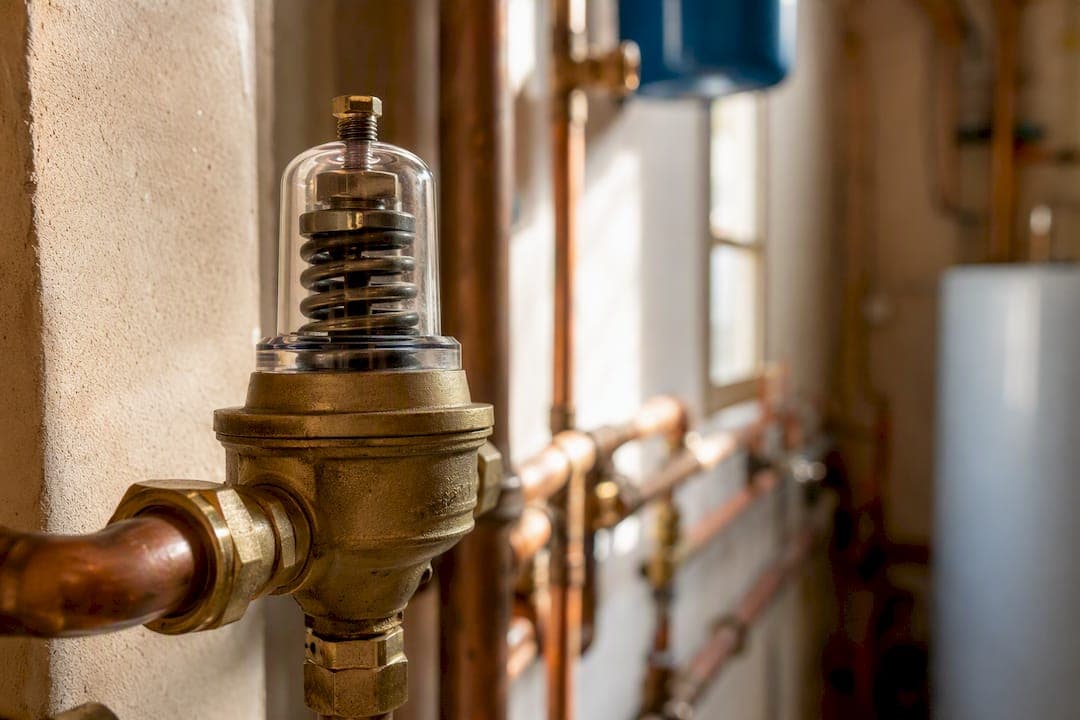
A pressure regulator reduces a higher, often unstable inlet pressure to a steady, lower outlet pressure through a force-balance mechanism, a spring or dome pushes a valve open while outlet pressure pushes back to close it, settling at the point you've dialed in. That balance point holds steady even as flow demand or supply pressure shifts upstream.
You'll run into a handful of regulator types on the job or in your own utility room:
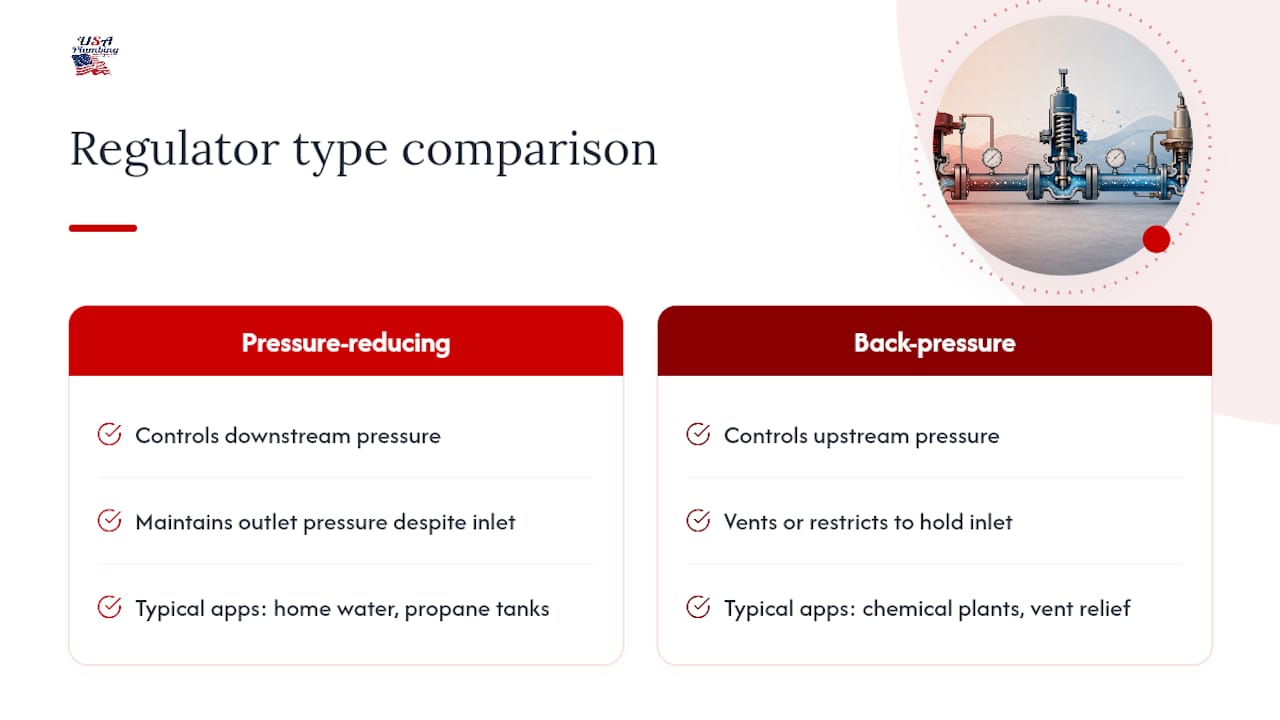
- Pressure-reducing regulators control downstream pressure; back-pressure regulators control upstream pressure instead.
- Single-stage regulators do the reduction in one step; two-stage regulators split it into two steps for tighter control.
- Pilot-operated and dome-loaded regulators use a secondary control signal for high-flow or high-precision jobs.
We'll cover practical setpoints later, including why most homes run around 50 psi and why anything above 80 psi at the meter usually means a pressure-reducing valve is required by code.
Key Takeaways
A pressure regulator holds a stable outlet pressure through a mechanical force balance between a spring, a diaphragm, and a valve, and understanding that balance explains nearly every regulator symptom you'll ever troubleshoot.
| Point | Details |
|---|---|
| Force-balance is the core mechanism | Spring force opens the valve, outlet pressure on the diaphragm closes it, and equilibrium sets the outlet pressure. |
| Droop is normal, hunting is not | Outlet pressure naturally dips under high flow, but rapid oscillation signals a damping or spring-rate problem. |
| Two-stage beats single-stage for stability | Splitting pressure reduction into two steps cancels out most of the decaying inlet characteristic as supply pressure falls. |
| Code sets the residential threshold | Static pressure above 80 psi requires a pressure-reducing valve, with most homes set near 50 psi outlet. |
| Usaplumbingseptic handles sizing and safe adjustment | Licensed plumbers inspect, size, and replace regulators to match your home's actual pressure and flow profile. |
Table of Contents
- How Do Pressure Regulators Function Internally?
- What Types of Pressure Regulators Are There?
- What Do Droop, Hunting, and Cv Actually Mean?
- How Do You Choose the Right Pressure Regulator?
- Why Is My Regulator Hunting, Leaking, or Sticking?
- How Do You Safely Adjust a Pressure Regulator?
- When Should You Call a Licensed Plumber?
- Need a Regulator Inspected, Sized, or Replaced?
- Sources
- FAQ
How Do Pressure Regulators Function Internally?
Every regulator, whether it's controlling natural gas at a grill, oxygen at a hospital bed, or municipal water at your house, runs on the same three-part system: a loading element, a sensing element, and a control element. The loading mechanism is usually a spring (sometimes a gas-charged dome), and it's the force that wants to push the valve open. The sensing element, typically a diaphragm or piston, reads the actual downstream pressure. The control element, a poppet or valve stem, physically restricts flow based on what those two opposing forces decide.
Here's the sequence, start to finish:
- At rest, with zero inlet pressure, the spring holds the valve wide open and the diaphragm sits neutral.
- Inlet pressure arrives. High-pressure fluid or gas pushes against the closed side of the poppet.
- The valve opens because spring force initially exceeds the resistance on the sensing side, letting flow through to the outlet.
- Outlet pressure builds and pushes against the diaphragm, working against the spring.
- Equilibrium is reached when diaphragm force (outlet pressure times diaphragm area) balances spring force. The poppet settles into a partially open position that holds outlet pressure at setpoint.
- Flow changes trigger correction. Open a faucet or a downstream valve, outlet pressure drops, the diaphragm relaxes, spring force pushes the poppet further open, pressure recovers.
That last step is the whole trick: it's a negative-feedback loop. The regulator doesn't "know" the setpoint in any active sense, it's a mechanical argument between two forces that automatically self-corrects every time downstream conditions change. Emerson's technical documentation frames this as the basic elements determining regulator behavior, and it's the same principle whether you're looking at a $15 grill regulator or a $2,000 industrial dome-loaded unit.
If you want to picture this as a diagram, imagine three labeled zones: P1 (inlet pressure) entering from the left through the poppet, P2 (outlet pressure) exiting to the right and looping back up to press on the diaphragm, and the spring chamber above the diaphragm providing the opposing load. The poppet's position is the visual output of that ongoing tug-of-war between spring force and P2 acting on diaphragm area.
Two design details change how sensitive that balance is to supply conditions:
- Unbalanced valve designs let inlet pressure act directly on the poppet, meaning changes in supply pressure shift the outlet setpoint slightly, a real limitation on cheaper regulators.
- Balanced valve designs use a second sealing area to cancel out most of that inlet-pressure influence, holding outlet pressure steadier, even when supply pressure swings.
Pro Tip: If you're specifying a regulator for an application where supply pressure varies a lot, like a well system with a pressure tank cycling between 40 and 60 psi, a balanced valve design will hold your downstream setpoint far more consistently than an unbalanced one costing half as much.
What Types of Pressure Regulators Are There?
Not every regulator solves the same problem, and picking the wrong category is the single most common sizing mistake we see in the field.
Pressure-reducing vs. back-pressure. A pressure-reducing regulator, the type in your home's water line or on a propane tank, holds downstream pressure steady regardless of what's happening upstream. A back-pressure regulator does the opposite job: it holds upstream pressure steady by venting or restricting flow, common in chemical processing and vent-relief systems where you need to protect equipment ahead of the regulator, not after it.
Single-stage vs. two-stage. A single-stage regulator drops inlet pressure to outlet pressure in one mechanical step. That's fine when inlet pressure stays fairly constant, but as a gas cylinder empties, inlet pressure decays, and single-stage units let that decay show up as drift in outlet pressure. Two-stage regulators split the reduction into two sequential steps, which cancels out most of that supply-pressure effect and delivers a flatter, more predictable output. That's why welding shops and medical gas systems lean on two-stage units even though they cost more.
Pilot-operated and dome-loaded variants use a small pilot regulator to control a larger main valve, which lets them handle much higher flow rates or tighter accuracy than a direct-acting spring design could manage alone. You'll find these on large-diameter gas distribution lines and industrial process skids.
Balanced vs. unbalanced, covered above, determines how much a regulator's outlet pressure drifts when supply pressure isn't rock steady.
Typical applications break down like this, depending on pressure stability and flow: household water service often uses single-stage, unbalanced, pressure-reducing regulators; propane or oxygen cylinders commonly use two-stage, often balanced regulators; welding torch supply utilizes two-stage for stable flame quality; compressed-air automation lines may use pilot-operated units for high, variable flow demands.
What Do Droop, Hunting, and Cv Actually Mean?
Setpoint is simply the outlet pressure you've adjusted the regulator to hold. Everything else on this list describes how well it actually holds that number.
Droop is the outlet pressure drop that happens as flow demand increases. It's not a defect, it's an inherent characteristic of direct-operated, spring-loaded regulators: as more fluid moves through, the diaphragm needs a little less counterforce to stay balanced, so the poppet settles slightly more open at a slightly lower pressure. A regulator set to 50 psi at low flow might droop to 46 psi at high flow.
Hysteresis and hunting describe instability. Hunting is rapid oscillation, the outlet pressure overshoots, corrects, overshoots again, in a cycle that never settles. Insufficient damping is the usual cause, and it accelerates wear on the seat and diaphragm every time it happens.
Decaying inlet characteristic (also called supply-pressure effect) is what happens to outlet pressure as inlet pressure falls, common on a nearly-empty gas cylinder. Two-stage or balanced designs largely cancel this out.
Cv (flow coefficient) measures how much flow a regulator can pass at a given pressure drop. A higher Cv means the regulator can serve higher demand without excessive droop, but oversizing hurts accuracy at low flow.
Statistic to remember: residential systems commonly run outlet pressure around 50 psi, and static utility pressure above 80 psi typically triggers a code requirement for a pressure-reducing valve.
How Do You Choose the Right Pressure Regulator?
Work through these in order, skipping a step is how you end up replacing a regulator that was never a match for the job in the first place.
- Confirm inlet and outlet pressure ranges. Know your maximum possible supply pressure, not just typical, and your required outlet setpoint.
- Calculate required flow and Cv. Estimate peak flow demand, then size to a Cv that handles peak without excessive droop, oversizing wastes accuracy, undersizing starves downstream fixtures.
- Check media compatibility. Water, natural gas, propane, oxygen, and corrosive process chemicals all demand different seat and seal materials.
- Verify temperature limits. Elastomer seals degrade outside their rated range, cold outdoor installs need cold-rated or heated variants.
- Match materials to the environment. Brass and bronze handle most residential water; stainless steel or specialty alloys handle corrosives or high-purity gas.
- Assess inlet stability. A well pump cycling pressure or a nearly empty cylinder both argue for a two-stage or balanced design.
- Plan mounting, orientation, and certifications. Some regulators are orientation-sensitive, and gas and medical applications often require specific listings.
A few real-world sizing examples:
- Residential main water line: a single-stage brass PRV set near 50 psi, sized for typical household peak flow, usually 10 to 15 gallons per minute.
- Specialty gas cylinder (argon, oxygen): a two-stage regulator matched to the gas type's specific fittings, since cross-threading gas fittings is a genuine safety hazard.
- Compressed-air automation: a pilot-operated regulator sized well above nominal demand to keep droop minimal during simultaneous actuator cycles.
Outdoor or unconditioned installations deserve extra thought. Freeze-prone locations need heated or freeze-protected regulator variants, and if your regulator feeds a home's broader distribution system, matching it to existing pipe material and fixture ratings matters as much as matching it to flow.
Why Is My Regulator Hunting, Leaking, or Sticking?
| Symptom | Likely cause |
|---|---|
| Rapid pressure oscillation (hunting) | Insufficient damping or a spring rate mismatched to the application |
| Outlet pressure creeps up over time | Worn seat or debris preventing full poppet closure |
| Sudden pressure spike near end of tank | End-of-tank dump, a worn seat lets full residual cylinder pressure pass through as supply nears empty |
| Valve won't respond to adjustment | Stuck poppet from contamination, mineral buildup, or corrosion |
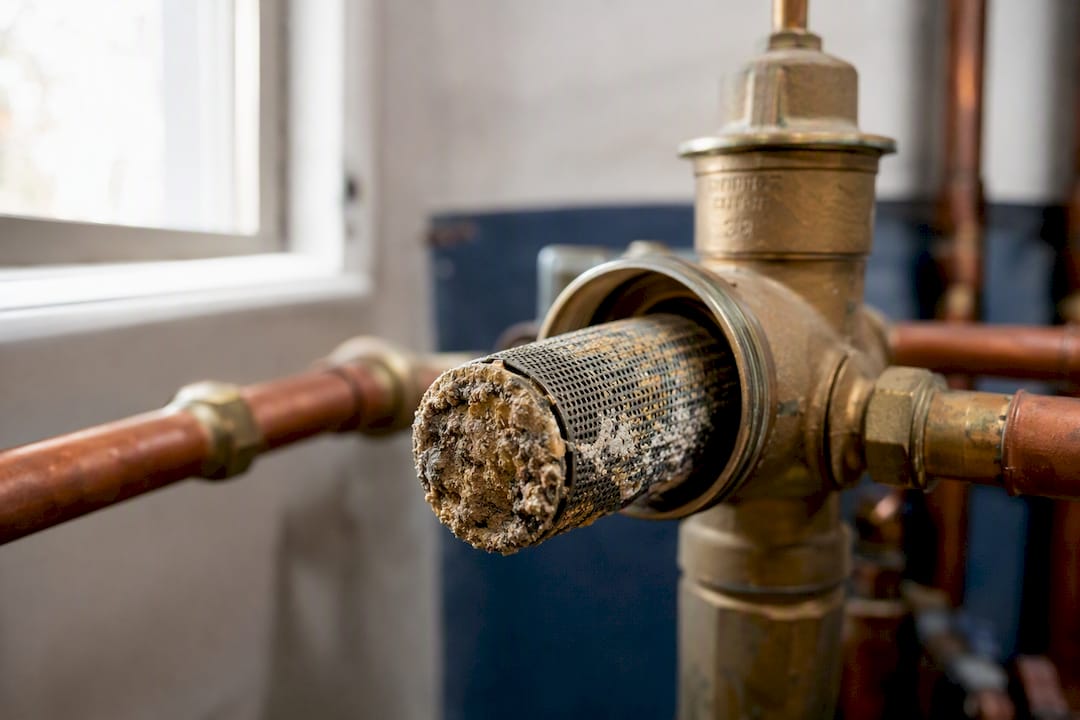
Before assuming the regulator itself is bad, run a few quick checks. Confirm your gauge readings on both sides of the regulator, since a "faulty regulator" is sometimes just a broken gauge. Isolate upstream and downstream valves to see if the problem persists with no flow at all. Pull the regulator's inlet screen or filter and look for sediment, especially common in areas with hard water mineral buildup.
Some signs mean it's past DIY territory. Persistent hunting that doesn't resolve after a basic inspection, any smell of gas near a gas regulator, or a regulator that never fully locks up (holds zero flow at rest) all point to internal wear that needs a certified technician, not a home fix.
Pro Tip: Keep spare diaphragm kits and seat washers on hand for your most common regulator models. Most field failures trace back to a worn diaphragm or a scored seat, both replaceable in minutes if you've got the part, both a wasted service call if you don't.
How Do You Safely Adjust a Pressure Regulator?
Adjusting a regulator isn't complicated, but skipping the isolation step is how people get hurt or flood a basement.
- Isolate the system. Close the upstream shutoff valve before touching the adjustment screw.
- Relieve downstream pressure by opening a fixture or bleed valve until the gauge reads zero.
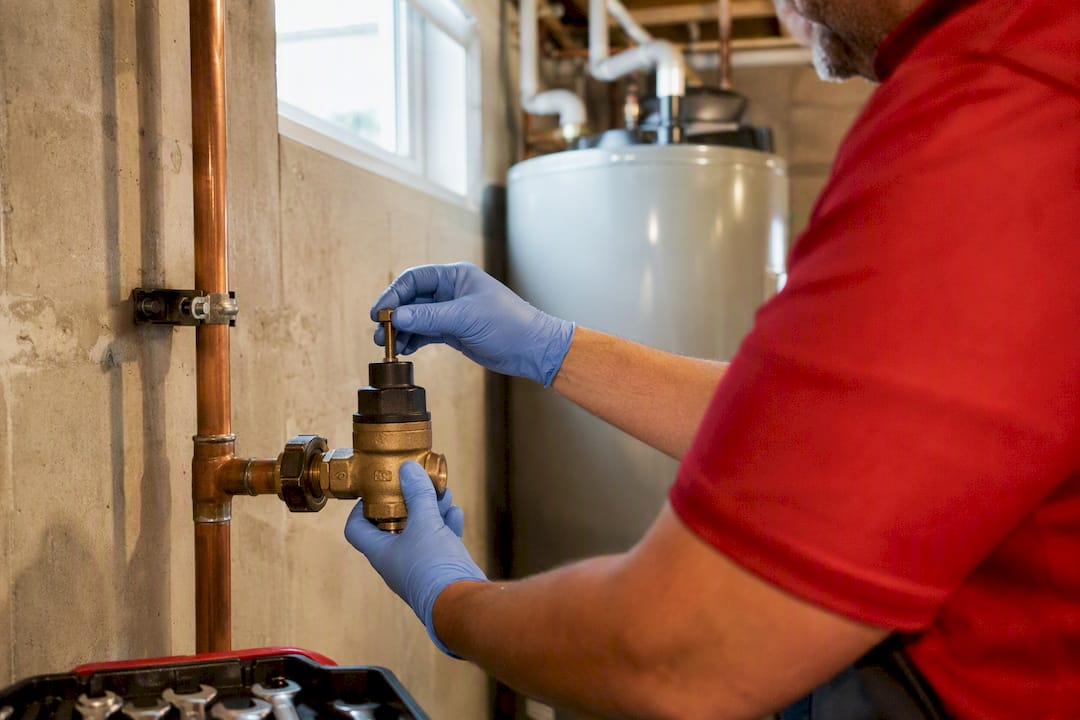
- Adjust in small increments, a quarter turn at a time, while watching the downstream gauge.
- Re-test under real flow, not just static pressure, since droop only shows up once fluid is actually moving.
Never treat a regulator as a shutoff valve. Regulators allow some residual seat leakage even when closed, which is exactly why every installation needs a dedicated downstream shutoff for true isolation. On gas systems, wear proper PPE and never adjust near an open flame.
Typical setpoints: residential water runs near 50 psi. Static utility pressure above 80 psi requires a pressure-reducing valve under most plumbing codes, so check your local code and the manufacturer's manual before finalizing any setpoint.
When Should You Call a Licensed Plumber?
Reading a gauge, doing a visual inspection, or making a minor adjustment on an isolated, drained household water PRV are all reasonable DIY tasks. Gas regulator work, anything touching a medical or oxygen system, persistent hunting that survives a basic inspection, or any sign of internal leakage all call for a certified technician, both for safety and because many gas and medical installations are legally required to be serviced by licensed professionals.
Before you call, gather your inlet and outlet pressure readings, a few photos of the installation, and note how long the problem has been happening. That short list turns a diagnostic visit into a repair visit.
A Note From the Field
I've walked into more service calls than I can count where the homeowner swore the water heater was failing, and the actual culprit was a regulator quietly drooping 15 psi under flow. Check the regulator first. It's cheaper, and it's usually the answer.
Need a Regulator Inspected, Sized, or Replaced?
Usaplumbingseptic gets you a properly sized, code-compliant regulator without the guesswork of picking one off a shelf and hoping it matches your home's pressure profile, backed by professional water submeter installation services for multifamily properties. We check your actual static and flow pressures, match the regulator to your pipe material and fixture load, and handle installation so the setpoint holds steady instead of drooping under a shower and a dishwasher running at once.
Whether you're dealing with a regulator that won't lock up, a home that's never had one installed despite pressure readings above 80 psi, or a commercial property needing a properly specified unit for higher flow demand, our licensed plumbers handle inspection, sizing, and replacement as part of everyday service across Bullhead City, Fort Mohave, Mohave Valley, and Laughlin. We're available 24/7 for emergency calls when a regulator failure turns into a real problem. Visit our Bullhead City area service page to schedule an inspection, or check our guide on plumbing essentials for Mohave County homeowners if you want more local context before booking.
Sources
For readers who want the original technical language behind the concepts covered here, these references go deeper than a blog post can:
- Understanding the Operational Mechanics (Proportionair blog)
- International Plumbing Code (IPC) — Section 604.8 (building code reference)
- Pressure Regulators (Emerson technical bulletin)
- The Basics of Pressure Regulators (Beswick Engineering)
Always check your specific regulator's manufacturer manual for model-specific adjustment ranges, and confirm installation requirements against your local building code before making changes.
FAQ
What psi should my pressure regulator be set at?
Most residential water systems run best around 50 psi at the outlet, and building codes typically require a regulator once static utility pressure exceeds 80 psi.
What are the most common problems with pressure regulators?
The most frequent issues are hunting (rapid pressure oscillation from insufficient damping), seat wear that causes slow leaks or pressure creep, and end-of-tank dump on gas cylinders as supply pressure decays.
How do I know if my pressure regulator is working correctly?
Check outlet pressure on a gauge both at rest and under flow. If it holds close to setpoint with only modest droop and doesn't oscillate, it's functioning normally; a regulator that drifts, hunts, or never locks up needs attention.
How do I adjust the pressure on a pressure regulator?
Isolate the system, relieve downstream pressure, then turn the adjustment screw in small increments while watching the gauge, retesting under real flow before finalizing the setpoint. If you're not comfortable with the isolation steps or you're working on a gas line, Usaplumbingseptic's licensed plumbers can handle the adjustment safely.