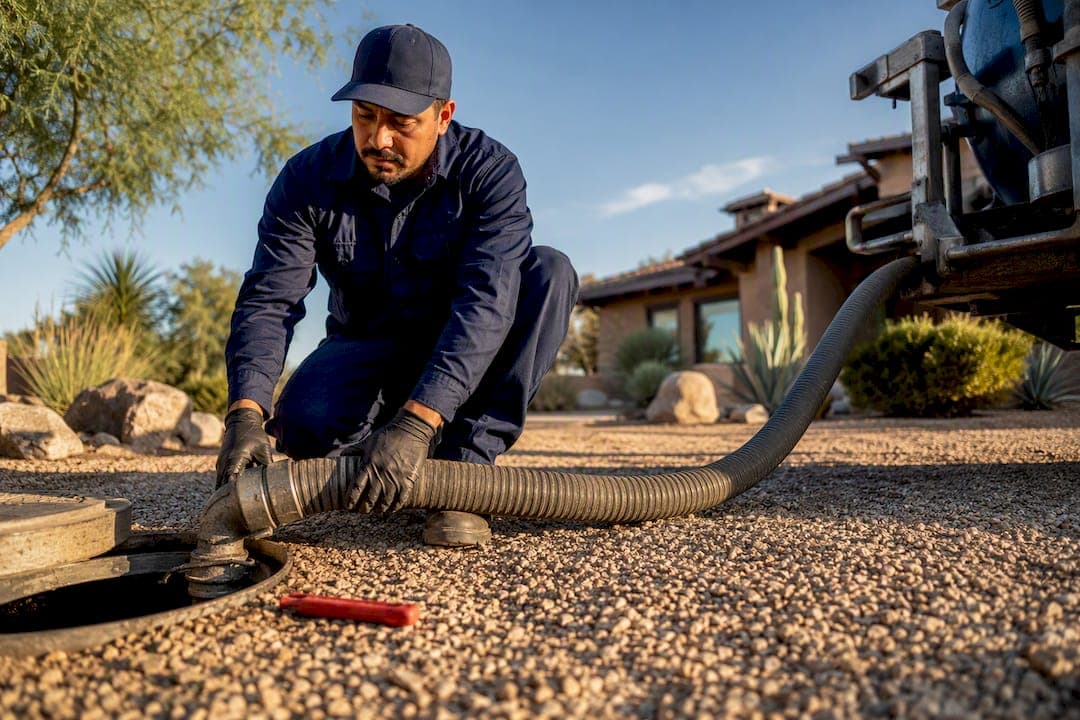
Most homeowners pay $300 to $600 to have a standard 1,000 to 1,500 gallon septic tank pumped, with the national average landing around $400. Costs in high-labor states like those on the West Coast or in the Northeast run higher, and rural properties often add travel fees. The right move is simple: get two or three local quotes, and confirm upfront whether disposal and access fees are already included.
TL;DR:
- Regional labor and disposal fees can significantly raise costs, especially on the West Coast, Northeast, and remote areas like Hawaii and Alaska.
- Bigger tanks and more intensive household water use increase pumping frequency and price, with larger properties often needing more complex or multiple trips.
- Extra services such as lid uncovering, camera inspections, or riser installation are billed separately and can add up to several hundred dollars per visit.
- Scheduling routine pump-outs every three to five years prevents costly drainfield failures that can exceed $5,000 in repair expenses.
- Always get an all-inclusive, written quote before work begins and verify licensing to avoid surprise charges and ensure proper waste disposal.
Table of Contents
- What Does Septic Pumping Cost Nationally?
- How Much Does Tank Size Change the Price?
- Why Does Septic Pumping Cost So Much More in Some States?
- What Hidden Fees Should You Watch for on a Septic Pumping Quote?
- How Often Should You Really Pump Your Septic Tank?
- How Do You Get an Accurate Local Septic Pumping Quote?
- What Does a Quality Pumping Visit Actually Include?
- What's the Real Cost of Waiting to Pump?
- Get a Straight Answer on Septic Pumping in Bullhead City
- Sources
- FAQ
What Does Septic Pumping Cost Nationally?
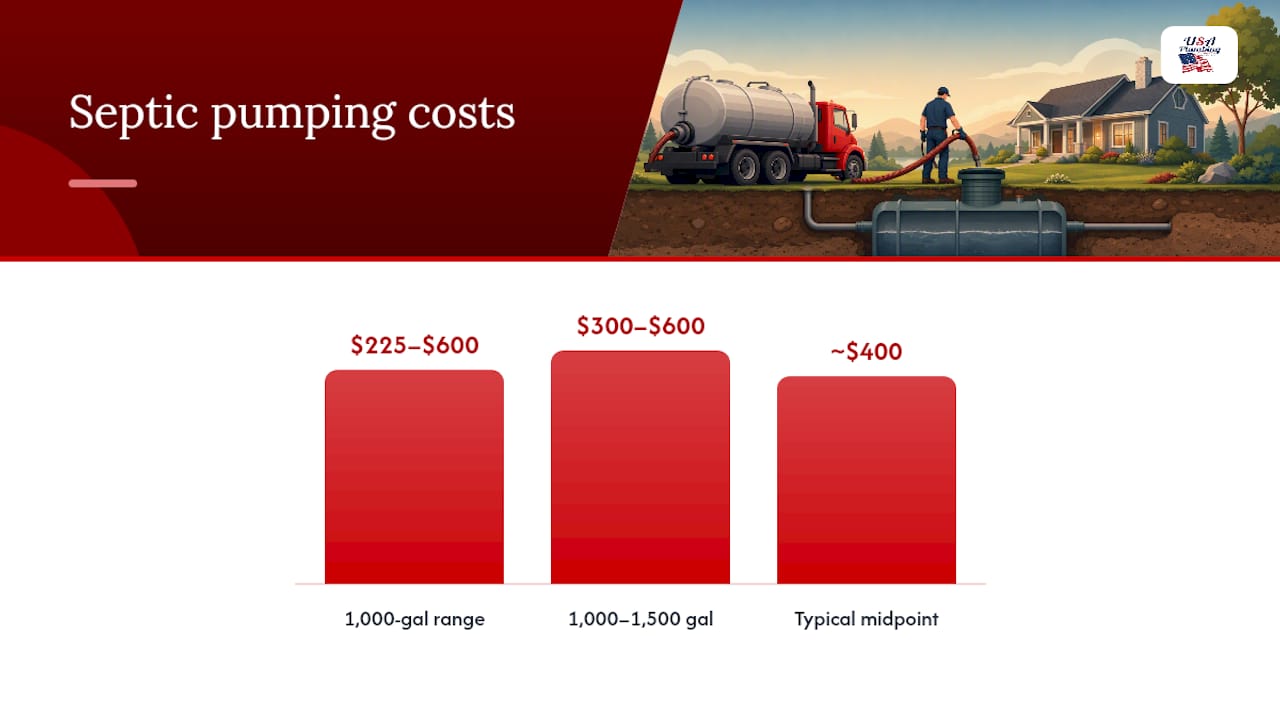
A routine, scheduled septic pumping visit typically runs $225 to $600 for a standard 1,000-gallon tank, with most homeowners landing close to the national average. Other cost trackers put the broader 1,000 to 1,500 gallon range at $300 to $600, with a common midpoint near $400. Either way, that's the number to use as your baseline when a contractor's quote comes in.
Emergency service changes the math fast. If your tank backs up on a Saturday night, expect the crew to tack on an after-hours or rush fee that can add $150 to $300 on top of the standard pump-out price. Scheduling ahead almost always beats waiting for a crisis, both on price and on your stress level.
A standard pump-out visit from a reputable company should include:
- Locating and uncovering the tank lid (if not already accessible)
- Pumping out solids and liquids from all chambers
- A basic visual check of the baffles and tank condition
- A note on the condition of the effluent filter, if your system has one
Pro Tip: Ask upfront whether the quoted price includes disposal fees. Some companies bundle everything into one number, while others itemize dumping charges separately, and that difference alone can shift your final invoice by $50 or more.
Add-ons push the price higher than that baseline. Effluent filter cleaning, camera inspections, baffle repairs, and riser installation are common upsells that a routine pump doesn't automatically include. None of them are scams. They're just separate line items you should expect to see, and understand, before you sign off on the work.
By the numbers: The national average cost to pump a 1,000-gallon septic tank sits around $375, while most 1,000 to 1,500 gallon jobs land closer to $400 once you factor in regional labor rates.
How Much Does Tank Size Change the Price?
Tank capacity is the single biggest variable in your quote, and it's the first question any contractor should ask. Bigger tanks hold more waste, take longer to empty, and sometimes require a second truck trip if the crew's tank fills up mid-job.
Those size-based bands hold up across most residential markets, though your local price could sit slightly outside them depending on labor costs and disposal fees in your area.
A few practical notes worth remembering:
- Households of four or more people, or homes running a garbage disposal heavily, tend to fill smaller tanks faster and need more frequent service.
- Commercial properties or multi-family buildings often use tanks larger than 2,000 gallons, which can require multiple truck trips and push pricing into custom-quote territory.
- If your last pump-out is unknown or your home changed owners recently, budget for the higher end of your tank's range. Unexpected sludge buildup sometimes means extra time on-site.
Why Does Septic Pumping Cost So Much More in Some States?
Where you live changes your quote more than almost anything else. Northeast and West Coast markets tend to run pricier because of higher labor rates and stricter disposal regulations, while Southern and Midwestern states generally land toward the lower end of the national range. Hawaii and Alaska are the extreme outliers, where shipping equipment and hauling waste long distances drives costs well above the mainland average.
Local example: in the Bullhead City area, per-pump pricing typically runs $300 to $600, with full project scopes reaching $500 to $3,000 depending on access, tank condition, and whether repairs come up during the visit. That range illustrates why a national average is only a starting point, not a promise.
A few factors explain most of the regional gap:
- Disposal tipping fees vary by county and state, and treatment facilities charge haulers differently depending on local capacity and regulation.
- Licensing requirements differ by state, and companies operating under stricter compliance rules often build that overhead into their pricing.
- Rural travel surcharges apply when your property sits far from a hauler's base, adding anywhere from $50 to $150 to the invoice.
If you're comparing your quote to a number you saw online, check whether that source is even talking about your region. A $300 quote in one state can represent a completely different service scope in another.
What Hidden Fees Should You Watch for on a Septic Pumping Quote?
The base pump-out price is rarely the whole story. Here's what tends to show up as separate charges:
- Lid digging or uncovering: $50 to $200 if your tank lid is buried under soil, mulch, or landscaping.
- Tank locating: $50 to $150 if there's no visible access point or map of your system.
- Travel or rural surcharge: $50 to $150 for properties outside a company's normal service radius.
- After-hours or emergency service: $150 to $300 for weekend, holiday, or same-day calls.
- Effluent filter cleaning: $25 to $100, often bundled with routine pumping.
- Camera inspection: $150 to $300 if you want a visual check of pipes or the drainfield.
- Riser installation: $200 to $400 as a one-time upgrade.
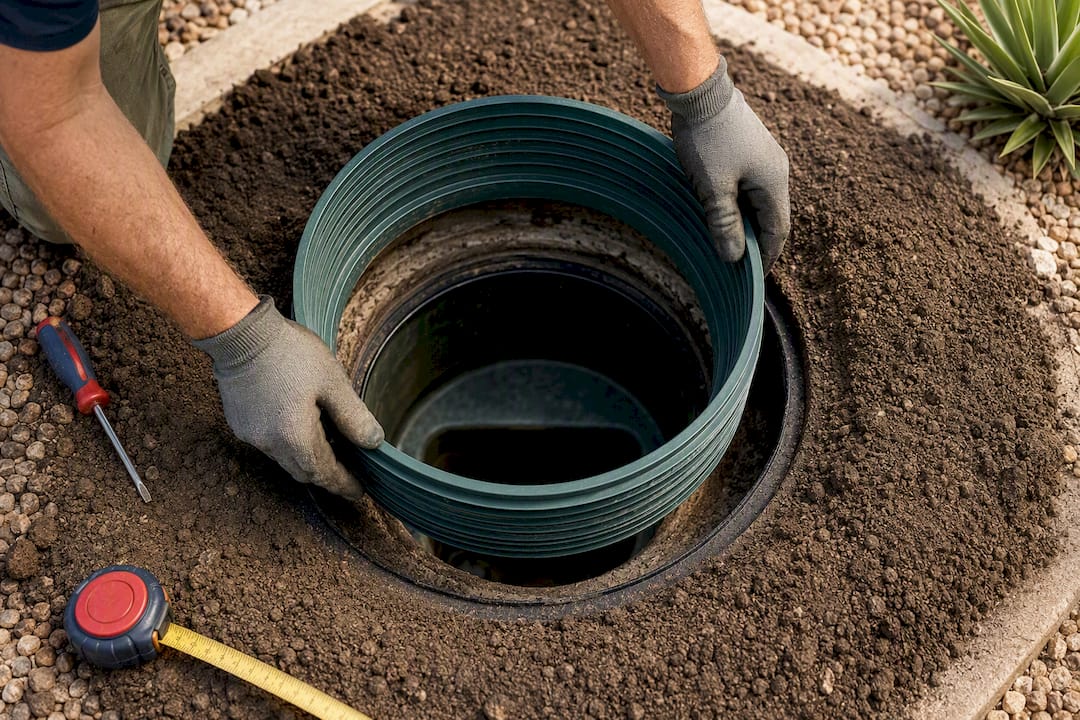
That last one deserves a closer look. Installing risers brings your tank lids up to ground level, which eliminates the digging fee on every future visit. For many homeowners, the one-time riser cost pays for itself within two or three pump-outs, since you're no longer paying $50 to $200 in labor just to find your own tank.
Pro Tip: If your lids are buried, ask your technician for a riser quote during the same visit. Scheduling it alongside your pump-out saves you a second trip charge and often gets you a better combined price.
How Often Should You Really Pump Your Septic Tank?
Most systems need pumping every 3 to 5 years, though that interval shrinks for smaller tanks, larger households, or heavy water use. A family of six running a smaller 750 gallon tank might need service every two years, while a couple with a 1,500 gallon tank could stretch closer to five.
The math on skipping pumping is brutal. A routine pump-out costs a few hundred dollars. A failed drainfield from neglected maintenance can run into the thousands, sometimes requiring full system replacement. Watch for these warning signs that mean you should schedule service now, not later:
- Slow drains throughout the house, not just in one bathroom
- Gurgling sounds from pipes when no water is running
- Standing water or unusually lush grass over the drainfield
- Sewage odor near the tank or in the yard
If you're seeing any of those, don't wait for your "3 to 5 year" mark. Overflow situations escalate quickly once a tank is truly full.
How Do You Get an Accurate Local Septic Pumping Quote?
Phone quotes vary wildly because contractors are often guessing at your tank size and access conditions. Ask these questions before you agree to anything:
- What size is my tank, and how did you determine that?
- Does this quote include disposal fees, or are those billed separately?
- Will this job require more than one truck trip?
- Are there additional charges for lid locating or digging?
- Are you licensed and insured for septic work in this state?
- Will you clean or inspect the effluent filter during this visit?
- Can I get this estimate in writing before you start?
Verify licensing directly rather than taking a company's word for it. The same due diligence you'd apply when hiring any licensed plumber applies here. Ask for a disposal receipt after the job too. It's proof the waste went to a licensed treatment facility, not dumped somewhere it shouldn't be.
Pro Tip: Write down each quote's total price, what's included, and what's extra, side by side. The lowest number on the phone isn't always the lowest number on the final bill.
What Does a Quality Pumping Visit Actually Include?
A crew that knows what they're doing follows a routine every time: locate the lid, pump every chamber, check the baffles, inspect and clean the effluent filter, and hand you documentation showing where the waste was disposed.
- Ask for a written estimate before the truck even shows up.
- Expect a mention of riser recommendations if your lids are buried deep.
- A disposal receipt or invoice noting the treatment facility is standard practice, not an extra favor.
Skipping the inspection step is a common red flag on rock-bottom quotes. Cheap and thorough rarely go together in this line of work.
By the numbers: Regular pumping every few years costs a few hundred dollars, while neglecting it raises the risk of drainfield failure and repair bills that can run into the thousands.
What's the Real Cost of Waiting to Pump?
Homeowners tend to think of pumping as an expense they can push off. That's backward. The cheapest year of septic ownership is the one where you pump on schedule, every time, without letting it slide.
I've seen the pattern play out the same way too often: a family skips a pump-out cycle to save $400, the tank overflows into the drainfield two years later, and the repair bill lands somewhere north of $5,000. That's not a rare worst case. It's what happens when solids build up past the point a routine pump can fix.
Set a reminder every three years if you have an average-size household, sooner if your tank is small or your household is large. Write your last pump-out date somewhere you won't lose it. That single habit prevents most of the expensive surprises septic owners run into.
— JOHN
Get a Straight Answer on Septic Pumping in Bullhead City
Guessing at septic costs from a national chart only gets you so far. Some local providers give homeowners in Bullhead City, Fort Mohave, Mohave Valley, and Laughlin a written, all-inclusive quote before any truck rolls, so there's no surprise disposal fee tacked on at the end.

Providers may handle the full scope covered in this guide: tank pumping, baffle and filter inspection, riser installation for buried lids, and emergency service when a tank backs up on the worst possible day. Visits often include a straightforward walkthrough of what was done and what, if anything, needs attention before your next scheduled pump. If your lids are hard to find or your last pump-out is a mystery, mention that when you call. It changes the quote, and it's better to know before the crew shows up than after.
For a more precise estimate, request an all-inclusive septic pumping quote for your property.
Sources
For further reading on state-level pricing and long-term system health, see SepticTankHub's state cost breakdown and why sewer system health matters for your property's long-term costs.
- Septic Tank Pumping Cost (2026) — Average Prices by Tank Size | SepticFind
- Septic Tank Pumping Cost 2026: What You'll Actually Pay | The Septic Guide
- Septic pumping cost by state — SepticTankHub
- How Much Does It Cost to Pump a Septic Tank? 2026 Data | Angi
FAQ
How much does it cost to pump a 1,000 gallon septic tank?
Expect to pay $275 to $475 for a standard 1,000-gallon tank, with the national average landing near $375 to $400 once local labor and disposal fees are factored in.
Can a septic tank go 20 years without being pumped?
It's possible on a very large tank with light usage, but it's a poor bet. Most systems need pumping every 3 to 5 years, and going decades without service dramatically raises the risk of drainfield failure and a repair bill in the thousands.
How often does a 1,000 gallon septic tank need to be pumped?
A 1,000 gallon tank serving a typical household usually needs pumping every 3 to 5 years, though a larger family or heavy water use can shorten that to every 2 years.
How often does a 2,000 gallon holding tank need to be pumped?
Holding tanks work differently than septic tanks since they store waste without treatment, so a 2,000 gallon holding tank often needs pumping every few weeks to a few months depending on household size and usage, not on the multi-year schedule used for standard septic systems.
What's included in a standard septic pumping visit?
A quality visit includes locating the tank, pumping all chambers, a baffle check, and often a note on your effluent filter's condition. Extras like camera inspections or riser installation are typically quoted separately.