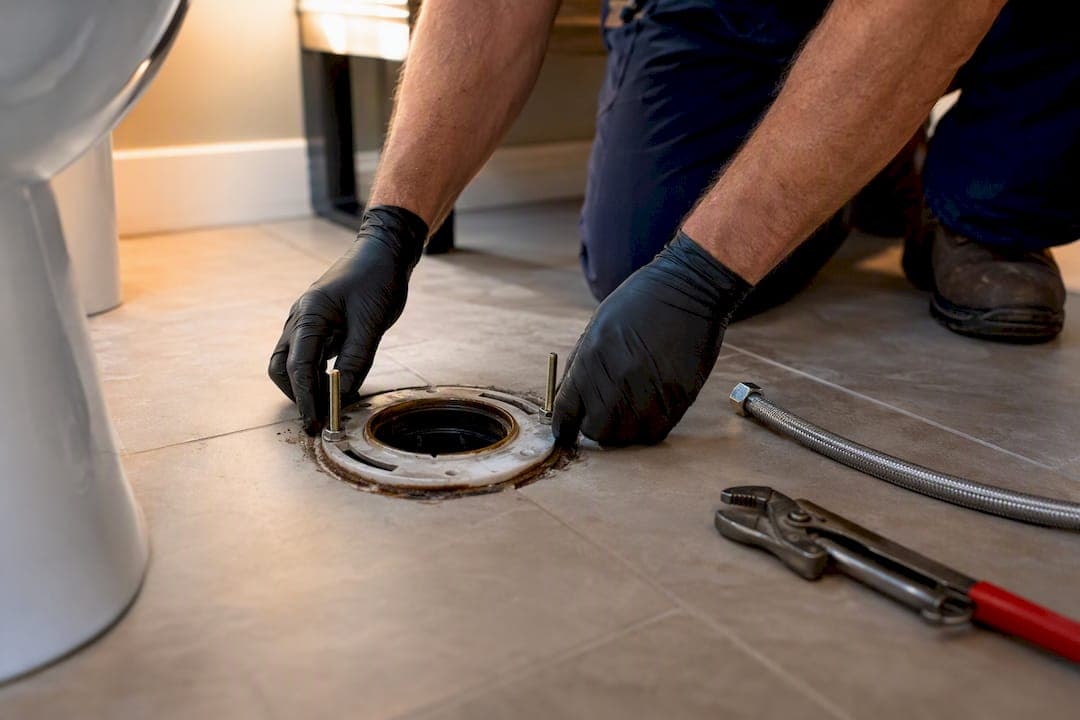
Most homeowners pay between $300 and $900 for a complete toilet replacement, parts and labor included, with a lot of straightforward jobs landing near the $400 to $600 mark. Expect the lower end for a basic two-piece toilet swapped onto an existing flange in good shape, and the higher end (or beyond) once a plumber finds a cracked flange, soft subfloor, or a seized shut-off valve. Get two or three written estimates before you commit, and set aside a contingency of a few hundred dollars for whatever the old toilet was hiding.
TL;DR:
- Most toilet replacements cost homeowners between $400 and $600 for a straightforward swap; costs can rise significantly if repairs to the flange or subfloor are necessary.
- Prices vary greatly depending on toilet type, with wall-mounted and smart toilets reaching up to $1,500 or more installed, and DIY parts-only costs under $300.
- Labor costs typically range from $150 to $500, depending on local rates and job complexity, with additional charges for unseen repairs like flange or subfloor damage.
- Hidden repairs such as flange repair, subfloor patching, and valve replacement can easily add $200 to over $1,500 to the total cost.
- Accurate quotes require confirming if the shut-off valve turns freely, whether the flange is in good condition, and ensuring disposal of the old toilet is included upfront.
Table of Contents
- How Much Does Toilet Replacement Cost on Average?
- What Toilet Type Should You Budget For?
- How Do Plumbers Price a Toilet Swap?
- What Hidden Repairs Drive the Price Up?
- Should You Replace the Toilet Yourself?
- How Do You Get an Accurate Quote?
- How Long Does a Toilet Replacement Take?
- What Our Plumbers See on Real Toilet Jobs
- What Actually Matters When You're Budgeting This
- Get a Straight Answer on Your Toilet Replacement
- Sources
- FAQ
How Much Does Toilet Replacement Cost on Average?
The national numbers agree on a range even when the exact midpoint shifts depending on who is doing the counting. ConsumerAffairs puts a standard toilet replacement at $300 to $900 installed, with most straightforward jobs clustering around $400 to $600. Cost calculator tools like Homewyse show a wider ceiling, often $700 to $1,200 or more, once they factor in site conditions and possible add-on repairs.
Here's what that spread looks like in real scenarios:
- DIY, parts only: $150 to $300 for the toilet plus wax ring, bolts, and a new supply line, with no labor cost.
- Pro straight swap: $350 to $600 total, covering removal, disposal, and installation on a flange that needs no work.
- Pro swap with repair: $700 to $1,200+ when the flange, subfloor, or valve needs attention before the new toilet goes in.
Location moves these numbers more than most people expect. Block Renovation reports that major metro areas like New York, Boston, and San Francisco run 30% to 50% higher than the national average for both labor and total installed cost. If you live in a high cost-of-living market, use the upper end of every range in this article as your starting assumption, not your worst case.
What Toilet Type Should You Budget For?
The toilet itself is only one line item, but it's the one you control most directly, and it sets the tone for everything else in the quote. A basic two-piece toilet typically costs a few hundred dollars for the unit itself, with installed totals varying depending on conditions. Low-flow and WaterSense-certified models cost a bit more upfront ($150 to $400 for the unit) but usually install the same way, so labor doesn't change much. If you're shopping specifically for efficiency, our roundup of low-flow toilet options breaks down which models hold up over time.
One-piece toilets, wall-mounted units, upflush systems, and smart toilets all pull the total in a different direction:
- One-piece toilets: $200 to $600 for the unit, $400 to $800 installed. Easier to clean, but heavier to maneuver during install.
- Wall-mounted toilets: Often $500 to $1,500 installed because the tank sits inside the wall and requires carrier system access.
- Upflush or macerating toilets: $700 to $2,000 installed, common in basements without gravity drain access.
- Smart toilets: $1,200 to $3,500+ installed when electrical work is needed for heated seats, bidet functions, or auto-flush sensors.
Pro Tip: A mid-range toilet in the $300 to $600 band tends to hit the sweet spot between durability and parts availability. Very cheap models often use proprietary flush valves that get discontinued within a few years, and very expensive smart toilets can leave you waiting on a specialty part when something breaks.
How Do Plumbers Price a Toilet Swap?
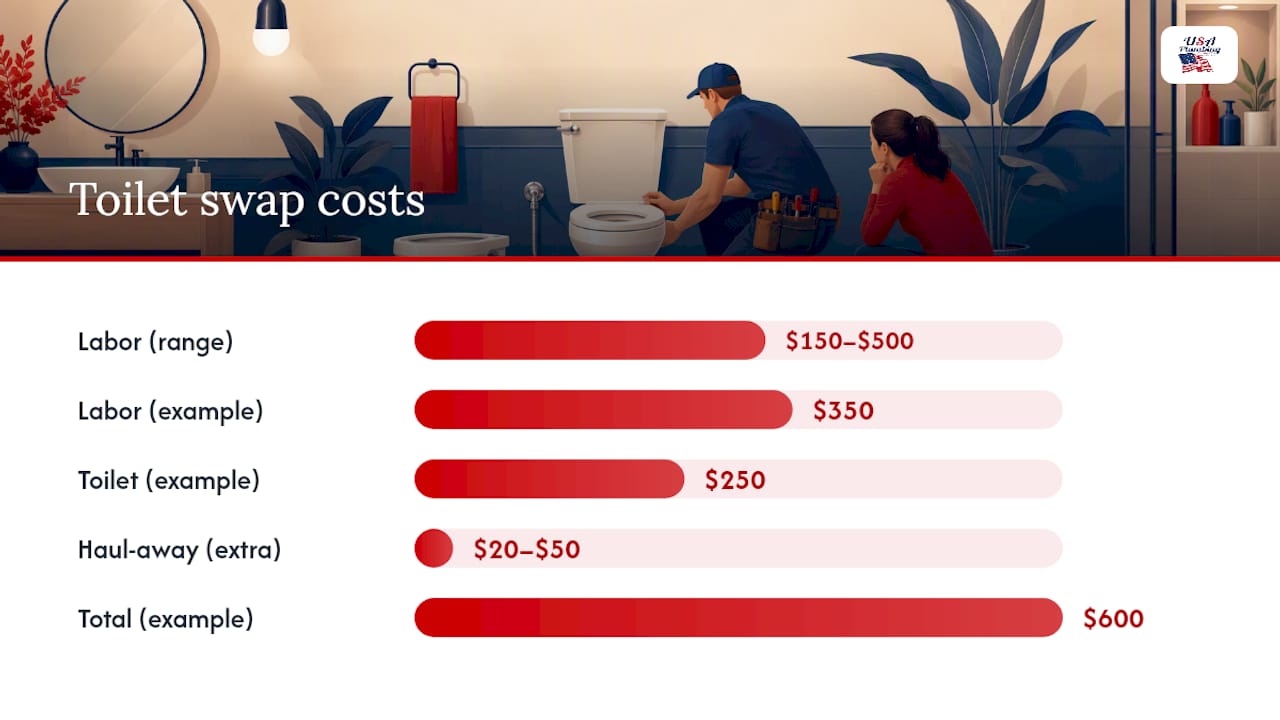
Labor is the piece homeowners have the hardest time predicting, mostly because it depends on what the plumber finds after the old toilet comes off the floor, not just what they see beforehand. PlumbingPicks puts professional installation labor for a straightforward swap at $150 to $500, with the wide range reflecting local rates, trip fees, and whether the job includes haul-away of the old fixture.
Here's how that labor typically breaks down on a service call:
- Diagnostic and removal: The plumber disconnects the supply line, removes the old toilet, and scrapes the old wax ring, usually 20 to 30 minutes.
- Flange inspection: A quick check for cracks, corrosion, or height issues, often bundled into the base labor charge unless repair is needed.
- Installation and seal: Setting the new toilet, torquing the bolts evenly, connecting the supply line, and running an initial flush test.
- Cleanup and disposal: Hauling away the old unit, which some companies include and others charge $20 to $50 extra.
A typical numeric example: a $250 toilet plus $350 in labor for a straight swap puts you at $600 total, right in the commonly cited mid-range.
What Hidden Repairs Drive the Price Up?
The gap between a $400 quote and a $1,500 quote almost always comes down to something the plumber couldn't see until the old toilet was off the floor. What It Actually Costs lists the repairs that show up most often once the fixture is out of the way, and every one of them is worth budgeting for before the truck arrives.
- Flange repair or replacement: Signs include a wobbly toilet or a wax ring that failed early. Typical cost: $150 to $400.
- Subfloor patching: Soft or discolored flooring around the base usually means water damage underneath. Typical cost: $200 to $1,500 or more, depending on how much has to be cut out and replaced.
- Shut-off valve replacement: A valve that won't turn or won't fully shut is a common surprise on older homes. Typical cost: $75 to $200.
- Supply line replacement: Cheap to swap out and worth doing anyway, since a braided line rarely costs more than $15 to $30.
- Cast-iron drain complications: On older homes with cast-iron waste lines, corrosion near the flange can escalate quickly. Our guide on cast-iron drain replacement covers cases running from a few hundred dollars into the thousands.
Older houses with visible water staining or a toilet that's been loose for a while should plan closer to the top of that range.
Should You Replace the Toilet Yourself?
DIY replacement saves real money, but only when the job stays simple. Parts-only totals typically run under $200 for the wax ring, bolts, and supply line, on top of whatever the toilet itself costs, according to PlumbingPicks. That means skipping $150 to $400 in labor compared to hiring a pro.
- DIY makes sense when: the flange is in good condition, the shut-off valve turns freely, and you're swapping like for like without moving the drain location.
- DIY gets risky when: the toilet has been wobbling for months (likely flange or subfloor damage), the shut-off valve is corroded, or you're changing toilet type (say, going from a two-piece to a wall-mounted unit).
- What goes wrong: an improperly seated wax ring can leak for weeks before anyone notices, and by then subfloor repair costs have jumped well past what professional installation would have cost upfront.
If your bathroom floor feels solid and the shut-off valve works smoothly, DIY is a reasonable weekend project. If you see any staining, softness, or a valve that won't budge, call a plumber before you start.
How Do You Get an Accurate Quote?
A vague quote is how homeowners end up with a surprise invoice. Ask for these specifics in writing before any plumber starts work:
- What's included: wax ring, bolts, supply line, and whether the toilet itself is supplied by you or the company.
- Haul-away: confirm whether disposal of the old toilet is part of the quoted price or billed separately.
- Flange inspection: ask whether the quote assumes a healthy flange, and what the repair rate is if it isn't.
- Warranty terms: get the labor warranty period in writing, separate from the manufacturer's warranty on the toilet.
- Timing: confirm whether the quote is a firm price or an estimate that could change once the old fixture is removed.
Compare quotes side by side rather than by bottom line alone. A $350 quote that excludes haul-away and assumes a perfect flange isn't actually cheaper than a $500 quote that covers both. Get two or three written estimates, and treat any quote that seems far below the others as a signal to ask more questions, not a reason to book immediately.
How Long Does a Toilet Replacement Take?
A straight swap with no complications typically takes 45 minutes to an hour and a half from start to finish. Add flange or subfloor repair and the job stretches to half a day, occasionally longer if the subfloor needs time to dry or cure before the new toilet goes down.
Before the plumber arrives, clear the area around the toilet and confirm you know where your shut-off valve is. Decide ahead of time whether you're supplying the toilet or having the plumber bring one. Before they leave, a plumber should check for wobble, run a full flush test, and confirm there's no water pooling at the base after a few minutes. If any of those checks get skipped, ask before you sign off.
What Our Plumbers See on Real Toilet Jobs
Across jobs in and around Bullhead City, quotes for a standard swap typically land between $350 and $700, with the spread usually explained by flange condition rather than the toilet itself. The most common surprise our team finds isn't dramatic. It's a shut-off valve that hasn't been touched in a decade and won't fully close, or a flange bolt that's rusted through and needs replacing before the new toilet can seat properly.
A few habits separate a clean install from a callback six months later: always replace the supply line during the swap, since a $20 part beats an emergency leak call later. Always inspect the flange before final sign-off, not after. And always confirm disposal of the old toilet is part of the estimate, not an add-on discovered at checkout.
What Actually Matters When You're Budgeting This
Most cost guides hand you a single average and call it a day. That's not wrong, exactly, but it undersells the real decision homeowners face: the number that matters isn't the average, it's the range between a clean swap and a swap that uncovers a bad flange or soft subfloor. Those two outcomes can differ by $500 or more, and no average captures that gap.
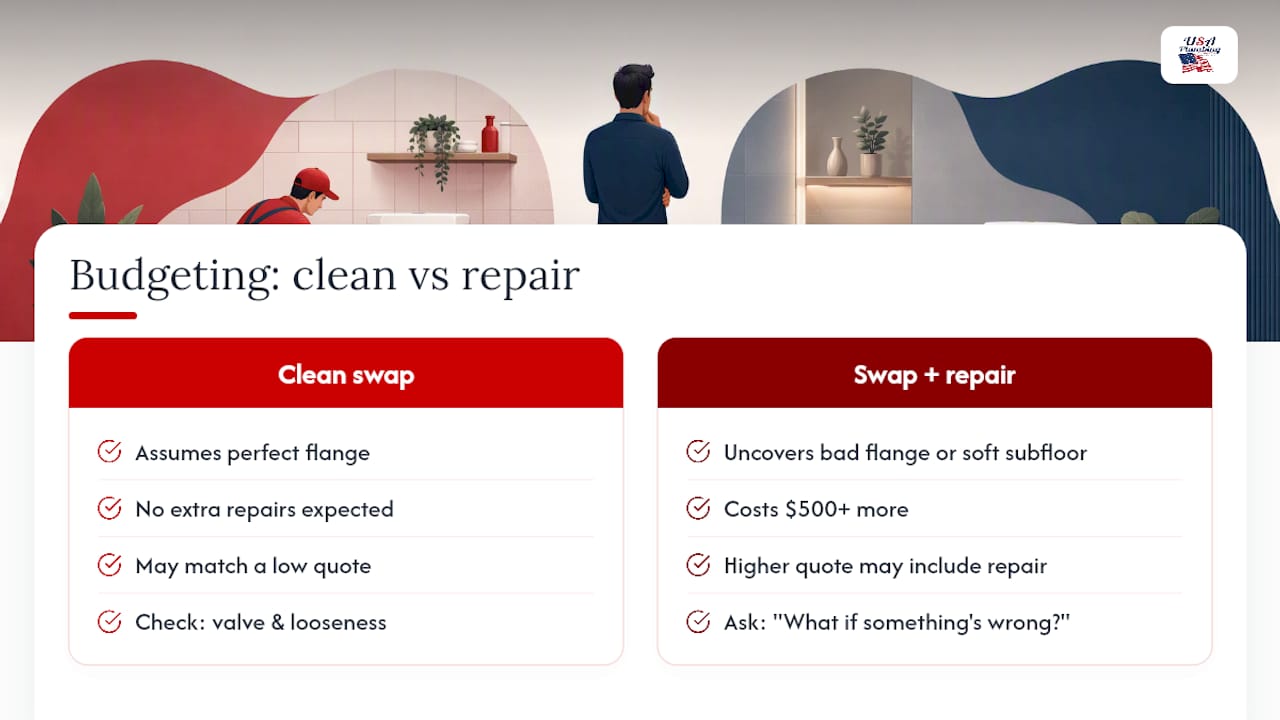
The conventional advice, get three quotes and pick the middle one, misses the more useful question: what does each quote assume about what's under the old toilet? A cheap quote that assumes a perfect flange isn't a better deal than a slightly higher quote that already accounts for a possible repair. Ask what happens to the price if something's wrong before you compare bottom lines.
Prioritize this first: confirm whether your shut-off valve turns freely and whether the toilet has ever felt loose. Those two checks predict your actual cost better than any national average ever will.
— JOHN
Get a Straight Answer on Your Toilet Replacement
Reading cost ranges only gets you so far when your own bathroom has a valve that won't budge or a floor that feels a little soft near the base. Some local plumbing companies offer in-person inspections of the flange, subfloor, and shut-off valve to provide a real number before any work starts, rather than just a national range estimate.

Some plumbing services cover toilet repair and replacement jobs including straight swaps, flange repairs, subfloor patching, and emergency calls. Availability and service areas vary, and estimates are usually provided in writing before work begins, detailing what's included and how unexpected findings are handled. If you're in Bullhead City specifically, our local plumbing team page has service details for your area. Ready to get a real number for your bathroom? Request your estimate today and get a licensed plumber's take before you budget another dollar.
Sources
- Cost of a Toilet Replacement (2026) | ConsumerAffairs®
- Cost to Replace Toilet - Cost Calculator | Homewyse
- How Much Does Toilet Replacement Actually Cost in 2026? | What It Actually Costs
- Cost to Replace a Toilet in 2026 (Plumber's Real Numbers) | PlumbingPicks
FAQ
How much would a plumber charge to replace a toilet?
Most plumbers charge labor fees that, combined with the toilet cost, result in typical total installed costs within a moderate price range in most markets.
How much does Home Depot charge to install a toilet?
Home Depot doesn't publish a fixed installation rate on this page; big-box retailers typically quote installation separately from the toilet price and often subcontract to a local plumber, so get the exact labor quote in writing before you buy.
How much will a plumber charge to fit a toilet?
Expect $150 to $500 for labor alone on a standard installation, with the total climbing if the flange, subfloor, or shut-off valve needs repair first.
How much did it cost to replace a toilet?
Nationally, homeowners report paying $300 to $900 for a complete replacement, with straightforward jobs commonly landing between $400 and $600.
Does USA Plumbing and Septic LLC provide toilet replacement quotes?
Yes, Usaplumbingseptic offers toilet repair and replacement service with written estimates provided before work begins; current pricing is available by request through the company's site.