
Restaurant plumbing codes are strict because commercial kitchens create public health risks that residential or standard commercial plumbing simply does not. The Uniform Plumbing Code (UPC) and International Plumbing Code (IPC) set the national baseline, but local health departments layer additional requirements on top. The result is a specialized set of regulations covering everything from grease interceptor sizing to backflow prevention and floor drain slopes. Understanding why restaurant plumbing codes are strict helps you design a compliant kitchen, pass inspections, and avoid fines that can shut your doors.
Why are restaurant plumbing codes so strict?
Restaurant plumbing codes are strict because cross-contamination risks in commercial kitchens are far higher than in any other building type. A single plumbing failure in a restaurant can expose hundreds of customers to pathogens through contaminated water, food contact surfaces, or sewer gas. Poor drainage creates standing water, which attracts pests and breeds bacteria directly in food preparation zones.
The UPC and IPC both treat restaurant plumbing as a public health matter, not just a building systems issue. Local Authorities Having Jurisdiction (AHJs) enforce these codes aggressively because the consequences of failure are immediate and widespread. Plumbing codes establish enforceable minimum safety thresholds focused on sanitation, sewer gas prevention, and contamination control. They are not designed to identify the best product or the most durable pipe. They exist to keep your customers safe.
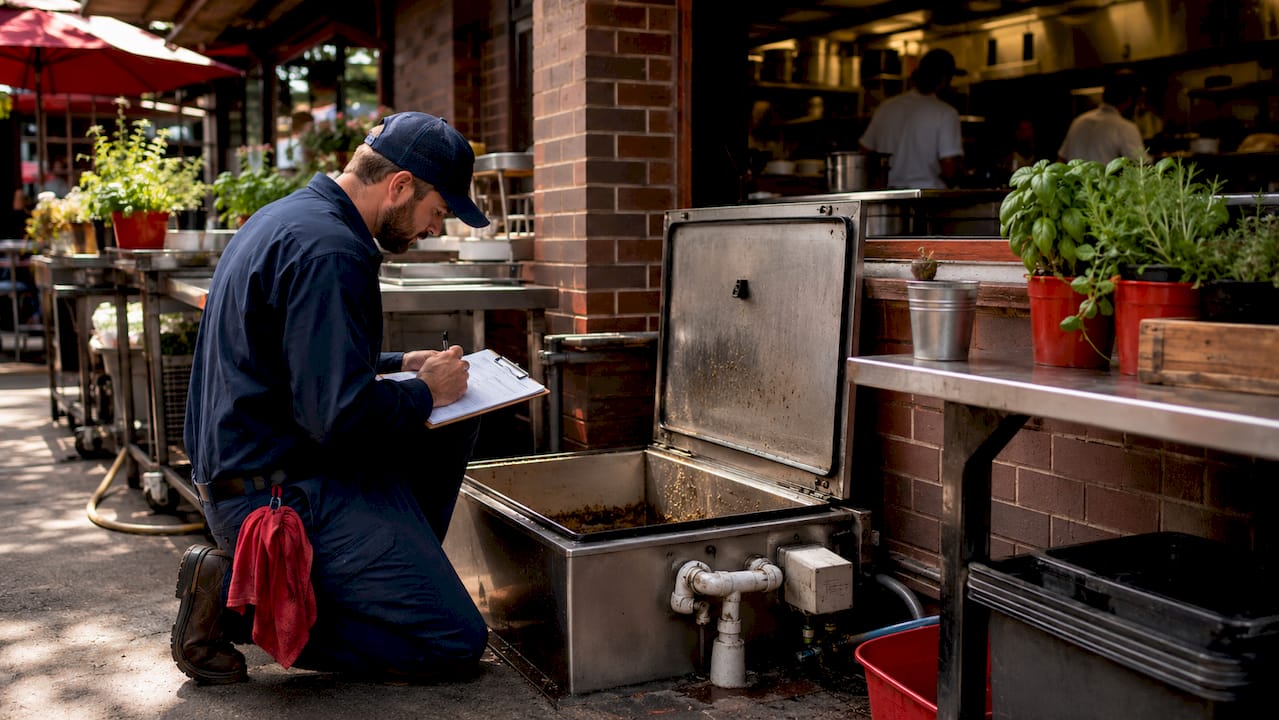
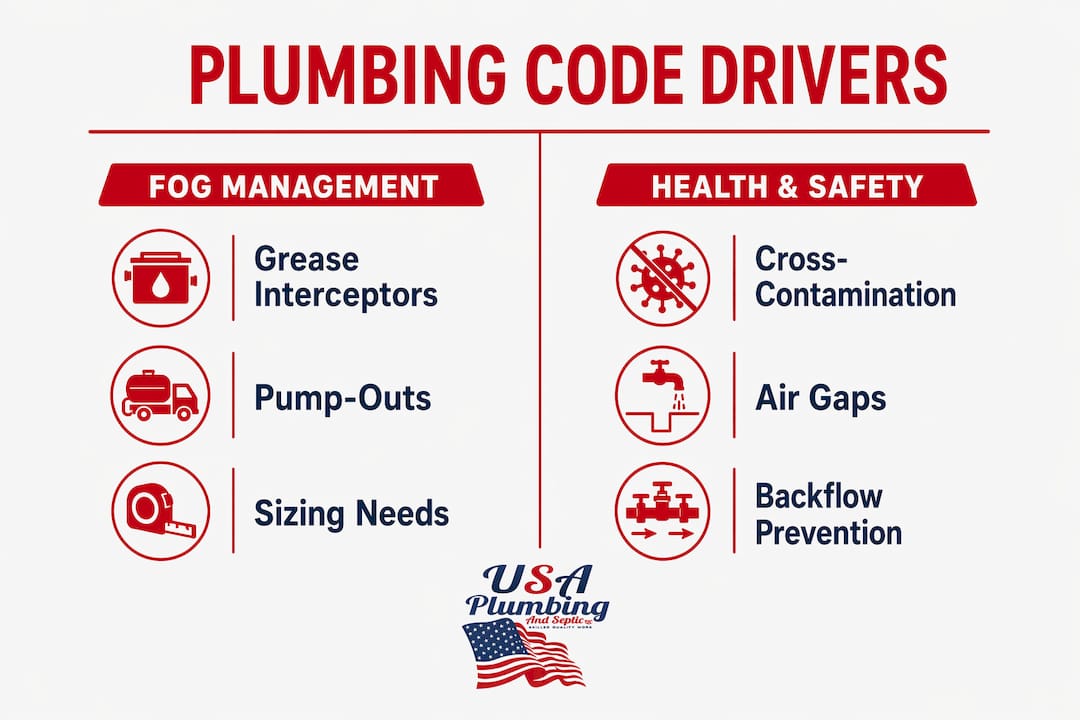
Two factors drive the strictness more than any other: fats, oils, and grease (FOG) management, and cross-contamination prevention. Both require plumbing solutions that go well beyond what a home or office building needs. A commercial plumbing maintenance schedule built around these two priorities is the most reliable way to stay compliant year-round.
How FOG management shapes restaurant plumbing regulations
Fats, oils, and grease are the single biggest driver of strict restaurant plumbing requirements. FOG solidifies inside pipes and municipal sewer lines, causing blockages that back up into kitchens and neighboring properties. Health departments treat FOG violations as serious public health offenses, not minor paperwork issues.
FOG violations can trigger EPA fines up to $37,500 per day, plus annual municipal permit fees ranging from $100 to $500. Those daily fines accumulate fast. A two-week enforcement action can cost a restaurant owner more than half a million dollars before any legal fees.
Municipal FOG programs require restaurants to:
- Install a correctly sized grease interceptor based on kitchen volume and menu type
- Maintain a cleaning log showing interceptor pump-out dates and service records
- Submit to periodic inspections by the local FOG program coordinator
- Prove that no FOG is bypassing the interceptor and entering the municipal sewer
Grease interceptor sizing is not a one-size-fits-all calculation. A burger restaurant producing heavy animal fats needs a larger interceptor than a salad bar operation. The grease interceptor cleaning logs are a legal record, and missing entries count as a violation even if the interceptor itself is clean.
Pro Tip: Schedule interceptor pump-outs at least quarterly and photograph the service each time. That photo log has saved restaurant owners from fines when paper records were disputed during inspections.
What plumbing design features does a commercial kitchen require?
Commercial kitchens require several plumbing features that do not appear in residential or standard office construction. Each one addresses a specific contamination or safety risk. Getting these right during the design phase costs far less than retrofitting after a failed inspection.
Air gaps and indirect waste connections
An air gap is a physical separation between a water outlet and the flood rim of a receiving fixture. It prevents contaminated water from siphoning back into the potable water supply. The IPC and UPC both mandate air gaps on dishwashers, ice machines, and prep sink drains. There is no mechanical substitute for a properly sized air gap.
Indirect waste connections work on the same principle. Equipment drains must discharge over a floor sink or receptor rather than connecting directly to the drain line. This physical break stops backflow from the sewer system from reaching food contact surfaces.
Backflow prevention devices
Backflow preventers protect the potable water supply from contamination caused by pressure reversals in the system. Commercial kitchens use high-pressure spray hoses, steamers, and dishwashers that create conditions where backflow is a real risk. The IPC requires reduced-pressure zone (RPZ) assemblies on connections where contamination risk is high. These devices need annual testing by a certified tester in most jurisdictions.
3-compartment sinks and hot water standards
3-compartment sinks require minimum interior dimensions of 14 inches by 16 inches by 12 inches, with hot water capacity maintained between 120°F and 140°F for effective sanitizing. That temperature range is not a suggestion. It is the threshold at which chemical sanitizers work correctly and pathogens are reliably destroyed.
NSF/ANSI standards govern the materials and construction of sinks, faucets, and drains in food service environments. Equipment that does not carry NSF certification will fail a health inspection regardless of how well it is installed.
Floor drains, floor sinks, and proper slopes
Floor slopes between 1/8 inch and 1/4 inch per foot are a code requirement in commercial kitchens. Flat floors pool water, create slip hazards, and generate odors that attract pests. Inspectors cite improper floor slopes as a violation even when all other plumbing passes.
Floor sinks are recessed receptors that receive indirect waste from equipment. Floor drains handle general wash-down water. The two serve different functions and are not interchangeable. Trap primers are mandatory mechanical devices in many jurisdictions to keep floor drain traps from drying out and allowing sewer gas into the kitchen.
Pro Tip: Work with a plumbing engineering firm during the design phase to confirm floor drain and floor sink placement before concrete is poured. Moving a drain after the slab is set costs between $4,000 and $15,000 per location.
What are the financial stakes of plumbing code compliance?
The financial investment in restaurant plumbing compliance is significant, but the cost of non-compliance is higher. Full commercial kitchen plumbing installations typically run between $15,000 and $80,000 depending on facility size, menu complexity, and local code requirements. That range reflects real differences in grease interceptor size, number of sinks, and the complexity of the drainage system.
Non-compliance carries costs that dwarf the installation budget:
- EPA fines up to $37,500 per day for FOG violations
- Business interruption while violations are corrected
- Permit revocation requiring a full re-inspection before reopening
- Concrete-cutting retrofits costing $4,000 to $15,000 per drain location when equipment alignment is wrong
- Legal fees and reputational damage from health department citations made public
Local AHJs can amend plumbing codes at any time, which means a design that was compliant last year may not pass inspection today. This is the most underestimated financial risk in restaurant construction. A code update between permit application and final inspection can require expensive redesigns.
The practical defense is early coordination. Meet with your local AHJ before finalizing any plumbing design. Confirm which version of the UPC or IPC your jurisdiction has adopted and whether any local amendments apply. That single conversation can prevent a $20,000 redesign.
Pro Tip: Budget 10–15% of your total plumbing installation cost for inspections, permit fees, and a maintenance reserve. Treating compliance as a line item from day one prevents cash flow surprises later.
How do restaurant plumbing standards differ from residential codes?
Restaurant plumbing standards differ from residential codes in three fundamental ways: usage volume, waste type, and public health exposure. A residential kitchen serves one household. A restaurant kitchen serves hundreds of people daily, each meal creating grease, food waste, and chemical runoff that a home drain system is not built to handle.
| Factor | Residential plumbing | Restaurant plumbing |
|---|---|---|
| Daily water usage | Low, intermittent | High, continuous |
| Waste type | General household | FOG, food solids, chemicals |
| Code authority | Building department | Building + health department |
| Inspection frequency | At construction | Ongoing, typically 1–4 times per year |
| Grease management | Not required | Grease interceptor mandatory |
| Backflow prevention | Basic check valves | RPZ assemblies, air gaps required |
The FDA Model Food Code and the National Sanitation Foundation (NSF) both influence restaurant plumbing requirements beyond what the IPC or UPC mandate alone. Health departments use the FDA Model Food Code as the basis for food safety inspections, which overlap directly with plumbing compliance. A plumbing violation is often also a food safety violation.
Offices and retail spaces face none of this. They use the same UPC or IPC as restaurants but without the health department overlay, the FOG program requirements, or the NSF equipment standards. That layered enforcement is exactly why restaurant plumbing regulations feel so much stricter than other commercial codes. They are stricter, by design, because the public health stakes are higher.
Key Takeaways
Restaurant plumbing codes are strict because commercial kitchens create concentrated public health risks that require specialized plumbing systems, active FOG management, and multi-agency enforcement to control.
| Point | Details |
|---|---|
| Public health is the driver | Codes exist to prevent contamination, sewer gas, and disease outbreaks in high-use kitchens. |
| FOG violations are costly | EPA fines reach $37,500 per day; cleaning logs are a legal requirement, not optional records. |
| Design features are mandatory | Air gaps, backflow preventers, and NSF-certified 3-compartment sinks are code requirements, not upgrades. |
| Early AHJ coordination saves money | Code amendments can invalidate prior designs; confirm requirements before finalizing any plumbing plan. |
| Restaurant codes exceed residential | Health department oversight, FOG programs, and NSF standards create a stricter multi-layer system. |
What I've learned from years of restaurant plumbing work
Restaurant owners consistently underestimate how much of their plumbing compliance burden is ongoing rather than one-time. Passing the initial inspection is the starting line, not the finish. The kitchens that stay compliant year after year are the ones where the owner treats the plumbing system as a living part of the operation, not a fixed asset to ignore.
The most common mistake I see is treating code compliance as the goal. Codes are the minimum. A grease interceptor pumped out exactly at the legal interval is doing the bare minimum. A well-run kitchen pumps it out before it needs it, keeps a clean log, and never gives an inspector a reason to look harder.
Floor drain installations deserve more attention than most operators give them. A dry trap from an infrequently used drain lets sewer gas into the kitchen. That gas is not just unpleasant. It is a health code violation and a fire risk. Trap primers solve this problem completely, and they cost almost nothing compared to the consequences of skipping them.
My strongest advice: build a relationship with your local inspector before you need one. Inspectors are not adversaries. They are the people who can tell you exactly what they look for before they show up. That conversation is free. The plumbing health inspection guide from Usaplumbingseptic is a solid starting point for knowing what to expect.
Hire a plumber who has done commercial kitchen work specifically. Residential experience does not transfer to FOG management, indirect waste systems, or RPZ assembly testing. The wrong hire costs you time, money, and your operating license.
— JOHN
Usaplumbingseptic keeps your kitchen compliant and running
Restaurant plumbing compliance is not a project you finish once. It requires regular maintenance, accurate records, and a plumbing team that knows commercial kitchen codes inside and out.
Usaplumbingseptic provides commercial kitchen plumbing design, grease trap servicing, inspection preparation, and emergency repairs for restaurant owners in Bullhead City, Fort Mohave, Mohave Valley, and Laughlin. Our team knows local AHJ requirements and health department standards, so you get plumbing work that passes the first time. Whether you are building a new kitchen or fixing a compliance issue before an inspection, we are available 24/7. Learn more about sewer line solutions for commercial properties, or review Mohave County plumbing essentials to understand what your local code requires. Call Usaplumbingseptic today.
FAQ
Why are restaurant plumbing codes stricter than residential codes?
Restaurant kitchens serve hundreds of people daily and produce FOG, food waste, and chemical runoff that create direct public health risks. Health departments enforce additional layers of code on top of the standard UPC or IPC to control those risks.
What is a grease interceptor and is it required?
A grease interceptor is a plumbing device that captures fats, oils, and grease before they enter the municipal sewer system. Most jurisdictions require one for any commercial kitchen that prepares food with cooking oils or animal fats.
What happens if a restaurant fails a plumbing inspection?
A failed inspection typically results in a notice of violation, a deadline to correct deficiencies, and a re-inspection fee. Serious violations, especially FOG-related ones, can trigger daily fines up to $37,500 and business closure until corrections are made.
What is an air gap in restaurant plumbing?
An air gap is a physical separation between a water supply outlet and the flood rim of a receiving fixture. It prevents contaminated water from siphoning back into the potable water supply and is required by the IPC and UPC on dishwashers, ice machines, and prep sinks.
How often should a restaurant grease interceptor be cleaned?
Most municipal FOG programs require cleaning when the interceptor reaches 25% capacity with grease and solids, which typically means quarterly service for a busy kitchen. Cleaning logs must be maintained and are subject to inspection at any time.