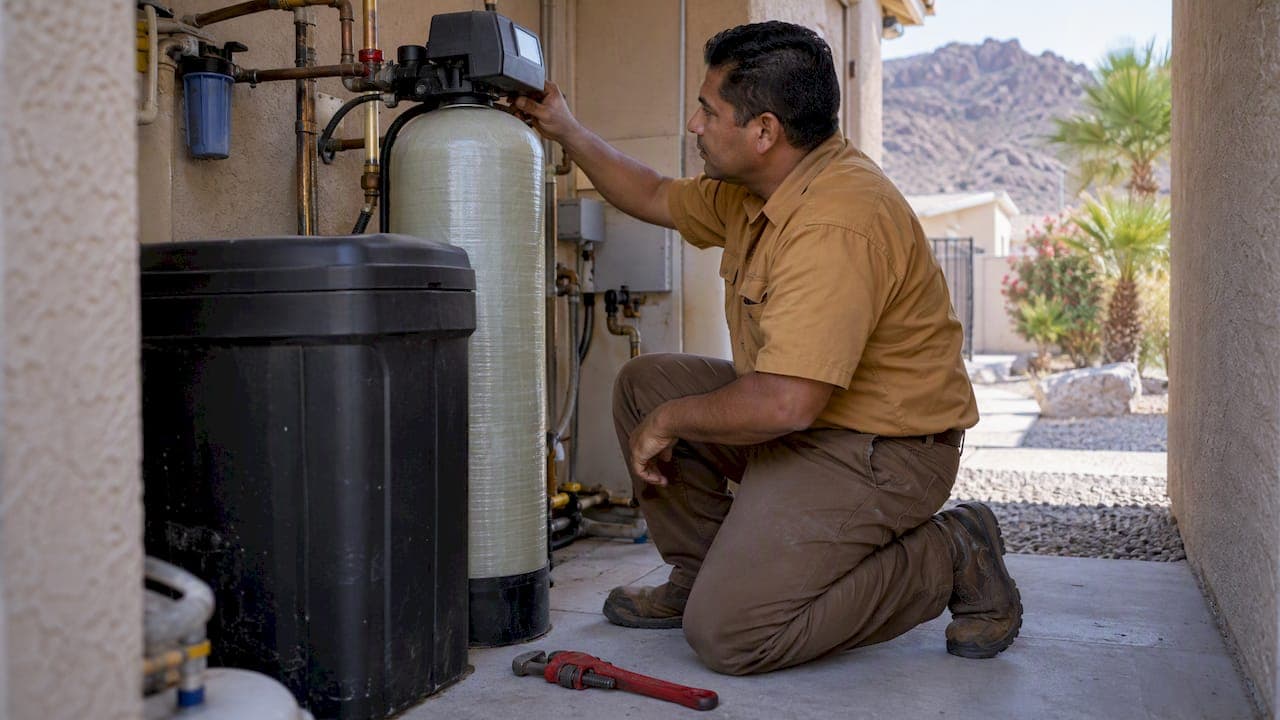
The right water softener size comes from three numbers: how hard your water is, how many gallons your household uses each day, and how fast water moves through your pipes at peak times. Multiply the first two, decide how many days you want between regenerations, and check the result against flow rate. In Bullhead City, where the water is very hard, that math pushes most homes toward a bigger unit than the national rules of thumb suggest.
We are a local plumbing and septic company, and we size softeners for homes and businesses around Bullhead City, Fort Mohave, Mohave Valley and Laughlin. This guide shows the same steps we use, with a worked example.
TL;DR
- Daily softening need = people x gallons per person x hardness in grains per gallon (GPG). The national average is 82 gallons per person per day.
- Bullhead City water is reported at roughly 36 GPG. Test your own tap or well, because your number may differ.
- The grain number on the box is not usable capacity. It depends on salt dose and resin volume.
- Check peak flow in gallons per minute (GPM) as well as grains, or hard water will slip through.
- Choose a demand-initiated regeneration (DIR) softener, not a timer-based one.
Table of Contents
- Why size matters more than brand
- Step 1: Find your real water hardness
- Step 2: Work out daily water use
- Step 3: Calculate your daily and weekly grains
- Step 4: Ignore the box, find usable capacity
- Step 5: Check peak flow, not just grains
- Step 6: Choose demand-initiated regeneration
- Is it better to oversize?
- Sizing for a business or rental property
- Our perspective: size to the property, not the chart
- Get your softener sized and installed locally
- After installation: keep it working
- FAQ
- Sources
Why size matters more than brand
A softener that is too small runs out of capacity and regenerates constantly. You pay for extra salt and water, and you still get hard water on the worst days. A softener that is far too large can also cause trouble. Guidance from the EPA's WaterSense program notes that an oversized system can regenerate inefficiently, use more water and stress the resin bed.
The goal is a unit sized to your real daily load and your real peak flow. That is a calculation, not a guess.
Step 1: Find your real water hardness
Hardness is measured in grains per gallon (GPG) or parts per million (PPM). One GPG equals about 17.1 PPM, so 200 PPM is about 11.7 GPG.
For Bullhead City, published figures put average hardness near 615 PPM, or about 36 GPG. That is far above the level most sizing charts print. Many online charts stop at 15 or 20 GPG, so they cannot answer for a home like yours.
City water and well water are different cases:
- City water: The utility publishes an annual water quality report. Bullhead City posts its water quality report online. Use it as a starting point.
- Well water: Minerals vary by well, depth and season. Test your own water. Our guide to well water testing costs explains what to ask county labs before you pay.
On-site testing beats any area average. A reading from your own tap is the one number that belongs to your property.
Add iron to the math if you have a well
Dissolved iron uses up resin capacity. The common convention is to add 5 GPG of effective hardness for every 1 PPM of dissolved ferrous iron. Water at 10 GPG with 2 PPM iron should be sized as if it were 20 GPG. Orange particles at the tap point to a different problem, and that needs an iron filter ahead of the softener.
Step 2: Work out daily water use
The usual figure is 82 gallons per person per day for residential use, and the source itself recommends checking local data. Some sizing guides use 50 to 75 gallons. Because Arizona households often run evaporative coolers, pools, irrigation and extra bathrooms, we lean toward the higher number.
If you want the real figure, read your water meter at the same time for several days. Divide the daily difference by the people in the home.
Step 3: Calculate your daily and weekly grains
The formula is simple:
People x gallons per person per day x hardness in GPG = grains of hardness to remove per day
Here is a worked example for a four-person home on Bullhead City water at 36 GPG:
- 4 people x 82 gallons = 328 gallons per day
- 328 x 36 GPG = 11,808 grains per day
- For a seven-day interval, 11,808 x 7 = 82,656 grains
Most sizing guides tell you to multiply by seven, as in the example of 3,000 grains a day giving 21,000 grains. That works for 8 to 10 GPG water. At 36 GPG, a seven-day cycle needs a very large tank, so it is not practical for most homes. Instead, pick a shorter interval, such as three to five days, and size for that.
For the same home:
| Regeneration interval | Grains needed between regenerations |
|---|---|
| 3 days | 35,424 |
| 4 days | 47,232 |
| 5 days | 59,040 |
| 7 days | 82,656 |
The longer the interval, the bigger the unit and the more salt it holds. The shorter the interval, the more often it regenerates. There is a middle point, and that is where you want to be.
Our own blog has a longer walk-through of a 7 to 10 day sizing example if you want another case to compare.

Step 4: Ignore the box, find usable capacity
A label that says 32,000 grains usually refers to a 1.0 cubic foot resin tank. That is a marketing name. Real capacity depends on how much salt each regeneration uses and on the resin type.
According to the OwnerSpec resin capacity calculator, 1.0 cubic foot of resin delivers about 20,000 grains at a 6 lb salt dose and only about 4,000 at 1 lb. More salt raises capacity, but efficiency drops steeply. The same source suggests designing around a moderate dose of 6 to 8 lb per cubic foot of resin.
Using the 20,000 grains per cubic foot at 6 lb figure, here is roughly what each resin volume gives you:
| Resin volume | Usable grains at 6 lb/cu ft | Days between regenerations for 11,808 grains/day |
|---|---|---|
| 1.0 cu ft | 20,000 | about 1.7 |
| 2.0 cu ft | 40,000 | about 3.4 |
| 3.0 cu ft | 60,000 | about 5.1 |
| 4.0 cu ft | 80,000 | about 6.8 |
This is a rough guide built on one published capacity figure. Actual numbers vary by resin and valve, so ask for the usable capacity at a stated salt dose, not the marketing grain count.
One popular rule is to run a softener at about 75% of its rated capacity for better salt efficiency. Treat it as a margin of safety, not a replacement for the math above.

Step 5: Check peak flow, not just grains
Grain capacity says how much hardness the resin can hold. Flow rate says how fast water can pass through without leaking hardness. Water moving too quickly through the bed does not exchange properly, and hardness leaks into your soft water.
How to check it:
- Count your fixtures that can run at once: showers, dishwasher, washing machine, irrigation.
- Estimate the gallons per minute for each and add them up.
- Confirm the softener's rated service flow covers that total at your hardness.
A large family home with three bathrooms can hit a high peak on a weekday morning. A small unit with plenty of grain capacity but a narrow valve will still disappoint. The same logic applies even more to commercial sites.
Step 6: Choose demand-initiated regeneration
Timer-based softeners regenerate on a fixed schedule whether or not they need to. Demand-initiated regeneration (DIR) softeners regenerate based on actual water use. EPA's WaterSense guide recommends DIR systems because they waste less water and salt.
In very hard water the point is sharper. A timer set for the worst case wastes salt on light-use weeks. A timer set too long lets hard water through on heavy ones. A DIR valve adapts to both.
Is it better to oversize?
A little extra capacity is wise in water as hard as ours. A lot of extra is not. Oversizing too far means long gaps between regenerations, which can leave resin sitting and brine stagnant. It also costs more up front. Aim for a unit that regenerates every three to five days at your real load, with enough headroom for guests, a new bathroom or a warm summer.
Sizing for a business or rental property
Commercial sites add two problems: higher peak flow and heavier daily volume. Laundries, restaurants, car washes and multi-unit buildings often need larger resin volumes and wider pipe sizes. Design guidance says the resin volume depends on service flow rate, hardness, volume of water and regeneration frequency. Get all four right.
Landlords and property managers should also think about service access. Twin-tank units keep soft water flowing during regeneration, which matters when tenants or customers cannot wait.
Our perspective: size to the property, not the chart
We work in the Lake Mohave basin, where groundwater minerals change from one well to the next, and from season to season. That is why we do not trust a chart, ours or anyone else's, as the final answer. We test the water at the property, read how the household really uses it, and then pick a unit.
Here is what we see over and over:
- Homes bought with a small box-store softener that regenerates almost every other day.
- Timer valves set years ago that no longer match the family.
- Well owners who skipped the iron adjustment and wonder why resin fails early.
- Softeners with enough grains but not enough flow for the home's peak demand.
We recommend a DIR unit, sized for a three to five day interval at your real hardness, with the flow rate checked against your fixtures. Hard water also does damage before it is softened, and our guide on hard water plumbing problems shows what to look for. If you want to understand the payoff, read about the benefits of a water softener installation.
— JOHN
Get your softener sized and installed locally
We repair and replace water softening and filtration systems for homes and businesses in Bullhead City, Fort Mohave, Mohave Valley and Laughlin. We also handle water well equipment, water lines and water heaters, so one team can look at the whole system. We are available 24/7 for emergencies. Call or book a visit with USA Plumbing and Septic and we will test, size and quote the job.
After installation: keep it working
A correctly sized softener still needs basic care. Check the salt level monthly. If the salt forms a crust and the unit stops producing soft water, our guide to salt bridges and safe fixes covers the first checks. If you also run reverse osmosis for drinking water, a short RO maintenance routine keeps it healthy too.
FAQ
What size water softener do I need for a house with 5 people?
At 82 gallons per person per day, five people use 410 gallons. At 36 GPG that is 14,760 grains per day, or about 59,040 grains over four days. That usually points to a unit with around 3 cubic feet of resin, but the exact choice depends on your tested hardness, iron and peak flow.
Does it matter what size water softener you use?
Yes. Too small and it regenerates constantly and lets hard water through. Too large and it can regenerate inefficiently and waste money. Size it from your real hardness, daily use and flow rate.
What does grain capacity mean on a water softener?
Grain capacity is the amount of hardness the resin can remove before it must regenerate. The labeled number is often a best-case figure. Usable capacity depends on resin volume and salt dose per regeneration.
Is a well water softener sized differently?
Often, yes. Well water can contain iron and manganese that use resin capacity, so the effective hardness is higher than the hardness test alone. Test the well and adjust the number before you size.
Sources
- How to Size a Water Softener, Aquasana
- Water Hardness Arizona, Aquatell
- Soften Water Without Wasting It, EPA WaterSense
- Water Softener for Well Water, Well Water Fix
- Softener resin volume to grain capacity calculator, OwnerSpec
- Guidelines for Designing Water Softeners, WC&P Online
- Water Quality Report, City of Bullhead City