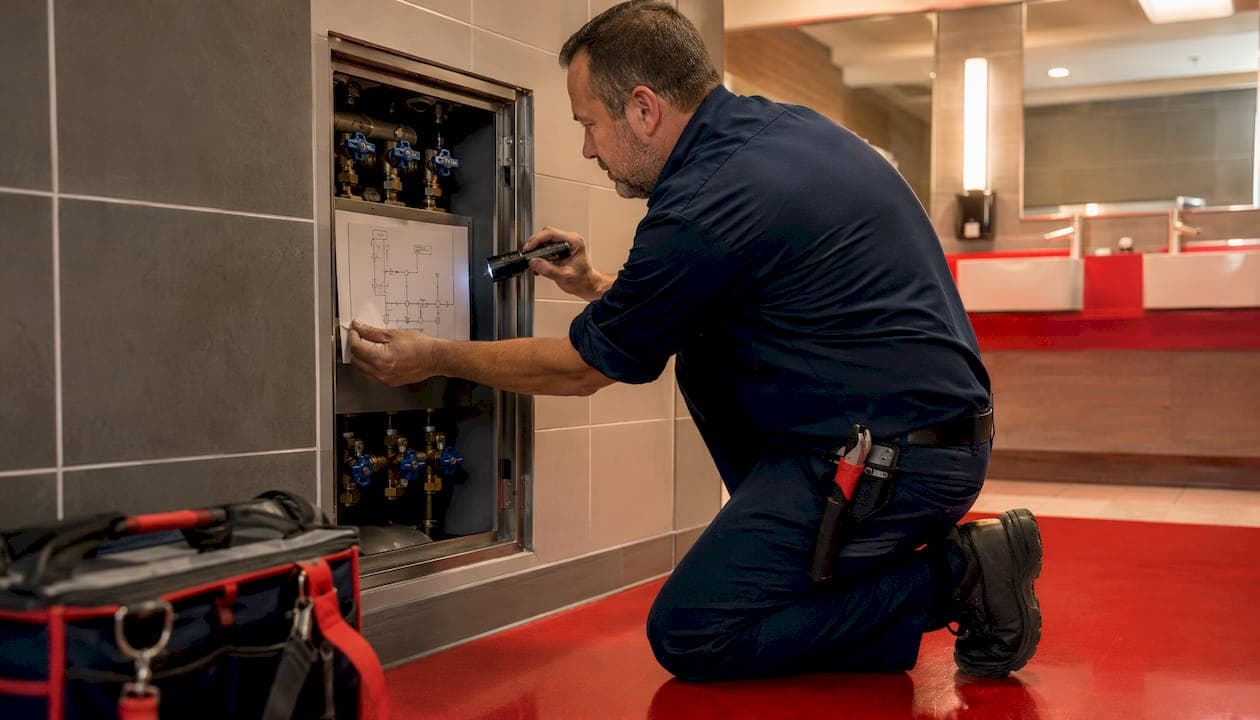
The most effective approach to commercial bathroom plumbing best practices is a proactive program that combines daily visual checks, weekly strainer cleaning, scheduled professional drain cleaning and backflow testing, code-compliant design, and documented contractor SLAs. Ground that program in the International Plumbing Code, EPA WaterSense fixture standards, and ADA provisions, and you have a system that prevents emergency closures rather than reacting to them.
Start this week with these six actions:
- Walk every restroom daily and log fixture condition, sensor function, and any visible leaks under sinks or at supply connections.
- Clean drain strainers and screens every week without exception.
- Test sensor-operated flush valves and soap dispensers weekly; replace batteries on a fixed schedule, not when they fail.
- Confirm your building pressure gauge reads within the normal range (typically 40–80 psi for commercial supply) and log it weekly.
- Schedule a licensed plumber for quarterly drain cleaning if your facility runs at high occupancy.
- Verify every shut-off valve is labeled, accessible, and turns freely. A stuck shut-off during a leak can turn a minor repair into a full-floor closure.
Pro Tip: Keep a labeled shut-off map posted inside each restroom's service panel. When a sensor line bursts at 2 AM, your on-call staff will thank you.
Table of Contents
- What daily and weekly tasks should facility staff run?
- How often should you schedule professional plumbing maintenance?
- What design rules reduce maintenance and failure risk?
- What compliance records does your facility need to keep?
- How do you diagnose common commercial restroom plumbing problems?
- A practical maintenance schedule your team can use today
- What should you require from a licensed commercial plumbing contractor?
- Key Takeaways
- The maintenance habit most facilities skip
- Usaplumbingseptic keeps your facility running on schedule
- Useful sources
- FAQ
What daily and weekly tasks should facility staff run?
Proactive commercial bathroom maintenance reduces emergency repairs and compliance violations. The key is building a repeatable routine that staff can execute without specialized tools.
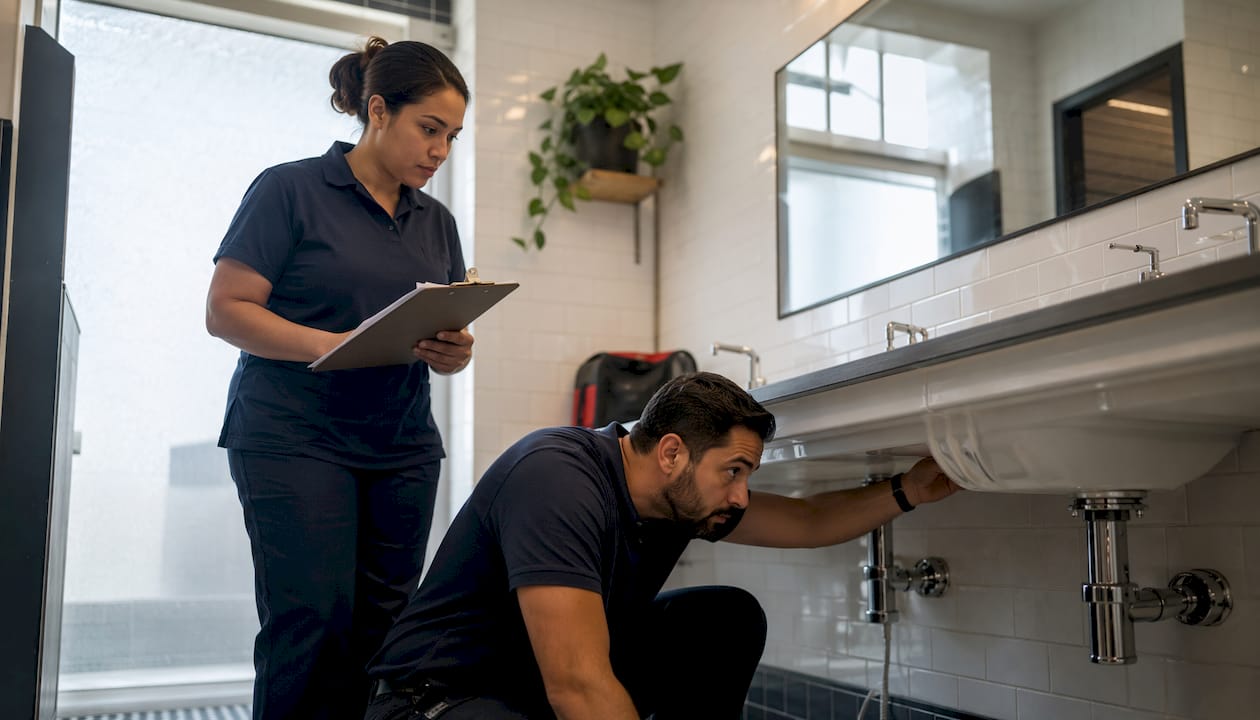
Daily checks
Run these every morning before peak occupancy:
- Visual fixture check: Inspect every toilet, urinal, and faucet for visible drips, running water, or cracks in supply lines.
- Flush verification: Manually flush each toilet and urinal. A sluggish flush is an early warning of a partial clog or low supply pressure.
- Faucet and sensor test: Confirm sensor-operated faucets activate within one second of hand placement. Slow response often means a dirty sensor lens, not a failing unit.
- Under-sink inspection: Open each vanity cabinet and check supply lines and drain connections for moisture, staining, or odor.
- Floor drain check: Pour a small amount of water into each floor drain and confirm it flows freely. A slow drain or sulfur odor signals a dry trap or partial blockage.
Weekly tasks
- Clean all strainer baskets and screens in floor drains, sink drains, and urinal strainers.
- Test supply stop valves by closing and reopening each one to confirm they move freely and do not leak at the packing nut.
- Log water pressure readings at building gauge points and note any readings outside the normal range.
- Wipe sensor lenses on flush valves and faucets with a dry cloth; check wiring connections at sensor heads for corrosion.
Staff should never attempt repairs on backflow prevention assemblies, pressurized water heater components, or gas-connected fixtures. Those require a licensed commercial plumber.
Pro Tip: Keep a small spare-parts kit in each restroom service closet: common faucet aerators, replacement sensor batteries (AA and lithium), extra flush valve seals, and a few feet of braided supply line. A small spare-parts kit can prevent costly service calls for minor repairs like dripping faucets.
How often should you schedule professional plumbing maintenance?
Certain tasks require a licensed commercial plumber, specialized equipment, or both. The table below maps the right cadence for each service so you can build a budget and a calendar at the same time.
| Service | Recommended Frequency | Why It Matters |
|---|---|---|
| Drain cleaning (hydrojetting or augering) | Quarterly for high-use sites | Quarterly drain cleaning prevents backups in heavy-use commercial settings |
| Camera inspection of main drain lines | Semi-annually or after any backup | Identifies root intrusion, offset joints, and buildup before failure |
| Backflow prevention device testing | Annually (required in most U.S. jurisdictions) | Protects potable water supply; certificates required for compliance |
| Water heater flush and T&P valve test | Annually | Removes sediment; verifies safety relief valve function |
| Full fixture inspection and re-caulking | Annually | Prevents water intrusion behind walls and under floors |
| Pressure regulator check | Annually or when pressure readings drift | Prevents fixture damage from supply spikes |
Backflow device testing carries statutory weight in most jurisdictions. Many local authorities having jurisdiction (AHJ) require annual testing by a certified backflow tester, and the test certificate must be on file. Failing to maintain that record can trigger fines or a failed health inspection. Budget for it as a fixed annual line item, not a discretionary expense.
For high-occupancy facilities, restaurants, hotels, or gyms, quarterly commercial drain maintenance is the standard. Lower-traffic offices may stretch to semi-annual drain cleaning without significant risk, but camera inspections should still run at least once a year.
What design rules reduce maintenance and failure risk?
Good plumbing design for commercial restrooms is the cheapest maintenance you will ever do. Getting the layout right during construction or a remodel eliminates entire categories of recurring problems.

Slope, distance, and venting
The standard horizontal drain slope is a gentle slope adequate to maintain flow and prevent sediment buildup. Too little slope and solids settle; too much and water outruns solids, leaving debris behind. Keep fixtures within a short distance of the main soil stack where practical to reduce clog risks. Longer horizontal runs lose velocity, and fixtures placed too far from the main drain stack increase clog frequency even when code minimums are technically met. Every fixture needs individual venting per code; shared wet venting is permitted in limited configurations under the IPC, but individual vents are more reliable in high-use commercial settings.
Fitting selection and cleanout placement
Use Wye fittings for horizontal-to-horizontal branch connections. Sanitary tees belong only in vertical-to-horizontal transitions. The 135-degree rule requires a cleanout at any directional change equal to or greater than 135 degrees. Skipping cleanouts to save money during construction is one of the most expensive decisions a project team can make; accessing a blockage without a cleanout often means cutting into finished walls.
Material selection
| Application | Recommended Material | Notes |
|---|---|---|
| Drain lines (noise-sensitive areas) | Cast iron | Superior sound dampening vs. PVC/ABS |
| Drain lines (standard commercial) | ABS or PVC | Lightweight, cost-effective, fire-rated versions available |
| Supply lines (standard) | Copper or PEX | Copper for longevity; PEX for flexibility in retrofit work |
| Supply lines (coastal/humid environments) | Stainless or CPVC | Corrosion resistance where copper oxidizes faster |
| Exposed supply connections | Braided stainless hose | Resists kinking and UV degradation |
Design for peak occupancy, not average use. A corporate office restroom that handles 20 people at 9 AM and 200 at noon needs to be sized for noon. Coordinate architects, engineers, and facility managers early; last-minute layout changes to accommodate structural constraints are where slope and venting compromises happen.
Maintain at least 6 inches of separation between supply and drain lines in areas prone to condensation or corrosion. In humid climates or mechanical rooms, that clearance prevents accelerated corrosion where condensation drips from cold supply lines onto drain fittings.
Pro Tip: Before closing any wall or ceiling, photograph every hidden pipe run and valve location with a timestamp. Upload those photos to a shared folder indexed by room number. Documenting hidden runs before walls close drastically reduces future demolition and diagnostic costs.
What compliance records does your facility need to keep?
Keep dated records of every inspection, test, and service call. That documentation is your first line of defense during a health department inspection, an insurance claim, or a liability review.
Required and recommended records
- Backflow prevention test certificates: Keep the signed certificate from a certified tester for every device, every year. Most AHJs require these on demand.
- Licensed contractor invoices: Every professional service call should produce a dated invoice showing the contractor's license number, work performed, and materials used.
- Permit documentation: Any remodel or fixture replacement that required a permit needs the permit card, inspection sign-off, and final approval on file.
- ADA compliance verification: Document fixture heights, clearances, and grab-bar placements for accessible stalls. If you modified a restroom, keep the architect's or contractor's ADA compliance statement.
- WaterSense or manufacturer spec sheets: When you replace fixtures, file the spec sheet confirming flow rates. This supports water efficiency compliance and documents that replaced fixtures meet EPAct baseline standards (1.6 gpf for toilets installed after 1994).
For code references, start with the International Plumbing Code published by the International Code Council and your local AHJ's adopted version. Many states amend the IPC, so always verify which edition and amendments your jurisdiction enforces. For Arizona-specific requirements, a commercial plumbing code checklist is a practical starting point.
Pro Tip: Store all records digitally in a folder structure organized by fixture or room (e.g., "Men's Room 1 > Backflow Device > 2024 Test Certificate"). Retain annual test certificates for at least three years, but check your local AHJ for the specific retention period that applies to your facility type.
How do you diagnose common commercial restroom plumbing problems?
Triage fast, isolate the problem, and decide whether it is a staff fix or an emergency call. Most issues fall into four categories.
Slow drains
Check the strainer first. A clogged strainer accounts for the majority of slow-drain complaints in commercial restrooms. If the strainer is clear, check nearby vent stacks for blockage (birds' nests, debris) and confirm the cleanout downstream is accessible. A slow drain that does not respond to strainer cleaning usually means buildup in the horizontal run and needs professional augering or hydrojetting.
Gurgling sounds and odors
Gurgling after a flush points to a venting problem. Air is being pulled through a trap rather than venting through the stack. Check that vent terminations on the roof are clear. Persistent odors with no gurgling usually mean a dry trap in a floor drain that sees infrequent use; pour water into it and add a trap primer if the drain dries out regularly.
Sensor failures
Before calling a plumber, check the battery and clean the sensor lens. Most sensor-operated flush valves and faucets fail due to dead batteries or a dirty infrared window, not a defective solenoid. If a fresh battery and a clean lens do not restore function, check the solenoid wiring connection at the valve body.
Low water pressure
Check the building supply gauge first. If building pressure is normal, the problem is localized. Look for a partially closed supply stop at the affected fixture. If multiple fixtures on the same branch are low, check for a partially closed zone valve or a failing pressure regulator on that branch.
When to treat it as an emergency: Standing water that cannot be isolated to a single fixture, any sewer backup with sewage on the floor, a gas smell anywhere near plumbing, or an inability to shut off hot or cold water to a fixture all require an immediate call to a licensed commercial plumber. Do not attempt to manage sewer backups beyond placing a wet-vac to contain minor overflow while you wait for help.
Pro Tip: A moisture meter and a handheld inspection camera are the two tools that prevent the most unnecessary demolition. Run the camera through a cleanout before cutting into a wall, and use the moisture meter to confirm whether a stain is active or old before scheduling a repair.
A practical maintenance schedule your team can use today
The table below is ready to copy into your maintenance software, a shared spreadsheet, or a printed binder. Assign roles before you post it.
| Task | Frequency | Responsible Role | Escalation |
|---|---|---|---|
| Visual fixture and leak check | Daily | On-site staff | Report to facility manager same day |
| Flush and sensor function test | Daily | On-site staff | Log failures; call plumber if not resolved by next shift |
| Floor drain flow and odor check | Daily | On-site staff | Dry trap: add water; persistent odor: call plumber |
| Strainer and screen cleaning | Weekly | On-site staff | Replace damaged strainers immediately |
| Supply stop valve test | Weekly | On-site staff | Stuck valve: tag and call plumber promptly |
| Water pressure log | Weekly | On-site staff or facilities manager | Readings outside 40–80 psi: call plumber |
| Drain cleaning (hydrojetting/augering) | Quarterly | Licensed commercial plumber | Emergency if backup occurs before scheduled service |
| Camera inspection of main lines | Semi-annually | Licensed commercial plumber | Immediate if camera reveals offset joint or root intrusion |
| Backflow device testing | Annually | Certified backflow tester | Failing device: shut off and replace before next use |
| Water heater flush and T&P test | Annually | Licensed commercial plumber | Failing T&P valve: replace immediately |
| Full fixture inspection and re-caulking | Annually | Licensed commercial plumber | Active water intrusion: treat as emergency |
For a detailed template and step-by-step setup, the guide on how to create a commercial plumbing maintenance schedule walks through building a calendar from scratch.
Onboarding staff and vendor visits
When onboarding new staff to this schedule:
- Walk the restrooms together and physically locate every shut-off valve and cleanout.
- Show staff the spare-parts kit location and what each part replaces.
- Confirm they know the escalation path: who to call, when to call, and what information to have ready (fixture location, symptom, whether water can be isolated).
When a contracted plumber visits, request a written inspection checklist with photos, a summary of work performed, and any recommendations for the next service interval. That documentation feeds directly into your compliance file.
Pro Tip: Leak sensors and demand-controlled recirculation pumps detect failures earlier than manual checks alone. Adding even basic IoT moisture sensors under sinks and at water heater connections reduces time-to-detection and can be integrated into your maintenance software as automated alerts, cutting the number of manual daily checks your staff needs to run.
What should you require from a licensed commercial plumbing contractor?
Require a licensed commercial plumber, a written scope of work, clear response-time SLAs, and documented preventive services before signing any contract. A handshake agreement with a residential plumber is not adequate for a commercial facility.
Vendor qualification checklist
- Active commercial plumbing license in your state (verify with your state licensing board, not just the contractor's word)
- General liability insurance and workers' compensation coverage, with your facility named as an additional insured
- Certified backflow tester on staff or a documented subcontractor relationship with one
- References from at least two comparable commercial facilities (similar occupancy type and size)
- Documented employee certifications for any specialty work (gas lines, medical gas, grease interceptors)
Understanding what plumbing compliance means when hiring a contractor is the foundation of a solid vendor relationship. Licensing requirements vary by state, so verify the specific credentials your jurisdiction requires before finalizing any contract.
SLA tiers and contract elements
| Priority Level | Response Time | Scope | Notes |
|---|---|---|---|
| Emergency (standing water, sewer backup) | 2–4 hours | Dispatch and containment | Flat-rate emergency cap in contract |
| Priority (sensor failure, single fixture out of service) | Same business day | Diagnosis and repair or temporary isolation | |
| Standard (scheduled maintenance) | Per agreed calendar | Drain cleaning, inspections, testing | Written report required after each visit |
Contract elements to require in writing: guaranteed response windows for each tier, flat-rate caps on emergency labor, a schedule for preventive services (drain cleaning, backflow testing, camera inspections), written inspection reports with photos after every visit, and warranty terms for replaced components (parts and labor, minimum 90 days).
Keep a secondary vendor on file for overflow work or specialty services your primary contractor does not cover. A single-vendor dependency is a risk during peak demand or when your primary contractor is unavailable for an emergency.
Pro Tip: Before signing, verify the contractor's license number directly on your state licensing board's website. A license number on a business card is not the same as a currently active, commercially endorsed license. This one check prevents most contractor fraud situations.
Key Takeaways
Proactive commercial bathroom plumbing maintenance, built on daily checks, quarterly professional drain cleaning, annual backflow testing, and code-compliant design, prevents emergency closures and keeps facilities inspection-ready year-round.
| Point | Details |
|---|---|
| Daily and weekly checks | Run visual fixture checks daily and clean strainers weekly to catch problems before they escalate. |
| Quarterly drain cleaning | High-use facilities need professional hydrojetting or augering every quarter to prevent backups. |
| Annual backflow testing | Most U.S. jurisdictions require annual certified backflow device testing; keep the certificate on file. |
| Design rules that last | A 1/4-inch-per-foot drain slope and fixtures within 6 feet of the main stack reduce clogs and maintenance costs. |
| Usaplumbingseptic as your partner | Usaplumbingseptic provides licensed commercial plumbing service, scheduled maintenance, and emergency response for facilities in Bullhead City, Fort Mohave, Mohave Valley, and Laughlin. |
The maintenance habit most facilities skip
Most facility managers focus on what breaks. The smarter move is focusing on what prevents the break in the first place, and the single most underrated habit is photo-documented as-builts combined with labeled shut-off maps.
Every facility I have worked in that struggled with emergency response had the same problem: nobody knew where the shut-offs were. A pipe bursts at 11 PM, and the on-call staff spends 20 minutes hunting for a valve while water spreads across a tile floor. That is not a plumbing failure. That is a documentation failure.
The second habit that pays back quickly is small, low-cost fixture upgrades. Replacing aging aerators with high-efficiency 1.0 gpm aerators is a low-cost change that reduces water consumption immediately without a major overhaul. Pair that with WaterSense-labeled fixtures that are certified to use at least 20% less water than standard models, and you have a measurable utility reduction that shows up on the next bill.
The facilities that run the smoothest are not the ones with the newest equipment. They are the ones with the best records, the clearest escalation paths, and a licensed contractor who shows up on a schedule rather than only when something fails. That combination, documentation plus proactive service, is what separates a facility that passes inspections from one that scrambles before them.
Usaplumbingseptic keeps your facility running on schedule
When a commercial restroom goes down, every hour of closure costs you in lost productivity, tenant complaints, and potential code violations. Usaplumbingseptic delivers the scheduled preventive care, licensed inspections, and 24/7 emergency response that keep those hours from happening.
We serve commercial facilities across Bullhead City, Fort Mohave, Mohave Valley, and Laughlin with a team of experienced, licensed plumbers equipped for everything from quarterly drain cleaning and backflow testing to full restroom remodels. Our service contracts include written inspection reports after every visit, documented maintenance logs for your compliance file, and guaranteed response windows so you are never waiting on a callback during an emergency. For facilities in Mohave County, our local plumbing essentials guide outlines the regional code considerations that affect your maintenance program. Ready to get a service contract in place? Contact Usaplumbingseptic today to request a site survey and a written scope tailored to your facility's occupancy and schedule.
Useful sources
These are the primary resources to consult for U.S. plumbing code, water efficiency standards, and inspection best practices.
- International Plumbing Code (IPC): Published by the International Code Council; the baseline code adopted (with local amendments) by most U.S. jurisdictions. Covers pipe slope, venting, fixture counts, and backflow prevention requirements.
- EPA WaterSense Commercial Buildings: EPA's WaterSense program provides fixture efficiency benchmarks, the 20% efficiency threshold for labeled products, and guidance on EPAct flow-rate compliance.
- U.S. Department of Energy, Commercial Buildings: energy.gov's commercial buildings resource covers water heating efficiency, energy-water nexus considerations, and federal building standards.
- Local AHJ (Authority Having Jurisdiction): Your city or county building department enforces the locally adopted plumbing code. Contact them for backflow testing certification requirements, permit thresholds, and inspection schedules specific to your location.
- Manufacturer installation and maintenance manuals: Keep digital copies linked to each fixture's maintenance file. Spec sheets confirm flow rates for compliance documentation and warranty terms for replaced components.
Save digital copies of all the above and link permit records to each fixture's maintenance file for fast retrieval during inspections.
FAQ
What is the 135-degree rule in plumbing?
The 135-degree rule requires a cleanout at any change in direction equal to or greater than 135 degrees in a drain line. It also governs fitting selection: use Wye fittings for horizontal-to-horizontal branches and sanitary tees only for vertical-to-horizontal transitions to prevent debris accumulation.
What are the most common plumbing mistakes to avoid in commercial restrooms?
The most common mistakes are placing fixtures too far from the main soil stack (which causes slow drainage and clogs), skipping individual fixture shut-offs, and failing to maintain the 1/4-inch-per-foot slope on horizontal drain runs. Skipping cleanout placement at directional changes is a close second.
Does every commercial bathroom need a floor drain?
Most commercial restrooms require floor drains under local plumbing codes, particularly in high-use or wet environments such as gyms, restaurants, and healthcare facilities. Requirements vary by jurisdiction and occupancy type, so confirm with your local AHJ and the adopted IPC edition for your area.
What are the most common problems in commercial plumbing systems?
The most frequent issues are slow or blocked drains from strainer buildup and long horizontal runs, sensor-operated fixture failures from dead batteries or dirty lenses, low pressure from partially closed zone valves or failing pressure regulators, and sewer odors from dry floor-drain traps. Usaplumbingseptic addresses all of these through scheduled maintenance contracts and 24/7 emergency response across Bullhead City and the surrounding area.
How often should backflow prevention devices be tested in commercial buildings?
Annual testing by a certified backflow tester is required in most U.S. jurisdictions, and the signed test certificate must be kept on file for compliance. Some high-risk facilities or local AHJs may require more frequent testing, so verify the specific requirement with your local authority.