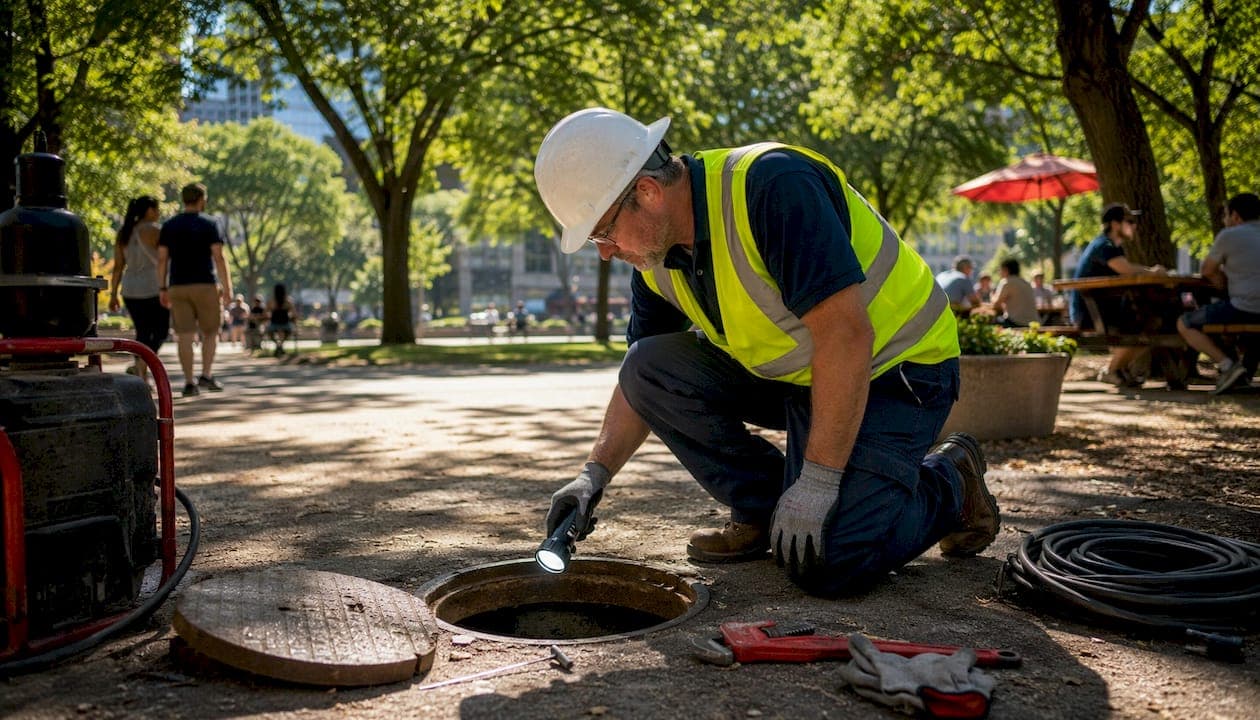
Stop the flow, contain the contamination, and call a licensed commercial sewer contractor with CCTV camera inspection and bypass-pumping capability. That's the short answer. Everything else in this guide helps you do those three things correctly, document them for insurance, and prevent the next one.
Immediate action checklist:
- Shut off fixtures in the affected zone (do not shut the building main if bypass pumping is planned)
- Block HVAC return paths near the affected area to prevent odor and pathogen spread
- Post warning signage and cordon off the zone before staff re-enter
- Photograph everything with timestamps before any cleanup begins
- Notify your municipal utility and local health department if sewage has left containment
The NASSCO PACP (Pipeline Assessment and Certification Program) standard is the industry benchmark for CCTV sewer inspection. Require it by name when requesting camera reports. For significant contamination events, EPA guidelines and most state health departments require notification. Backwater valves can reduce surcharge-related backup risk for below-grade fixtures by up to 70%. That single piece of equipment, installed proactively, prevents most of the scenarios this guide covers.
Pro Tip: Keep a laminated one-page emergency contact sheet in your mechanical room: municipal sewer utility, your licensed commercial plumber, and your insurance carrier's claims line. When sewage is on the floor, you don't have time to search.
Table of Contents
- What should you do in the first 60 minutes of an active sewer backup?
- What are the red flags that a commercial sewer is about to fail?
- What causes commercial sewer backups and how do they show up?
- How do professionals diagnose a commercial sewer failure?
- What repair options are available and which one fits your situation?
- How do you prevent commercial sewer backups long-term?
- What does it cost to fix a commercial sewer backup, and how long does it take?
- How do you coordinate with municipalities, health departments, and insurance?
- DIY troubleshooting and temporary containment before the plumber arrives
- Key Takeaways
- What most facility managers get wrong about commercial sewer backups
- Usaplumbingseptic is ready when your building needs it most
- Useful sources and references
- FAQ
What should you do in the first 60 minutes of an active sewer backup?
Speed matters. Every minute of active sewage flow increases remediation costs and health risk. Here's how to prioritize.
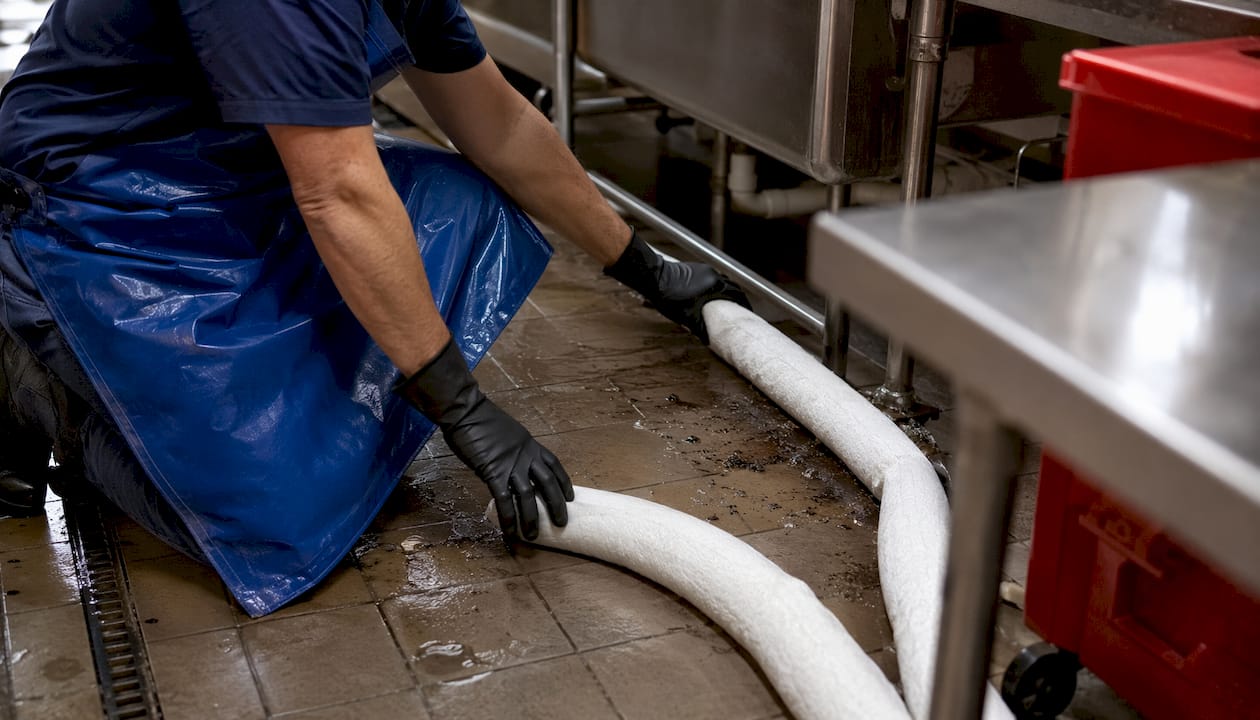
Stop the source first. Shut off fixtures in the affected zone. If the backup is isolated to a single restroom or floor drain, shutting those fixtures is enough. Do not shut the building's main water supply if your contractor has confirmed bypass pumping is part of the repair plan. Shutting the main can interfere with that setup.
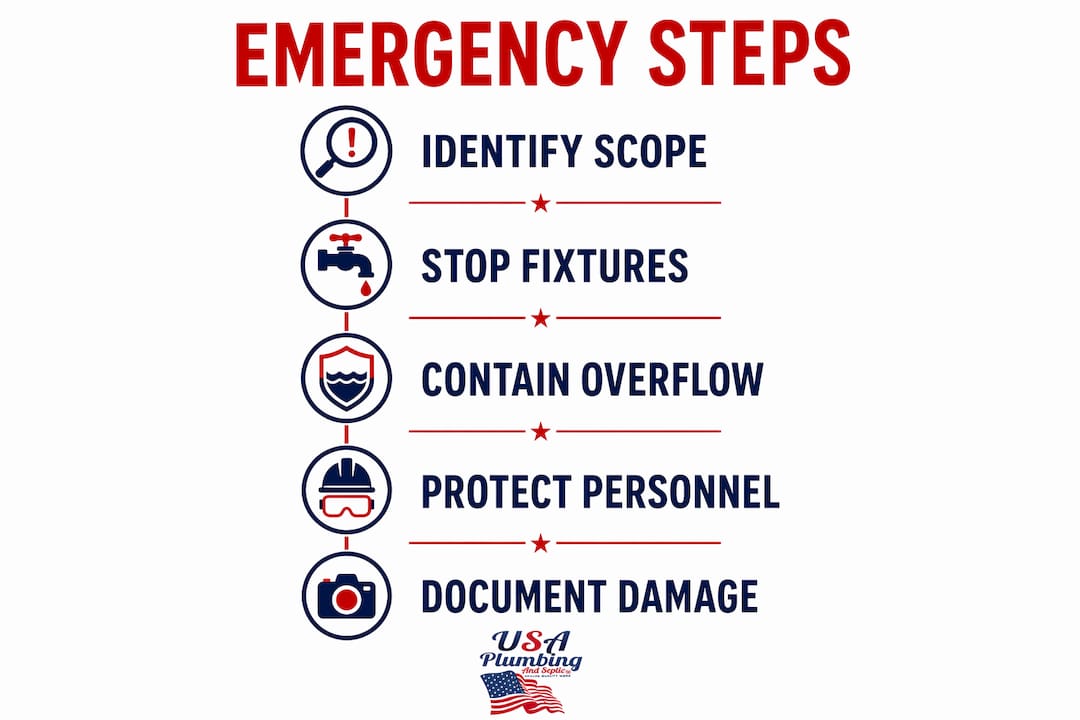
Contain the contamination. Raw sewage carries bacteria, protozoans, and pathogens that pose serious health risks. Block floor drain overflow paths using temporary sandbags or absorbent booms. Close HVAC dampers serving the affected zone to prevent airborne spread. If the backup involves a below-grade mechanical room, elevator pit, or food-service area, treat it as a biohazard zone immediately.
Protect your people. Anyone entering the affected area needs at minimum: rubber gloves, eye protection, and waterproof boots. If sewage is visible in occupied spaces or strong sewer gas odors are present, evacuate those areas. Hydrogen sulfide from sewage can reach dangerous concentrations quickly in enclosed spaces.
Preserve evidence. Photograph and video the affected area before any cleanup. Record timestamps. Do not allow untrained staff to attempt full cleanup. Premature cleanup can void insurance claims and complicate health-department reporting. A commercial plumbing emergency handled correctly from minute one costs far less to resolve than one where evidence was lost.
When to call emergency services or notify utilities. If sewage has reached a public right-of-way, entered a storm drain, or is threatening neighboring properties, call your municipal utility immediately. Most jurisdictions require notification within hours of a significant discharge event.
What are the red flags that a commercial sewer is about to fail?
Catching a developing problem before it becomes a full backup saves you the emergency call, the remediation bill, and the health-department visit. These signs point to main-line stress, not just a clogged fixture.
- Multiple slow drains simultaneously. One slow drain is a localized clog. Two or more fixtures draining slowly at the same time, especially on different floors or in different zones, points to a shared main-line restriction.
- Gurgling toilets or floor drains. Gurgling means air is being displaced by rising sewage in the line. It's the pipe telling you it's nearly full.
- Sewer gas odor in occupied spaces. Hydrogen sulfide smell in restrooms, break rooms, or mechanical areas means the water seal in a trap has been compromised, often by negative pressure from a partial blockage downstream.
- Recurring snaking at the same location. If your maintenance team has snaked the same drain more than twice in a year, the root cause is structural, not just debris.
- Backups that coincide with heavy rain or municipal flow events. This is the signature of a combined sewer surcharge. Your building's lateral is receiving backpressure from an overwhelmed municipal main.
The most expensive mistake a facility manager can make is treating a main-line symptom as a fixture-level problem. Snaking a floor drain that's backing up because of a municipal surcharge accomplishes nothing. A CCTV inspection tells you within minutes whether the problem is inside your building or outside it. Request one before authorizing any repair work.
Pro Tip: Ask your contractor to mark the cleanout locations on a building floor plan after every service visit. Many commercial buildings have cleanouts buried under flooring or behind walls. Knowing where they are before the next emergency cuts response time significantly.
What causes commercial sewer backups and how do they show up?
Root causes in commercial buildings differ from residential ones. Higher occupancy, food service, and aging infrastructure all create failure modes you won't find in a single-family home.
The most common causes, ranked by frequency in commercial settings:
- Grease buildup (restaurants, cafeterias, food courts). Kitchen grease cools and solidifies on pipe walls. Over months it narrows the line until flow stops. This is the leading cause of commercial sewer failures in food-service buildings.
- High-occupancy solids loading. Multi-tenant office buildings, schools, and healthcare facilities generate far more solids per linear foot of pipe than residential lines. Wipes labeled "flushable" are a major contributor; they do not break down in commercial lines.
- Tree-root intrusion. Roots seek moisture and enter through joints in older clay or cast-iron pipe. Once inside, they grow into a mass that catches debris and eventually blocks flow entirely.
- Pipe corrosion or collapse. Cast-iron pipe installed before 1980 is often at or past its service life. Clay tile pipe is brittle and prone to offset joints. Either can collapse under traffic loads or soil movement.
- Municipal sewer surcharge. Combined sewer systems carry both stormwater and sewage. During heavy rain, the municipal main fills and backpressure pushes sewage back up building laterals, especially into below-grade fixtures.
- Ejector pump or lift station failure. Buildings with below-grade restrooms or mechanical rooms rely on ejector pumps to lift sewage to the gravity main. A failed pump means sewage accumulates in the pit until it overflows.
Industrial facilities introduce an additional layer: chemicals and particulates that accelerate pipe corrosion and may require specialized materials and permitting for any repair work.
Causes that require structural repair (not just cleaning): pipe collapse, severe offset joints, root intrusion that has deformed the pipe wall, and advanced corrosion. Causes addressable by cleaning or equipment: grease buildup, solids accumulation, and surcharge events (backwater valve).
How do professionals diagnose a commercial sewer failure?
The single most important rule: camera inspection before any repair authorization. Hydro-jetting a collapsed or offset pipe wastes money and delays the correct fix. Here's the full diagnostic sequence.
Step-by-step diagnostic process:
- Locate and access cleanouts. The contractor maps all cleanout locations and determines which provide access to the affected run. If cleanouts are missing or buried, locating them is the first billable step.
- PACP/NASSCO-coded CCTV inspection. A camera is run through the line and every defect is coded to the NASSCO PACP standard. This produces a video record and a condition score that drives repair method selection. Camera inspection is the standard first step in every commercial sewer project.
- Electronic locating and depth measurement. The camera transmitter is tracked above ground to confirm pipe routing, depth, and proximity to utilities before any excavation is planned.
- Smoke or dye testing where relevant. Used to identify cross-connections, illicit discharges, or the source of infiltration when the camera alone doesn't resolve the question.
- Hydrostatic testing. Confirms whether a section holds pressure after repair, used as post-repair verification for insurance and municipal inspection.
Questions to ask every contractor before signing a scope:
- Do you provide pre-repair and post-repair camera video coded to NASSCO PACP?
- Does your quote include bypass pumping if the line must stay active during repair?
- Who pulls the permits, and is permit cost included in the quoted price?
- Does the scope explicitly state whether excavation is included or excluded?
- What Certificate of Insurance (COI) documentation will you provide?
Pro Tip: Request a written scope that lists exclusions, not just inclusions. "Trenchless lining of 40 linear feet" sounds complete until you discover the quote excludes bypass pumping, cleanout installation, and post-repair video. Get the exclusions in writing.
What repair options are available and which one fits your situation?
Once the camera tells you what you're dealing with, the repair method follows from the diagnosis. Here's how each option works and when to use it.
| Method | How it works | Best fit | Downtime | Surface disruption |
|---|---|---|---|---|
| Hydro-jetting | High-pressure water (2,500 PSI) clears grease, scale, and debris | Grease/scale buildup, pre-camera cleaning | Hours | None |
| Mechanical rodding | Rotating cable breaks up soft blockages | Minor clogs, emergency clearing | Hours | None |
| CIPP lining | Resin-saturated liner cured in place creates a new pipe inside the old one | Cracked, corroded, or root-damaged pipe; no collapse | 1–2 days | Minimal |
| Pipe bursting | New pipe pulled through while old pipe is fractured outward | Full replacement without open trench | 1–2 days | Access pits only |
| Localized excavation/patch | Open-cut repair of a single defect | Isolated collapse, offset joint, or service connection | 1–3 days | Targeted |
| Full open-cut replacement | Trench excavation and new pipe installation | Severely deteriorated runs, large-diameter mains | 3–5 days | Significant |
| Backwater valve installation | One-way valve on the building lateral blocks municipal surcharge | Below-grade fixtures in combined sewer areas | Hours | Minimal |
| Ejector pump replacement | New pump and controls in below-grade pit | Failed lift station serving below-grade fixtures | Hours to 1 day | None |
Trenchless lining typically completes in 1–2 business days; open-cut replacement runs 3–5 days depending on scope and site restoration. For facilities that cannot tolerate downtime, bypass pumping keeps critical restrooms and production lines operational during the repair window.
Backwater valves deserve special attention for any building with below-grade fixtures draining to a combined sewer. Installing a backwater valve is a primary prevention measure that can reduce surcharge-related backup risk by up to 70%.
Pro Tip: For CIPP lining, confirm the liner material is rated for the discharge type. Standard polyester resin liners are fine for most commercial waste streams, but industrial discharges with solvents or high-temperature effluent require chemical-resistant materials. Ask the contractor to specify the liner resin in writing.
How do you prevent commercial sewer backups long-term?
Prevention is cheaper than emergency repair. Proactive maintenance and targeted trenchless repairs typically cost far less than emergency excavation and remediation after a full failure. Here's a practical template.
Recommended maintenance schedule by occupancy type:
| Task | Restaurant/Food Service | Office/Multi-Tenant | Light Industrial |
|---|---|---|---|
| Grease interceptor pump-out | Every 30 days | N/A | As applicable |
| Hydro-jetting (main lateral) | Every 6 months | Annually | Every 6 months |
| CCTV inspection | Annually | Every 2 years | Annually |
| Backwater valve inspection | Annually | Annually | Annually |
| Ejector pump inspection | Quarterly | Semi-annually | Quarterly |
| Floor drain trap priming | Monthly | Quarterly | Monthly |
Equipment to install and maintain:
- Backwater valve: Required for any below-grade fixture in a combined sewer area. Inspect annually; clean the flapper of debris.
- Grease interceptor: Size per local code (typically based on fixture units and flow rate). Pump out before solids reach 25% of capacity.
- Ejector/lift pump: Test the float switch and alarm monthly. Keep a spare pump on-site for critical facilities.
Tenant and housekeeping rules that actually matter:
- No wipes of any kind in toilets, including products labeled "flushable." They do not break down in commercial lines.
- Kitchen staff training on grease disposal: all fats, oils, and grease go in the grease bin, not the drain.
- Post drain-use rules at every sink in food-service areas.
Portfolio maintenance contracts are common for commercial property owners managing multiple buildings. These agreements include scheduled inspections, priority emergency response, and consolidated billing. For a facility manager overseeing more than two properties, a single service agreement typically reduces per-job administrative cost and guarantees response time in writing. Learn more about building a maintenance schedule that covers all your commercial drain systems.
Pro Tip: Add a "no wipes" policy to your tenant lease addendum. It gives you contractual standing to charge back remediation costs when a tenant's kitchen or restroom practices cause a backup.
What does it cost to fix a commercial sewer backup, and how long does it take?
Costs vary widely by method, pipe diameter, access conditions, and urgency. These ranges reflect typical commercial projects in the United States.
| Repair method | Typical cost range | Typical timeline |
|---|---|---|
| Hydro-jetting / cleaning | $500–$2,500 | 2–8 hours |
| Localized excavation and patch | $3,000 | 1–3 days |
| CIPP lining, 4" restaurant lateral | $8,500–$22,000 | 1–2 days |
| CIPP lining, 6" apartment/commercial main | $18,000–$48,000 | 2–3 days |
| Pipe bursting or full open-cut replacement | $20,000–$75,000+ | 3–5 days |
| Backwater valve installation | Typical cost varies and installation takes hours to 1 day | |
| Ejector pump replacement | $1,500 | Hours to 1 day |
Trenchless repair pricing for a 4" restaurant lateral runs $8,500–$22,000; a 6" commercial main runs $18,000–$48,000. Off-hours work typically carries a 15–20% surcharge on labor.
Factors that push costs higher:
- Paved parking lot or under-slab access requiring saw-cutting and concrete restoration
- Permit fees and traffic control for street-adjacent work
- Larger pipe diameters (8" and above are quoted by scope)
- Required bypass pumping for occupied buildings
- After-hours or weekend emergency scheduling (15–20% premium)
- Specialty liner materials for industrial discharge streams
Hidden costs facility managers often miss:
Remediation and contents restoration after sewage contact can exceed the repair cost itself in finished commercial spaces. Business interruption losses are rarely covered unless specifically endorsed in your property policy. Municipal reinstatement fees and required post-repair inspections add to the final invoice. Budget for these before authorizing work, not after.
Delaying small sewer repairs is consistently the most expensive strategy. Partial blockages escalate to structural failures, and structural failures close buildings.
How do you coordinate with municipalities, health departments, and insurance?
Getting this coordination right protects you legally and financially. Getting it wrong can result in fines, denied insurance claims, or personal liability.
Notification triggers you cannot ignore:
- Sewage has reached a public right-of-way or storm drain
- Untreated discharge has left your property boundary
- The repair requires cutting into a public main or lateral connection
- Contamination affects a food-service area subject to health-department inspection
Notification checklist:
- Call your municipal sewer utility first. Report the event, get a case or reference number, and ask whether the blockage is on the public or private side.
- Notify your local health department if the backup affected a food-service area, healthcare space, or any occupied zone with sewage contact.
- Contact your property insurance carrier within 24 hours. Most policies require prompt notice; delayed reporting can reduce or void coverage.
- If the event may involve environmental discharge, contact your state environmental services agency.
Insurance documentation checklist:
- Timestamped photographs and video of the affected area before cleanup
- Pre-repair and post-repair CCTV camera video (NASSCO PACP coded)
- Written scope of work with explicit inclusions and exclusions
- Contractor's Certificate of Insurance (COI)
- All invoices, permits, and inspection records
- Health-department correspondence and any closure or re-opening notices
- A final documentation packet delivered at job close supports insurance claims and municipal inspections and should be requested in writing before work begins
Pro Tip: When a sewer issue affects public infrastructure or poses health hazards, contractors must coordinate with municipal utilities and environmental services. Confirm in writing that your contractor will handle this coordination. If they won't, find one who will.
DIY troubleshooting and temporary containment before the plumber arrives
There's a clear line between what facility staff can safely do and what requires a licensed commercial plumber. Stay on the right side of it.
Step 1: Identify the scope. Walk the building and determine which fixtures are affected. If it's one toilet in one restroom, the problem is likely localized. If floor drains in multiple areas are backing up simultaneously, you're dealing with a main-line event. Do not attempt to snake a main-line backup with a household auger.
Step 2: Stop adding flow. Post "Out of Order" signs on all affected fixtures. Redirect building occupants to unaffected restrooms. If the building has a single main lateral and all fixtures are backing up, advise occupants to minimize water use entirely until the contractor arrives.
Step 3: Contain the overflow. Use absorbent booms, sandbags, or folded towels to dam sewage at the perimeter of the affected area. Place plastic sheeting under the dam to protect flooring. Do not use a wet/dry vacuum on raw sewage without proper PPE and a HEPA filter.
Step 4: Protect floor drains from backflow. If you have removable floor drain grates, you can install a backflow float plug in the drain pipe. These plugs have a ball or float that seals when sewage begins to rise. They are a legitimate temporary measure for below-grade floor drains during a surcharge event.
Step 5: Ventilate carefully. Open exterior doors and windows in the affected zone if weather permits. Do not run the HVAC system in recirculation mode through the affected area. Sewer gas in an enclosed mechanical room is a safety hazard.
Step 6: Document before you clean. Before any staff member touches anything, photograph and video the full extent of the backup. Note the time, the fixtures affected, and any odors or visible damage. This documentation is your insurance claim.
What not to do: Do not pour chemical drain cleaners into a backed-up commercial line. They are ineffective against main-line blockages and create a chemical hazard for the contractor's crew. Do not attempt to rod or snake a line that may be collapsed. Do not remove cleanout caps without knowing what's behind them. A pressurized line can eject sewage forcefully when a cap is removed.
For a step-by-step 24-hour emergency checklist you can adapt for your facility, that resource walks through the same containment logic in a printable format.
Key Takeaways
A commercial sewer backup requires immediate containment, a CCTV camera inspection before any repair method is selected, and complete documentation from the first minute to protect insurance claims and municipal compliance.
| Point | Details |
|---|---|
| Stop, contain, document | Shut affected fixtures, dam overflow, and photograph everything before cleanup begins. |
| Camera inspection is mandatory | Order NASSCO PACP-coded CCTV before authorizing hydro-jetting or trenchless repair to avoid wasted spend. |
| Match method to diagnosis | CIPP lining fits cracked or corroded pipe; open-cut is for collapse; backwater valves prevent surcharge events. |
| Budget for hidden costs | Remediation, business interruption, and municipal reinstatement fees often exceed the repair invoice itself. |
| Usaplumbingseptic for local response | Usaplumbingseptic provides 24/7 emergency commercial sewer service in Bullhead City, Fort Mohave, Mohave Valley, and Laughlin. |
Pro Tip: Assign a named owner for each action item on your emergency checklist. "Facilities team will handle it" means no one handles it. One person owns the contractor call, one person owns the insurance notification, one person owns the documentation.
What most facility managers get wrong about commercial sewer backups
The conventional wisdom says: call a plumber, snake the drain, get back to business. That approach works for a clogged toilet. It fails badly for a main-line commercial backup, and the failure is expensive.
The most common mistake is authorizing cleaning before diagnosis. A contractor who shows up with a hydro-jetter and no camera is offering you a guess, not a repair. If the line has a collapsed section or a severe offset joint, hydro-jetting at 3,000 PSI won't clear it. It will pressurize the blockage, potentially worsen the structural defect, and send you a bill for work that accomplished nothing. The camera comes first. Always.
The second mistake is treating a surcharge backup as a building problem when it's a municipal problem. If your floor drains back up every time it rains hard, no amount of snaking will fix that. A backwater valve on the building lateral is the correct answer, and it's a one-time installation that prevents the event from recurring. Many facility managers spend years paying for reactive cleaning when a single valve installation would have ended the cycle.
The third mistake is incomplete documentation. Insurance carriers and health departments both want a paper trail that starts at the moment of discovery. Managers who clean up first and document later often find their claims reduced or denied. The phone in your pocket is your most important tool in the first 15 minutes.
Usaplumbingseptic is ready when your building needs it most
When a commercial sewer backup hits, you need a team that shows up fast, brings the right equipment, and handles everything from the first camera run to the final permit inspection. That's exactly what Usaplumbingseptic delivers for commercial properties in Bullhead City, Fort Mohave, Mohave Valley, and Laughlin.
Usaplumbingseptic's commercial sewer services include 24/7 emergency response, CCTV inspection with NASSCO-coded video, hydro-jetting, trenchless lining, pipe bursting, bypass pumping, and full permit handling and municipal coordination. Every job closes with a documentation packet ready for your insurance carrier. We work with purchase orders and provide written scopes with explicit inclusions and exclusions, so there are no surprise change orders. For sewer line solutions in Bullhead City and the surrounding area, Usaplumbingseptic is the local commercial plumbing team you can count on around the clock. Call us now to get a licensed plumber on-site and your building back in operation.
Useful sources and references
These primary sources informed the cost ranges, repair methods, and prevention guidance throughout this article.
- What to Do After a Sewer Backup | Portland.gov — Municipal guidance on notification steps, cleanup procedures, and the sewer backflow prevention program. Referenced in the municipal coordination and DIY containment sections.
- Plugging Home Drains to Prevent Sewage Backup | NDSU Agriculture — Technical guidance on temporary drain plugging and backflow float valves. Referenced in the DIY containment section.
- Commercial Sewer Backup Prevention | Enervise — Industry source for backwater valve effectiveness data (up to 70% reduction in surcharge events). Referenced in the BLUF, repair options, and prevention sections.
- Commercial Sewer Line Rehabilitation | The Trenchless Team — Source for proactive vs. reactive cost comparison and trenchless method overview. Referenced in the costs and prevention sections.
- Commercial Trenchless Sewer Repair | Wooley — Source for trenchless repair cost ranges ($8,500–$48,000 by diameter), off-hours surcharge (15–20%), portfolio maintenance agreements, and documentation packet guidance. Referenced in costs, prevention, and municipal coordination sections.
- Usaplumbingseptic — Sewer Systems' Health Importance — Internal resource on why proactive sewer maintenance matters for commercial and residential properties.
The core principle across all these sources is consistent: diagnose before you repair, document before you clean, and install prevention equipment before the next event. Every dollar spent on scheduled CCTV and backwater valve installation returns multiples in avoided emergency costs.
FAQ
How much does it cost to fix a commercial sewer backup?
Costs range from $500–$2,500 for hydro-jetting to $8,500–$48,000 for trenchless lining depending on pipe diameter, with full open-cut replacement running $20,000–$75,000 or more. Off-hours emergency work typically adds a 15–20% surcharge.
How do you fix a backed-up commercial sewer line?
Order a NASSCO PACP-coded CCTV inspection first to identify whether the cause is a blockage or structural failure, then select the appropriate method: hydro-jetting for grease and debris, CIPP lining for cracked or corroded pipe, or open-cut replacement for collapsed sections.
What is the 135 rule in plumbing?
Most commercial plumbing codes require a cleanout at any sharp change of direction in a drain line to prevent debris traps.
How do you get rid of sewer smell in a commercial building?
Sewer gas odor in occupied spaces usually means a floor drain trap has dried out or a partial blockage is creating negative pressure in the drain system. Prime all floor drain traps with water, check that all fixture traps are intact, and order a CCTV inspection if the odor persists. Usaplumbingseptic can diagnose and resolve persistent sewer gas issues in commercial buildings throughout the Bullhead City area.
When should a facility manager call for emergency sewer repair?
Call immediately if sewage is visible in occupied spaces, if multiple fixtures on different floors are backing up simultaneously, if sewer gas odors are strong in enclosed areas, or if the backup has reached a food-service or healthcare zone. These conditions require a licensed commercial plumber, not a maintenance staff response.