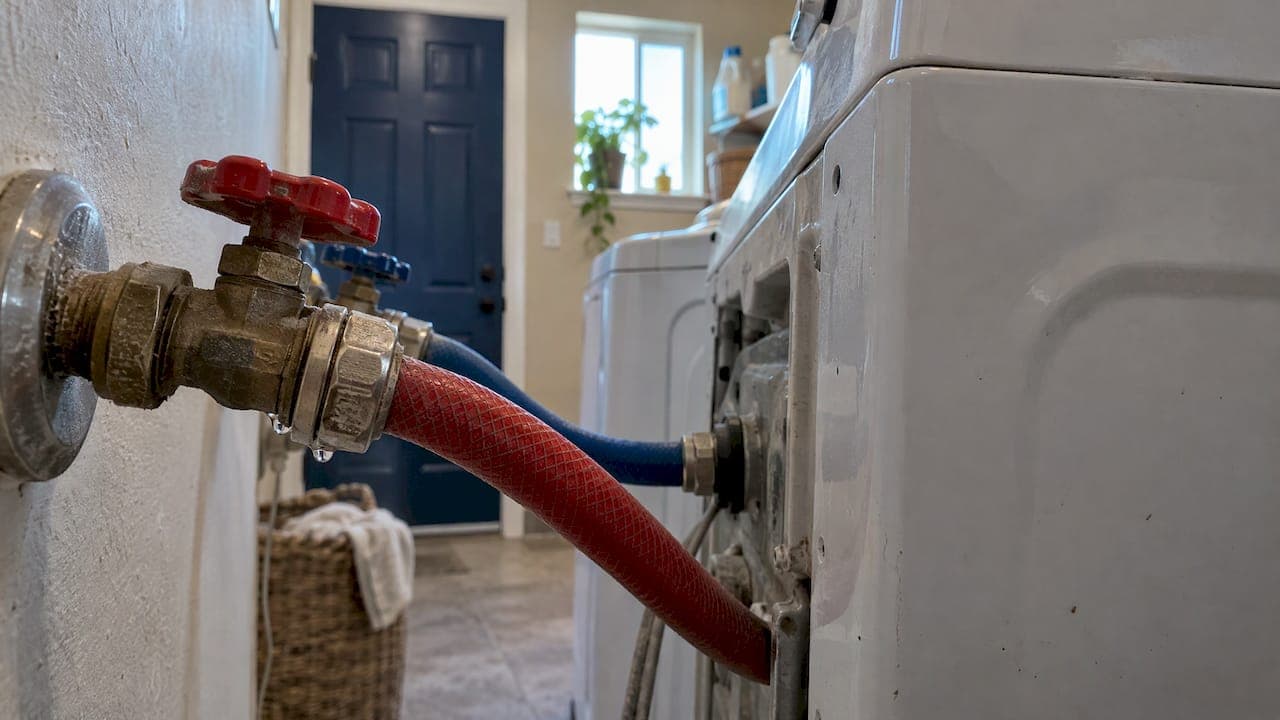
If your washing machine hose is leaking, shut off the water at the hot and cold valves first, then work out which hose is dripping. Most leaks come from a loose connection, a worn washer inside the coupling, or an old hose that has cracked or bulged. A loose fitting takes minutes to fix. A damaged hose needs full replacement, not tape. If the valve on the wall is the part leaking, that is a plumbing repair, and we handle it.
We are USA Plumbing and Septic LLC, serving Bullhead City, Fort Mohave, Mohave Valley and Laughlin. This guide shows what to check, what to tighten, what to replace and when to call a professional.
TL;DR
- Turn both shut-off valves clockwise until they stop, then unplug the washer before you inspect anything.
- Timing points to the source: water during fill usually means a supply hose or inlet valve, water during drain or spin points to the drain hose or pump.
- Hand-tighten each fitting, then add a quarter turn with a wrench. Do not overtighten.
- Tape is only an emergency measure. A cracked, bulging or old hose should be replaced, and supply hoses should be swapped about every five years.
- A leak at the wall valve, or water backing up out of the standpipe, is a plumbing problem. Call a licensed plumber.
Table of Contents
- Stop the water first
- Work out which hose is leaking
- Common causes of a leaking hose
- How tight is tight enough
- Tape, sealant and why replacement wins
- Replace the hose: when and how
- Drain hose placement that prevents leaks
- When to call a plumber
- Our perspective
- Need a plumber for the leak?
- FAQ
- Sources
Stop the water first
A hose leak can get worse fast. Before you diagnose anything, cut the supply.
- Pull the washer out a few inches if you can do it safely, so you can reach the valves.
- Turn the hot and cold shut-off valves clockwise until they stop. GE Appliances explains this shut-off step for its washers, and it applies to nearly any standard setup.
- Unplug the machine. Water and a live outlet should never share a floor.
- Mop up standing water and move towels or a shallow pan under the connections.
If the valves will not turn, or they drip even when closed, close the main supply to the house. Our guide on finding and closing your main water shut off walks through it in five steps.
Why the rush? A burst supply hose is not a slow drip. A study of failed washing machine hoses, as reported by Patch, puts the flow from a single burst hose in a typical home at about 650 gallons per hour. AIG's water damage guidance also warns that an unattended burst hose can release hundreds of gallons an hour. If a hose has already let go and water is spraying, close the valves, kill the power to the area if water has reached outlets, and see our steps for handling a burst pipe at home.
Work out which hose is leaking
Your washer has three hose types, and each fails differently.
- Fill (supply) hoses: two hoses, hot and cold, running from the wall valves to the back of the machine.
- Drain hose: a corrugated hose that carries used water from the machine up and into a standpipe or laundry sink.
- Internal pump hose: a hose inside the cabinet connecting the tub to the drain pump.
Use timing as your clue
Note when in the cycle the water appears. Appliance Surgeon's troubleshooting guide calls timing the most useful clue for narrowing down the cause. Here is how that plays out:
| When the leak shows up | Likely source | What to check |
|---|---|---|
| While the tub fills, usually at the back | Fill hose or inlet valve | Both hose ends, the washers inside the couplings, the valve body on the machine |
| During drain or spin, water under the machine | Drain hose or pump housing | Cracks in the drain hose, the clamp at the pump, the hose's connection at the back |
| Water pours out of the wall pipe during spin | House drain clog | The standpipe and the drain line, not the washer |
| A steady drip even when the machine is off | Wall valve or hose connection under pressure | The valve stem, the threads at the valve, the hose couplings |
The first two rows match what MSA Appliance's help center describes: water during fill, usually at the back, points to a loose or cracked supply hose or a leaking inlet valve, while water under the machine during drain or spin can come from the pump housing or a cracked drain hose.
Do the paper towel test
Dry the floor completely. Lay dry paper towels around the base of the washer and along each hose, as Appliance Surgeon suggests. Reopen the valves, run a short fill, and watch where the first wet spot appears. Turn the valves off again when you have your answer. A flashlight and a dry cloth wiped along each hose will also show a slow seep that towels miss.
Rule out the house drain
If water backs up the standpipe and spills onto the floor late in the spin cycle, the hose is not the problem. GE Appliances states that overflow at the standpipe, often about three quarters of the way through the spin, points to a household plumbing problem rather than a washer hose leak. That is a clogged drain line. Read our page on a washer drain backup to see what you can safely try and when to stop and call.
If you are not sure whether the overflow is a hose or a drain issue, the washing machine overflow timing breakdown at washing machine overflow causes can help you decide whether to replace a damaged hose rather than patch it.
Common causes of a leaking hose
Loose or damaged hoses are the usual reason for water under the washer. Beacon's guide advises checking the hot and cold hoses at both ends for loose connections, cracks or bulges. In practice, these are the culprits we would look at first.
A loose coupling
Vibration during spin cycles can slowly back a coupling off its threads. The fix is simple: hand-tighten, then snug it with a wrench. More on how tight below.
A worn or missing rubber washer
Every supply hose coupling has a flat rubber washer inside it that makes the seal. Over time it hardens or flattens. If tightening does not stop a drip at the connection, shut off the water, unscrew the hose, and look at that washer. A hardened, cracked or missing washer means the hose end needs a new washer or, better, a new hose.
A cracked, blistered or bulging hose
Rubber hoses age from the inside. Look for a bulge near the coupling, a blister, cracks in the outer surface or rust-colored stains at the ends. Any of these means the hose is near failure. Do not wait for it to burst.
Damaged threads or a leaking valve
If the water comes from where the hose meets the wall valve, or from the valve stem itself, replacing the hose will not help. Corroded or cross-threaded valves often need replacing. That is a plumber's job, and it is the same kind of leak we look at with hose bib packing, just indoors.
A drain hose out of position or cracked
The drain hose can leak from a crack, a loose clamp, or because it has slipped out of the standpipe. Inspect its full length. Position matters too, as covered in the drain hose section below.

How tight is tight enough
This is one of the most common questions, and the answer is less than most people think. Lowe's washing machine guide says to hand-tighten both ends, then tighten each a quarter turn with a wrench. Slip joint pliers also work.
Step by step:
- Close both valves and let the hose pressure drop.
- Unscrew the hose and check the rubber washer inside. Replace it or the hose if it is flattened or cracked.
- Thread the coupling on by hand until it stops. It should spin freely at first, not bind. Binding means cross-threading, so back it off and restart.
- Add one quarter turn with a wrench.
- Repeat at the washer end. Hot is usually marked red, cold blue.
- Open the valves slowly and check both ends of each hose for drips. Dry each coupling with a cloth first so a drip is easy to see.
- Run the washer for a full fill and watch again.
Overdoing it crushes the rubber washer and can crack the plastic inlet fitting on the machine. If a hose still weeps after a quarter turn, the washer or the hose is the issue, not the tightness.
Tape, sealant and why replacement wins
People ask what they can use to seal a leaking hose. The honest answer is that waterproof tape is only a temporary emergency measure. RapidRepair.blog's drain hose guide says it should never be considered a permanent fix, and that a lasting repair means replacing the damaged hose. It also notes that the vibration of a spin cycle degrades tape adhesive and leads to failure.
You may see advice to wrap pipe thread tape on a leaking connection. Tape on the threads is a common trick for threaded fittings, but a washer hose coupling seals on its rubber washer, not on the threads. If the washer is bad, tape will not reliably fix it. A new hose costs little compared with what a failure can cost, and the same source points out that a failed patch can lead to thousands of dollars in water damage restoration.
Use tape only to get through the night, with the water off at the valves. Then replace the hose.

Replace the hose: when and how
How often
Lowe's guidance is to inspect hoses regularly, about every six months, and replace them every five years. AIG recommends inspecting at least twice a year, replacing hoses older than five years or showing any sign of damage, and choosing reinforced stainless steel braided hoses.
The age figures explain why. The IBHS study cited by Patch found that failure rates rise sharply after five years, the average age of failed hoses was 8.7 years, more than half of failures happened by eight years, and nearly 80 percent happened before ten years. Write the install date on the new hose with a marker so you know when it is due.
Steps
- Shut off both valves and unplug the washer.
- Place a bucket and towels under the connections, since the old hose holds water.
- Unscrew the hose at the valve, then at the machine.
- Install the new hose with a fresh washer, hand-tight plus a quarter turn.
- Match hot and cold correctly.
- Leave a little slack so the hose does not kink when you push the washer back.
- Reopen the valves slowly, check for drips, then run a cycle and recheck after 10 minutes and again the next day.
What it costs
The part is cheap. According to Thumbtack's 2026 cost data, a replacement drain hose costs $3 to $30 for the part, while national average washer repair costs range from $128 to $324, with most people paying around $204. That is a national figure for appliance repair, not a quote. Local plumbing jobs vary with the valve, access and time of day. Call us for a visit price on your exact situation.
Drain hose placement that prevents leaks
A drain hose in the wrong spot can leak, siphon or overflow even when the hose itself is sound.
- Depth in the standpipe: Manufacturers differ, so follow your manual. Whirlpool and Maytag say a top load drain hose should go no more than 4.5 inches into the pipe. Samsung's US support page calls for at least 6 and no more than 8 inches. Too deep creates a siphoning effect. Too shallow and it can fall out and spill onto the floor.
- Standpipe height: Whirlpool says the standpipe should be at least 30 inches high for a top load washer.
- Air gap: Whirlpool's front load guidance says never seal the drain hose into the standpipe with tape. Air must flow around it to prevent vacuum siphoning.
So if you are tempted to wrap tape around the hose where it enters the pipe, don't. Use the hose's own guide or a hook, and leave the gap.
When to call a plumber
A hose swap is a reasonable weekend job. These situations are not:
- Water leaks from the wall valve stem or the pipe behind it.
- The valve will not shut off fully, or it breaks when you turn it.
- Water backs up out of the standpipe, which means a drain clog.
- You see staining, soft drywall or a musty smell near the laundry area, which suggests a slow leak inside the wall.
- The leak is at a gas-fired water heater closet or near any gas line.
- The washer sits on a second floor or over a finished ceiling, where a failure means serious damage.
Small leaks add up, too. Our page on how minor water leaks cost you in Bullhead City explains why we like to catch them early. If the leak is from a supply line feeding another appliance, see our checks for an icemaker water line leak.
Our perspective
Most washing machine hose leaks we see are not mysteries. They are old rubber hoses, hardened washers and tired shut-off valves that nobody has looked at in years.
Our advice is simple. Replace the hose before it fails. Use a braided hose, mark the date, and check it twice a year. The hose costs very little. The water damage costs a great deal.
The other half of the story is the valve behind the washer. Many homes have an old valve that has not been turned in a decade. When it fails, a hose swap will not fix it. That is where a licensed plumber earns the call, and it is why we are ready 24/7 for emergency plumbing in Bullhead City and the surrounding area.
We go the extra mile on every call. We find where the water is coming from, fix the cause, and leave your laundry area dry and safe.
JOHN
Need a plumber for the leak?
If the hose is fine but the valve, the supply line or the drain is the problem, we can help. We handle emergency plumbing, faucet and fixture repair and replacement, water line leak detection and repair, drain cleaning and more for homes and businesses in Bullhead City, Fort Mohave, Mohave Valley and Laughlin. Our plumbers work 24/7, so a leak at midnight does not have to wait.

Call or book a visit with USA Plumbing and Septic and tell us what the washer is doing. Call Now, Book Now.
FAQ
Why is my washing machine hose leaking at the connection?
The usual causes are a loose coupling or a worn rubber washer inside it. Turn off the water, unscrew the hose, check the washer, and reconnect with hand-tight plus a quarter turn. If it still drips, replace the hose.
Can I use tape to stop a leaking washer hose?
Only as a short emergency measure with the water turned off at the valves. Spin-cycle vibration wears tape out, so replace the hose for a lasting fix. Never tape the drain hose into the standpipe, because it needs an air gap.
How often should I replace washing machine hoses?
Inspect them about every six months and replace them every five years, or sooner if you see cracks, bulges or rust at the ends. Stainless steel braided hoses are the style AIG recommends. Write the install date on the hose.
How much does a new washer hose cost?
The part runs about $3 to $30 for a drain hose, per Thumbtack's 2026 data. National average washer repair with labor runs $128 to $324. Plumbing visits for a failed valve are priced by the job, so call us for specifics.
Sources
- GE Appliances: Washer water shut-off location
- GE Appliances: Washer leaking in rear
- MSA Appliance: Washer leaking water
- Appliance Surgeon: Why is my washing machine leaking
- Beacon: Washer water under it
- Lowe's: Washing machine how-to guide
- Patch: Washing machine hoses, a disaster waiting to happen
- AIG: Washing machine water damage prevention
- RapidRepair.blog: Repair a leaky washing machine drain hose
- Whirlpool: Continuously fills, top load washer
- Maytag: Continuously fills, top load washer
- Whirlpool: Not draining, front load washer
- Samsung: Washing machine is leaking
- Thumbtack: 2026 washing machine repair cost