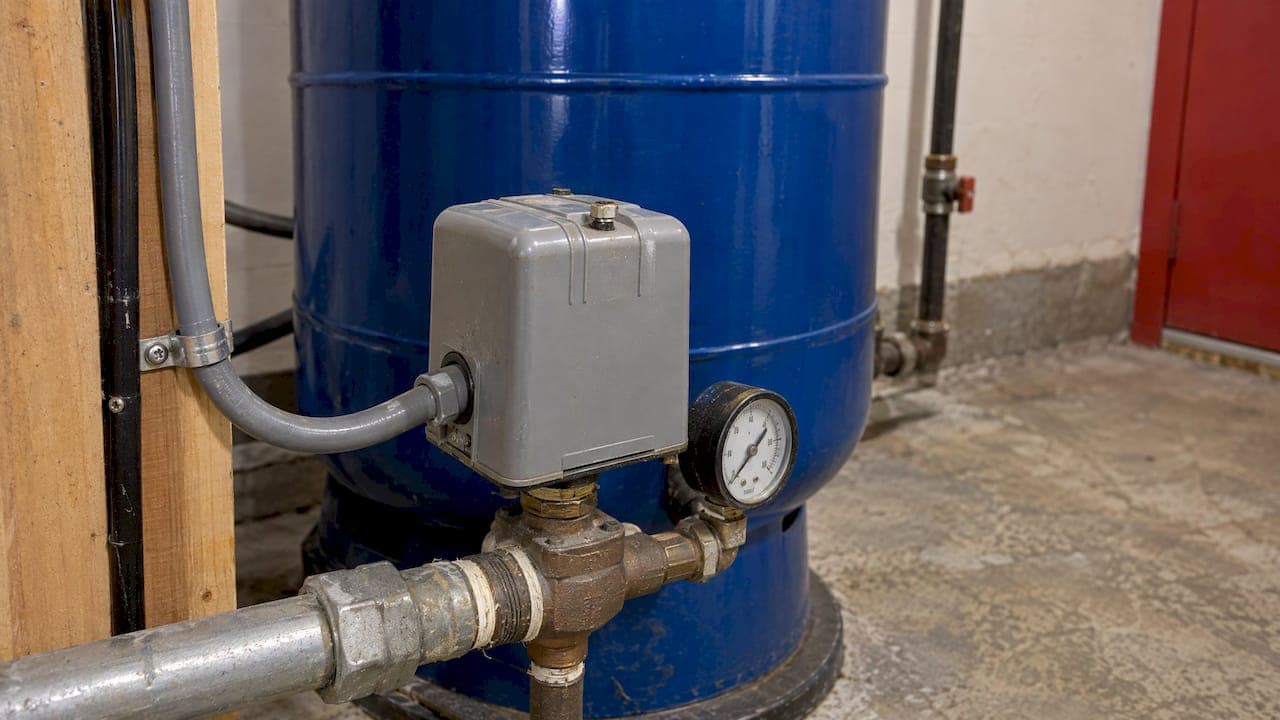
If your well pump won't start, won't shut off, or cycles on and off every few seconds, the pressure switch is often the first suspect. It is not always the guilty part. A waterlogged tank, a clogged switch port, burned contacts, or a leak can all look the same from the faucet. This guide shows how to tell them apart, what the right pressure settings are, and where the line sits between a safe homeowner check and a job for a licensed plumber. A leaking pipe can also cause short cycling, so it helps to detect a water leak early.
TL;DR
- The switch turns the pump on at a low "cut-in" pressure and off at a higher "cut-out" pressure. Common ranges are 30/50 psi and 40/60 psi.
- Rapid cycling usually points to the tank, not the switch. A waterlogged tank is the most common cause.
- Tank pre-charge should sit 2 psi below the cut-in pressure, measured with the tank drained and the power off.
- Never adjust or repair a pressure switch yourself. It is wired to line voltage, and the injury risk is real.
- Call us if the pump won't start, won't stop, or surges. We serve Bullhead City, Fort Mohave, Mohave Valley and Laughlin, 24/7.
Table of Contents
- What the pressure switch actually does
- Well pressure switch symptoms
- What psi should your well pressure tank be?
- Why well water pressure surges
- Why pressure switches go bad
- Safe checks you can do yourself
- Can you bypass a well pressure switch?
- Do not adjust the switch yourself
- Our perspective
- Need help with your well system?
- How to keep your switch and tank healthy
- FAQ
- Sources
What the pressure switch actually does
Your well system has three parts that work together: the pump, the pressure tank, and the pressure switch. The tank holds water and a cushion of air. As the pump fills it, the air compresses and pressure rises. The switch senses that pressure and opens or closes electrical contacts to start and stop the pump.

A tank acts as a buffer so the pump doesn't have to start every time you open a tap. A typical residential tank holds 20 to 80 gallons, and its job is to reduce how often the pump runs. That matters because the tank maintains the pumping cycle rate needed to avoid overheating the pump motor and premature motor failure.
When something goes wrong in this trio, the symptoms overlap. That is why guessing at the switch can cost you a part you didn't need.
Well pressure switch symptoms
Here is what homeowners in our service area describe most often, and what each usually means.
| Symptom | Most likely cause | Switch at fault? |
|---|---|---|
| Pump turns on and off rapidly | Waterlogged or uncharged tank, damaged bladder | Usually no |
| Pump runs but pressure stays low | Worn pump, leak, clogged pressure line, low-producing well | Sometimes |
| No water, pump silent | Burned contacts, tripped breaker, plugged switch port, failed pump | Often |
| Pump won't shut off | Welded contacts, clogged port, major leak, undersized pump | Often |
| Pressure surges at faucets | Waterlogged tank, failing check valve, air in the system | Rarely |
| Clicking, buzzing or chattering at the switch | Pitted or burned contacts, loose wiring | Yes |
A Square D service bulletin lists the switch-side problems: pitted, burned, overloaded or welded contacts, a plugged pressure line, or a damaged diaphragm. The same bulletin lists rapid cycling causes that have nothing to do with the switch: a waterlogged or uncharged tank, a damaged diaphragm, an undersized tank, a major leak, a faulty check valve, foreign material, or no holding tank. It also says to check for an oversized pump and a low-producing well.
Rapid cycling is a tank symptom first
Boshart's technical support makes a point we see in the field all the time: rapid cycling is a primary symptom of a waterlogged tank, but it does not mean the pressure switch is defective. Replacing the switch won't fix a tank that has lost its air charge. The new switch will just cycle the same way.
The Washington State Department of Health notes that rapid cycling signals a waterlogged tank and may shorten the life of the pump motor. It also says a waterlogged tank can push the pump past six cycles an hour, which wastes energy and invites equipment failure. If you hear your pump kick on every time you fill a glass, don't wait. For a deeper walkthrough, see our guide to diagnosing well pump short cycling.
What psi should your well pressure tank be?
The short answer: set the tank's air pre-charge 2 psi below the pump's cut-in pressure. The Washington DOH gives this rule and says common switch ranges are 30/50 psi or 40/60 psi. University of Nebraska Extension gives the same rule: pre-charge 2 psi below the cut-in setting.
That works out to:
| Switch setting (cut-in/cut-out) | Tank pre-charge |
|---|---|
| 30/50 psi | 28 psi |
| 40/60 psi | 38 psi |
Two details trip people up:
- Pre-charge is measured with the tank empty of water and the pump power off. Reading the air valve while the tank is full of pressurized water tells you nothing useful.
- The switch setting and the tank charge are different numbers. Changing one without checking the other is a common cause of surging and short cycling.
The manufacturer instructions typically call for turning off pump power or isolating the tank, draining it completely, and checking the air pressure at the air valve with a gauge. Draining and depressurizing a system carries a backflow and contamination risk, so if you are unsure about any step, that is the point to bring in a professional.
Why well water pressure surges
Surging, where pressure pulses or swings while a faucet runs, is the symptom people search for most after a no-water event. In most homes it traces back to the tank. A waterlogged tank can make pressure pulsate because pressure is no longer properly regulated.
The air cushion shrinks over time as water absorbs air, and the Washington DOH says an automatic way to replenish the air is needed. Waterlogging also raises energy costs and lowers efficiency.
Other causes of surging we check:
- Failing check valve. Pressure bleeds back down the well, so the pump restarts more often.
- A leak. Even a slow one in a buried line or a fixture lets pressure drop and forces cycles. Our meter test guide works for well homes that also track pump run time.
- A low-producing well. The pump pulls the water level down and draws air.
- An oversized pump. It can overwhelm the tank and the switch contacts.
If you want steady pressure regardless of use, there are alternatives. Constant pressure valves or variable speed (VFD) pumps are used to maintain consistent pressure in well systems. We can walk you through whether that upgrade fits your home.
Why pressure switches go bad
Pressure switches wear out for ordinary reasons. Every start and stop opens and closes electrical contacts, and that creates small arcs.
Burned or pitted contacts. Square D identifies severely burned contacts as a possible cause of no flow. The fixes it lists are replacing the contacts, adding a contactor, or replacing the switch. It adds that an oversized pump may need a switch with heavy-duty contacts.
A plugged pressure line. The same bulletin says a blocked line prevents the switch from reading tank pressure, and names silt, obstructions and calcium deposits as possible blockages. Bullhead City and the Colorado River corridor have hard water, so mineral buildup is a realistic concern here. A clogged port is a classic reason for a switch that won't shut off or won't start.
Welded contacts. When contacts fuse closed, the pump keeps running even when pressure reaches the cut-out. That is a safety issue as much as a nuisance.
Short cycling damage. A bad tank forces the switch to cycle far more than designed, and it ages faster. Fix the tank first, or the new switch has a short life.
Loose wiring or moisture. Corroded or loose connections cause chattering and intermittent starts. Tapping the switch box may make the pump work again for a while. That is a warning sign of a failing connection, not a repair.

Safe checks you can do yourself
Some checks are observation only, and none of them require opening the switch.
- Watch the gauge. Note where the pump kicks on and off. If the range doesn't match your 30/50 or 40/60 setting, something is off.
- Time the cycles. Open a faucet and count how often the pump starts. More than six cycles an hour suggests waterlogging.
- Tap the tank. A healthy tank sounds hollow at the top and dull at the bottom. If it sounds dull all the way up, or feels unusually heavy, it may be waterlogged. The Washington DOH lists weight and sound among the checks.
- Check for leaks. Look at fixtures, hose bibs and visible lines, and shut off water to see if the gauge holds.
- Check the breaker. A tripped breaker is a simple cause of a silent pump.
The air valve test is a step further. Pressing the central pin on the air-charging valve should release air. If water comes out, the bladder has failed and the tank is waterlogged. Do this only after the power is off, and only if you are comfortable with it. If water sprays out, you have your answer, and the tank needs replacement.
For low flow without surging, start with our three safe checks for low well water pressure. If the trouble is only at one tap, see low water pressure at one faucet. If you suspect the pump itself, read our list of well pump failure signs.
Can you bypass a well pressure switch?
No. We don't recommend it, and we won't do it. The switch is what stops the pump at the cut-out pressure. Take it out of the loop and nothing tells the pump when to quit. Pressure can keep climbing past what the tank, fittings and seals were built for. Schneider Electric's Pumptrol instructions warn against using the switch above 220 psi because excess pressure can cause seal leakage, injury or equipment damage.
Running a jumper to get water flowing for an evening is tempting when the house is dry. If it is an emergency, call us instead. We can get you running safely, often the same day.
Do not adjust the switch yourself
The switch is connected to power. University of Nebraska Extension says homeowners should generally not attempt to adjust or repair pressure switches because of the risk of serious injury. It advises contacting a licensed professional if a no-water problem persists, if little or no water is available, or if pressure-switch work is needed.
The Connecticut Department of Public Health also notes that hydropneumatic tanks need regular care and can fail catastrophically, with the potential for major damage or injury. Treat a pressurized tank with respect. Never open fittings on a tank that still holds pressure.
When to stop and call
Call a licensed plumber when:
- The pump is silent and the breaker is on.
- The pump runs constantly or won't shut off.
- You see burn marks, melted insulation or smell something hot at the switch.
- Rapid cycling continues after anyone has confirmed the tank charge.
- The tank is waterlogged or the bladder has failed.
- You aren't sure the water is safe after working on a depressurized system.
Our perspective
We see well pressure switch calls every week in Bullhead City, Fort Mohave, Mohave Valley and Laughlin. The pattern is the same. A homeowner replaces the switch, the pump still cycles, and a week later the real problem, a tired tank or a leak, is still there.
That is why we start with the whole system. We check the tank charge, the gauge, the check valve, the pressure line and the contacts before we recommend a part. Our licensed plumbers are equipped to handle well equipment repair and replacement, and we would rather fix the cause once than sell you the same switch twice.
Hard water and sediment are part of life in our desert area. We pay attention to clogged ports, mineral scale and the stress short cycling puts on your pump. If your system needs a new tank, a switch, or a smarter setup, we will tell you what it needs and why. We answer the phone around the clock because a dry house doesn't wait for business hours.
JOHN
Need help with your well system?
USA Plumbing and Septic LLC repairs and replaces water well equipment for residential and commercial customers across Bullhead City, Fort Mohave, Mohave Valley and Laughlin. Our licensed plumbers are available 24/7 for emergencies, from a pump that won't shut off to a house with no water. If hard water is hitting your switch and fixtures, we also maintain water softening and filtration systems. Book a well equipment visit or see our water softening and filtration service in Bullhead City.

Call now or book online. Tell us what the pump is doing, how often it cycles, and what the gauge reads, and we will arrive ready.
How to keep your switch and tank healthy
Good habits make a switch last. None of these need you to touch wiring.
- Check tank pre-charge on a schedule. Do it once or twice a year, or whenever cycling changes. Always with power off and the tank drained.
- Listen to the pump. A new click pattern or a change in how long it runs is the earliest warning.
- Fix leaks quickly. A dripping toilet or a hose bib forces extra cycles. Our high water bill guide helps you find hidden ones.
- Know your shut-off. Learn where your main water shut-off is so you can stop a leak fast.
- Mind the system as a whole. If you want to understand how supply, pressure and fixtures fit together, read how residential plumbing systems work.
- Treat water that scales. Softening and filtration reduce the minerals that clog small ports.
One more point for landlords and commercial property managers: a pump that cycles too fast costs money in electricity and shortens equipment life. A routine inspection costs far less than a pump replacement or an emergency call to a tenant with no water.
FAQ
Why does my well pump keep turning on and off?
The most common cause is a waterlogged pressure tank that has lost its air cushion. Other causes include a failed bladder, a major leak, a faulty check valve, or an undersized tank. Have a licensed plumber confirm the tank charge before replacing the switch.
What PSI should my well pressure tank be?
Set the pre-charge 2 psi below the pump's cut-in pressure. That means 28 psi for a 30/50 switch and 38 psi for a 40/60 switch. Measure it with the power off and the tank drained.
Why won't my well pressure switch shut off?
Welded contacts, a clogged pressure port, a major leak or an undersized pump can all keep the pump running. Turn off the breaker to the pump and call a plumber. Don't leave a pump running unattended.
Can I replace a well pressure switch myself?
We advise against it. The switch is wired to line voltage, and university extension guidance says homeowners should generally leave switch adjustment and repair to a licensed professional. We can test, replace and set it correctly in one visit.
Sources
- Drinking Water Tech Tip: Troubleshooting Bladder Pressure Tanks, Washington State DOH
- Hydropneumatic Tank Control Systems, Washington State DOH
- Preventive Maintenance and Troubleshooting Guidelines, Square D pressure switch bulletin
- How can I tell if my pressure tank is waterlogged? Boshart support
- Private Drinking Water Wells: Operation and Maintenance, University of Nebraska Extension
- Well Owner's Guide, University of Maryland Extension
- 9013FS, 9013FY Pumptrol Pressure Switch instructions, Schneider Electric
- Hydropneumatic Tank Fact Sheet, Connecticut Department of Public Health