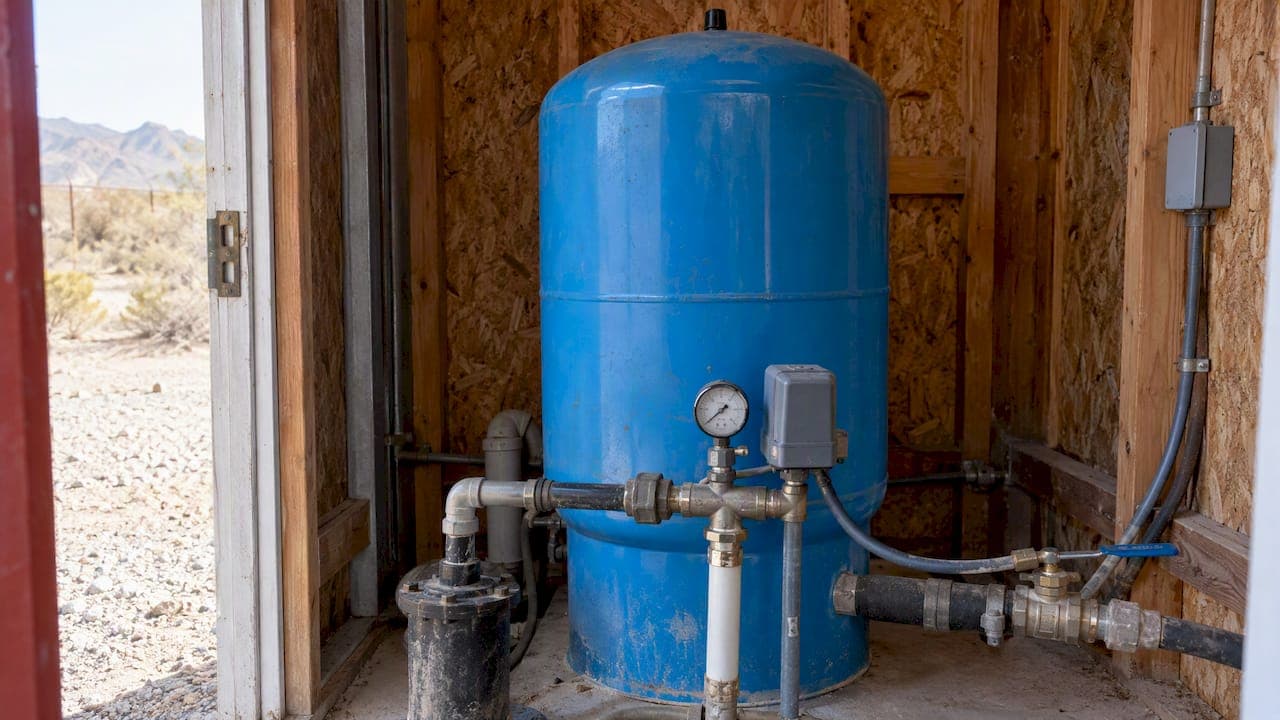
The most common well pump failure signs are no water at all, pressure that drops or surges, air sputtering from faucets, a pump that runs nonstop or switches on and off every few seconds, a tripping breaker, and sandy or cloudy water. Any one of these can mean a dying pump. Any one of them can also mean a bad pressure switch, a waterlogged tank, a leak or a falling water level. Telling those apart is the real job, and it saves you from paying for a pump you did not need.
We are USA Plumbing and Septic LLC. We work on private well systems for homeowners and commercial properties in Bullhead City, Fort Mohave, Mohave Valley, Laughlin and the surrounding area. This guide walks through what each sign usually means, the few checks you can safely run yourself, and the point where you should stop and call.
TL;DR
- No water, a hot or humming pump, or a breaker that trips again after one reset means call a licensed pro. Do not keep resetting it.
- Sputtering air, falling pressure and a pump that never shuts off often point to the pressure tank, switch, a leak or a check valve, not only the pump.
- A pump that starts and stops every few seconds (short cycling) can ruin a good pump. Fix the cause early.
- Sandy, cloudy or odd-smelling water is both a mechanical warning and a water-quality issue. Cut back on drinking it and get it tested.
- Replacement cost depends on well depth, pump type and access. We price after an inspection, not by guess.
Table of Contents
- The well pump is one part of a system
- The signs, and what each one usually means
- Quick reference: symptom, likely suspects, next move
- The one check most people skip
- Perspective: what we see in the field
- How long does a well pump last, and what does replacement cost?
- Municipal water or private well? Know which problem you have
- When to call right away
- Prevention that actually works
- Need a well pump diagnosis in Bullhead City?
- FAQ
- Sources
The well pump is one part of a system
A private water system has more than a pump. Water moves from the well through a pump, a check valve, a pressure tank and a pressure switch, then into your house. University of Nebraska Extension makes the point that the same complaint, no water, can come from power, pump height, groundwater level, check valves, a buried line or tank air. So one symptom rarely proves a pump has failed.
That matters for your wallet. Pulling a pump is a real job with real cost. A good diagnosis first keeps you from replacing a working motor while the actual fault, say a $30-class switch problem or a tank with no air charge, keeps wrecking the new one.
The signs, and what each one usually means
No water at all
This is the clearest sign, and the most urgent. Possible causes include a tripped breaker, a dead motor, a failed pressure switch, a broken line between well and house, or a water level that has dropped below the pump intake. Extension guidance lists these same possibilities: the pump, pressure tank, switch, a leak, a check valve, a blocked line or a falling water level.
What you can do safely: confirm that other outlets in the building have power, then check the well pump breaker once. If it trips again, or if you still have no water, stop. Nebraska Extension advises calling a licensed well professional rather than repeatedly resetting power or opening the well system.

Pressure that drops or will not build
Pressure that slowly fades, or never reaches the normal level, is the first thing many homeowners notice. Common causes:
- A failing pump that can no longer lift or push the water it used to.
- A leaking drop pipe or buried line.
- A failing check valve that lets pressure bleed back down the well.
- A clogged filter or sediment screen.
- A pressure switch that is worn or set wrong.
- A lower water table, or demand that the system was never sized for.
Our own walkthroughs cover the household side of this problem: three safe checks for low well water pressure, plus six fast checks for low water pressure in a house and what to do when only one faucet is weak. If every fixture is weak and the pump seems to be working, the problem is probably upstream of your plumbing.
Air sputtering from faucets
Bursts of air mean the system is pulling or pushing air along with the water. The Water Systems Council lists several possible causes for air in a well's water line, including a failed pressure tank caused by a leak in the precharge. A pump drawing near the bottom of a low well can do it too, and so can a leak on the suction side.
Air that shows up once after a power outage or repair is usually harmless. Air that returns day after day is a pattern, and patterns deserve a diagnosis.
A pump that runs constantly
If the pump runs and runs while no one is using water, think leak first. A running toilet, a dripping fixture or a broken buried line can all keep the pump working. If you have checked inside and the pump still runs, the pump may be worn and unable to reach shutoff pressure, or the switch may not be opening. Published pump troubleshooting charts list failure to reach shutoff pressure and a pump that will not shut off among the signs to investigate.
A soggy patch of ground between the well and the house is a strong clue to a broken buried water line. Tell the technician about it.
A pump that starts and stops every few seconds
This is short cycling. The pressure tank is meant to hold reserve water and reduce pump starts and stops, which extends pump life. When a tank is waterlogged or has lost its air charge, the pump has to start far more often, and the motor takes the beating.
Extension guidance says a pump that runs only a few seconds can point to too little air in the pressure tank. The documented target for a drained bladder or diaphragm tank is 2 psi below the system's cut-in setting. Common cut-in/cut-out settings cited by Clemson Extension are 20/40, 30/50 and 40/60 psi. Checking and recharging a tank involves electrical power and pressurized equipment, so leave it to a qualified professional. We explain how to narrow this down in our short cycling guide.
Tripping breaker, humming or a hot motor
A pump motor that hums without moving water, runs hot, or keeps tripping its breaker is under electrical or mechanical stress. Troubleshooting charts list motor overheating and overload trips among the signs of trouble, and they point to checks like voltage, wiring, impeller blockage and switch operation.
This is not a do-it-yourself sign. Repeated resets can burn out a motor that might have been saved. Shut the breaker off and call.
Sand, sediment, cloudy or smelly water
Sand is not just a nuisance. Penn State Extension lists abrasive sand or sediment, corrosion, excessive heat and cavitation as causes of pump damage. Sediment can mean a well-level or intake problem, and it is also an active mechanism that wears pump parts faster.
It is a water-quality question as well. Arizona's environmental agency states that ADEQ does not regulate the water quality of private wells and that private well owners are responsible for maintaining them. That means testing is on you. If the look, taste or smell of your water changes, reduce drinking use until you know why, and arrange testing along with the mechanical diagnosis.
Higher electric bills and strange noises
A pump working harder than it should uses more power. Grinding, rattling, clicking or banging from the well or pressure tank area are worth a call even when the water still flows. These signs rarely show up alone. Look for them together with a drift in pressure or cycling behavior.
Quick reference: symptom, likely suspects, next move
| What you notice | Common suspects | Your next move |
|---|---|---|
| No water | Breaker, pump motor, switch, broken line, low water level | Check power once, then call |
| Slowly falling pressure | Pump wear, leak, check valve, clogged filter | Watch the gauge, then book a diagnosis |
| Air sputtering | Tank precharge, suction leak, low water level | Note how often it happens, then call |
| Pump never shuts off | Leak, worn pump, switch | Check fixtures for leaks, then call |
| Starts and stops in seconds | Waterlogged or undercharged tank | Call soon, this damages pumps |
| Trips breaker or hums | Motor, wiring, stuck impeller | Shut off, call right away |
| Sand or cloudy water | Intake issue, well condition, wear | Limit drinking use, test, call |
The one check most people skip
Watch your pressure gauge with all water use stopped. Turn off every tap, make sure no one flushes, and leave the pump idle. According to Nebraska Extension, a gauge that falls with use stopped points toward a leak or a check valve fault. A gauge that holds steady suggests the pump may not be the cause.
This takes five minutes and needs no tools. It also gives a technician something solid to work from. Clemson Extension adds that simple observation is the best maintenance: check that the gauge moves between cut-in and cut-out, and look over the wellhead and wiring at least monthly, watching for corrosion, cracks, gaps or drainage toward the casing.
Perspective: what we see in the field
We work on well equipment alongside water heaters, sewer lines and septic systems, so we see the whole house, not only the well. Here is how we think about a well pump call.
First, we do not start with the assumption that the pump is bad. A homeowner calls with no pressure, and the cause turns out to be a switch, a tank or a broken line. We would rather find that out before anyone pulls a pump.
Second, short cycling is the failure we most want people to catch early. A pump with a bad tank behind it can look fine for a long time and then fail all at once. Fixing the tank is cheaper than replacing both.
Third, the fix should match the cause. If sand is wearing out pumps, a new pump alone just resets the clock. The well condition has to be addressed too.
Fourth, we tell you what we find and what it costs before the work starts. We publish no fixed replacement price because depth, pump type, wiring and access change every job. Our owner's promise is straightforward: 24/7 emergency availability, licensed plumbers, and honest answers.
— JOHN
How long does a well pump last, and what does replacement cost?
There is no honest single number. Pump life depends on how often it cycles, the sediment in your water, corrosion, heat, voltage, water level, installation quality and maintenance. The only firm life figure in our research is for the tank, not the pump: Nebraska Extension says a pressure tank lasts about 10 years, though some last 30. Treat that as a guide for the tank only.
On cost, a published Delaware well-owner guide reports about $3,000 to $3,200 for a household submersible pump and roughly $1,545 to $1,570 for a household jet pump. Those are regional figures from that guide, not a Bullhead City quote. Local cost moves with depth, pump type, wiring, drop pipe, access, well condition, permits and labor.
Jet pump type also matters for diagnosis. The troubleshooting guide we reviewed says shallow-well jet pumps are generally limited to a water depth of about 25 feet. Deeper water needs a properly designed deep-well system, and exact limits depend on the model and installation. For a detailed look at how we approach estimates, read our well pump replacement cost guide.

Municipal water or private well? Know which problem you have
Many of our service area homes run on city water, and some do not. The two are different problems. Bullhead City's public system is monitored: its 2024 water quality report says the city collects 40 monthly samples across the system and tests selected homes for lead and copper every 3 years. That program covers the public system only. It does not test your private well and does not replace your own testing.
If you are on city water and pressure drops, look at your pressure regulator, fixtures and house lines. If you are on a well, the pump, tank, switch and wellhead are all yours to maintain. Not sure which applies to you? Tell us when you call and we will sort it out.
When to call right away
Call for urgent service when you see:
- Complete loss of water.
- A breaker that trips again after one reset.
- A pump that hums or overheats without moving water.
- Continuous running with no visible use of water in the house.
- Air and sediment at several fixtures.
- Any suspected contamination.
In the meantime, shut off the pump at the breaker if it is hot or humming. Save water in the house, and keep a few gallons of drinking water on hand. Our 24 hour plumbing emergency checklist covers what to do while you wait for a plumber, and our homeowner guide to how residential plumbing works helps if you want to see where the well fits in.
Prevention that actually works
- Glance at the pressure gauge now and then. It should swing between the cut-in and cut-out points.
- Inspect the wellhead and exposed wiring monthly for corrosion, cracks, gaps or surface water draining toward the casing.
- Fix leaking fixtures and toilets quickly. Small leaks make the pump cycle more.
- Have the tank's air charge checked by a professional during service.
- Test your water when its look, taste or smell changes, and keep a record of the results.
- Keep the original well construction and pump test data. Penn State Extension notes that you need a point of reference to detect deterioration in well performance.
Need a well pump diagnosis in Bullhead City?
We handle water well equipment repair and replacement, pressure and water line leak detection, water softening and filtration repair, and emergency plumbing for homes and businesses in Bullhead City, Fort Mohave, Mohave Valley and Laughlin. We are available 24/7. Tell us what you are seeing, and we will work out whether it is the pump, tank, switch, line or well before recommending a repair.
Call now or book your service visit with USA Plumbing and Septic LLC.
FAQ
What are the first signs of well pump failure?
The earliest signs are usually lower pressure, reduced flow, a pump that runs longer than before, or a pump that starts and stops after only a few seconds. Air sputtering and new noises often follow. These can also come from the tank, switch or a leak, so a diagnosis should come before replacement.
Can I test a well pump without pulling it out?
Yes, to a limited degree. Check power elsewhere in the building, check the pump breaker once, and watch the pressure gauge with all water use stopped. A falling gauge suggests a leak or check valve problem. If the breaker trips again or you still have no water, call a licensed professional instead of resetting it again.
Why does my well pump turn on and off every few seconds?
That is short cycling, and the usual culprit is a waterlogged or undercharged pressure tank. It can also come from a leak or a switch problem. It wears out the motor quickly, so have it looked at soon, and leave tank pressure work to a professional.
Is sandy or cloudy water from my well safe to drink?
Do not assume it is. Sediment can signal wear inside the system and a change in water quality. Cut back on drinking it and arrange testing. In Arizona, ADEQ does not regulate private well water quality, so testing is your responsibility.
How much does it cost to replace a well pump?
Published regional figures run from about $1,545 for a household jet pump to about $3,200 for a submersible, but those are not Bullhead City quotes. We publish no fixed price because depth, wiring, access and well condition vary. We give an estimate after inspecting your system.
Sources
- University of Nebraska Extension: Private Drinking Water Wells, Mechanical Components
- University of Nebraska Extension: Private Water Systems guide (PDF)
- Clemson HGIC: Residential Drinking Water Well, Well Components
- Penn State Extension: Water Well Maintenance and Rehabilitation
- Shallow Well Jet Pump Troubleshooting Chart
- Delaware Well Owner's Guide (PDF)
- Bullhead City Water Quality Report (PDF)
- ADEQ: Resources for Private Well Owners