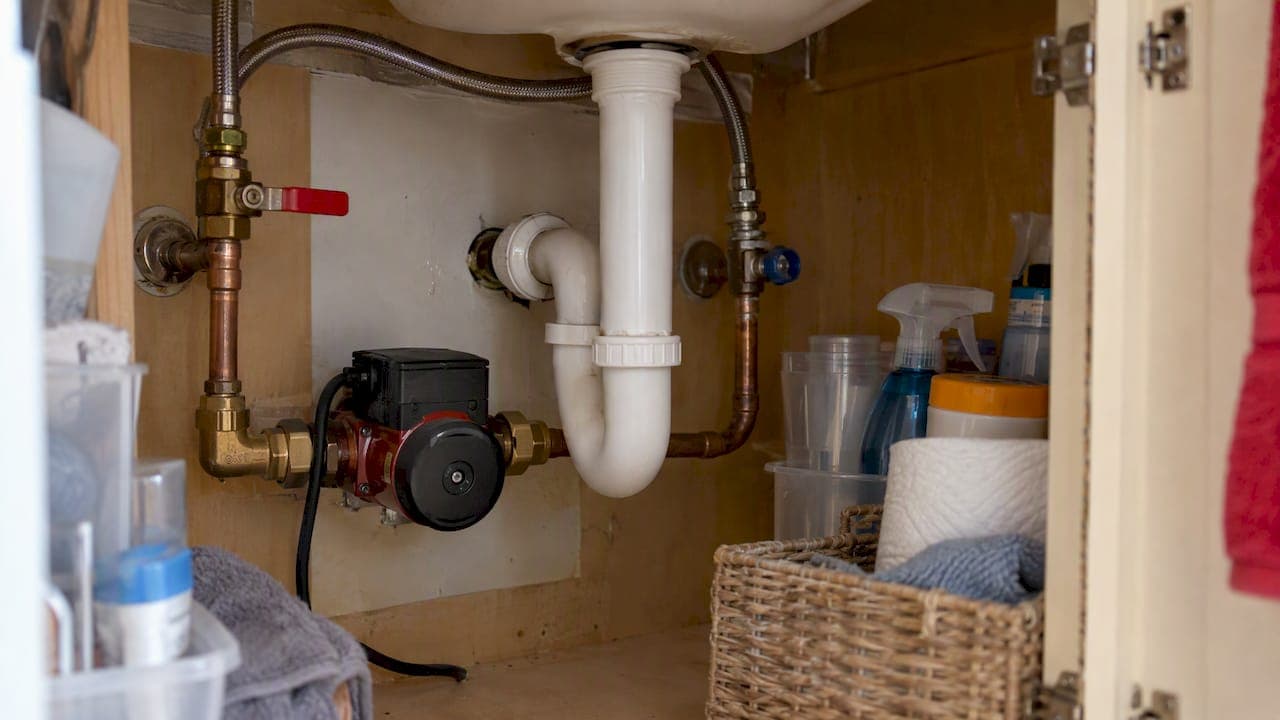
Most homeowners pay between a few hundred dollars and about $1,200 for a hot water recirculation system. A simple pump kit on an existing line sits at the low end. A full retrofit with a dedicated return line, electrical work and permits sits at the high end, and complex jobs can go past $1,800. The number on your quote depends on how your pipes are laid out, not on the pump itself.
We are USA Plumbing and Septic LLC. We install and repair water heaters and water lines for homes and businesses in Bullhead City, Fort Mohave, Mohave Valley and Laughlin. This guide shows what each part of the bill covers, so you can read a quote and know if it is fair.
TL;DR
- A recirculation pump alone runs roughly $60 to $300. A pump kit runs roughly $200 to $475, before installation.
- Typical installed totals range from about $350 to $1,700 for a U.S. home. A straightforward retrofit commonly lands around $800 to $1,200.
- Adding a dedicated return line, electrical outlet work or permits is what pushes a job toward $1,800 or more.
- Running the pump costs roughly $26 to $52 a year if it is on a timer or sensor. A pump that runs nonstop costs more.
- It pays off in comfort and water savings first. Dollar payback takes years, and it depends on the design and the controls.
Table of Contents
- What a Hot Water Recirculation System Costs
- Where the Money Goes on an Installed System
- Comfort System or Dedicated Return Line
- Tankless Heaters and Built-In Recirculation
- What It Costs to Run
- Is It Worth the Money?
- How Long a Pump Lasts and What Can Go Wrong
- Our Perspective
- How to Compare Quotes
- Recirculation for Commercial Buildings
- Get a Recirculation Quote in Bullhead City
- FAQ
- Sources
What a Hot Water Recirculation System Costs
Prices online vary because the phrase "recirculation system" covers very different jobs. One person is buying a $200 pump and mounting it under a sink. Another is paying for new pipe, an outlet, a permit and a day of labor. Here are the published ranges side by side.
| What you are pricing | Typical range | Source |
|---|---|---|
| Pump only | $60 to $300 | PickHVAC |
| Pump kit | $200 to $475 | PickHVAC |
| Professional installation labor | $125 to $250 | PickHVAC |
| Dedicated recirculation water line, added | $200 to $500 or more | PickHVAC |
| Whole system, equipment and install | $350 to $1,700 | Well Built Florida |
| Straightforward retrofit, average | about $800 to $1,200 | Well Built Florida |
| Complex project | about $1,800 or more | Well Built Florida |
Some sources land lower. This Old House puts a hot water recirculation system at about $200 to $400. That figure fits a basic kit where the homeowner or a plumber does a quick install. It does not fit a home where the pipes are buried in a slab or the nearest outlet is across the garage.
The gap between $400 and $1,200 is not padding. It is access, pipe routing and electrical work. That is why two honest quotes for the same house can differ.

Where the Money Goes on an Installed System
A detailed 2026 estimate from Well Built Florida breaks a typical project into these pieces:
- System kit: $250 to $1,000
- Pipe and fittings: $150 to $800
- Installation labor: $400 to $2,000
- Electrical work: $100 to $700
- Permits and inspections: $50 to $500
Not every job has every line. A comfort kit that uses your existing cold line as the return skips most of the pipe and fittings. A job with a pump next to the water heater and an outlet already there skips the electrical line. When you get a quote, ask which of these five lines apply to you and which do not.
The kit
Pumps vary in size, controls and build quality. A pump with a built-in timer or temperature sensor costs more than a bare pump, and it is usually the better buy, for reasons we cover in the running-costs section. Cheap units are a false economy. Installers quoted in one industry guide warn that low-cost units can leak or fail in as little as three years.
Pipe and fittings
This line grows with the length of the run and the number of fixtures you want served. A short run to one far bathroom is cheap. A two-story house with several bathrooms on different branches costs more. Pipe layout, pipe diameter and insulation are all design choices that affect performance, and National Laboratory research on recirculation design notes that insulation is what keeps heat loss down.
Labor
Labor is the widest line, from a quick under-sink install to a day or more of opening walls and running pipe. A tight crawl space, a slab foundation or a finished ceiling all add hours. Single-story homes with open attic or crawl access are the easy cases.
Electrical work
The pump needs power. The same national laboratory guidance says proper installation takes coordination between plumbers and electricians, and that electricians are often needed for dedicated non-switched outlets and low-voltage sensor wiring. If there is no outlet near the water heater, or one near the farthest fixture, budget for it.
Permits
Permit rules depend on your city or county and on how much pipe work is involved. Ask your plumber if your job needs one. A licensed contractor pulls it and handles the inspection.
Comfort System or Dedicated Return Line
The biggest price decision is the type of system.
Comfort or bypass systems use a pump under the farthest sink and your existing cold water line as the return path. There is no new pipe. It is the cheaper route and the more practical one for existing houses. The tradeoff is that the cold line warms up for a bit when the pump runs.
Dedicated return systems add a separate pipe that carries water back to the heater. They are the fastest and most efficient option, but This Old House plumbing expert Richard Trethewey says they are best for new construction or a major remodel, because adding a return line to a finished house is a big job.
That is why PickHVAC lists the added water line at $200 to $500 or more on top of the pump and labor. In a house with open walls, that is easy to price. In a finished house, it is where quotes jump.

If you are planning a whole-house repipe anyway, adding a return line then is far cheaper than doing it later. Our guide to what a house repipe really costs shows how that kind of project is priced.
Tankless Heaters and Built-In Recirculation
If you own a tankless heater, check the model before you buy a pump. Some come with recirculation built in. Rheem lists its RTG-R tankless line as having an integrated recirculation pump that can save up to 12,000 gallons of water a year. If you are replacing a heater, that can fold the pump into one purchase and one install.
If your tankless heater has no built-in pump, a recirculation kit is usually still possible. A plumber needs to confirm that the heater and the kit are compatible. We cover heater pricing in our tankless water heater cost guide and our water heater install cost guide. If you are picking a new unit, see our picks for the best water heaters for homes.
What It Costs to Run
The pump is cheap to run. Heat loss from the pipes is what can make it expensive.
- A continuously running 25-watt pump uses about 200 kWh a year. At $0.13 per kWh, that is roughly $26 a year, before heat loss.
- Another industry guide puts the average pump at about 219 kWh a year, around $52. The gap comes from different electricity prices.
- InterNACHI warns that continuous circulation in a real house can use about 400 to 800 kWh a year for a modest pump, and that poorly insulated pipe makes the water heater work more.
The lesson is control. Richard Trethewey cautions that an improperly controlled recirculation line can become a major energy waster, and he points to timers and temperature sensors as the fix. Research on circulator pumps backs this up: pumps with controls were found to be more efficient. Pay a little more for a timer or sensor. It is the cheapest way to cut your running costs.
Insulation matters too. NRDC reports that most existing multifamily buildings lack insulation on their recirculation loops. If you own a rental building, that is a cost worth checking.
A worked example
Say you have a single-story home with an accessible crawl space, and you choose a comfort kit with a built-in timer.
- Kit: in the $200 to $475 range for pump kits.
- Professional install: $125 to $250.
- Outlet needed? If not, $0 for electrical.
That puts you around $325 to $725 for equipment and labor. Compare that with the $800 to $1,200 range for a typical retrofit, which is more likely to include added pipe, outlet work or permits. If your quote is much higher than the simple math, ask where the difference is.
Is It Worth the Money?
Here is the honest answer. A recirculation system will almost certainly make hot water arrive faster. Whether it saves enough money to pay for itself depends on your house.
The national laboratory's design guidance says that recirculation can offer convenience and water savings, but results depend on design, installation quality and how people use it. It also says long-term data on total life-cycle costs is limited. We would not trust anyone who promises a fixed payback period.
On the water side, one industry guide estimates a pump can save 11,461 gallons a year that would otherwise run down the drain while you wait. The same guide says the system nearly breaks even after 10 years, and that the rest of the value is water conservation and comfort. Treat these as vendor estimates, not guarantees.
Who gets the most out of one:
- Homes where the farthest bathroom or kitchen is a long pipe run from the heater.
- Households that wait a minute or two for hot water every day.
- Properties where water is expensive or limited, such as homes on a private well.
- Homes on septic. The same guide notes less water down the drain can extend the life of a septic system. If you are on septic, our septic pumping frequency guide explains what to watch.
Who may not: small homes where the heater is close to every fixture, and anyone who will not use a timer or sensor.
How Long a Pump Lasts and What Can Go Wrong
A good pump can last for years, but we will not quote you a number from a single source. Low-cost units are the main risk, with leaks or failure in as little as three years. Common drawbacks:
- Poor controls, which raise energy use and heat loss.
- Warm water in the cold line on bypass systems.
- Wasted heat in uninsulated pipes.
- A lower-quality pump that needs early replacement.
A licensed plumber can size the pump, set the timer to your routine and insulate exposed pipe. That is a small part of the labor cost, and it protects the rest of the investment.
Our Perspective
We see the same pattern in Mohave County homes. The pump is rarely the problem. A homeowner buys a kit, plugs it in, lets it run all day, and then wonders why the water heater is working harder. The cost of recirculation is in the design: where the pump goes, how it is controlled, and how well the pipes are insulated.
Our advice is plain. Decide what you want first: faster hot water at one far bathroom, or a whole-house loop. For most existing homes, a comfort system with a timer or sensor is the right answer, and it keeps the project affordable. Save the dedicated return line for a remodel or repipe, when walls are already open.
We also tell customers to look at the heater before the pump. If the heater is near the end of its life, replacing both at once is often cleaner than pairing a new pump with an old unit. If the water heater is fine, a pump install is usually a short visit.
And always ask for the quote itemized. If you cannot see the kit, the labor, the electrical and the permit, you cannot compare.
— JOHN
How to Compare Quotes
A solid quote lists the pump model and its controls, the type of system (comfort or dedicated return), the labor, any electrical work, and any permit. Get at least two so you can see where they differ. If you want a structured way to line up bids, the renovation quotes comparison tips walk through the process, and our plumbing repair cost guide gives context on how local plumbing work is priced. If you are not sure what is behind your walls, a plumbing inspection can show you the pipe layout before you commit.
Questions to ask every contractor:
- Is this a comfort system or a dedicated return line?
- Does the pump have a timer or temperature sensor?
- Is an outlet needed near the heater or the far fixture?
- Does the price include a permit, if one is required?
- Will you insulate the hot water pipes you can reach?
- Is the pump compatible with my water heater, especially if it is tankless?
Recirculation for Commercial Buildings
Property managers face the same cost drivers at a larger scale: longer pipe runs, more fixtures and more electrical work. The design points also matter more. Pipe diameter, insulation and sensor placement shape both cost and performance, and a well-built loop is worth more as the building grows. We handle commercial plumbing along with residential, so a walkthrough of the building is the right first step.
Get a Recirculation Quote in Bullhead City
If you want hot water at the tap faster, we can look at your heater, your pipe layout and your outlets, and tell you which system fits. We serve Bullhead City, Fort Mohave, Mohave Valley and Laughlin, with 24/7 emergency service when a line or heater fails. We also work in Kingman and Golden Valley.
Call now or book a visit through USA Plumbing and Septic LLC. For a broader overview of how these systems work, read our homeowner's guide to hot water recirculation systems.
FAQ
Is recirculating hot water worth it?
For many homes, yes, for comfort and for the water you stop wasting. Dollar payback is slower and depends on the design, the controls and your water and power rates. National laboratory guidance says results depend on design, installation quality and user behavior.
Can you add a recirculating pump to an existing water heater?
Yes. The usual choice is a comfort or bypass system, which uses your existing cold line as the return and needs no new pipe. This Old House says a dedicated return line suits new construction or a major remodel better. A plumber should confirm the pump is compatible with your heater.
What does it cost to run a recirculating pump?
A timed or sensor-controlled pump costs roughly $26 to $52 a year in electricity, based on published estimates. A pump that runs all day with poor pipe insulation can cost more, because the heater has to replace the lost heat.
What are the drawbacks of a recirculating pump?
The main ones are higher energy use when the pump is not controlled, warm water in the cold line on bypass systems, and early failure of cheap units. A timer or sensor, insulated pipes and a quality pump address most of these.
How much does it cost to have a plumber install one?
Professional labor alone is often listed at $125 to $250 for a simple install. Whole-system totals typically run $350 to $1,700, with retrofits commonly around $800 to $1,200. Ask for an itemized quote for your home.
Sources
- How To Install a Hot Water Recirculation Pump, This Old House
- How To Get Hot Water With a Recirculating Pump, This Old House
- Hot Water Recirculating System Cost in the U.S., Well Built Florida
- Best Recirculating Pumps for Water Heater, PickHVAC
- Hot Water Recirculation Systems: Designing for Success
- Research and Analysis of the Benefits of Appliance Standards for Hot Water Circulator Pumps, NRDC
- Rheem Non-Condensing Tankless Brochure
- What Is A Water Recirculation Pump And Why Do I Need One?
- Hot Water Recirculation Pumps: Pros, Cons, and Costs, Rise
- Hot Water Recirculation Systems, InterNACHI
- Renovation quotes comparison tips