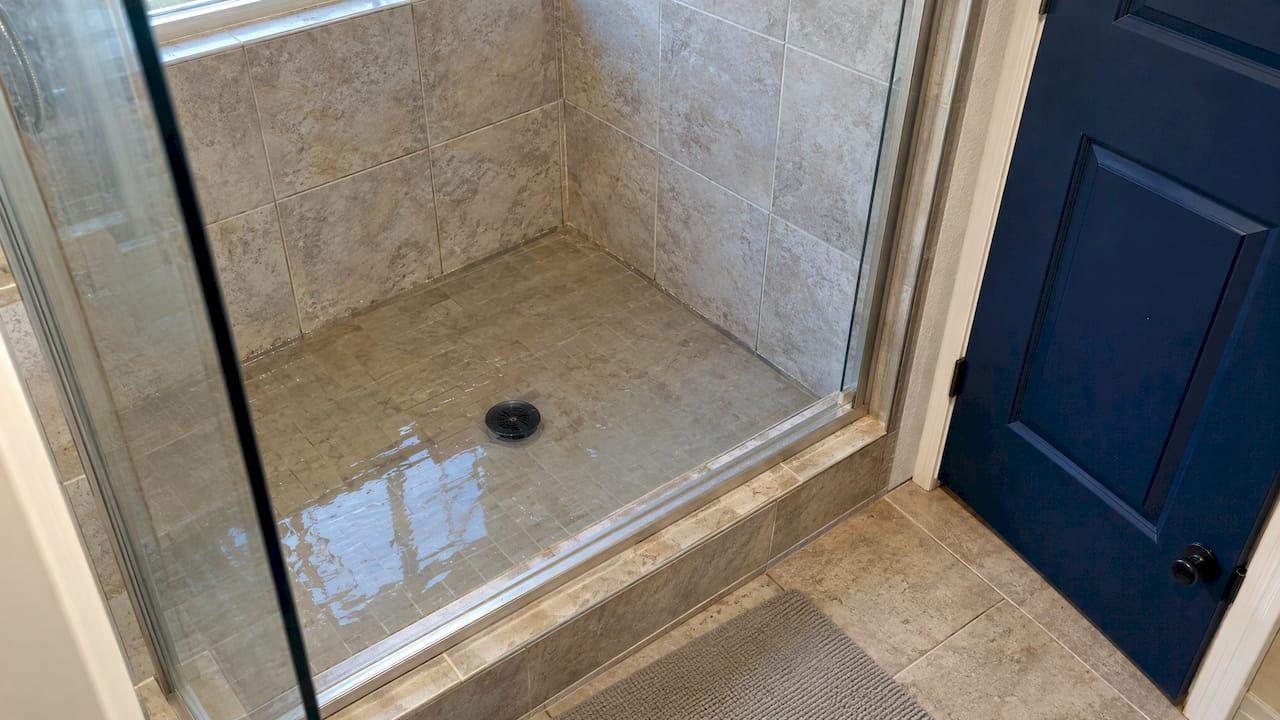
If water is showing up on the ceiling below your shower, on baseboards near the bathroom, or around loose floor tile, the shower pan is a prime suspect. It is also easy to blame wrongly. A bad drain seal, a failed valve or a supply line in the wall can look exactly the same. Pulling out tile before you know the source is the costliest mistake you can make. The fix is to isolate the leak first, in order, and to bring in a licensed plumber the moment the evidence points below the floor or inside a wall. In Bullhead City, Fort Mohave, Mohave Valley and Laughlin, that call is to us.
TL;DR
- A shower pan is the waterproof layer under the shower floor that sends water to the drain. When it cracks or separates, water gets under the tile.
- Early signs: stains on baseboards or trim near the shower, loose tiles in the bathroom, and water or stains on the ceiling or walls of the room below or next to it.
- A flood test settles the question: plug the drain, fill the base with water from another source, mark the level and watch it. Test the drain and plumbing first, so you do not tear out a pan that was never the problem.
- Wet materials that are not dried within 24 to 48 hours can grow mold, so do not wait on a suspected leak.
- Leaks inside walls, under the floor or at the drain are plumbing work. We handle them 24/7 in the Bullhead City area.
Table of Contents
- What a shower pan is and why it leaks
- Signs your shower pan may be leaking
- Pan leak or plumbing leak? Rule out the easy suspects first
- How a shower pan leak test works
- What to do right now if you suspect a leak
- Can a shower pan leak be fixed without removing tile?
- Why homeowners and property managers call us first
- Perspective: why the test comes before the teardown
- Book a plumber for your shower leak
- FAQ
- Sources
What a shower pan is and why it leaks
The shower pan is the waterproof layer beneath the shower floor that directs water to the drain. Over time it can develop cracks or separations that let water seep through. The same source lists a damaged drain, meaning a worn gasket, loose connections or cracks, as a separate leak source.
That distinction matters. Many "shower pan leaks" are really one of these:
- The pan or membrane itself: a crack, a failed seam or a puncture.
- The drain connection: the seal where the drain meets the pan, or a gap between the mortar bed and the drain.
- The valve, shower arm or supply line: water that leaks only when the shower runs, or all the time.
- Grout, caulk or tile joints: surface gaps that let water behind the finish.
Each has a different repair and a very different price. A drain gasket is a plumbing repair. A failed tiled pan means rebuilding the waterproofing under the floor. Knowing which one you have before anyone starts demolition is the whole game.
Signs your shower pan may be leaking
The American Society of Home Inspectors (ASHI) describes what leaking pans leave behind. ASHI is the professional body for home inspectors. Its guidance says:
- Leaks often show up first in the area around the drain.
- Over a slab floor, pans can stain baseboards or wood trim nearby.
- Loose floor tiles in the bathroom, or in rooms that share a wall with the shower, are a red flag.
- Wet carpet in a closet that backs up to the shower is another warning.
- In a crawlspace, a leaking pan can show as white crusty stalactites dripping from soggy black wood.
Homes around Bullhead City are often built on slabs, so the baseboard, trim and adjoining-wall clues matter most. If your shower is upstairs, look at the ceiling below. ASHI cautions that water on that ceiling cannot always be told apart from a defective wax seal at a toilet or a misused shower curtain. Do not assume the pan from one stain.
Other signs that point to a hidden leak:
- A musty smell in the bathroom or the next room that does not clear.
- Grout that keeps cracking or staining at the base of the walls.
- A floor that feels soft or springy near the shower.
- A water bill that climbs with no change in use. That points to a pressurized line rather than the pan, which only leaks when water lands on it.
If the stain is on a ceiling and you are not sure whether the source is the bathroom above or the roof, our guide on whether to call a plumber or a roofer first walks through the difference.
Pan leak or plumbing leak? Rule out the easy suspects first
This Old House lays out a sensible order for troubleshooting a leaky shower: inspect visible areas for water stains or mold, check the pan for cracks or separation from the walls, examine the drain, look for gaps in caulk and grout, and test the shower valve with water both on and off. Richard Trethewey of This Old House suggests pouring water from another source straight into the drain first, so you can rule the drain out and then work upward, rather than simply turning the shower on.
Use this quick sorting guide:
| What you see | Most likely source |
|---|---|
| Water appears only while the shower runs | Pan, drain seal, grout or caulk, or the shower arm and valve |
| Water appears even when the shower is off | Supply line or valve leaking inside the wall |
| Stain grows right after someone showers | Pan or drain connection |
| Drip from the showerhead after use | Valve or cartridge. See our dripping shower head guide |
| Water around the tub overflow cover | Overflow gasket or tub drain. See tub overflow leaking |
| Stain on a ceiling below an upstairs shower | Pan, drain, a toilet seal or a supply line. Needs testing |
A leak that shows up with the shower off is not a pan problem. If that is your case, a hidden water line is the more likely cause. Our overview of how leak detection works explains how we find leaks without opening walls at random.
How a shower pan leak test works
A flood test is the standard way to find out whether the pan holds water. Tile manufacturer Schluter describes the water test as a quality-control check: stop the waste line with a test plug, fill the shower base with water, mark the level and leave it for a set time, typically 24 hours. If the level holds, the shower passes.
ASHI's inspection method ends the same way. After the earlier checks, the drain is plugged and the base is filled to about an inch below the threshold. Sometimes it sits full for a couple of hours while someone watches the surfaces below and around the shower. ASHI adds two cautions:
- Showers over slab floors may need more water and more time.
- A shower should not get a pass until the entire testing process is complete.
The steps, and where they go wrong
- Check the drain first. Pour water from a bucket directly into the drain. If the leak appears, the shower valve and walls are not your problem.
- Plug the drain properly. The plug must seal against the drain pipe. A loose plug leaks and gives you a false result, or hides the real one.
- Fill from another source. Use a bucket or hose, not the shower. This keeps the supply plumbing out of the test, so any loss comes from the pan and drain.
- Mark the water level. Use tape and a marker, and take a photo with the time on it.
- Wait. Hold the water for the test period, several hours at minimum and up to 24 hours for a slow leak. Do not run the shower during the test.
- Watch the other side. Check the ceiling below, the adjoining wall, the closet carpet and any crawlspace. A stain growing there tells you more than the water line in the pan.
- Read the result. A dropping level means water is escaping through the pan, drain or membrane. A level that holds with water still appearing elsewhere points to the valve, shower arm or an in-wall line.
The common failures are a leaking plug, evaporation mistaken for loss in a very long test, and a ceiling stain that has nothing to do with the shower. The test also cannot tell you which part of the pan has failed, only that water is leaving it. That second question is where an experienced plumber earns the visit: we can sort the drain connection and the plumbing from the pan, and that decides whether the job is a plumbing repair or something much larger.
The new-construction test timing in Schluter's FAQ does not apply to an old shower, but its point is worth knowing: thin-set mortar needs a minimum of 24 hours after setting before a test, and longer in cooler weather. In an older shower, none of that applies. What does apply is patience with the test period and honesty about what you see below.
What to do right now if you suspect a leak
Moisture does its damage quickly. A water-damage guide that cites the EPA says that damp materials dried within 24 to 48 hours usually will not grow mold, while mold can start in that same window. The point is that days count more than weeks.
Before anyone arrives:
- Stop using the shower if water is clearly reaching the room below or the wall beside it.
- Dry any wet floor, trim or carpet you can reach.
- Photograph the stains with the date, and note when they show up (during a shower, after, or all the time).
- Do not caulk over the drain or pan edge. Caulk can trap water under the tile and make the leak harder to read.
- If water is spraying or pooling from a supply line, shut off the water to the house and call for emergency service.
This Old House advises calling a professional for leaks within walls or under the floor, for extensive water damage or mold, for structural issues from long-term water exposure, and whenever you are unsure of the source or extent. That fits what we see as the usual line: the moment you are guessing, test it properly.
Can a shower pan leak be fixed without removing tile?
Sometimes the leak is not in the pan at all. A worn drain gasket, a loose drain connection, a failed valve or a leaking supply line can be repaired without touching the tile floor. Surface gaps in grout and caulk are also a repair, not a rebuild.
When the flood test shows the pan or its waterproof layer itself is losing water, the repair usually means opening the floor to reach it. ASHI's emphasis on step-by-step isolation exists because replacing a pan is expensive. Confirming the pan is the culprit before tile comes out avoids paying for a major repair when a cheaper part, such as a seal, joint or valve, is at fault.

That is also why price questions have no honest single answer. The cost depends on whether the problem is a drain connection or the pan, how far the water has traveled, whether framing or subfloor is damaged, and the type of shower. Anyone who quotes a number before testing is guessing. A correct diagnosis first is what keeps the bill tied to the real problem.
Why homeowners and property managers call us first
When a shower leak shows up, the first job is finding where the water comes from. That is plumbing work: testing the drain, checking the valve and supply lines, and tracing leaks that run behind walls and under floors. Our plumbers are licensed, and we offer water line and gas line leak detection and repair, drain cleaning, and faucet and fixture repair and replacement for residential and commercial customers.
For landlords and commercial property managers, a pan leak is more than a repair. It can reach the unit below, a neighboring suite or a shared wall. Calling early with a clear test result protects the building and the tenant relationship.
A slab-foundation home adds another wrinkle. Water that escapes under a slab can look like a shower problem when it is a line leak. Our guide to slab leak warning signs shows what separates the two.
Perspective: why the test comes before the teardown
The most expensive shower repairs we hear about start with a guess. Someone sees a stain, assumes the pan, and tile comes out before anyone has checked the drain, the valve or the lines in the wall.
Our approach at USA Plumbing and Septic is the opposite. We start with the plumbing: the drain connection, the valve, the supply lines. We find where the water is actually coming from. Then the repair matches the problem. Sometimes that is a drain seal. Sometimes it is a hidden water line. Sometimes it is the pan.
We serve Bullhead City, Fort Mohave, Mohave Valley and Laughlin, for homeowners, landlords and commercial properties. A leak does not wait for business hours, so our emergency plumbing service is available 24/7. If you see water where it should not be, call us before you open anything up.
JOHN
Book a plumber for your shower leak
If your shower is leaking, or you are not sure whether it is the pan, the drain or a line, USA Plumbing and Septic can find the source and repair the plumbing side of the problem. We serve homes and commercial properties in Bullhead City, Fort Mohave, Mohave Valley and Laughlin, with emergency service around the clock. Call or book through our website.

If the leak is active and water is reaching other rooms, ask for emergency plumbing service and say so when you call. If you are in Kingman, Lake Havasu City or Golden Valley, see our local pages for Kingman, Lake Havasu and Golden Valley.
FAQ
How do I know if my shower pan is leaking?
Look for stains on baseboards or trim near the shower, loose floor tiles, a musty smell, or water and stains on the ceiling or walls of the room below or next to the bathroom. ASHI lists these as red flags. A flood test with the drain plugged confirms whether the pan is the source.
How long should a shower pan leak test run?
Schluter's guidance for a water test says a typical hold is 24 hours, marked at the starting level. ASHI describes shorter inspection tests of a couple of hours, with longer times on slab floors. A level that drops means water is escaping. Test with water from a bucket, not the shower.
Why is my shower leaking into the room below?
The cause may be the pan, a loose or worn drain seal, a leaking valve or supply line, or even a toilet seal. ASHI notes that a ceiling stain under an upstairs shower cannot always be pinned on the pan without testing. Stop using the shower and have the source confirmed.
Can I just caulk a leaking shower pan?
Caulk fixes surface gaps at joints, but it will not repair a cracked pan or a failed waterproof layer. Caulk over a drain gap can also trap water under the tile and hide the problem. Test first so the repair matches the source.
How fast do I need to act on a shower leak?
Moisture problems get worse quickly. Guidance citing the EPA says damp materials dried within 24 to 48 hours generally do not grow mold, and mold can start growing in that window. If water is reaching a ceiling, wall or floor, stop using the shower and call a plumber right away.
Sources
- Inspecting Tiled Showers and Shower Pans, American Society of Home Inspectors
- What You Need to Know to Troubleshoot a Leaky Shower, This Old House
- What is a water test? Schluter Systems FAQ
- Water Damage Restoration Guide