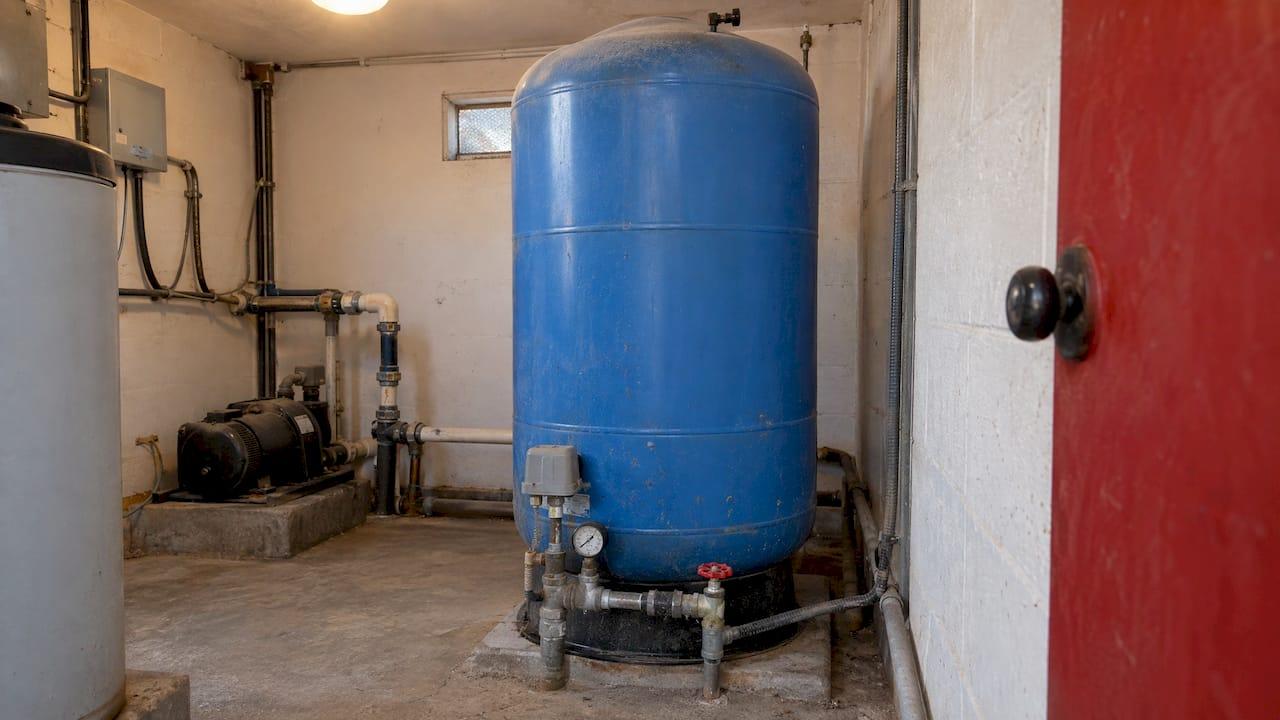
If your well pump clicks on and off every few seconds, or your water pressure pulses at the tap, a failed pressure tank bladder is one of the most likely causes. When the bladder tears, water floods the air space, the tank becomes waterlogged, and the pump takes the punishment. The fix is a proper diagnosis and, in most cases, a tank replacement before the pump motor burns out. We handle water well equipment repair and replacement for homes and businesses around Bullhead City, Fort Mohave, Mohave Valley and Laughlin, with 24/7 emergency service.
TL;DR
- A failed bladder lets water fill the air cushion in the tank. The pump then starts and stops rapidly because the tank can no longer hold pressure.
- Water spraying from the air valve on top of the tank is conclusive: the bladder has failed and the tank needs replacement.
- Rapid cycling that goes unfixed overheats the pump motor and can burn it out, so the tank is cheaper to deal with early than the pump later.
- A pump that runs constantly or will not shut off is not always the tank. A pressure switch, a leak or a falling water level can cause the same thing.
- Have a licensed plumber confirm the cause before you buy parts. Call us any time of day.
Table of Contents
- What the bladder does inside your pressure tank
- Signs the bladder has failed
- Is it the bladder, or something else?
- Why bladders fail
- Bladder tank, diaphragm tank or old galvanized tank
- Safe checks you can do before you call
- What a failed bladder costs if you wait
- Our approach to pressure tank problems
- Get the tank checked by a local plumber
- Property managers and commercial wells
- FAQ
- Sources
What the bladder does inside your pressure tank
A well pressure tank is the buffer between your pump and your faucets. Inside a bladder tank, a rubber bladder holds the water, and a pocket of pressurized air sits around it. When you open a tap, the air pushes water out into your plumbing. That means the pump does not have to start every time you rinse a glass.
The Washington State Department of Health explains that the tank's air pressure forces water into the system when you call for it. When the internal bladder fails, water fills the air space and the tank is waterlogged. With no cushion left, the pump motor cycles rapidly.
That cycling is the real cost. Every start draws a surge of current and heats the motor. A pump built to run for a few minutes at a time ends up starting dozens of times an hour.
Signs the bladder has failed
No single symptom tells the whole story, but several together point straight at the tank.
Rapid pump cycling
You hear the pressure switch click, the pump kicks on, shuts off within seconds, then starts again. The Washington State Department of Health lists rapid pump cycling as the main indicator of a failed bladder. If you are on a well in Mohave County, you may also notice the lights dim slightly each time a submersible pump starts.
Pulsing or fluttering pressure
The needle on the pressure gauge bounces instead of dropping smoothly. Showers surge and fade. Without an air cushion, the system has nothing to smooth the pressure out.
A tank that sounds or feels wrong
The same state guidance says a waterlogged tank sounds different when tapped. A healthy tank sounds hollow near the top, where the air is, and dull lower down. A waterlogged tank sounds dull all the way up. It can also feel noticeably heavy if you gently tip it. Tipping a full-size tank is not a job for one person, so do not try it on a large vessel.
Water at the air valve
The air valve (a Schrader valve, the same style as a tire valve) sits on top of the tank. If water comes out when the stem is pressed, the bladder has ruptured. A manufacturer's installation manual from Wessels adds that air blowing from an open faucet while you add air to the tank also indicates a tear or hole in the bladder. Either result means the tank needs replacement.
Stale or rusty water
The Washington guidance also lists stale, rusty water at the tap from internal corrosion once a tank is waterlogged. If your water has turned brown, there are several possible causes, so read our guide on brown well water and what to do first.
Is it the bladder, or something else?
This is where homeowners lose money. Short cycling and constant running look alike from the kitchen, but the causes differ. Replacing a tank that was never the problem does not stop the pump from running.
Here is how the common causes compare.
| What you notice | Likely cause | What it means |
|---|---|---|
| Pump clicks on and off every few seconds | Waterlogged tank or failed bladder | Tank usually needs replacement |
| Water sprays from the air valve | Ruptured bladder | Tank replacement |
| Pump runs and never reaches shut-off pressure | Pump not building pressure, pipe leak, falling water level, worn pump parts | Needs pump and well diagnosis |
| Pump will not shut off, gauge stays low | Leak or lost prime | Find the leak or restore the prime |
| Pump will not shut off, pressure keeps climbing | Pressure switch stuck or out of adjustment | Switch repair or replacement |
| Low air charge, bladder intact | Tank has lost its pre-charge | Recharge the air, then recheck |
A jet pump troubleshooting guide lists common reasons a pump will not shut off: a pressure switch that is out of adjustment, wired wrongly, defective or stuck closed, a pump that cannot build shut-off pressure, a falling well water level, or leaking pipes. A tank problem is only one name on that list.
On the other side, if the pump is cycling quickly and the pressure switch looks suspect, the tank is often the real culprit. Boshart's support team makes the same point: short cycling points to a waterlogged tank more often than a defective switch. For the switch side of the question, see our guide to well pressure switch problems. For the cycling pattern itself, see how to diagnose well pump short cycling fast.
Why bladders fail
Bladders do not last forever. A few things shorten their life.
- Age and fatigue. The rubber flexes every time the pump runs. After years of cycling, it can crack or tear.
- Low air pre-charge. If the air charge drops, the bladder stretches too far on each fill and wears out sooner.
- Constant short cycling. The Drinking Water site and other well guides note that constant switching strains the diaphragm or bladder, so one problem feeds another.
- Wrong settings. A pressure switch set higher than the tank is rated for can overstress the bladder.
- Heat and mineral buildup. Desert wells in the Colorado River valley can carry hard water. Hard water and minerals are not kind to any component in a well system.
The tank's manufacturer recommends checking the air pre-charge at least once a year. That check is the cheapest way to find an early problem.
Bladder tank, diaphragm tank or old galvanized tank
You may see these terms on a quote or in a search. In a bladder tank, a balloon-like bladder holds the water, and on many models it can be swapped out. A diaphragm tank uses a fixed rubber membrane that is part of the shell, so if it fails the whole tank is replaced. An older galvanized tank has no barrier at all. The air sits directly on the water and gradually dissolves into it, which is why those tanks waterlog and need regular bleeding.

For a homeowner the practical answer is simple. Most tanks sold today keep air and water separated, and when one fails, a new tank is the normal repair. The Washington State Department of Health notes that replacing a waterlogged tank is often the most cost-efficient option. We can tell you on site whether yours is a replacement job and what size and type suit your pump and household.
Safe checks you can do before you call
You do not need tools for a first look. These checks help you describe the problem, and they keep you safe.
- Watch the gauge. Run a faucet and watch the pressure gauge near the tank. Fast jumps or a fluttering needle suggest a lost air cushion.
- Time the cycles. Count how long the pump runs and how long it rests. A pump that turns on and off every few seconds is short cycling.
- Knock on the tank. Tap from top to bottom. A hollow top and a dull bottom is normal. Dull everywhere is a bad sign.
- Look for leaks. Check the tank, pipes and fittings for drips, rust streaks or wet ground around a buried line.
- Note what changed. Did the trouble start after a power surge, a new fixture or a long dry spell?
Avoid pressing the air valve while the system is under pressure unless you know what you are doing. Water can spray out under pressure.
The full test is a different matter. The Washington State Department of Health advises following the manufacturer's safety warnings and knowing your limits. Its procedure is to cut pump power or isolate the tank, drain the tank by opening a faucet, check the air pressure at the valve with a gauge, set it about 2 psi below the pump's start pressure, then confirm the pump's on and off pressures. It also warns against depressurizing the whole water system, because that creates a high risk of backflow and contamination.
That is why we do this work for you. Power has to be off, the tank has to be drained and the gauge has to be accurate. Turning off a well pump and working near a pressurized vessel and its electrical controls is not a casual Saturday job.
What the right pressure looks like
The air pre-charge is set with the tank empty of water. A manufacturer manual from Wessels says to set it 2 to 3 psi below the pump's cut-in pressure. With a common 30/50 pressure switch (pump starts at 30 psi, stops at 50 psi), the pre-charge lands around 27 to 28 psi. If the number does not hold, or water comes out of the valve, you have a bladder problem rather than a charge problem.
What a failed bladder costs if you wait
The tank itself is the smaller part of the bill. The larger risk is the pump. Boshart's support team explains that rapid starting and stopping overheats a submersible pump motor and can burn it out. A submersible pump is pulled from deep in the well, which is a bigger job than swapping a tank in the pump house or garage. Our guide on well pump replacement costs for Bullhead City homes explains why diagnosis comes first.
Other side effects add up too: wasted electricity from constant starting, uneven pressure in showers and appliances, and, in a rental or business, tenant complaints and downtime.

If you are also dealing with weak flow rather than pulsing, run through the safe checks for low well water pressure to see whether the tank is even part of the picture. Before that pump fails completely, learn the well pump failure signs and when to call.
Our approach to pressure tank problems
Most calls about a pump that will not stop running turn out to be one of three things: the tank, the pressure switch, or a leak. Swapping parts without finding out which one costs you twice.
Our approach is to look at the whole system, not just the tank. We are a plumbing and septic company, and water well equipment repair and replacement is part of what we do, for homes and for commercial properties. If the bladder has failed, we replace the tank. If the tank is fine, we look at the switch, the piping and the pump instead.
We serve Bullhead City, Fort Mohave, Mohave Valley and Laughlin, and our plumbers are available 24/7 for emergencies. A pump that cycles all night is an emergency for the motor, even if the faucets still run. Call early.
JOHN
Get the tank checked by a local plumber
If your pump is cycling fast, running nonstop or spraying water from the air valve, we can diagnose the cause and repair or replace the equipment. That covers the pressure tank, the pressure switch, well piping and the pump. We work on residential and commercial well systems throughout the Bullhead City area.

Book through our Bullhead City plumbing page or start at USA Plumbing and Septic. Tell us what you hear, how often the pump cycles and what the gauge does. That helps us arrive with the right parts. Our team also offers special pricing for military and first responders.
Property managers and commercial wells
For landlords and commercial managers, the same symptoms matter more. A small business or rental on a well has no backup when the pump quits. Rapid cycling that goes unreported can show up as tenant complaints about pulsing water, or as a pump that fails on a weekend. Keep a note of when problems appear, share it with your plumber, and ask for the tank and pressure settings to be checked at the same visit as any pump work. Our commercial plumbing service is set up for business properties, including emergency calls.
FAQ
How long does a pressure tank bladder last?
There is no fixed number. Life depends on tank quality, water conditions, how often the pump cycles and whether the air pre-charge is kept correct. Checking the air charge at least once a year, as one manufacturer manual recommends, catches trouble early. When the bladder tears, the tank is usually replaced.
Why does my well pump run constantly or not shut off?
It can be a waterlogged tank, but it can also be a pressure switch that is stuck or out of adjustment, a leak in the pipes, a pump that cannot build shut-off pressure or a falling water level in the well. Because the causes differ, the fix differs too. A plumber should confirm which one you have before parts are replaced, because a switch calling for more pressure than the pump can deliver can damage the motor.
How much air pressure should a bladder tank have?
With the pump off and the tank drained, the air pre-charge is set 2 to 3 psi below the pump's cut-in pressure, according to one manufacturer's manual. On a 30/50 switch, that is about 27 to 28 psi. The Washington State Department of Health gives the same 2 psi rule of thumb. Do not add air to a tank that still has water pressure on it.
Can a waterlogged tank be fixed without replacing it?
If the bladder is intact and the tank has only lost air, recharging the air can restore it. If water comes out of the air valve, the bladder has failed and the tank should be replaced. Washington State's guidance notes that replacement is often the most cost-efficient choice for a waterlogged tank.
Who should I call for a failing pressure tank in Bullhead City?
Call a licensed plumber who works on well equipment. We serve Bullhead City, Fort Mohave, Mohave Valley and Laughlin and answer emergency calls around the clock. Use our Bullhead City page to reach us.
Sources
- Washington State Department of Health: Drinking Water Tech Tip, Troubleshooting Bladder Pressure Tanks
- Wessels FXA Series product manual
- Jet Pump Troubleshooting Guide
- How can I tell if my pressure tank is waterlogged?