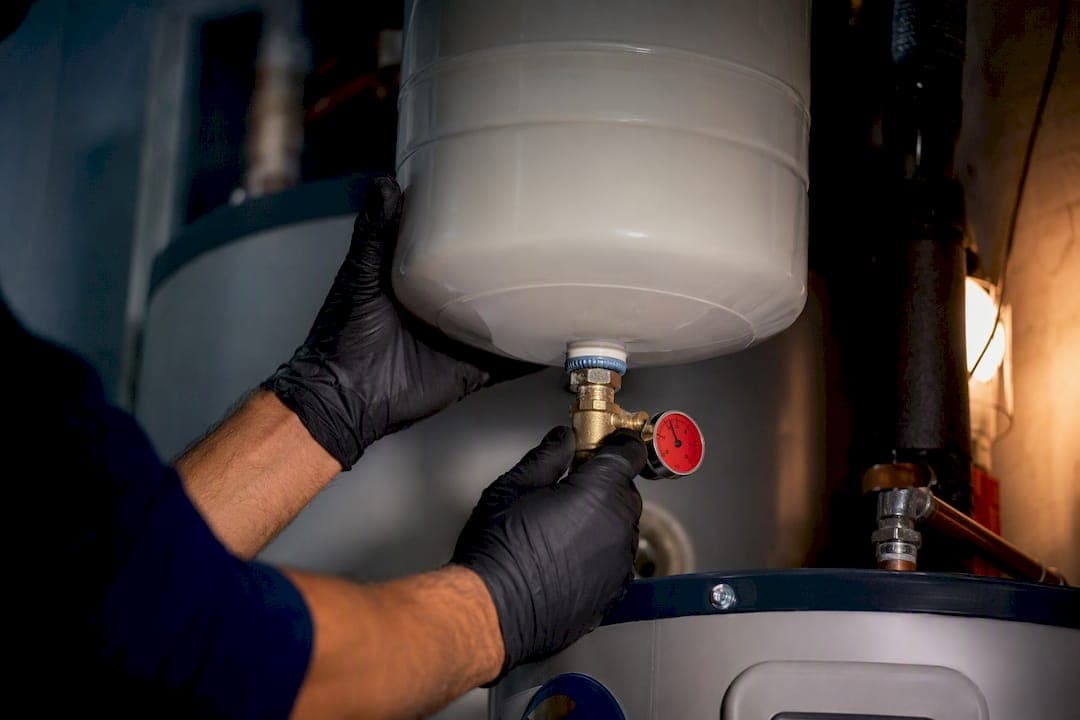
An expansion tank is required whenever your water heater sits on a closed system, meaning a check valve, backflow preventer, or pressure-reducing valve blocks water from flowing back into the street main. Without one, the temperature and pressure relief valve becomes your only pressure release, and it will discharge repeatedly as the heater cycles. Your next move: look at your incoming water line for a check valve or PRV, or measure your static pressure with a gauge.
TL;DR:
- An expansion tank is necessary in closed systems with check valves, PRVs, or backflow preventers to prevent repetitive relief valve discharge from thermal expansion.
- Proper sizing depends on the heater capacity and incoming pressure, with 2 gallons usually suitable for 40-60 gallon heaters under moderate pressure; higher pressure may require larger tanks.
- Correct installation requires mounting on the cold water line near the heater, matching the pre-charge to static pressure, and avoiding compressor use to prevent bladder damage.
- Failures include relief valve leaks, rust, or pressure fluctuations, which signal the need for inspection, pre-charge adjustment, or tank replacement.
- Regular checks of the pre-charge and signs like heavy tank, leaks, or unusual noises extend the lifespan of the heater and prevent early component failure.
Table of Contents
- What an expansion tank is and how it works
- Do I really need an expansion tank? A quick homeowner checklist
- Sizing and choosing the right expansion tank for a residential water heater
- Installation essentials and pre-charge setup homeowners should know
- Troubleshooting, maintenance, and replacement signals
- Installer checklist and real-world tips from USA Plumbing and Septic LLC
- Signs and indicators of expansion tank failure beyond common modes
- Effects of expansion tanks on water heater efficiency and lifespan
- Author perspective: why I recommend prioritizing system protection
- Service offer: expansion tank diagnosis, sizing, and installation by USA Plumbing and Septic LLC
- Manufacturer specs, sizing calculators, and reputable guides
- Sources
- FAQ
What an expansion tank is and how it works
An expansion tank is a small precharged steel vessel that sits on your cold water line near the water heater. Inside, a rubber diaphragm or bladder separates two chambers: one holds air at a set pre-charge, the other fills with water. When the heater warms 50 gallons of cold water, that volume grows by roughly one to two gallons, and that extra water has nowhere to go in a closed system. The tank absorbs it instead of forcing your pipes and fittings to handle the added pressure.
- The air-filled side compresses as water pushes in, cushioning the pressure spike.
- A Schrader valve on top lets you check and adjust the air charge, just like a tire valve.
- The tank does not raise your household water pressure. It only absorbs the extra volume created by heating.
Reputable explainers describe this diaphragm design consistently: a sealed vessel that separates water and air to absorb thermal expansion. That's the whole job. It's a buffer, not a booster.
Do I really need an expansion tank? A quick homeowner checklist
Most homes built or re-plumbed in the last couple of decades have some form of backflow prevention, and that single detail decides whether you need a tank.
- Look at your main water line where it enters the house and check for a backflow preventer or a dedicated check valve.
- Check your water meter for a built-in check valve, which many utilities now install as standard.
- Look for a pressure-reducing valve (PRV), usually a bell-shaped device near the main shutoff.
- If any one of these is present, your system is closed and an expansion tank is required or strongly recommended.
- If none are present, you likely have an older open system, though local code may still call for a tank on replacement or new installation.
When backflow devices make a system closed, manufacturers and local codes require an expansion tank to stop repetitive relief valve discharge. If you're not sure which category your home falls into, our guide to how residential plumbing systems work walks through static pressure and backflow devices in more detail.
Sizing and choosing the right expansion tank for a residential water heater
Tank size depends on two things: how much water your heater holds and how much pressure is already pushing on your system. Higher incoming pressure eats into the tank's usable cushion, so the same heater might need a bigger tank in a high-pressure home than in a low-pressure one.
- A 2-gallon expansion tank typically covers a 40 to 60 gallon heater under moderate pressure.
- A 4.5 to 5 gallon tank suits larger heaters or homes running higher incoming pressure.
- Many guides recommend a 2-gallon tank for a 40 to 60 gallon heater under moderate pressure, moving up to 4.5 or 5 gallons for higher pressure or larger tanks.
As an illustration: a 50-gallon gas water heater running at 60 PSI incoming pressure typically calls for a tank in the 2 to 4.5 gallon range, with the larger size chosen when pressure or heater capacity sits at the high end. That's a worked example, not a universal number, since your own static pressure reading changes the math.
If you want a precise figure instead of a range, use a manufacturer or trade sizing calculator that asks for heater capacity, supply pressure, and pre-charge preference and returns a specific tank size for your system. When in doubt, size up rather than down. A tank that's slightly oversized still works fine, but one that's undersized will waterlog fast. If your incoming pressure runs above 80 PSI or your plumbing includes soldered fittings you're not comfortable cutting into, that's a job for a licensed plumber.

Installation essentials and pre-charge setup homeowners should know
Placement and pre-charge matter as much as size. The tank goes on the cold water inlet, close to the heater but with clearance from heat sources, and it needs freeze protection if it's in an unheated space.
- Mount the tank on the cold supply line, not the hot side, and keep it away from direct heat.
- Follow the manufacturer's sequence: pressure gauge, then pressure-reducing valve if one is present, then the expansion tank.
- Never alter, cap, or bypass the T&P relief valve, no matter what other adjustments you make.
- Measure static pressure with a gauge before setting the tank's air charge, and match the pre-charge to that reading.
- Use a manual pump and a tire gauge to adjust air pressure. Never use an air compressor.
Manufacturer specs commonly call for the tank to sit at least 18 inches from the cold inlet and installed in a specific sequence relative to the pressure gauge and PRV, so check the sheet for your exact model rather than guessing. Rapid air from a compressor can rupture the internal bladder, while a manual pump and tire gauge measured at ambient temperature give an accurate, safe reading.
Pro Tip: Write your static pressure reading on a piece of tape stuck to the tank. You'll need it again the next time you check the pre-charge.
Consider professional plumbing assistance if your fittings are soldered copper, your incoming pressure is high, or if local codes on tank placement are unclear.
Troubleshooting, maintenance, and replacement signals
A failing expansion tank gives off clear warning signs before it stops working entirely.
- The T&P relief valve drips or discharges every time the heater runs a full cycle.
- The tank feels heavy all the way through when you tap or lift it, suggesting the bladder has failed and water has filled the air chamber.
- Water sprays out instead of air when you press the Schrader valve with a tire gauge.
- Rust or pitting shows up on the tank shell, a sign of internal corrosion working its way outward.
To test safely, isolate the tank with its shutoff valve, drain the pressure, then check the Schrader valve with a standard tire gauge. A repeating relief valve leak often gets blamed on the valve itself, but experts recommend checking system pressure and the expansion tank first before replacing a part that isn't the actual problem. Check the pre-charge yearly. A bladder rupture means the tank needs replacement, not a recharge. Never cap the relief valve as a workaround.
Installer checklist and real-world tips from USA Plumbing and Septic LLC
When our plumbers install or service an expansion tank, the process starts before any tool touches the pipe.
- We log your static pressure reading and compare it against your heater's rated capacity before recommending a size.
- We check local code requirements for your specific setup rather than assuming a standard tank fits every home.
- We mount the tank with proper isolation valves so future checks don't require draining the whole system.
- We set the pre-charge with a manual pump and tire gauge, never a compressor, to protect the bladder from day one.
The most common mistakes we see in the field are over-pressurized tanks from compressor use, tanks mounted with no isolation valve, and pre-charge settings that were never matched to the home's actual static pressure. During a service visit, expect a diagnosis of your current setup, a pre-charge reading and adjustment or replacement as needed, correct mounting, and written notes on what was done and why.
Signs and indicators of expansion tank failure beyond common modes
Beyond the obvious waterlogged tank or leaking relief valve, some failure signs are easy to miss because they show up elsewhere in the house first. A knocking or hammering sound in the pipes when a faucet shuts off can point to a tank that's no longer cushioning pressure spikes, even if it looks fine from the outside. Fluctuating water pressure at fixtures, where the flow seems to surge and drop for no reason, sometimes traces back to a bladder that's partially failed rather than fully ruptured.
Condensation or a damp patch on the floor under the tank, separate from any visible leak at the fittings, can mean the tank shell has developed a pinhole from internal corrosion. A change in the sound the water heater makes during its heating cycle, particularly a hissing or gurgling near the tank, is worth checking with a pressure gauge rather than ignoring.
Age is its own indicator. Tanks that have been in service for many years are more likely to fail internally even without an obvious external sign, since the bladder degrades from repeated flexing over thousands of heating cycles. If your expansion tank predates your current water heater by a significant margin, it's worth checking regardless of whether anything looks wrong. None of these signs on their own confirms failure, but any one of them is a reason to check pre-charge and pressure before the problem grows into a relief valve leak or a soaked utility closet.
Effects of expansion tanks on water heater efficiency and lifespan
An expansion tank doesn't make your water heater run more efficiently in terms of energy use, but it protects the components that determine how long the heater lasts. Repeated pressure spikes from thermal expansion stress the tank lining, the fittings, and the T&P relief valve every time the heater cycles. Over years of daily heating and cooling, that stress adds up, and a heater working against constant overpressure tends to develop leaks and fitting failures sooner than one protected by a properly sized expansion tank.
The relief valve itself benefits directly. A valve that's forced to discharge repeatedly to relieve pressure wears out faster than one that only opens in a genuine overpressure event. Since the relief valve is your last line of defense against a dangerous pressure buildup, keeping it in reserve rather than using it as a routine pressure release matters for both the heater and the plumbing around it. Homeowners weighing a full heater replacement instead of a repair can find more context in our breakdown of tankless water heater costs, which touches on how system pressure and component wear factor into replacement timing.
In short, the tank's contribution isn't measured in lower utility bills. It's measured in fewer stressed fittings, a relief valve that lasts as long as it's designed to, and a heater that reaches its expected service life instead of failing early from pressure damage it was never built to absorb.

Author perspective: why I recommend prioritizing system protection
When a system is closed, I always recommend the expansion tank rather than skipping it. If your relief valve is discharging constantly, your pressure is unusually high, or you suspect a leak, call for professional help right away rather than waiting.
— JOHN
Service offer: expansion tank diagnosis, sizing, and installation by USA Plumbing and Septic LLC
Getting the size and pre-charge right the first time saves you from a waterlogged tank six months down the road, and that's exactly where our plumbers earn their keep. Qualified plumbing professionals can provide expansion tank diagnosis, sizing based on heater and static pressure, pre-charge setting with proper tools, and full installation or replacement when a tank has failed.

- The static pressure is measured and the tank size matched to the actual heater capacity.
- Installation includes proper isolation valves for ease of future maintenance.
- Written notes are provided on what was installed and how it was set.
If you're not sure whether your home needs a plumber to look at a water heater issue at all, our guide on what plumbers handle for water heaters covers the range of work we take on. Ready to get your expansion tank checked or installed correctly? Reach out through Usaplumbingseptic to schedule a visit.
Manufacturer specs, sizing calculators, and reputable guides
For anyone who wants the manufacturer detail behind this guide, the Zurn expansion tank spec sheet and the Xylem installation manual cover pre-charge rules and pressure limits directly from the source.
Sources
- HotWater101: Installing a Thermal Expansion Tank (Whirlpool Water Heaters)
- Water Heater Thermal Expansion Tanks — Watts/InspectApedia manual
- Pressurized expansion tanks IOM (Xylem/Bell & Gossett / product manual)
FAQ
Do I really need an expansion tank on my water heater?
You need one if your system is closed, meaning it has a check valve, backflow preventer, or PRV on the incoming line. Without a tank in that setup, thermal expansion has nowhere to go except through the T&P relief valve, which will discharge repeatedly.
What size expansion tank do I need for a 50 gallon gas water heater?
A 50-gallon heater typically pairs with a tank in the 2 to 4.5 gallon range, depending on your incoming water pressure. Sizing calculators that ask for heater capacity and supply pressure give the most accurate figure for your specific home.
How often should I replace the expansion tank on my water heater?
There's no fixed replacement schedule, but check the pre-charge yearly and watch for a waterlogged feel or a leaking relief valve as signs of failure. Replace the tank immediately if the bladder ruptures or if water comes out of the Schrader valve instead of air.
How does an expansion tank work for a water heater?
The tank uses a diaphragm or bladder to separate a precharged air chamber from your water supply. As heated water expands and needs somewhere to go, it pushes into the tank's water side, compressing the air cushion instead of overpressuring your pipes and fittings.