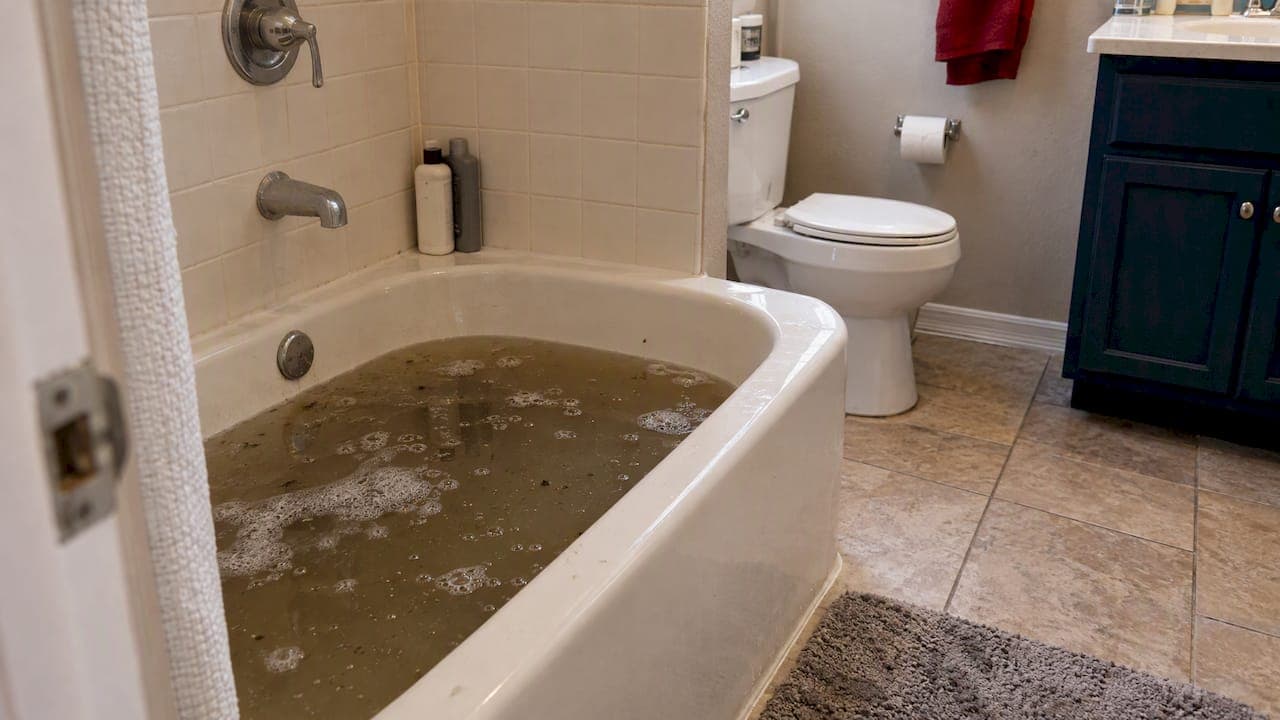
If sewage or dirty water is coming up in your bathtub, stop using water in the house, keep kids and pets out of the bathroom and call a licensed plumber. A tub is usually the lowest drain in the home. When the main line or a septic system can't carry waste away, the tub is the first place it shows. This is rarely a plain tub clog. It is a warning about the line behind it.
We are USA Plumbing and Septic LLC. We handle sewer and septic emergencies in Bullhead City, Fort Mohave, Mohave Valley and Laughlin. Below is what the backup means, what to do in the first minutes, how to clean up safely and what a plumber does to fix it.
TL;DR
- Stop all water use right away: no flushing, no showers, no laundry, no dishwasher.
- Water rising in the tub when you flush or run another fixture points to a blockage in a shared drain, the main sewer line or a septic system, not just the tub drain.
- Sewage carries harmful bacteria. Wear gloves, boots and eye protection, and don't touch it bare-handed.
- Don't pour in chemical cleaners or keep plunging. Call a licensed plumber who can camera-inspect the line.
- Photograph the damage and keep receipts for your insurance claim.
Table of Contents
- Why sewage comes up in the bathtub
- Why sewage can come out of a shower drain too
- What to do in the first 10 minutes
- If your home is on a septic system
- How a plumber diagnoses and fixes the backup
- Cleaning up after sewage in the tub
- Who pays and who to call
- Our perspective: what we see on these calls
- Need help with a sewer backup in Bullhead City?
- Preventing the next backup
- FAQ
- Sources
Why sewage comes up in the bathtub
Every drain in your home feeds a branch line, and the branch lines feed one main line that leaves the house. Your tub sits low in that system. If the main line is blocked, wastewater has nowhere to go and rises to the lowest opening it finds.
That is why the pattern matters more than the smell. According to municipal wastewater guidance from North Augusta, SC, slow drains, backups at several fixtures at once, and one fixture affecting another (a toilet flush backing up a shower, for example) are signs of a drain blockage. The same guidance advises cutting back or stopping water use to limit the damage.
Common causes
This Old House lists the usual causes of sewer backups: nonbiodegradable items or grease in the drains, tree roots, aging or damaged pipes, and heavy rain overloading the system. Here is how each tends to show up in a home:
- Grease and "flushable" wipes. Buildup narrows the pipe until a clump seals it. Backups often start with slow drains for weeks.
- Tree roots. Roots find small joints and cracks, grow inside the pipe and catch everything that passes. Older clay and cast iron lines are the usual victims.
- Aged or collapsed pipe. A sagging or broken section holds water and waste. Snaking may clear it for a few weeks, then it returns.
- Overloaded municipal system. Heavy rain can strain shared sewer mains. If neighbors have the same problem, call your sewer utility as well as a plumber.
- A full or failing septic system. Homes outside city sewer service often rely on septic tanks. More on that below.
Tub clog or main line? A quick way to tell
The test is simple: what happens at the other fixtures?
| What you see | What it usually means |
|---|---|
| Only the tub drains slowly, no other fixture is affected | Hair and soap buildup in the tub drain or trap |
| Tub gurgles or fills when the toilet is flushed | Blockage in a shared branch line or the main line |
| Tub and toilet back up, or the washing machine drain overflows into the tub | Main sewer line blockage |
| Sewage in a floor drain or at the cleanout outside | Main line blocked, confirmed |
| Sewage plus soggy, bright-green grass or damp ground near the tank | Possible septic system failure |
If you see anything in rows two through five, stop troubleshooting. A plunger or a store-bought drain cleaner will not help, because the blockage is farther down the line than either can reach. Our guide on why bathroom drains slow covers the milder, tub-only cases.
Why sewage can come out of a shower drain too
The tub and shower often share the same branch line, or sit at similar low points. So when you see sewage in the shower drain, the cause is the same as for the tub: a blockage in the shared line or the main line. A shower in a basement or a ground-floor bathroom is typically the first to show it, since it is closest to the lowest point of the plumbing.
Treat a shower backup exactly like a tub backup. Stop water use, avoid contact and call a plumber.
What to do in the first 10 minutes
This Old House gives the same core steps for any sewer backup: stop using all water fixtures, keep children and pets away, turn off power if water might reach electrical components, and contact a licensed plumber. Here is how that works in a real house.
- Stop all water use. Don't flush. Don't run the washer, dishwasher or taps. Every gallon you send down adds to what comes up.
- Clear people and pets out of the room. Close the bathroom door if you can.
- Protect yourself. The same guidance says sewage contains harmful bacteria and contaminants. Rubber boots, gloves, eye protection, an N95 respirator and disposable coveralls are what it recommends for contact.
- Watch for electrical risk. If water is near outlets, appliances or a panel, turn off power at the breaker only if you can reach it without standing in water. If you can't, leave it and call for help.
- Check the cleanout if it is safe. Most homes have a capped cleanout pipe outside. If it holds sewage, the main line is blocked. Our guide to the main sewer line clog shows how to find it and when to call the city first.
- Call a licensed plumber. Tell them which fixtures are affected and whether it started after a flush, laundry or rain.
- Document everything. Take photos before you touch anything. The Ohio health department's sewage backup fact sheet notes that photos and receipts for expenses, damaged items and cleanup are vital for insurance claims or for asking a municipal utility for reimbursement.
For a longer list that applies to any burst pipe, overflow or leak, see our 24 hour plumbing emergency checklist.
What not to do
- Don't keep flushing to "push it through." It floods the bathroom.
- Don't pour in caustic drain cleaner. It rarely reaches a main line blockage, and it leaves a hazardous liquid your plumber then has to work around.
- Don't wade in barefoot or bare-handed. Sewage is not just dirty water.
- Don't mix cleaning products. The Indiana Department of Health warns that mixing bleach and ammonia produces toxic gases.
If your home is on a septic system
Many properties outside the city sewer area in Mohave County run on septic tanks. If that is your home, a tub backup can mean the tank is full, the pipes to the tank are blocked or the drainfield is failing.
The EPA lists these signs of a possible septic malfunction: wastewater backing up into household drains, slow tubs and showers, gurgling sounds, standing water or damp spots near the tank or drainfield, sewage odors, and bright-green spongy grass over the drainfield. The University of Minnesota's onsite sewage program lists similar failure indicators, including sewage surfacing in the yard and wet, spongy soil in the treatment area.
If you see those signs along with a tub backup, don't try to pump or dig yourself. A septic backup needs a septic professional who can find out whether the tank, the lines or the drainfield is at fault. The EPA says septic systems should generally be inspected every 1 to 3 years. Skipped inspections are a common reason a first sign shows up in the tub.
How a plumber diagnoses and fixes the backup
A licensed plumber will inspect the sewer line, locate the blockage and recommend drain cleaning, a camera inspection or pipe repair. In practice, the visit goes like this:
- Questions and a look. Which fixtures are affected, how long, what changed lately.
- Access to the line. Usually through the cleanout, or through a toilet pull or roof vent if there is no cleanout.
- Clearing the blockage. A cable machine for soft clogs and roots, or hydro-jetting for grease and heavy buildup.
- Camera inspection. A camera shows what caused it: roots, a belly, a crack or a collapse. This is the step that separates a one-time clog from a pipe that will keep failing.
- Options if the pipe is damaged. Spot repair or full sewer line replacement, depending on what the camera finds.
For septic homes, the EPA says inspections may include checking tank levels, inlet and outlet pipes, pumps and distribution equipment, and using a camera to look for blocked or collapsed solid pipes and leach lines.
If the plumber finds the blockage is in the city's main rather than your private line, the fix belongs to the utility. That is why we say call the city as well, and why photos matter.
Cleaning up after sewage in the tub
The first rule: if you have sewage on floors, walls or belongings beyond the tub itself, hiring a professional restoration company is worth a call. Contact with sewage is a health risk, and large spills are hard to dry out properly. For a small spill confined to the tub and a tiled floor, here is what the health departments recommend.
Hard surfaces
The Washington State Department of Health advises cleaning hard surfaces with hot water and mild detergent, then rinsing with a solution of one tablespoon of unscented bleach per gallon of water. If you want a ready-made product instead, look for a disinfectant cleaner sold for infection control and follow the label for use on surfaces exposed to sewage. Never combine it with bleach or ammonia products.
Porous materials
Carpet, padding, drywall and similar porous materials are a different story. The same Washington guidance says saturated carpeting and padding should be removed, and the Ohio fact sheet says porous materials that contact sewage should be discarded unless thoroughly cleaned and disinfected. When in doubt, throw it out and photograph it first.
Dry it completely
Cleaning is not finished until the area is dry. The Indiana guidance says the damaged area should be thoroughly dried, because microorganisms keep growing while humidity stays high. Run fans and open windows. In our dry desert climate that goes faster than in humid regions, but wet drywall and subfloor can still hold moisture for days.
Who pays and who to call
Who is responsible depends on where the blockage is. The private line runs from your house to the connection with the public main, and a blockage in it is usually the homeowner's to fix. A blockage in the public main is the utility's. In Bullhead City, the Utilities Department maintains the public system; it recently put out specifications for a project to slipline two sanitary sewer main sections and rehabilitate three manholes. That tells you the city is working on its aging sewer infrastructure, but it doesn't tell you where your own blockage is. Only a camera does.
Call your plumber and the utility if neighbors have the same problem, if the backup began during heavy rain or if the cleanout is full right at the property line. Ask your insurer separately whether your homeowner's policy covers sewer or drain backup, because many policies exclude it unless an endorsement was added.

Our perspective: what we see on these calls
Most tub backup calls we get start the same way: "It was just slow, so I ignored it." A slow tub is the cheapest warning you will ever get. A line that is half full of grease or roots is much easier to clear than one that is fully blocked at 9 p.m. on a weekend.
We also see people spend a weekend with plungers and drain cleaner before they call. If water moves from the toilet to the tub, that effort is wasted. The problem is in a line none of those tools reach. We would rather you call us in the first hour, while the mess is still small.
Our approach is simple. We find the blockage, show you what caused it and explain the options in plain terms. We serve homes, rentals and commercial properties across Bullhead City, Fort Mohave, Mohave Valley and Laughlin, and we work on both city sewer lines and septic systems. If a camera shows the line needs repair, we tell you that and what the choices are. If it only needs clearing, we tell you that too.
— JOHN
Need help with a sewer backup in Bullhead City?
Sewage in your tub is an emergency. We offer 24/7 emergency plumbing for residential and commercial customers, along with drain cleaning, sewer line repair and replacement, and septic system solutions. Call us now or book through our site, and tell us which fixtures are backing up so we arrive ready.

See our full list of services at USA Plumbing and Septic LLC. If you are in Kingman, our Kingman plumbing page has local details. Not sure yet whether it is an emergency? Our emergency plumber first 10-minute checklist helps you decide.
Preventing the next backup
- Flush only toilet paper and human waste. Wipes, even labeled flushable, don't break down like paper.
- Keep grease out of the kitchen sink. It cools and sticks to the pipe walls.
- Use a hair catcher in the tub. It stops the most common tub-only clog.
- Act on slow drains. Read our list of signs your drains need professional cleaning.
- Know where your cleanout is. You will need it in an emergency.
- Keep trees and shrubs away from the sewer line when you plant, and have an older line camera-inspected before problems start.
- Schedule septic inspections at the interval the EPA recommends, and keep a record.
For more routine upkeep, our DIY home plumbing maintenance tips are a good starting point.
FAQ
Why does water come up in my tub when I flush the toilet?
Because both fixtures drain into the same line, and that line is blocked downstream. Flushing sends water into a pipe that can't carry it away, so it rises at the lowest opening, often the tub. It usually points to a main sewer line or shared branch line blockage, so stop using water and call a plumber.
Is sewage in the bathtub dangerous?
Yes. Sewage contains harmful bacteria and other contaminants, so avoid skin contact and wear gloves, boots and eye protection if you must go in. Keep children and pets out until the area has been cleaned and disinfected. If anyone feels ill after contact, see a doctor.
Can I fix a backed-up bathtub drain myself?
If only the tub is slow and nothing else is affected, a hair catcher, a plunger or a drain snake can clear a local clog. If sewage is coming up, or other fixtures are involved, the blockage is in a shared or main line. That needs professional equipment, so don't use chemical cleaners.
What if I have a septic tank?
A backup into the tub can mean the tank is full or the drainfield is failing. Look for damp ground, odors or bright-green spongy grass over the drainfield, and call a septic professional for an inspection instead of waiting.
Will insurance cover a sewer backup?
It depends on your policy, since many exclude sewer or drain backup unless you added coverage. Take photos, keep receipts and call your insurer early to ask. If the city's main caused the backup, you may also be able to ask the utility about reimbursement.
Sources
- Wastewater Collection, North Augusta, SC
- What To Do When Your Sewer Backs Up, This Old House
- Resolving Septic System Malfunctions, US EPA
- Troubleshooting, Onsite Sewage Treatment Program, University of Minnesota
- Frequent Questions on Septic Systems, US EPA
- Sewage Spills: Cleaning Them Up, Washington State Department of Health
- When Sewage Backs Up Into Your Home, Ohio health department
- Cleaning Up after Residential Sanitary Sewer Backups, Indiana Department of Health
- Specifications and Contract Documents, Bullhead City Utilities
- Infection control disinfectant cleaner