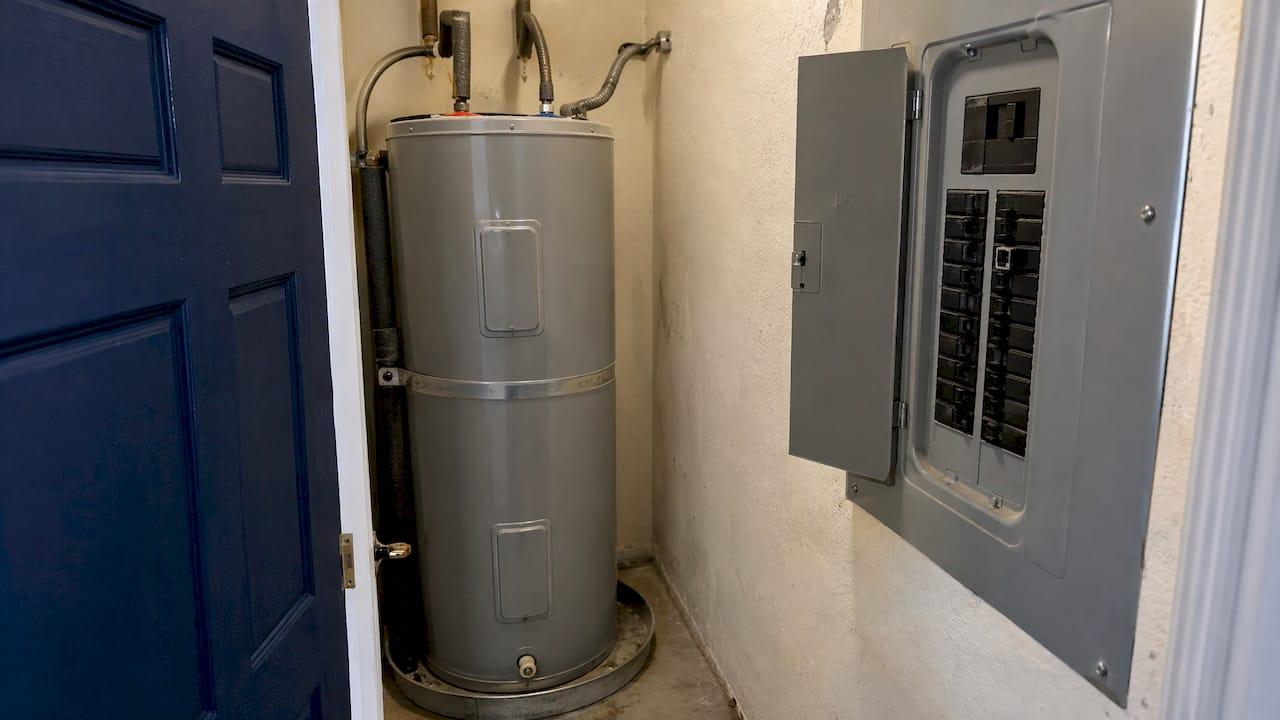
An electric water heater that keeps tripping its breaker almost always has a faulty heating element, a bad thermostat, a loose or corroded wire connection, or a worn breaker. The breaker is doing its job: it is telling you something in that circuit is drawing too much current or leaking power. Leave it off, don't keep resetting it, and have a licensed professional find the cause. If you are in Bullhead City, Fort Mohave, Mohave Valley or Laughlin, we are on call 24/7.
TL;DR
- The usual culprits are a shorted or failing heating element, a stuck thermostat, bad wiring connections, or a worn breaker.
- How fast the breaker trips after you reset it is a strong clue to which part has failed.
- If it trips instantly, or you see scorching, melted insulation or smell burning, stop resetting it and call for help.
- Repair costs vary widely: published U.S. ranges run from about $100 to $350 for an element or thermostat, and more if the circuit or panel needs work.
- We repair and replace electric water heaters around Bullhead City, and we answer emergency calls day and night.
Table of Contents
- Why an electric water heater trips the breaker
- What the trip timing tells you
- What to do right now when the breaker trips
- Signs you need help right away
- How a plumber finds the fault
- Fix it by cause: what each repair involves
- What it costs in the United States
- Common causes of breaker trouble in other appliances
- Promo: electric water heater help in Bullhead City
- Our perspective
- FAQ
- Sources
Why an electric water heater trips the breaker
A standard residential electric water heater runs on a dedicated 240-volt circuit with a 30-amp double-pole breaker, so another appliance on the same circuit is usually not the cause. That narrows the search to the heater itself, the wiring that feeds it, or the breaker.
The four common causes work like this:
- Heating element shorted to the tank. When an element fails, current can leak to the tank wall, and the breaker can trip the moment power comes on.
- Faulty thermostat. If the thermostat contacts stick closed, the heater keeps heating and overheats, and a thermostat problem can also switch both elements on at once. That pulls more current than the circuit should carry.
- Loose or corroded wiring. A poor connection creates heat at the terminal, and over time that heat can trip the breaker.
- A worn breaker. An old breaker can trip even at normal current.
All four are described in this causes-and-fixes guide. Sediment is a fifth factor in some homes: a layer of mineral buildup around an element makes it run hotter and fail sooner. That is common wherever water is hard, and it is one reason we also service water softening and filtration systems in the Bullhead City area.
What the trip timing tells you
Before anyone opens the heater, the pattern of tripping already points toward a cause. One troubleshooting table from 2026 lays it out like this:
| When the breaker trips | Most likely cause |
|---|---|
| The instant you reset it | A dead short: a shorted element or damaged wiring |
| After about 5 to 30 minutes | A weak breaker or undersized wire |
| After 1 to 6 hours | A stuck thermostat or an element buried in sediment |
Treat this as a guide, not a diagnosis. Several faults can look alike from the panel, and only testing the parts confirms which one it is. But it is worth noting the time it took, because it helps the plumber who comes out.
The temperature of the water itself does not trip a breaker. If your water is lukewarm or runs out fast, that is a separate symptom, and our guides on why hot water runs out and how to diagnose a water heater that is not heating cover it. A failed element often causes both problems at once.
What to do right now when the breaker trips
Take these steps in order:
- Leave the breaker off. Don't reset it over and over. Each reset pushes current through a fault that may be heating wires or parts.
- Look at the panel and the heater, without opening anything. If you see scorch marks, melted insulation or discolored wires, or you smell burning, do not reset the breaker. This is the safety advice cited from Lennox, and we agree with it fully.
- Do not remove the heater's access panels yourself. An electric water heater runs on line voltage, which is enough to kill. The same source notes the breaker must be off before any panel comes off, and the wires must be confirmed dead with a non-contact tester. That is work for a trained technician.
- Note what you saw. How long the breaker held after the last reset, whether the water was hot, whether you heard popping or sizzling, and whether anything changed recently, such as a new heater or a power outage.
- Call a professional. Give them those notes. The faster the cause is found, the sooner you have hot water again.
If you have no hot water in the meantime, keep the breaker off and use the cold supply as normal. The tank itself is not harmed by sitting unpowered.
Signs you need help right away
Some situations should not wait for a convenient appointment. Call a licensed professional promptly if:
- The breaker trips immediately every time you reset it.
- You see overheating, melted insulation or a burning smell at the panel or at the heater's junction box.
- Your home has aluminum branch wiring, or an older panel type such as a Federal Pacific Stab-Lok or Zinsco panel.
- You are not certain you can switch off the circuit safely.
That list follows the guidance in this 2026 troubleshooting guide. Problems in the panel itself, or in aluminum or older wiring, sit on the electrical side of the house. A licensed electrician is the right professional for those. We work on the water heater and its connections; when the evidence points back to the panel, we tell you so and you get the right person for it.
A tripping heater that is also overheating is a different kind of warning. Our article on a hot water heater that overheats explains why it needs prompt attention. If the tank is also making noise, see why a water heater pops.
How a plumber finds the fault
Here is what a proper diagnosis looks like at the heater, with the power off and confirmed dead.
Test the elements. A healthy 4,500-watt, 240-volt element typically reads about 10 to 16 ohms on a multimeter. A burned-out element reads infinity. A shorted element reads near zero. Any continuous reading between an element terminal and the tank flange means the element is leaking current to the tank. Those figures come from this 2026 guide. A reading to the tank is a clear reason for replacement.

Check the thermostats. Upper and lower thermostats should switch cleanly. Contacts that stay closed, or a thermostat that has failed on one side, can cause overheating and nuisance trips.
Inspect the connections. The technician looks for loose terminals, corroded lugs, brittle or discolored insulation and signs of arcing. A wire connection that has been running hot often shows browning.
Check the breaker and circuit. The breaker, wire size and condition all matter. For a 4,500-watt, 240-volt heater, an electrical code Q&A from EC&M works through the sizing: the heater is treated as a continuous load, which leads to a 10 AWG conductor with a 30-amp breaker. If the wire or breaker is not what the heater needs, trips at the 5 to 30 minute mark make sense.
Look inside the tank, when needed. Heavy sediment around the lower element shortens its life. Replacing the element and addressing the buildup together saves a repeat visit.
Then comes the repair: new element, new thermostat, cleaned and tightened connections, or a conversation about the breaker or circuit. If the heater is old and the tank is leaking or corroded, replacement may make more sense than another repair. Our water heater install cost guide helps you plan for that, and the tankless cost guide covers that option.
Fix it by cause: what each repair involves
Shorted or burned-out heating element
The most frequent answer. The element is unscrewed or unbolted from the tank, replaced with one of the correct wattage and voltage, and the heater is refilled with air purged before power is restored. Power must never be turned on before the tank is full, because a dry element burns out in moments.
Stuck or failed thermostat
Thermostats are replaced as a matched job with the elements in many cases, since all of these parts age together. A new thermostat also resets the upper and lower element sequence to what it should be.
Loose or corroded wiring
Connections are cleaned back, damaged conductors are cut back to good copper, and terminals are retightened to the proper torque. Heat-damaged insulation is replaced, not just taped.
Worn breaker or undersized circuit
An old breaker can be replaced with the correct 30-amp double-pole unit. If the wire is undersized, the circuit itself must be corrected. Panel problems belong to a licensed electrician, and we coordinate with the homeowner on next steps.
What it costs in the United States
We don't publish fixed prices for these repairs, because the cost depends on what the diagnosis finds. Published national ranges help you set expectations. HomeGuide figures cited in a 2026 article give these typical costs:
| Repair | Typical U.S. range |
|---|---|
| Electric water heater repair, overall | $100 to $350 |
| Heating element replacement | $100 to $350 |
| Thermostat replacement | $100 to $350 |
| New dedicated electrical circuit | $250 to $900 |
| Electrical panel replacement | $850 to $1,700 |
The Bob Vila repair cost guide adds that total cost depends on the type of repair, parts, labor fees and geographic location. Parts themselves are inexpensive. What you pay for is the diagnosis, safe work around live circuits, and getting the job right the first time.
Common causes of breaker trouble in other appliances
Home breakers trip for similar reasons across appliances: overloaded circuits, loose connections, worn breakers and failing components. If you want the same logic applied to cooling equipment, this explainer on why a breaker keeps tripping shows how the same warning signs apply to an air conditioner, and when to stop resetting.
Promo: electric water heater help in Bullhead City
When your water heater trips the breaker, you want a plumber who answers the phone, arrives quickly and fixes the real problem. That is what we aim to do. USA Plumbing and Septic LLC serves homeowners, landlords and commercial property managers in Bullhead City, Fort Mohave, Mohave Valley and Laughlin, with emergency plumbing service 24/7.

We handle water heater repair and installation, including element and thermostat work, and replacement when a heater has reached the end of its life. Our licensed plumbers carry the tools to test the circuit and the heater and explain what they find. Call or book water heater service today. Our guide to water heater work explains what a plumber does, and our common water heater problems article helps you spot trouble early.
Our perspective
We see the same story often. The breaker trips, the homeowner resets it, it holds for a while, and then it trips again. Resetting feels like a fix. It is not. The breaker is the warning, and the cause is waiting in the heater or the wiring.
Our approach is simple. We shut the circuit down safely, test the parts, and tell you what failed and why. A shorted element, a stuck thermostat or a hot connection each has a clear repair. We would rather replace the right part once than come back for the same call.
We also know a heater without power is not a small problem. It means no hot showers, no dishwasher and, for a rental or business, unhappy tenants and customers. That is why we are available 24/7 and why we serve both residential and commercial customers. Our licensed plumbers are trained to work on water heaters of every kind, and we treat every call as the urgent one it feels like to you.
If the problem turns out to be bigger than the heater, such as the panel, we say so plainly and help you take the next step. Our promise is a straight answer and reliable work.
JOHN
FAQ
Why does my water heater keep tripping the breaker?
The usual causes are a shorted heating element, a stuck thermostat, a loose or corroded connection or a worn breaker. How soon it trips after a reset helps narrow it down: instantly suggests a dead short, while a trip after hours suggests a thermostat or sediment problem. A plumber can test each part and confirm.
Is it safe to keep resetting the breaker?
No. If anything looks burned or damaged, do not reset the breaker. Repeated resets send current through a fault that may be overheating a part or a wire. Leave the breaker off and call for service.
How much does it cost to fix a water heater that trips the breaker?
Published U.S. ranges put an element or thermostat replacement at about $100 to $350 each. A new dedicated circuit runs $250 to $900 and a panel replacement $850 to $1,700. Your final cost depends on the diagnosis, the parts and local labor.
Can another appliance on the circuit cause the trip?
Usually not. A standard electric water heater has its own dedicated 30-amp double-pole breaker on a 240-volt circuit, so the cause is normally in the heater, its wiring or the breaker itself.
Should I call a plumber or an electrician?
If the fault is in the heater, such as the element or thermostat, a plumber handles it. If you see burning at the panel, or your home has aluminum branch wiring or an older Federal Pacific or Zinsco panel, involve a licensed electrician. We can help you work out which one you need.
Sources
- Water Heater Tripping Breaker: 7 Causes and Fixes, Heater Guides
- Electric Water Heater Tripping Breaker: 5 Fixes, Water Heater Checker
- Water Heater Breaker Keeps Tripping, Tank and Breaker
- Code Q&A: Electric Water Heaters, EC&M
- How Much Does Water Heater Repair Cost?, Bob Vila