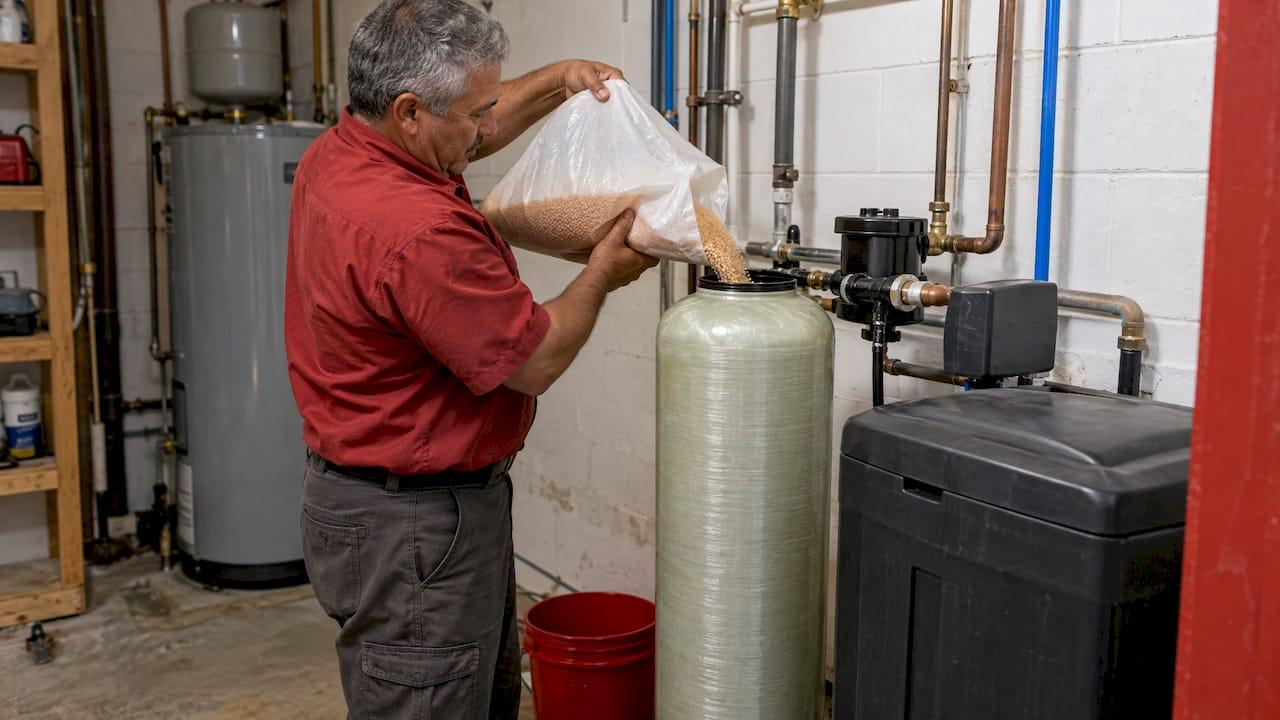
Water softener resin usually needs replacing after about 10 to 15 years. Harsh water conditions can shorten that. If your soap stops lathering, your softener regenerates more often, or your water pressure drops, the resin may be worn out. A plumber can confirm it and replace it, or tell you when a new softener is the smarter move.
We are USA Plumbing and Septic LLC. We serve homeowners and businesses in Bullhead City, Fort Mohave, Mohave Valley, Laughlin and the surrounding area. This guide covers how to tell the resin is done, how long it lasts, what a replacement involves and how to decide between new resin and a new unit.
TL;DR
- Resin is the small beads inside the tank that capture hardness minerals. Over time they wear out, and the softener stops doing its job.
- Typical life is 10 to 15 years. Chlorine in city water and iron in well water can cut that sharply.
- Warning signs: poor lather, more frequent regeneration, more salt use, low water pressure, sediment or odd tastes.
- Replacement is a defined job: drain and open the tank, remove the old resin, check the internal parts, refill, rinse and regenerate.
- If the tank, valve or controls are also failing, a new softener can cost less over time than repairing an old one. We can look at both options on one visit.
Table of Contents
- What softener resin does
- Signs your resin needs replacing
- How long water softener resin lasts
- Replace the resin or the whole softener?
- What goes in a water softener resin tank
- What resin replacement involves
- What affects the cost
- Making new resin last
- Our perspective
- Get your softener checked
- FAQ
- Sources
What softener resin does
A salt-based softener holds thousands of tiny resin beads. As hard water passes over them, they trap calcium and magnesium and release sodium in their place. When the beads are full, the unit regenerates: it flushes the beads with salt brine and starts again.
The beads do all the work. The valve, the brine tank and the controls only manage the cycle. When the resin breaks down, the rest of the softener can look and sound normal while the water coming out is hard again.
Hard water is a real problem in our region. It leaves scale on fixtures and inside water heaters and pipes. Our guide to hard water plumbing problems explains what that scale does to a home's plumbing when a softener stops working.
Signs your resin needs replacing
Resin rarely fails all at once. It fades. These are the signs we look for.
Soap and skin tell you first
Soap and shampoo stop foaming the way they used to. Dishes spot. Showers leave a film. Laundry feels stiff. These are the same signs you had before you owned a softener, and they point to hardness getting through. Soft water is usually described as producing a good lather, so a drop in lather is one of the easiest things to notice.
The unit regenerates more often
When resin loses capacity, it fills up faster and the softener calls for regeneration more frequently. You may see the salt level dropping faster than it used to. According to SoftPro Water Systems, poor lather, more frequent regeneration, sediment and strange tastes are all signs that resin may need replacement, along with higher salt use and weaker cleaning performance.
Low water pressure
This one surprises people. As resin ages it swells and softens, and fragments can collect at the bottom of the tank and restrict flow. Morton's support guidance on old or expired resin says expired resin can cause a pressure drop and low water pressure. It also says resin can escape from the tank into the plumbing.
Resin beads or grit in the water
If you find tiny tan or brown beads in a faucet aerator, a showerhead or a toilet fill valve, the tank's internal parts or the resin itself may be failing. Stop and call a plumber. Beads in the lines can clog fixtures and appliances. Our faucet replacement cost guide shows how quickly small clogs turn into repair bills.

Check the easy problems first
Not every hard-water symptom means bad resin. A salt bridge, which is a hard crust in the brine tank, can stop the unit from making brine and produce the same symptoms. Our guide to salt bridge fixes walks through it. If the salt is moving freely and the water is still hard, resin becomes the likely cause.
How long water softener resin lasts
Most resin lasts about a decade or more. Family Handyman puts a resin bed at 10 to 15 years, and notes that iron in well water and excessive chlorine in city water can kill it sooner. WaterWorld reports that some manufacturers see standard gel-type 8% resin as a 10 to 15 year event.
The whole softener tends to land in a similar range. Morton gives roughly 10 years as the average life of a unit.
| Factor | What it does to resin | What to expect |
|---|---|---|
| Chlorinated city water | Chlorine attacks the resin's structure, so beads swell and soften | Shorter life as chlorine levels rise |
| Iron in well water | Iron coats the beads and blocks the exchange sites | Shorter life, and cleaning may be needed |
| Water use and hardness | More hardness means more regeneration cycles | Wear builds faster in heavy-use homes |
| Resin type | Higher crosslink resin resists chemical attack better | Longer life, according to the manufacturer data in the next section |
| Maintenance | Clean salt and cleaning cycles protect the bed | Helps the resin reach the upper end of its range |
What shortens resin life
Chlorine is the biggest enemy in treated water. WaterWorld explains that chlorine and chloramines attack the resin's divinylbenzene backbone. The beads then swell and take on moisture, and the pores inside them collapse. Eventually the resin gets so soft it can be crushed between two fingers, and pressure loss follows. The same article reports that 2 ppm of residual chlorine can cut a standard resin's life expectancy in half.

If your home is on a private well, iron is the usual concern. Iron and organic matter foul the beads and reduce their capacity. We service water well equipment, so we can look at the whole system, not just the softener, when we see this.
Does higher crosslink resin last longer?
Resin comes in different crosslink percentages. Standard resin is 8%. Some units use 10%. Manufacturers say the higher-crosslink option resists chemical attack better. If you are replacing resin, ask us what is in your tank now and what the unit is designed to use, because the right choice depends on your valve and tank.
Replace the resin or the whole softener?
This is the question most homeowners are really asking. Our approach is simple. Look at the age and condition of every part, not only the resin.
New resin makes sense when:
- The tank is sound, with no cracks, leaks or bulging.
- The control valve works and the unit cycles normally.
- The softener is properly sized for your household.
- The only issue is that the water has gone hard again.
A new softener makes sense when:
- The unit is at or past the 10 to 15 year mark and the valve is also acting up.
- The tank is cracked or corroded.
- Your household has grown or changed and the old unit is undersized.
- You are repeating repairs.
Sizing matters either way. If the resin was fine and the softener simply could not keep up, new resin will not fix it. Our guides on choosing a water softener size and on softener sizing with a worked grain example show how capacity is figured from household size and water hardness.
A general reference point on capacity: a Whirlpool 48,000-grain system contains 1.33 cubic feet of high-capacity ion-exchange resin and is designed for households of one to six or more people. Resin volume rises with the rated capacity of the unit. That is why the right amount of resin is set by the tank and valve, not by guesswork.
If your old softener is truly at the end, our overview of the benefits of water softener installation explains what a new unit brings to a home.
What goes in a water softener resin tank
A resin tank holds more than beads. Depending on the unit, you will find:
- Resin beads. These are the exchange media that do the softening.
- A riser tube. This runs from the valve down to the bottom of the tank and carries water through the bed.
- A distributor or underdrain at the bottom. It spreads flow evenly and keeps beads inside the tank.
- Sometimes a gravel bed. Many tanks have a layer of gravel under the resin to support it.
These details matter at replacement time. The riser tube has to be protected so resin does not fall into it while the tank is refilled. The underdrain has to be inspected, because a damaged one lets beads escape. A job that skips these checks risks beads in your pipes later.
What resin replacement involves
The job follows a clear sequence. A technician working through it will:
- Put the softener in bypass and relieve pressure in the tank.
- Disconnect the valve head.
- Remove the old resin from the tank.
- Inspect the underdrain and the inside of the tank, and replace the gravel layer if the unit needs one.
- Seal the top of the riser tube so nothing falls in.
- Add the correct volume of new resin.
- Reassemble the valve, reconnect it and bring the system back to pressure slowly.
- Backwash the new resin to flush fines.
- Run a manual regeneration.
- Test the first softened water for hardness.
That sequence is the standard way to do this work. We follow it so the unit comes back to service with confirmed results, not assumptions. The final hardness test is the step that tells you the job worked.
This is also the reason we treat resin replacement as a plumbing job. Old resin is heavy and messy. The tank has to be handled and the valve disconnected without damaging fittings. Any slip leaves a leak or a bypass that you only discover later. It is faster and safer for us to do it, and we can check your plumbing connections at the same visit.
What affects the cost
We do not publish flat prices for this work, because the job depends on your unit. The main factors are:
- The resin volume. A bigger tank needs more resin.
- The resin type. Standard and higher-crosslink resin are priced differently.
- The condition of the internals. A worn riser tube, distributor or valve seal adds parts.
- Whether the tank can be reused. If it cannot, you are looking at a different job.
- Access. A softener in a tight garage corner or utility closet takes more labor.
- Whether the job is routine or urgent. We offer 24/7 emergency service.
Call us with the make and model of your softener, a photo of the label if you can, and a short description of what you are seeing. We will explain the options and give you a clear quote before work starts.
Making new resin last
Once the new bed is in, a few habits protect it.
- Keep the salt tank clean and use clean salt. Dirty salt leaves residue that builds up on the beads.
- Watch the salt level and check for bridges. A bridge stops brine production and leaves the beads unregenerated.
- Match the settings to your water. If your hardness or household changes, the regeneration settings should change too.
- Test your water now and then. A quick hardness test shows you when output slips before the signs get obvious.
- Have the system looked at periodically. A short inspection catches valve and tank problems before they reach the resin.
If you also run a reverse osmosis unit, our RO maintenance guide covers the targets to check. And our water filtration checklist for Bullhead City homeowners covers the rest of a home's treatment equipment.
Our perspective
Most homeowners call us when the water feels wrong. Soap will not lather, spots are back on the glass, or the pressure has dropped. Their first guess is usually a failed softener, and the fix they have in mind is a new one.
We start with the whole picture. Resin is a wear item, and when everything else in the system is sound, new resin is a practical, affordable repair. When the tank or valve is also worn, or the unit was never sized for the household, we say so and walk you through a replacement.
We handle residential and commercial plumbing, water softening and filtration repair and replacement, and water well equipment. That means we can tell the difference between a resin problem, a salt problem, a sizing problem and a well water problem. We are a local team, licensed and available around the clock, and we go the extra mile to get your water right the first time.
Our advice is simple. If your softener is more than ten years old and the signs are there, have it looked at before low pressure or beads in the lines turn a small job into a bigger one.
JOHN
Get your softener checked
We repair and replace water softening and filtration systems for homes and businesses across Bullhead City, Fort Mohave, Mohave Valley and Laughlin. We can inspect your softener, confirm whether resin is the issue and give you a straight answer on repair or replacement. Emergency calls are handled 24/7.

Call or book a visit with USA Plumbing and Septic for water softener service. If you are in Kingman, we also have a page for plumbing service in Kingman, AZ, and one for Lake Havasu City.
FAQ
How often should water softener resin be replaced?
There is no fixed calendar date. Resin commonly lasts 10 to 15 years, though chlorine in city water or iron in well water can shorten it. Replace it when the signs show up: hard water despite regeneration, higher salt use or falling pressure.
How long do water softeners last?
Morton gives about 10 years as the average life of a softener unit. Well-maintained systems can run longer, and heavy use or poor water conditions can shorten that. The resin, valve and tank each age differently, so one failing part does not always mean the whole unit is finished.
When should I replace the whole water softener instead of the resin?
Replace the unit when the tank is cracked or corroded, the valve is failing, the softener is undersized for your household, or you keep paying for repairs. If the tank and valve are sound and only the water is hard, new resin is usually the right fix. We can inspect the unit and tell you which applies.
Can bad resin damage my plumbing?
Yes, it can. Resin that breaks down can restrict flow, and beads that escape can clog fixtures and valves. If you find beads in your faucets or showerheads, stop and call a plumber.
How much resin does my softener need?
The amount is set by the tank size and the unit's rated capacity. For example, a 48,000-grain Whirlpool unit holds 1.33 cubic feet. Your own model may differ, so give us the make and model and we will confirm the right volume.
Sources
- When to Replace Resin in a Softener, SoftPro Water Systems
- Old or Expired Resin, Morton Water Softeners
- Extending the Life of Resin for Water Softeners, WaterWorld
- Replace a Water Softener Resin Bed, Family Handyman
- WHES48 PRO 48,000 Grain Water Softener System, Whirlpool