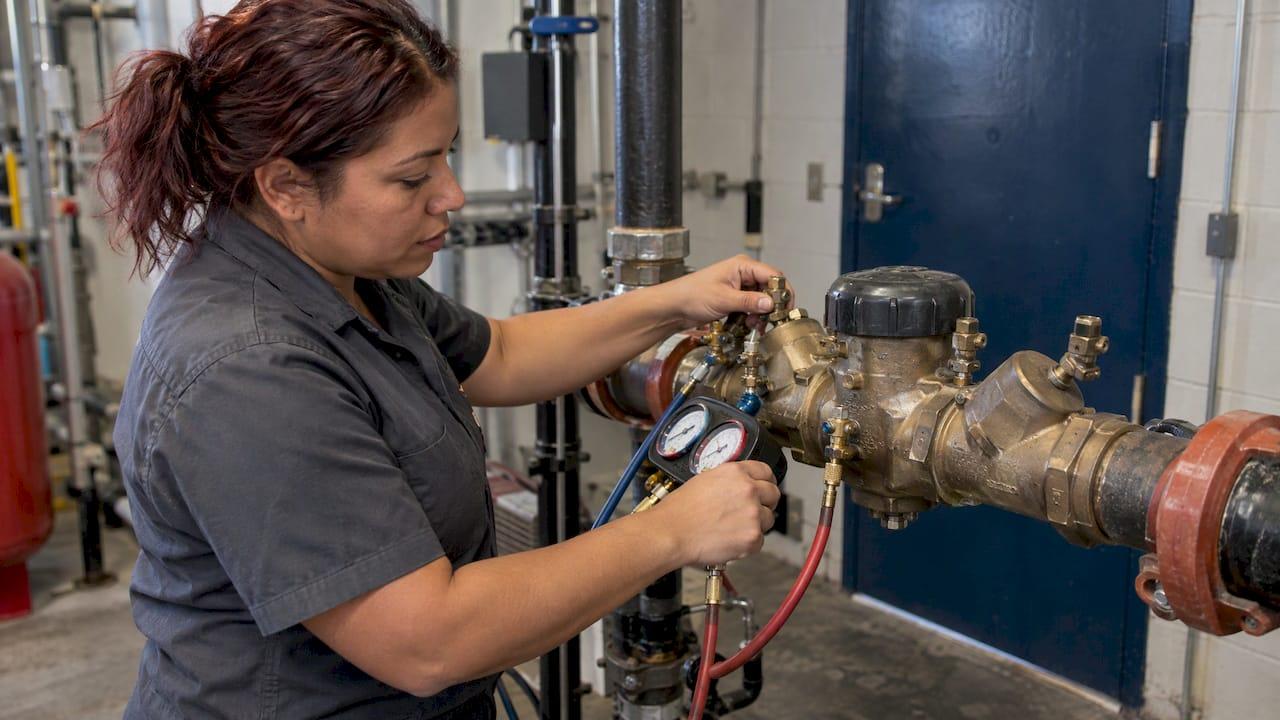
Backflow preventer maintenance comes down to two jobs. You look at the device every month, and a certified tester checks it at least once a year. In Arizona, required assemblies must be tested at least annually, and also after installation, relocation or repair. If the device leaks, dumps water or fails a test, it gets repaired or replaced and retested before it goes back into service.
We are USA Plumbing and Septic LLC, serving Bullhead City, Fort Mohave, Mohave Valley and Laughlin. This guide is for homeowners, landlords and property managers who own a backflow assembly and want to keep it working, legal and out of trouble.
TL;DR
- Arizona requires required backflow assemblies to be tested at least annually, and after installation, relocation or repair.
- Testing must be done by a currently certified tester, not by the owner.
- Do a quick visual check every month: leaks, relief-valve discharge, closed valves, damage, freeze protection and the test tag.
- Never plug a relief port. If a device dumps water continuously, shut it off and call a licensed professional.
- A defective assembly must be repaired or replaced and tested before it returns to service.
Table of Contents
- What a backflow preventer does and why upkeep matters
- The Arizona rules in plain words
- Backflow preventer maintenance checklist
- Common problems to watch for
- What you can safely do yourself
- When to call a licensed plumber
- What happens if a device fails the test
- Residential and commercial: different stakes
- Get help with your backflow device
- FAQ
- Sources
What a backflow preventer does and why upkeep matters
A backflow preventer keeps water from flowing backward into the public supply. Think of irrigation systems, fire sprinkler lines, commercial equipment, boilers and car wash or restaurant plumbing. Any of these can hold water that should never mix with what comes out of your neighbor's tap.
Arizona's environmental agency treats testing as a public-health control. ADEQ explains that assemblies are required where there is a significant possibility that harmful substances or unapproved water could enter the public system. The device sits quietly for months. It only matters on the day pressure drops or reverses, and that is the day it has to work.
That is why maintenance is not optional upkeep. Springs wear, check valves foul with debris, seals harden in the desert heat, and a closed shutoff valve can leave a system unprotected or without water. A device you have not looked at in a year is a device you cannot trust.
If you are not sure which kind of assembly you have, our guide to backflow preventer types explains how they differ and why the right choice depends on the hazard, not the price tag.
The Arizona rules in plain words
The state rule is Arizona Administrative Code R18-4-215. Here is what it means for an owner.
- Annual testing. Required assemblies must be tested at least once a year and again after installation, relocation or repair.
- A certified tester. The test must be performed by a currently certified general tester approved by CA-NV AWWA, ASETT or another authority approved by ADEQ. ADEQ confirms that the certification must come from an ADEQ-approved authority.
- Repair or replace. A defective assembly must be repaired or replaced. It may not be placed in service until it has been tested and works as designed.
- Records. Public water systems must keep assembly and test records for at least three years.
Cities and water companies add their own details on top of the state rule. These examples show the pattern, and your own water provider's rules are the ones that apply to you:
| Provider | What it adds |
|---|---|
| Phoenix | Approved test-certification report, submitted by the due date. Customers keep test records for at least three years. Test gauges need a valid calibration within the 12 months before the report date. |
| Mesa | Testers submit reports through the city portal within seven days of service. Customers arrange a retest right after maintenance or repair. |
| Arizona Water Company | Customers choose, hire and pay the tester. Results go to the company within 30 days. |
| Williams | Customer-paid testing on the anniversary of the first inspection. Certified retest within ten days after repair, repiping, overhaul or relocation. |
The lesson is simple. The yearly test is the floor, and your utility may set the due date, the paperwork route and the repair deadline. Check with your water provider for the current process in your area. For a wider view of local code, read our plumbing code compliance guide for Arizona homeowners. If you manage a business, the commercial building plumbing code checklist for Arizona covers more ground.
Backflow preventer maintenance checklist
Use this list for the monthly look and the yearly test. It follows the items that official inspection checklists and published maintenance checklists cover.
Monthly visual check (about five minutes)
- Relief valve. Is water coming out? A drip or spurt is a sign to note and watch. A steady stream is a call to a professional.
- Leaks. Look at the body, unions and test cocks for drips or mineral crust.
- Cracks or damage. Check the body, bonnet and the pipe on both sides.
- Shutoff valves. Both should be fully open, unless a professional has told you otherwise.
- Enclosure and insulation. The cover, hot box or wrap should be intact and secure.
- Test tag. Confirm the tag is present and the date is current.
- Bypasses and hoses. Nothing should be connected to the relief port, and no hose should run to a drain.
- Access and clearance. Keep the area free of weeds, gravel, storage and anything else that blocks the tester.
Yearly record for each device
Keep one page per assembly with these entries:
- Location, type, make, model and size
- What the device protects (irrigation, fire line, boiler, building supply)
- Last test date and next due date
- Tester name and certificate number
- The test report and who submitted it to your water provider
- Repairs, replacement parts and retest dates
Arizona's rule requires public water systems to keep tester names and certificate numbers on file. As an owner, keep your own copy too. Phoenix, for example, asks customers to retain test records for at least three years, and Williams requires owners to keep accurate test and repair records, including replacement materials.
If you manage several buildings, a spreadsheet with a due-date column prevents most missed tests.
Common problems to watch for
Most backflow trouble shows up in the same few places.
Relief valve discharge
On a reduced pressure assembly, the relief valve is designed to open when something is wrong. Manufacturer instructions from Zurn explain that occasional discharge can come from pressure swings or water hammer. Continuous discharge points to a fault in the device. The first check is usually where debris collects.
In practice: note when it happens. If the discharge follows a pump cycle or a pressure surge, tell your plumber. If it never stops, shut the supply and call.
Leaking body or test cocks
A drip at a test cock is often a worn cap or seal. A leak from the body itself can mean a crack, which is common after a freeze. Either way, an unprotected leak is not something to monitor for weeks.
Debris and fouled check valves
Sand, scale and pipe fragments get trapped under a check valve seat. The valve cannot seal, and the assembly fails its test. Manufacturers recommend flushing the line before installation to clear debris. In our area, well systems and older lines can carry more sediment, which is one more reason to keep the yearly test on the calendar.
Worn springs and seals
Springs and rubber parts age. Heat, chlorine and years of cycling take their toll. Repair kits address these items, and a certified person retests afterward.
Freeze and sun damage
Bullhead City is warm most of the year, but overnight freezes do happen in the Mohave County desert, and devices above ground are exposed. Keep the insulation or enclosure in good condition. If the body splits, shut it off, call a tester or plumber, and tell your utility if the device is out of service. Sun can also crack plastic covers and age exposed seals, so check the enclosure each month.

What you can safely do yourself
Owners can do a lot without opening the device.
- Do the monthly visual check above.
- Keep the area clear and drained so water does not pool around the assembly.
- Keep the shutoff valves accessible.
- Wipe down the exterior and keep vegetation back.
- Keep records and watch the test due date.
The rest belongs to a professional. Testing needs a certified tester with a calibrated gauge. Repairs and rebuilds need a qualified person, and Phoenix, for one, requires testing and repairs to be done by a certified tester or repair technician. Do not plug the relief port, and do not pipe the discharge directly into a drain. Manufacturers call for the relief discharge to go through a suitable air gap, not a direct connection.
Can you replace a backflow preventer yourself? Replacement changes the installation, so the new assembly has to be tested afterward by a certified tester. Many cities also require a permit for new work. Our article on permit requirements for commercial plumbing work in Arizona explains how that process typically works for businesses.
When to call a licensed plumber
Call right away if:
- The relief valve discharges continuously.
- The body is cracked, split or leaking.
- The assembly failed its annual test.
- You are unsure whether a device is required on your property.
- Water pressure drops sharply or the water looks cloudy or tastes off after work on the system.
- You are adding irrigation, a fire line or equipment that needs protection.
If the device is out of service, the Arizona rule is clear: no returning it to service until it has been tested and works as designed. That means the repair and the retest should be planned together.
What happens if a device fails the test
A failed test is a repair order, not a penalty. The usual sequence is:
- The tester records the failure and reports it as your provider requires.
- The assembly is repaired or replaced by a qualified person.
- A certified tester retests it. Williams sets this at within ten days after repair, and Mesa asks for an immediate retest.
- The new report goes to your water provider, and you file your copy.
If the failure is a worn part, repair is often straightforward. If the body is cracked or the model is obsolete, replacement is the better route. Our overview of what backflow testing costs helps you plan the budget, and the U.S. backflow testing rules article explains the requirements further.
Residential and commercial: different stakes

Homeowners usually have a lawn irrigation backflow device, and sometimes one on a well or a pool fill line. A cross-connection at home can be easy to miss, so see how to identify cross-contamination plumbing risk at home.
Commercial properties often have several assemblies: domestic supply, fire sprinklers, irrigation, boilers, kitchens and carwash equipment. Glendale, for example, states that commercial customers must have assemblies inspected annually and use a city-approved certified tester. Missing a test on one device can hold up an inspection, so see our guide to passing a plumbing health inspection.
Our perspective
We see the same pattern on service calls. The device was installed, nobody looked at it again, and the first sign of trouble was water pouring out of a relief valve or a notice from the utility. Backflow assemblies are easy to forget because they do their job quietly.
Our advice is to treat the device like any other piece of plumbing that protects your family or your tenants. Do the monthly look. Put the test date on a calendar. When something is off, call early, because a small repair on a worn part costs far less than an emergency after a freeze or a surge.
We are a 24/7 plumbing company with licensed plumbers serving residential and commercial customers across Bullhead City and the surrounding area. We handle water line repairs and replacements, leak detection, and installations, and we are glad to talk through your situation, whether it is a dripping device, a new irrigation line or a building with several assemblies.
JOHN
Get help with your backflow device
If your device is leaking, discharging or overdue for attention, we are ready to help. Our licensed plumbers handle water line repair and replacement, leak detection and plumbing installations for homes and businesses in Bullhead City, Fort Mohave, Mohave Valley and Laughlin, with emergency service available 24/7. Call or book through our plumbing service page and tell us what you are seeing.

We also serve nearby communities. See our page for plumbers in Bullhead City or our Mohave Valley plumbing page for local details.
FAQ
How often should a backflow preventer be maintained?
Look at it monthly and have it tested at least once a year. Arizona requires annual testing, and also testing after installation, relocation or repair. Your water provider may set a specific due date or require more frequent tests, so confirm with them.
Is a backflow preventer required by code in Arizona?
Where a significant risk of contamination exists, yes. ADEQ explains that assemblies are required where harmful substances or unapproved water could enter the public system. Your water provider decides which connections need protection, so ask them or a licensed plumber about your property.
Is it common for a backflow preventer to leak?
Some discharge from a reduced pressure relief valve can happen with pressure changes or water hammer. Constant leaking is a fault, as is a leak from the body or test cocks. If it is constant, shut off the supply and call a licensed plumber or tester.
Can I test or repair a backflow preventer myself?
You can do the monthly visual check and keep the area clear. The annual test must be performed by a currently certified tester, and repairs are handled by a qualified person followed by a certified retest. Do not plug the relief port.
Sources
- Ariz. Admin. Code R18-4-215, Backflow Prevention
- ADEQ Backflow Prevention and Cross-Connection Control
- Phoenix backflow tester requirements and customer responsibilities
- City of Mesa Backflow Prevention
- Arizona Water Company Backflow Prevention
- Williams, AZ code § 51.22 Backflow Prevention
- City of Glendale Water Services
- Philadelphia backflow assembly inspection checklist
- Backflow preventers: annual test and monthly look checklist
- Zurn backflow preventer installation and maintenance instructions