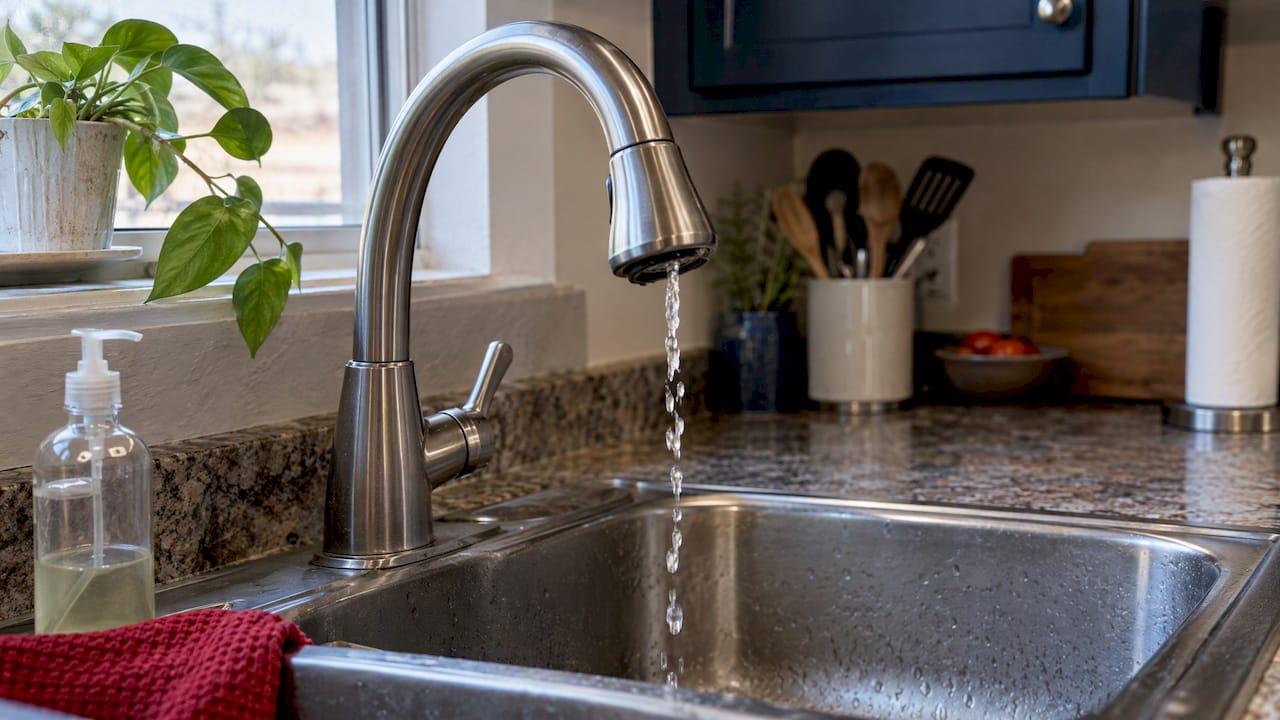
If your faucets went dry when the power went out, the first question is where your water comes from. City water usually keeps flowing or returns on its own. A private well stops the moment its electric pump loses power, and it can need more than a breaker flip to come back safely. If you're in Bullhead City, Fort Mohave, Mohave Valley, Laughlin or the surrounding area and the water is still off after the lights are back, the steps below tell you what is safe to try yourself and when to stop and call us.
TL;DR
- Well or city? A well pump runs on electricity, so no power means no water. City systems often ride through an outage on generators and elevated tanks.
- Check the basics once: the pump breaker, the pressure switch and the tank gauge. Reset a tripped 240-volt pump breaker one time only. If it trips again, stop.
- Don't drink it yet: if the well lost all pressure, the water should be tested before you drink it. Use bottled or treated water until then.
- Call a licensed plumber if the pump runs but nothing comes out, the pump cycles on and off every few seconds, or the breaker keeps tripping. We take emergency calls 24/7.
Table of Contents
- First, figure out where your water comes from
- Why a well goes dry when the power goes out
- When the power comes back and the water doesn't
- Weak flow, spurting or one dead faucet
- Safety first: electricity, generators and a dry pump
- Is the water safe to drink after the outage?
- How much water to keep on hand
- When to stop and call a plumber
- Our perspective
- Get the water back on
- FAQ
- Sources
First, figure out where your water comes from
The fix depends on this, so settle it before you touch anything.
City or utility water. According to the CDC figure cited by EcoFlow, about nine out of ten people in the U.S. get tap water from a public system. Those systems can keep flowing for a while because of elevated storage tanks and backup generators. A utility such as Port St. Lucie's states that treatment facilities run on generator power, so city customers see no impact from an outage there. Your own utility may handle things differently, so check with it. If you are a Bullhead City Utilities customer and the water is out on your street, the city's customer service page lists the office at 2355 Trane Road, open Monday to Friday, 8 a.m. to 5 p.m., with (928) 763-0166 for service questions.
Private well. The same EcoFlow guide cites an EPA estimate that more than 43 million Americans rely on private wells. For those homes, Ohio's health department explains that pumping systems won't run in an outage and only a limited amount of water sits in the pressure tank and lines. Treatment units need electricity too, so they stop treating the water.
Not sure which you have? Look for a water meter and a bill from a utility, or look for a pressure tank, a well cap or a pump breaker in your panel. A well home has no monthly water bill from a utility.

Why a well goes dry when the power goes out
A well pump pushes water into a pressure tank. The tank holds a cushion of air that keeps the pipes under pressure, and a pressure switch turns the pump on and off as the tank fills and empties. When the power dies, the pump stops. You get whatever water is left in the tank and the pipes, and then you get air.
Open faucets are what drain that stored water. Michigan's environmental agency, in its guidance for private water supplies in an emergency, explains that an electric pump maintains pressure in the tank and piping. Drawing water during an outage depressurizes the system and raises the contamination risk. That is why it advises against opening faucets, taking showers or flushing toilets during an extended outage.
So during a long outage, a shower is not worth it. Save the water in the tank for drinking and the essentials.
When the power comes back and the water doesn't
Power is on, lights are on, and the taps are dry or weak. Work through these in order. Each one is safe for a homeowner, and none of them involves opening the pump, the wiring or the tank.
1. Look at the pump breaker
Find the breaker labeled for the well pump. Well pumps commonly run on a 240-volt double-pole breaker. A power surge as the grid comes back can trip it. If it is tripped, reset it once, firmly, from fully off to fully on.

If it trips again right away, do not keep resetting it. A short in the pump or the buried wire is the likely cause, and repeated resets can make the damage worse. Leave the breaker off and call us.
2. Check the pressure gauge and listen
Go to the pressure tank. Most have a gauge. At rest with the pump off, you want to see pressure in the normal range for your system. Zero means the system lost pressure completely.
Now listen. Does the pump hum, click or run? Silence usually points to a power or switch problem. A pump that runs and runs without building pressure points to a different problem, often the pump itself or the water level in the well.
3. Look for a tripped overload
Some pumps have a built-in motor overload, a protection device that shuts the motor off when it overheats or draws too much current. The Wayne SWS50 troubleshooting chart lists the usual reasons a pump won't run: power off, a blown fuse or tripped breaker, a faulty pressure switch, a tripped motor overload or low line voltage. It notes that you can let a tripped overload cool so it resets automatically. Don't force it.
4. Check the pressure switch from the outside
The pressure switch is a small gray box near the tank where the pipe and wires meet. You do not need to open it. If the pump doesn't start while pressure is low, the switch may have failed. Opening that box means working near live 240-volt wiring, so leave it closed and read our guide to well pressure switch problems to see what the symptoms look like.
5. Open one faucet and watch
The CDC's guidance for private wells says to check whether the well lost pressure even after the power returns. Turn on a faucet. If the water comes in intermittent spurts, the system lost pressure. In that case the CDC says not to drink the water until it is tested for bacterial contamination at a minimum.
Weak flow, spurting or one dead faucet
Not every outage leaves you with a fully dry house. Here is what the pattern tells you.
| What you see | Likely meaning | What to do |
|---|---|---|
| Nothing at any faucet, pump silent | Tripped breaker, blown fuse, failed pressure switch or tripped overload | Reset the breaker once. If it trips again or the pump stays silent, call a plumber |
| Pump runs but little or no water | Air in the lines, a lost prime, or a pump that is no longer submerged | Turn the pump off at the breaker and call for service |
| Pump runs a few seconds, then shuts off | Not enough air in the pressure tank, so pressure builds too fast | Stop using the pump and have the tank checked |
| Spurting, sputtering faucets | System lost pressure and has air in the lines | Run water briefly once pressure returns, and test before drinking |
| One faucet is weak, the rest are normal | Often a clogged aerator or fixture problem, not the well | Clean the aerator, then see the one-faucet checks |
The University of Nebraska Extension's well operation and maintenance publication explains two of these. Little or no water can mean the pump is set too high in the well and is no longer submerged as the water level drops, which is more likely in drought years. A pump that runs only a few seconds before shutting off means pressure is building too fast because there isn't enough air in the pressure tank. It adds that a state-licensed professional can set the pump at the right height.
For a single weak tap, our one-faucet low pressure checks take about five minutes. If every fixture is weak, start with the low well water pressure checks. A pump that clicks on and off rapidly is covered in our short cycling guide.
Safety first: electricity, generators and a dry pump
Turn the power off before you inspect anything. The CDC says to turn off power to the pump before inspecting it to avoid electrical shock. Never work on a pump, pressure switch or wiring with wet hands or standing in water.
Don't let the pump run dry. A pump that runs with no water moving through it can overheat, and the motor depends on that water for cooling. If you hear it running and nothing comes out, kill the breaker and don't wait to see if it catches up.
If you use a generator, keep it outside. The CDC says a generator may be used to run the well if appropriate. It also says a licensed well contractor, electrician or the power company should determine the proper generator size to avoid damaging the pumping system. Generators must only be used outdoors, at least 20 feet from doors, windows and vents, because the exhaust carries carbon monoxide.
If you have solar panels, know that grid-tied systems disconnect during a blackout. How a photovoltaic system disconnects from the grid in a blackout decides what kind of backup you would need to run a pump.
Downed lines. If the outage came with a downed live wire, sparks or smoke, call 911 first and stay away from the wire. Mohave Electric Cooperative serves Bullhead City, so report an outage to them rather than guessing at a cause in your own panel.
Is the water safe to drink after the outage?
This is the question most homeowners skip. When a well loses pressure, contaminants can be drawn in. Michigan's guidance says that if the system loses all pressure, meaning no water from the faucet, you should have the water checked for coliform bacteria. It says water is considered safe to drink after two consecutive samples, collected 8 hours apart, show no coliform bacteria.
While you wait on results, the same agency lists these temporary options:
- Bottled water.
- Boiling the water at a rolling boil for at least 2 minutes.
- Adding 10 drops of unscented household chlorine bleach per gallon, with at least 4 hours of contact time.
- A portable filter that removes microorganisms down to 0.3 microns.
When water returns, the wellcare Hotline says to let the tap run a few minutes. If you see discoloration or smell an odor, use another water source and have the water tested. Our guide to brown well water explains what to do first if it looks off. Sediment often stirs loose when a system is repressurized.
If your well was flooded, have a qualified electrician, well contractor or pump contractor check the wiring before you turn anything on, as Michigan advises. Flooded equipment can shock you or be damaged.
How much water to keep on hand
Bullhead City summers make outages harder to ride out. The wellcare Hotline says the average family of four uses about 400 gallons a day indoors. It recommends storing at least one gallon per person per day for at least three days, and replacing the stored water every six months.
That covers drinking and basic cooking. It does not cover flushing or washing. A few practical points:
- Fill clean containers before a storm or planned outage if you get notice.
- Keep a small stock of bottled water on a shelf you rotate.
- Count pets. They drink too.
- Your water heater tank holds a supply. Shut off its power or gas first, and ask us how to draw from it safely if you've never done it.
The wellcare Hotline notes that a bulk gravity storage tank can be added beside the pneumatic tank to supply water when power fails. If outages are a recurring problem where you live, that is a project worth planning rather than improvising.
When to stop and call a plumber
Call us if any of these apply:
- The breaker trips again after one reset.
- The pump runs but delivers little or no water.
- The pump cycles every few seconds.
- The pressure gauge reads zero with the pump running.
- You smell burning or see scorched wiring at the pressure switch.
- Water is cloudy, discolored or smells after power returns.
- You can't tell whether the problem is the pump, the switch or the tank.
Many of these overlap with the signs in our well pump failure guide, and our 24 hour plumbing emergency checklist covers what to do while you wait for help. If the pump needs to come out, our well pump replacement cost guide explains how we diagnose first.
Landlords and commercial property managers face the same issue at larger scale. A dry building means tenants without water, so a single well or booster system failure is worth a same-day call.
Our perspective
Most no-water calls after an outage start the same way. The power is back, but nobody knows which part of the well system took the hit. The breaker, the pressure switch, the tank and the pump all look fine from the outside.
We tell homeowners to do the simple things: reset the breaker once, read the gauge, and leave the wiring alone. A pump that has been running dry or tripping repeatedly is a job for a licensed plumber who can test the circuit and the pump instead of guessing.
We repair and replace water well equipment, and we handle emergency calls around the clock in Bullhead City, Fort Mohave, Mohave Valley and Laughlin. Our aim is to find the actual fault and tell you what we found.
JOHN
Get the water back on
We repair and replace water well equipment for residential and commercial customers, and our licensed plumbers take emergency calls 24/7 in Bullhead City, Fort Mohave, Mohave Valley and Laughlin. If your well pump, pressure switch or tank isn't bringing water back after an outage, book a visit.

See our services and contact us at USA Plumbing and Septic LLC.
FAQ
Will my water still run without power?
On city water, often yes for a while, because of elevated tanks and generator-backed treatment. On a private well, no, because the electric pump stops. You get only what is left in the pressure tank and pipes.
How do I reset my well pump after a power outage?
Turn the pump breaker fully off and then on, once. Check that the pressure switch and gauge look normal and give the pump a few minutes to build pressure. If the breaker trips again, leave it off and call a licensed plumber.
Why is my well water pressure low after a power outage?
The system may have lost its air charge or pressure, the pressure switch may have failed, or the pump may not be getting full power. Air in the lines also causes spurting. If pressure doesn't recover in a short time, have the pump and tank checked.
Can I shower on a well with no power?
It's best not to during an extended outage. Michigan's environmental agency says drawing water depressurizes the system and raises contamination risk. Save stored water for drinking, and test the well before drinking if it lost all pressure.
Sources
- Does Water Work When Power Is Out? City, Well, Hot Water
- Storm Preparation & Recovery, City of Port St. Lucie, FL
- Customer Service, Bullhead City
- Power Outages and Private Water Systems, Ohio Department of Health
- Protecting Your Private Water Supply in an Emergency, Michigan EGLE
- Wayne SWS50 Troubleshooting Guide
- Private Wells after a Wildfire, CDC
- Private Drinking Water Wells: Operation and Maintenance, University of Nebraska Extension
- Wells: What to Do When the Power Fails, wellcare Hotline
- Photovoltaic grid disconnection in a blackout