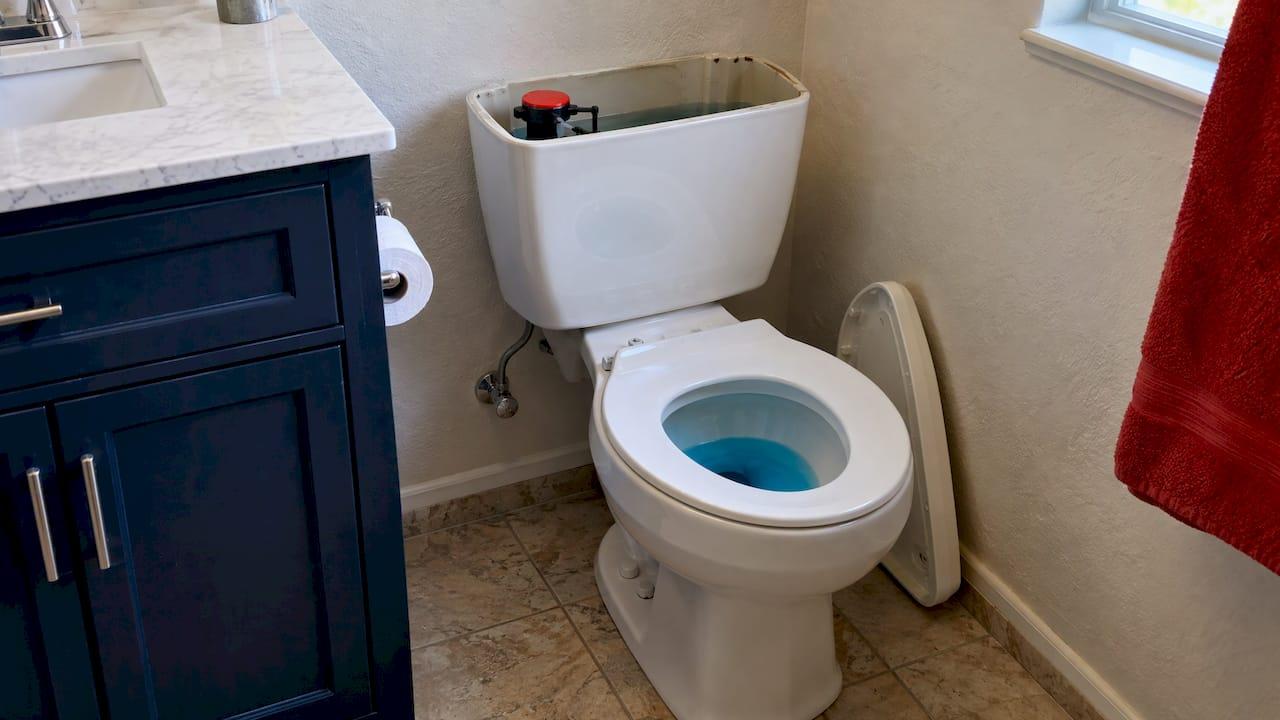
A toilet dye test takes about 15 minutes and one bottle of food coloring. Put the dye in the tank, don't flush, and wait. If color shows up in the bowl, water is leaking from the tank, usually past a worn flapper. If you want the leak found and fixed without guesswork, our licensed plumbers serve Bullhead City, Fort Mohave, Mohave Valley and Laughlin.
This guide covers the test step by step, what each result means, how to avoid a false reading and when a leak is a job for a plumber.
TL;DR
- Add a dye tablet or a few drops of food coloring to the tank, wait 10 to 15 minutes without flushing, and check the bowl. Color in the bowl means a leak.
- The usual cause is a worn flapper. A tank water level set too high, a snagging chain or a faulty fill valve can also be the cause.
- Flush as soon as you finish so the dye doesn't stain the tank.
- Remove tank cleaners that color the water first, or you will get a false result.
- If the test shows a leak and the repair is beyond you, or the dye stays clear but your bill keeps climbing, call us.
Table of Contents
- What a toilet dye test actually detects
- Why it is worth ten minutes
- What you need
- How to run the toilet dye test
- Reading the result
- Why a toilet fails the dye test
- Avoiding a false result
- When the dye stays clear but the bill stays high
- Fixing it: what a homeowner can do and when to stop
- Let us handle the toilet repair
- Our perspective
- FAQ
- Sources
What a toilet dye test actually detects
A toilet has two parts that matter here: the tank at the back, which holds the water for the next flush, and the bowl. A rubber seal at the bottom of the tank, called the flapper, lifts when you flush and drops back to hold the water in. When that seal stops sealing, water seeps from the tank into the bowl and on down the drain. You don't see it and you don't hear much. This is why plumbers call it a silent leak.
The dye test makes that invisible flow visible. As New York City's Department of Environmental Protection explains, clear bowl water means no leak, dye in the bowl means water is moving from tank to bowl, and the faster the dye appears, the bigger the leak.
The test only checks that one path: tank to bowl. It will not find a leaking supply line, a weeping shutoff valve or a wax ring failing at the floor. Those show up as water outside the toilet. If you see that, read our guide on a toilet leaking at the base.

Why it is worth ten minutes
A leaking flapper costs money because the toilet keeps refilling to make up for lost water. The figures from public water agencies vary with the size of the leak:
- The City of Downey, California notes that more than 20 percent of gravity-flush toilets leak.
- The South Florida Water Management District says leaks inside a toilet can waste up to 200 gallons per day.
- The City of St. Paul says a badly leaking toilet can waste up to 5 gallons per minute, or 7,200 gallons a day.
The range is wide because a hairline seep and a flapper stuck open are very different problems. Either one adds to your water bill, and in a rental or a commercial restroom the leak can run for months because nobody is looking at it.
Small leaks are also the easiest to miss. Many toilets leak mostly overnight, when water pressure rises and the tank level creeps above the overflow tube. Santa Barbara's water department describes this as a common cause of constant running down the tube.
What you need
- Food coloring in a dark color (blue or red shows best), or dye tablets made for toilet leak detection. NYC DEP notes that tablets are non-toxic and convenient.
- A timer or your phone.
- A towel for the tank lid.
That's all. If you are testing several toilets, as in a rental, an office or a multi-unit building, bring enough dye for each tank.
How to run the toilet dye test
- Prep the tank. Lift off the tank lid and set it on a towel. If you use in-tank cleaner tablets, bleach pucks or any product that tints the water, take them out. Flush until the bowl water is clear. Downey's guidance is to do this before starting the dye test to avoid a false result.
- Let the tank refill. Wait until the water stops running and the tank is full.
- Add the dye. Use one tablet, or put in a few drops of food coloring. Guidance differs a little by agency. Portland Water Bureau suggests 10 to 15 drops, while the City of Ogden says 4 to 5 drops of dark coloring. Enough to turn the tank water clearly colored is the goal.
- Do not flush. Stay out of the bathroom if you can, and tell everyone in the house not to use that toilet.
- Wait. The EPA's WaterSense technical sheet says 5 to 10 minutes. Other agencies ask for 15 minutes or longer. Fifteen minutes is a sensible middle. A very slow leak can take longer, and one county water department in Georgia suggests two to four hours for the most patient result.
- Check the bowl. Look at the water in the bowl, not the tank. Any color means a leak.
- Flush right away. The EPA advises flushing within 5 to 10 minutes after the dye goes in so it does not stain the tank. If the bowl is colored, flush after you've noted the result.
The EPA's own checklist recommends the same thing, with the same food coloring method, as a basic part of finding leaks around the house. NYC DEP recommends testing each toilet once a year, and Portland suggests every 6 to 12 months.
Food coloring or dye tablets?
Both work. Food coloring is already in your kitchen. Tablets are made to dissolve in a tank and give a strong, even color, which makes faint leaks easier to see. Either way, flush promptly and the dye does not stay in the tank.
Reading the result
| What you see after 15 minutes | What it means | Usual next step |
|---|---|---|
| Bowl water stays clear | No tank-to-bowl leak right now | Test again in 6 to 12 months |
| Color appears in the bowl within minutes | A significant leak, most often a worn or warped flapper | Replace the flapper or have it replaced |
| Faint color after a long wait | A slow leak, early flapper wear | Plan the repair, and retest after |
| Color, and the tank water sits high | Water spilling into the overflow tube | Lower the water level |
Why a toilet fails the dye test
Once the dye shows color in the bowl, the next question is where the water is getting past. Public water agencies list a short set of common causes.
A worn or warped flapper. This is the most common cause by far, according to Ogden City's guide. Rubber hardens, warps and picks up mineral buildup over time. Portland notes that flappers are typically guaranteed for only five years, and St. Paul suggests replacing worn ones every three to five years.
A chain that snags. If the lift chain is too short it holds the flapper slightly open. Too long and it can slip under the flapper and keep it from seating. Fairfax Water lists a malfunctioning flush arm or lift chain among the common causes.
A water level set too high. If the tank fills past the top of the overflow tube, water runs down the tube into the bowl and the dye shows up there. San Jose Water says the level should sit about 1 inch below the top of the tube.
A worn flapper seat or a faulty fill valve. The seat is the ring the flapper rests on. If it is pitted or crusted, even a new flapper will not seal. The fill valve is the part that refills the tank, and when it fails the tank can overfill.
Corroded or misaligned floats and rods. Fairfax Water also lists a corroded float rod, ballcock or float ball.

Telling a flapper leak from a fill valve leak
NYC DEP gives a simple follow-up. Mark the tank water level with a pencil, flush, and watch the refill. If the water rises above the mark and then drops, the flapper is leaking. If it rises below the mark and then climbs above it, the fill valve is the problem.
The sound helps too. Downey points out that a continuous trickling sound usually means water is running over the overflow tube, while a toilet that refills by itself every so often points to a leaky flapper. That repeated refill is often called ghost flushing, and we cover it in stopping toilet ghost flushing.
Avoiding a false result
The test is simple, but a few things can mislead you.
- Tinted water. Blue or green tank sanitizers color the water on their own. Take them out and flush until it runs clear first.
- Cleaner tablets that damage parts. NYC DEP warns that in-tank chlorine tablets corrode rubber flappers and can cause leaks, especially when a home sits empty and the chlorine builds up without flushing. If you manage a vacant rental or a seasonal property, this matters.
- Flushing too soon. Flushing early can send dye down the drain before a slow leak shows it.
- Checking the tank, not the bowl. The test result is in the bowl.
The most common mistake is stopping at one toilet. Each fixture in the building needs its own test.
When the dye stays clear but the bill stays high
A clean result means that one toilet isn't leaking from tank to bowl. It does not clear the whole house. To isolate a leak, Downey suggests shutting off fixtures one at a time and watching the meter's flow indicator. If it keeps moving, something else is leaking. Our guide to the 15 to 20 minute meter test walks through the same idea for owners and managers.
Other common culprits include faucets, a running irrigation line, a supply line behind a wall and the water heater. A tank that is losing water slowly is one example, and the same logic of tracing where water goes applies to electric water heater leaks. In Bullhead City and the surrounding desert communities, a leak in a slab or an underground line can run a long time before anything shows on the surface, so a rising bill is worth chasing.
If you're on a septic system, steady extra water going into the tank is also a concern, because it can overload the system. Our article on why septic tanks overflow explains how.
Fixing it: what a homeowner can do and when to stop
A flapper swap is a common repair. You shut off the supply valve at the wall, flush to empty the tank, unhook the old flapper and fit one that matches the toilet. A mismatched flapper is its own problem. Santa Barbara warns that the wrong style can stay open for a few seconds longer and waste gallons per flush. The Georgia water department above likewise says a replacement should meet the toilet manufacturer's specifications.
Stop and call a plumber when:
- A new flapper does not stop the color from showing in the bowl, which points to the seat or the fill valve.
- The fill valve runs continuously. NYC DEP says water can pass through an open fill valve at three to five gallons per minute, up to 4,000 gallons a day.
- The toilet is old, cracked or rocking, and repair parts are hard to match. Our toilet replacement cost guide helps you weigh repair against replacement.
- You manage several units and need every toilet checked and documented.
- You can't make the repairs yourself. NYC DEP advises calling a licensed master plumber in that case.
For a stuck or overflowing toilet, a different problem, see why toilets overflow.
Let us handle the toilet repair
We repair and replace toilets, faucets and fixtures, and we find and fix water line leaks, for homes and commercial properties. Our plumbers are licensed, we are available 24/7 for emergencies and we serve Bullhead City, Fort Mohave, Mohave Valley and Laughlin. If your dye test shows a leak, or the dye stays clear and your water use still looks wrong, book a visit with USA Plumbing and Septic.
Landlords and property managers can have us look at every restroom in one visit, so a worn flapper doesn't turn into a month of wasted water.
Our perspective
A dye test is the right first move, and we encourage every owner to do it once a year. It costs almost nothing and it tells you in minutes whether a toilet is losing water.
What we want you to take from the result is the next step. A colored bowl means a part is failing, and the part is usually inexpensive. The cost of waiting is the water that runs the whole time, every day, until someone fixes it.
We serve homeowners, landlords and commercial property managers across the Bullhead City area, so we see the same pattern in houses and in business restrooms: a leak that nobody noticed because nothing looked wrong. Our licensed plumbers repair and replace toilets, fixtures and water lines, and we are available around the clock for emergencies.
If you ran the test and you aren't sure what the result means, or you would rather not take the tank apart, call us. We would rather fix a flapper early than see a leak grow into a bigger repair.
JOHN
FAQ
How long should I leave the dye in the toilet tank?
Wait 10 to 15 minutes without flushing. The EPA's technical sheet gives a 5 to 10 minute window, and several water agencies use 15 minutes. If the bowl is still clear and you suspect a slow leak, leave it longer, then flush to clear the dye.
Can I use food coloring instead of dye tablets?
Yes. A few drops of dark food coloring, such as blue or red, work the same way as a tablet. Make sure the bowl water is clear first, and flush when you are done so the dye doesn't stain the tank.
How much water can a leaking toilet waste?
It depends on the leak. Public agencies cite figures from about 200 gallons a day for a typical silent leak to several thousand gallons a day if the flapper or fill valve is badly stuck. A faster dye result usually means a bigger leak.
Do plumbers use dye to find leaks?
For a toilet, yes. The dye test is the quick way to confirm a tank-to-bowl leak. For hidden leaks in walls, slabs or underground lines, we use leak detection to locate the source before repairing a water or gas line.
How often should I test my toilets?
Once a year at minimum. Portland's guidance is every 6 to 12 months, and it makes sense to test after replacing a flapper and in any rental unit between tenants.
Sources
- Toilet Leak Detection, NYC DEP
- WaterSense Labeled Homes Technical Sheet: Free of Leaks, EPA
- Detect and Chase Down Leaks Checklist, EPA WaterSense
- Dye in the tank, Ogden City
- Checking for Toilet Leaks, San Jose Water
- Detecting Leaks, Fairfax Water
- How to Detect a Toilet Leak, Rockdale County Water Resources
- Check Your Toilet, City of Santa Barbara
- Finding Leaks Indoors, City of Downey
- Fix a Leak Week, Portland Water Bureau
- Toilets, South Florida Water Management District
- Is your money going down the drain, City of St. Paul
- Electric water heater leaks