A toilet that flushes weakly is almost always telling you one of two things. Either the tank is not releasing enough water, or the bowl and drain cannot move that water along the way they should. In Bullhead City, hard water scale in the rim jets is a common reason. A partly blocked drain line is the one that costs the most if you ignore it. At USA Plumbing and Septic, we repair and replace toilets, clean drains and repair sewer lines, so we can tell you which problem you have and what to do about it, around the clock if it is an emergency.
This guide walks you through what is happening inside the toilet, the quick checks that separate a tank problem from a drain problem, and the signs that mean it is time to call a licensed plumber.
- ✓Toilet repair and replacement
- ✓Drain cleaning
- ✓Sewer line repair
TL;DR
- A weak flush comes from the tank (low water level, loose chain, worn flapper), the bowl (scaled rim and jet holes) or the drain and vent (a partial clog).
- Water that rises fast and drops slowly, frequent clogs, or gurgles from other drains point below the toilet, not at the toilet itself.
- Bullhead City's hard water leaves chalky mineral build-up on fixtures, which is why rim jets and flush parts need attention sooner here.
- If the flush is still weak after the tank and bowl checks, or if more than one drain is acting up, book a plumber before the problem becomes an overflow.
- We handle toilet repair and replacement, drain cleaning and sewer line repair in Bullhead City, Fort Mohave, Mohave Valley and Laughlin.
Table of Contents
- How a toilet flush actually works
- Start with the tank: water level, chain and flapper
- Check the bowl: scaled rim holes and jet
- Tell a clog from a weak flush
- When the toilet is not clogged but still flushes slowly
- Signs you should stop and call a plumber
- Is it time for a new toilet?
- Book a plumber for a weak or slow flush
- Our perspective
- FAQ
- Sources
How a toilet flush actually works
A flush is a quick release of tank water into the bowl. The water pushes through the rim holes and a larger jet hole at the bottom of the bowl, and that surge starts a siphon in the trapway, the curved passage in the base of the toilet. The siphon pulls the waste out and into the drain. When the siphon starts strongly, the bowl empties with a swirl and a gulp. When it does not, you get a lazy, weak flush that leaves water or waste behind.
Three things have to go right for that to happen:
- Enough water has to leave the tank fast. That depends on the water level, the flapper and the chain.
- The water has to enter the bowl through open holes. Scale and debris in the rim and jet holes slow it down.
- The drain and vent have to let it go. A partial blockage or a clogged vent stops the siphon from pulling.
Every weak flush traces back to one of those three. The sections below take them in order, from the cheapest check to the most serious.
Start with the tank: water level, chain and flapper
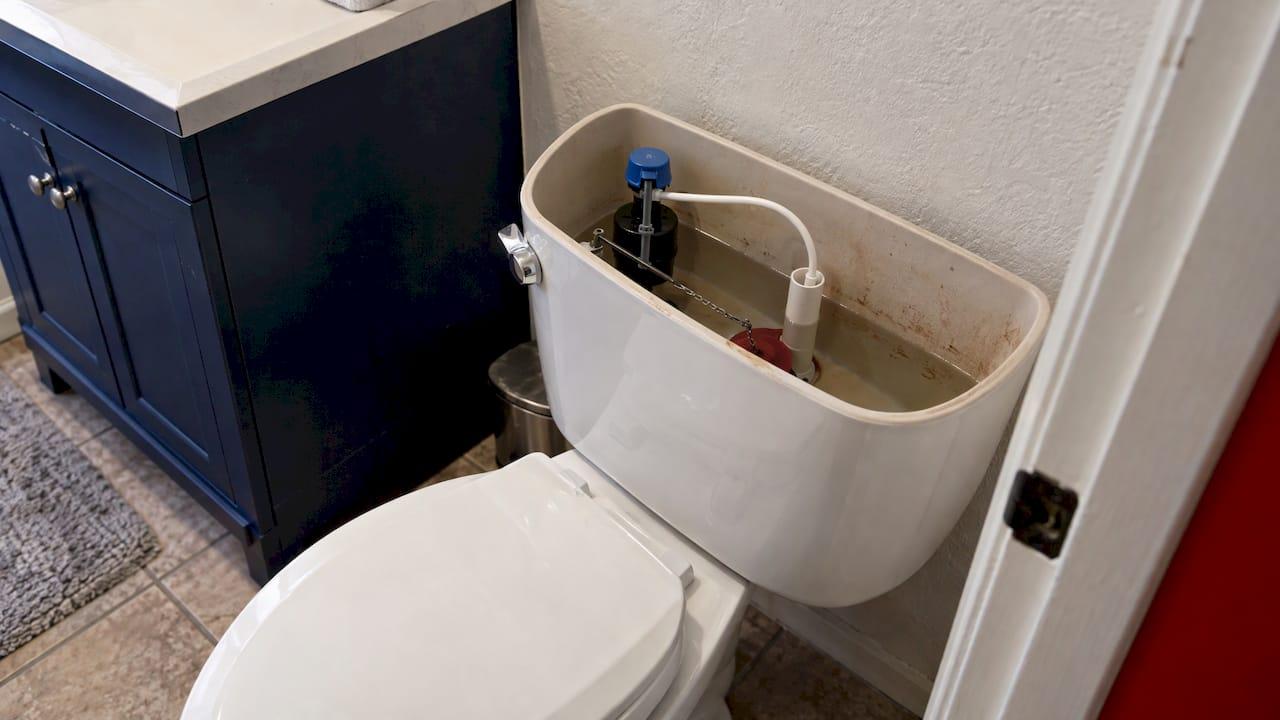
Remove the tank lid and look. These are the parts that cause most weak flushes, and they are quick to read.
Water level
If the tank is not filling high enough, the flush has less water behind it. American Standard's guidance is that the tank water should sit no lower than 1/2 inch below the top of the overflow tube, the open vertical pipe in the tank, and that the refill tube should be connected and seated in the overflow tube without kinks or damage. Portland's water bureau gives a similar range of about 1/2 to 1 inch below the top of the overflow tube, and explains that the float is adjusted by a screw or a bent arm on float-ball toilets, or by a spring clip on vertical-float designs.
If the water sits well below that mark, the fill valve is the likely culprit. A fill valve that is worn, stuck or clogged with mineral deposits cannot bring the tank to its proper level.

Chain slack
The chain connects the handle lever to the flapper, the rubber seal at the bottom of the tank. Too much slack and the lever pulls the chain tight without lifting the flapper far enough, so water leaves the tank slowly. Korky says a loose chain keeps the flapper from lifting off the flush valve opening, which produces a weak flush, while a chain that is too tight keeps the flapper from sealing and makes the toilet run. It recommends one or two links of slack. American Standard's figure is about 1/4 inch.
If you find yourself holding the handle down to finish a flush, the chain or flapper is the first place to look.
Flapper condition
A flapper is rubber, and rubber ages. A warped or worn flapper may not open fully or may leak into the bowl and lower the tank level between flushes. The Saving Water Partnership suggests replacing the flapper about every five years and notes that a flapper that does not fall back into place after a flush needs its chain adjusted or the handle nut tightened.
If the flapper is soft, sticky or visibly warped, replace it. Flappers come in different sizes to match the tank drain opening, so a mismatch can cause the same weak-flush symptom you are trying to cure. Replacing the flapper and chain is part of the toilet repair work we do every day.
Ghost flushing and running
A tank that refills on its own or runs after the flush is draining the water that should be there when you press the handle. If you hear that, read our guide on stopping ghost flushing and how long a toilet should run: how long a toilet should run after flushing.
Check the bowl: scaled rim holes and jet
If the tank looks right and the flush is still weak, the next suspect is the bowl. Water enters through small holes under the rim and through the jet hole at the bottom. When those holes narrow, the water trickles in instead of surging.
Fluidmaster explains that calcium, lime and debris such as rust commonly build up in the rim feed and jet holes over time, restricting flow and causing a weak or incomplete flush. Korky describes the visible result: water drops straight down the bowl instead of swirling around it.
Why this matters in Bullhead City
Our water is hard. The City of Bullhead City explains that the region's hard water comes from calcium and magnesium carried into Lake Mead by the mineral-rich Colorado River, and that it leaves chalky build-up on fixtures. The same page notes that white particles in your water can be scale that formed on pipes or fixtures and came loose. That is exactly the material that narrows rim holes and jets. A toilet in Fort Mohave, Mohave Valley, Laughlin or Bullhead City can develop a weak flush from scale alone, even with the tank working perfectly.
What to look for
Shine a flashlight under the rim, using a small mirror if needed. Rim holes should be open and evenly spaced. Crusty white or tan deposits, or holes that look partly closed, mean scale. American Standard also notes that a normal bowl water spot is about 8 to 9 inches of surface water from side to side, so a bowl sitting much lower than that can also weaken a flush.

Cleaning carefully
The manufacturers agree on a few cautions:
- Porcelain chips easily. Korky recommends in-bowl cleaner and a brush as the easiest method and warns to be careful.
- American Standard advises clearing the rim holes and jet hole with a mirror and a coat hanger or a 6 or 8 penny nail, and warns not to put your finger in the jet hole.
- Gerber's support guidance covers hard scale: it suggests a gallon of pure vinegar in the tank for up to 24 hours, and it warns against abrasive cleaners, pumice and steel wool. It also says chlorine or bleach in-tank cleaners can damage tank components and void a warranty.
If the deposits are heavy, if you are not comfortable working under the rim, or if the bowl is cracked or chipped already, have a plumber do it. A slip with a metal hook on old glaze can ruin a toilet that only needed cleaning, and our team can clear the jets or replace the toilet if it has reached the end of its life.
Tell a clog from a weak flush
A bucket test separates a drain problem from a flush-strength problem. With the bowl at its normal level, slowly pour two to three gallons of water into the bowl. If it drains as you pour, the drain is open and the trouble is in how the toilet delivers water. If the level climbs, something is blocking the line.
Here is how the symptoms compare:
| What you see | Likely cause | Where to look |
|---|---|---|
| Weak flush, bowl refills to normal level, no gurgling | Low tank water, loose chain, worn flapper | Tank |
| Water swirls poorly or drops straight down | Scaled rim and jet holes | Bowl |
| Water rises quickly, then falls slowly | Partial clog in the toilet trap or drain | Drain |
| Frequent clogs, must hold the handle down | Drain or vent restriction | Drain and vent |
| Gurgling or sounds from other drains when you flush | Blocked drain line or vent | Main line |
| Bubbles at the trapway opening | Venting or drainage problem | Vent and drain |
The last four rows follow the signs Kohler lists for a clogged waste stack or vent pipe: water rising in the bowl, a slow flush, frequent clogs, sounds from other drains and bubbles. Kohler also notes that older toilets used more water to move waste, while newer toilets depend on adequate venting. A modern toilet in a house with a restricted vent can flush poorly even when every part of the toilet is fine.
When the toilet is not clogged but still flushes slowly
This is the frustrating case: the plunger does nothing because there is nothing for it to clear, and yet the flush is lazy. Work through this order:
- Tank level and chain. Confirm the water reaches the right mark and the chain has only a link or two of slack.
- Flapper. Make sure it lifts fully and seats cleanly. Replace it if it is old.
- Rim and jet holes. Look for scale, especially in a hard-water area like ours.
- Other fixtures. Run the sink and shower. If they also drain slowly, the issue is the line, not the toilet. Our guide to why bathroom drains slow explains the common causes.
- Which toilet. If only an upstairs toilet is weak, or only the toilet farthest from the main line, venting and slope of the drain are more likely than the toilet itself.
If you replaced the flapper and chain and the flush is still weak, stop swapping parts. The cause is in the bowl or below it.
Signs you should stop and call a plumber
Some weak flushes are a nuisance. Others are a warning. Call a plumber when you see any of these:
- The toilet keeps clogging, even after plunging.
- Water rises toward the rim when you flush.
- You hear gurgling from the shower, tub or sink when the toilet flushes. Our article on a toilet that gurgles when other drains run explains why that points to the line.
- More than one drain is slow. See the signs your drains need professional cleaning.
- The toilet has overflowed or nearly overflowed. Read why toilets overflow.
- Water appears around the base. That is a separate repair, covered in toilet leaking at the base.
- A septic property starts showing slow drains throughout the house. A weak flush can be an early sign the system needs attention.
For a landlord or commercial property manager, a toilet that is slow in one restroom and gets worse across a busy day is a sign to schedule service before tenants or customers notice. A restroom out of order costs more than a visit.
Is it time for a new toilet?
Sometimes the answer is replacement. A toilet with a cracked bowl, a rim that is scaled beyond cleaning, or a design that never flushed well can be swapped for a better one. If you are comparing models, our guide to the best low-flow toilet options is a good place to start. We handle toilet repair and replacement, so you can have the old unit removed and the new one set and tested on the same visit.
Book a plumber for a weak or slow flush
We are USA Plumbing and Septic LLC, a 24/7 plumbing and septic company serving residential and commercial customers in Bullhead City, Fort Mohave, Mohave Valley and Laughlin. Our licensed plumbers repair and replace toilets, clean drains, detect and repair water and gas line leaks, and repair or replace sewer lines. That covers every layer of a weak flush: the toilet itself, the drain it empties into and the line beyond.
If the toilet is overflowing or the whole house is backing up, we offer emergency plumbing service. Tell us what the toilet is doing when you call, and we will get a plumber to you.
Ready for a fix that lasts? Call or book USA Plumbing and Septic and have a plumber find the cause of the weak flush.
Our perspective
Most weak flushes we see are small problems that turn into bigger ones because people keep adjusting parts that were never the cause. The tank gets a new flapper, then a new fill valve, and the toilet still flushes badly because the real issue is scale in the jets or a slow line downstream.
Our approach is simple. We look at the whole path the water takes: tank, bowl, trap, drain and sewer line. In Bullhead City, hard water is part of that picture, so we pay attention to mineral build-up on fixtures. If the toilet needs a repair or a replacement, we do it. If the drain needs cleaning or the sewer line needs repair, we do that too, so you are not calling one company for the toilet and another for the pipe.
A toilet is the fixture you cannot live without for a day. That is why we are available 24/7 for homeowners, landlords and commercial property managers across our service area.
JOHN
FAQ
Why is my toilet flushing slowly but not clogged?
The usual causes are a low tank water level, a loose chain, a worn flapper or scaled rim and jet holes. In Bullhead City, mineral build-up from hard water makes the rim and jet holes a frequent cause. If those check out, the drain or vent may be partly restricted.
How do I make a toilet flush stronger?
Confirm the tank fills to about 1/2 inch below the top of the overflow tube, keep only a link or two of chain slack, and replace an old flapper. Then check the rim holes for scale. If the flush stays weak, a plumber can find whether the drain or vent is the cause.
Why does my toilet keep clogging?
Frequent clogs usually mean the toilet is not moving water strongly enough, or the drain behind it is partly blocked. A toilet that clogs and also gurgles or backs up other fixtures needs drain cleaning or a line inspection, not another plunging.
Can I use bleach tablets in the tank to clean the toilet?
Manufacturers advise against it. Gerber warns that in-tank chlorine or bleach cleaners can damage tank components. If scale is the problem, have a plumber clean the jets or inspect the toilet.
Do I need a plumber for a weak flush in a rental or commercial restroom?
A plumber is the right call when the weak flush repeats, affects more than one fixture, or could lead to an overflow. We serve landlords and commercial property managers with 24/7 emergency service as well as scheduled repairs.
Sources
- Customer Service | Bullhead City
- How do I fix a toilet with a poor flush? | American Standard
- How to find and fix a toilet leak | Portland.gov
- How to Fix a Slow Flushing Toilet | Korky
- Toilet Leaks | Saving Water Partnership
- Toilet Not Flushing All the Way? | Fluidmaster
- How do I clean the toilet siphon jets? | Gerber
- Poor Flush | Kohler Assist