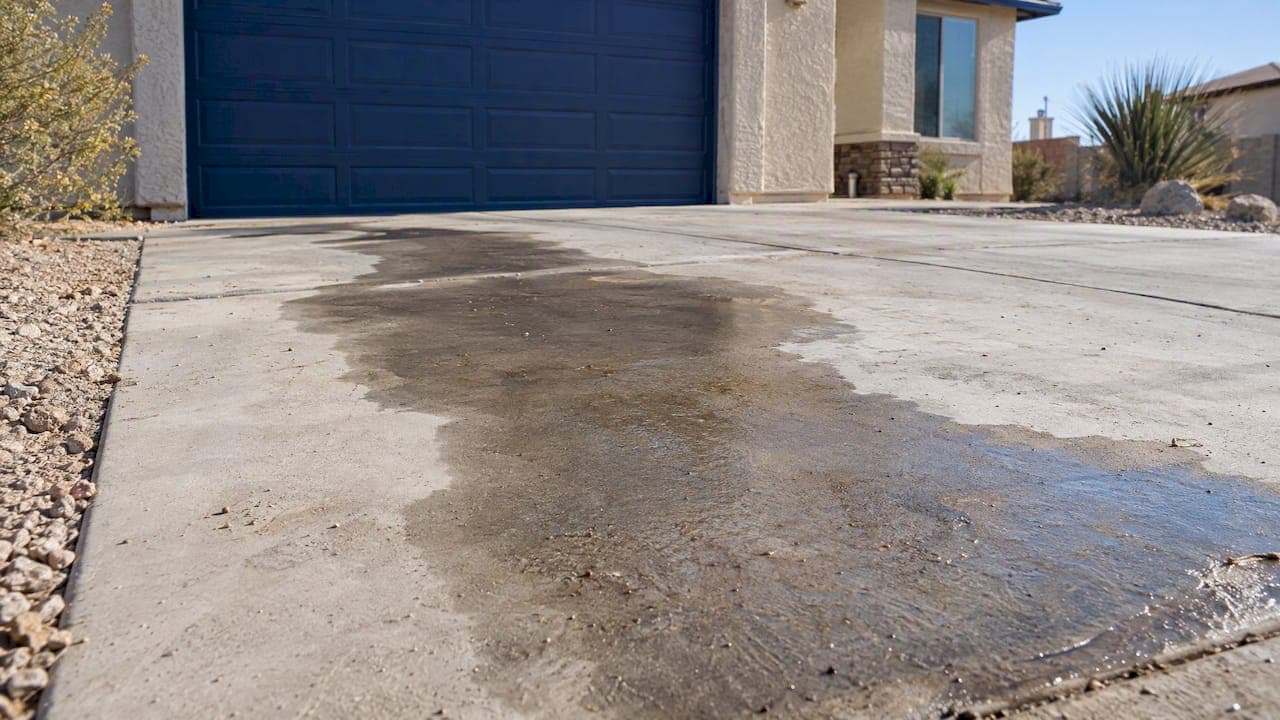
If water is seeping through a driveway crack, a patch of pavement stays wet, or your water bill jumps for no reason, you may have a leak under the concrete. Start with a meter test to confirm it. Then shut off the water if the leak is active and call a licensed plumber. Don't dig or break concrete yourself. We are USA Plumbing and Septic LLC, and we handle driveway-area leaks for homeowners and property managers in Bullhead City, Fort Mohave, Mohave Valley and Laughlin.
TL;DR
- Wet pavement, a soft spot, a new crack with water in it, or an unexplained high water bill are the usual signs of a leak under a driveway.
- Not every wet driveway is a pipe leak. Irrigation lines, roof runoff, poor grading and groundwater can look the same.
- A meter test tells you whether water is leaking at all. Turn off everything that uses water and watch the meter.
- Homeowners are generally responsible for the water line from the meter to the house. Confirm where your utility's side ends before you call anyone.
- Pipe repair under concrete is specialist work. Call a licensed plumber before anything gets cut or dug.
Table of Contents
- Signs of a Water Leak Under a Driveway
- What Else Can Make a Driveway Wet?
- Step One: Confirm a Leak With the Meter Test
- Who Is Responsible for the Repair?
- What to Do Right Away
- How a Plumber Finds a Leak Under Concrete
- Repair Options and What They Cost
- Our Perspective: Why We Start With the Meter
- Prevent Leaks Under Your Driveway in the Future
- Need a Leak Located? Call Us
- FAQ
- Sources
Signs of a Water Leak Under a Driveway
A driveway hides what is going on below it. The water has to travel before it shows itself, so the damp spot you see is often not where the pipe has failed. Watch for these signs:
- Water rising through a crack or joint. This is especially telling if it happens on dry days with no rain.
- A damp or darker strip of pavement that doesn't dry out in the sun.
- Sinking or heaving concrete. Leaking water washes out the soil under the slab. That leaves voids, and the slab can settle or crack.
- Pooling at the edge of the driveway or in the yard beside it.
- A high water bill with no change in how your household uses water.
- A water meter that keeps moving when every fixture is off.
- Low water pressure at faucets throughout the house. If it is only one faucet, the problem is probably local. Our one-faucet pressure checklist covers that case.
In the Mohave Valley desert, ground that stays wet is out of place. Persistent wet areas that do not follow rainfall may point to a natural spring, high groundwater or a leaking pipe, according to Fairfax County's soil and water conservation guidance. That is a good rule anywhere: if it stays wet when it hasn't rained, find out why.
What Else Can Make a Driveway Wet?
Before you assume a broken pipe, rule out the other usual causes. Each one has a different fix and a different cost.
Grading and runoff
Water beside a driveway can come from grading that sends runoff toward it. Roof runoff and a failed base under the paving can also make water collect, as one paving guide explains. If the wet spot shows up only after rain or after the gutters overflow, drainage is the likelier culprit than a supply pipe.
Irrigation lines
A broken sprinkler head, cracked riser or loose fitting near the driveway can push water under or along the concrete. If your landscaping has drip or spray zones that cross under the driveway, they are a prime suspect. The utility test below separates an irrigation leak from a house line leak.
Groundwater or a spring
Water that appears regardless of weather and has no link to any pipe may be groundwater. A plumber can rule out your pipes. A drainage or grading contractor then deals with the water itself.
A pressurized water line
This is the one that costs money every hour it runs. The service line carries water from the meter to your home, and in many Bullhead City neighborhoods it runs under a driveway or walkway. Corrosion, shifting soil, a bad joint or tree roots can open it up. Our guide to underground water leak repair walks through how these failures develop.
Step One: Confirm a Leak With the Meter Test
The meter test costs nothing and takes under an hour. It answers the most important question first: is water leaking at all?
Bullhead City tells residents to turn off faucets and water-using appliances, then look at the meter's leak indicator. They also suggest checking whether the reading changes after one to two hours with no water use, per the City's water leaks page.
Here is the sequence:
- Turn off every faucet, the ice maker, the washing machine and the dishwasher. Make sure nobody flushes a toilet.
- Open the meter box and find the leak indicator. It is usually a small dial or triangle that spins when any water moves through.
- If the indicator is moving, water is flowing somewhere. Note the reading.
- Wait one to two hours with no water use, then check again.
- A changed reading means a leak.
Is it inside the house or outside?
The City describes an isolation method. After you confirm the meter is moving continuously, shut off your home's main valve. If the indicator stops, the leak is inside the home. If it keeps moving, shut off irrigation to learn whether the leak is in the sprinkler lines, according to the same City page. The East Bay Municipal Utility District gives matching advice: shut the houseline valve and irrigation valve, and run irrigation zones one at a time, in its leak guide.
If the meter still moves with your main valve closed, the leak is likely between the meter and the valve. That is the stretch that often runs under a driveway, as the Fairfax County guidance notes.

Not sure where your main shut-off is? Our five-step shut-off guide shows you how to find it and close it. We also have a step-by-step meter test written for Bullhead City, and a yard leak meter test for homeowners.
Who Is Responsible for the Repair?
This is the question that stops many owners from acting. The general U.S. rule is this: the water utility handles its side of the system, and homeowners are generally responsible for the water line from the street edge to the home, according to Fairfax County's guidance. Where that line is drawn depends on the local utility and its rules.
For Bullhead City, the practical steps are:
- Find your meter. In general, the leak is yours to fix if it is on the house side of the meter.
- If water is bubbling up near the meter or in the street, call the City utility, because that may be the utility's side.
- Bullhead City Utilities lists (928) 763-0166 for service questions and (928) 763-1999 for after-hours water emergencies, per its customer service page. The office is at 2355 Trane Road.
If you live outside city limits in Mohave Valley, Fort Mohave or Golden Valley, your water provider may be different. Check your bill for the provider's name and number.
Renters and tenants should call the landlord or property manager first. Landlords and commercial property managers can call us directly, and we will diagnose the leak and give you what you need for the repair decision.
What to Do Right Away
If you think the leak is real, act in this order:
- Shut off the main valve to your house, if the water is actively running. This stops flow into the line you are testing and limits damage.
- Do not dig or break the concrete. A shovel or jackhammer can strike a gas line, an electric conduit or a second water line.
- Call 811 before any digging at all. Calling 811 is free and legally required in most states, as a driveway-paving guide notes. Utilities usually mark their public portion, typically up to the meter or property line, but not the private side. A private line from the meter to the house is yours to locate, which is another reason to bring in a plumber.
- Photograph the wet area, the meter reading and the date. Records help with bill disputes and insurance questions.
- Call a licensed plumber and say it is a suspected line leak under a driveway.
OSHA's excavation safety standards require employers to determine the approximate location of underground installations before work starts, per its trenching and excavation safety booklet. Professionals do this as routine. A homeowner with a shovel usually doesn't.
Water near gas equipment, or a smell of gas near the driveway, is a different emergency. Leave the area and call your gas utility or 911. Our guide on who repairs gas leaks explains what happens next.
How a Plumber Finds a Leak Under Concrete
Guessing wastes concrete. Professional detection pinpoints the leak so the repair is as small as possible.
A typical confirmation starts the way your test did: stop all water use, close the interior main valve, and compare meter readings after about an hour. A rising reading means leakage. Detection under concrete may then use acoustic or thermal equipment, as HomeGo's repair guide describes.
In practice:
- Acoustic listening picks up the sound of water escaping a pressurized pipe.
- Thermal imaging can show temperature differences where a hot or cold line is leaking.
- Pressure testing isolates sections of line to narrow down where the failure is.
We lay out the process in how leak detection works. The goal is a precise mark on the concrete, so the work opens a small area instead of the whole driveway.
Repair Options and What They Cost
Once the leak is located, the options generally are:
- Spot excavation and repair. Cut the concrete over the break, dig down, replace the damaged section and restore the surface.
- Full line replacement. If the pipe is old or failing in several places, replacing it is usually the better long-term choice.
- Rerouting. A new line is run around the driveway so the slab stays intact.
- Relining. A new lining is installed inside the old pipe, which may avoid some digging.
The right choice depends on the pipe's age, material and how many failures it has. We will explain the options before any work begins.
What drives the price
Cost varies a lot from job to job. The main factors are leak size, pipe material and diameter, burial depth, soil stability, access under the driveway, labor, permits, and restoring the concrete or asphalt. For a ballpark, HomeGo says underground water line leak repairs average about $3,000 and corroded water main repairs about $5,000, per its repair guide. Treat those as national averages from one source, not a quote. A short run that is easy to reach costs far less than a long run under a wide slab.
We don't publish a flat price, because every driveway leak is different. We give you a written estimate after we have located the leak, so you know the scope before any concrete is cut.
A slow leak is not cheaper to ignore. Water keeps washing soil from under the slab, which can lead to cracks, settling and a bigger repair.
Our Perspective: Why We Start With the Meter
We get many calls where an owner is sure the driveway pipe is broken. About as often, it turns out to be a sprinkler lateral, a leaking hose bib, or runoff. So we start the same way every time. We confirm the leak with the meter, rule out the inside of the house, and then locate the pipe before anyone picks up a saw.
Our view is simple. The cheapest concrete cut is the one you don't make. A good detection visit costs far less than a wrong guess. We would rather tell you the leak is a $100 irrigation fitting than open your driveway for nothing.
We also see how much waiting costs here. Desert soil can shift, old lines corrode, and a line that weeps for months will wash out the base under the slab. If your meter is moving, don't wait for the driveway to crack.
For commercial properties, a leak under a parking lot or loading drive costs more in downtime. Call early, and we plan the repair around your hours.
— JOHN
Prevent Leaks Under Your Driveway in the Future
You can't inspect a buried pipe, but you can lower the risk:
- Check your meter every few months. Our 15 to 20 minute meter test catches slow leaks early.
- Read your water bill. A jump with no change in use is an early warning.
- Keep trees and large shrubs away from lines. Roots seek water and can break into pipes. Our article on tree roots in sewer lines covers the sewer side of that problem.
- Know where your shut-off valve is, and make sure it turns.
- Fix drainage the right way. Don't send runoff onto a neighbor's property while solving your own problem.
- Replace old galvanized or failing lines before they fail under the slab, particularly when the driveway is being redone.
If the leak has already reached the house foundation, read about slab leak warning signs.
Need a Leak Located? Call Us
USA Plumbing and Septic LLC offers 24/7 emergency plumbing, water line leak detection and repair or replacement, sewer line repair, and gas line leak detection and repair for residential and commercial customers in Bullhead City, Fort Mohave, Mohave Valley and Laughlin. Our plumbers are licensed and will tell you straight what is wrong and what it takes to fix it.

See all our services and book at usaplumbingseptic.com. Call Now for emergency service, or Book Now for a leak detection visit. We also serve nearby areas like Kingman and Golden Valley, and our Mohave County plumbing guide covers local basics.
FAQ
Can a water leak under a driveway damage the concrete?
Yes. Leaking water can wash soil from under the slab and leave voids. The slab can then crack, settle or heave. Catching the leak early keeps the repair smaller.
How do I know if the leak is from a pipe or from my sprinklers?
Test in steps. With all fixtures off and the meter still moving, close your main valve. If the meter stops, the leak is inside the house. If it keeps moving, shut off irrigation and run zones one at a time, as Bullhead City and EBMUD both suggest.
Who pays for an underground water leak?
In general, the utility covers its side and the owner covers the line from the meter or street edge to the home. Confirm exactly where that line sits for your property with your water provider. In Bullhead City, call the City utility at (928) 763-0166.
How much does it cost to fix a broken water pipe under concrete?
It depends on depth, access, pipe type and surface restoration. One national source puts the average underground water line repair at about $3,000, per HomeGo. A plumber should give you a written estimate once the leak is located.
Can I locate the leak myself?
You can confirm that a leak exists with the meter test. Pinpointing it under concrete needs acoustic or thermal equipment. Call 811 before any digging, and leave the digging to a professional.
Sources
- Water Leaks | Bullhead City
- Customer Service | Bullhead City
- DIY Guide for Leaks and High Bills | EBMUD
- Wet Yard for Months: Solving Drainage Problems | Fairfax County
- Trenching and Excavation Safety | OSHA
- Why Water Pools Next to Your Driveway
- Driveway Water Main Location
- Water Leak Under Driveway: A Comprehensive Fix-it Guide | HomeGo