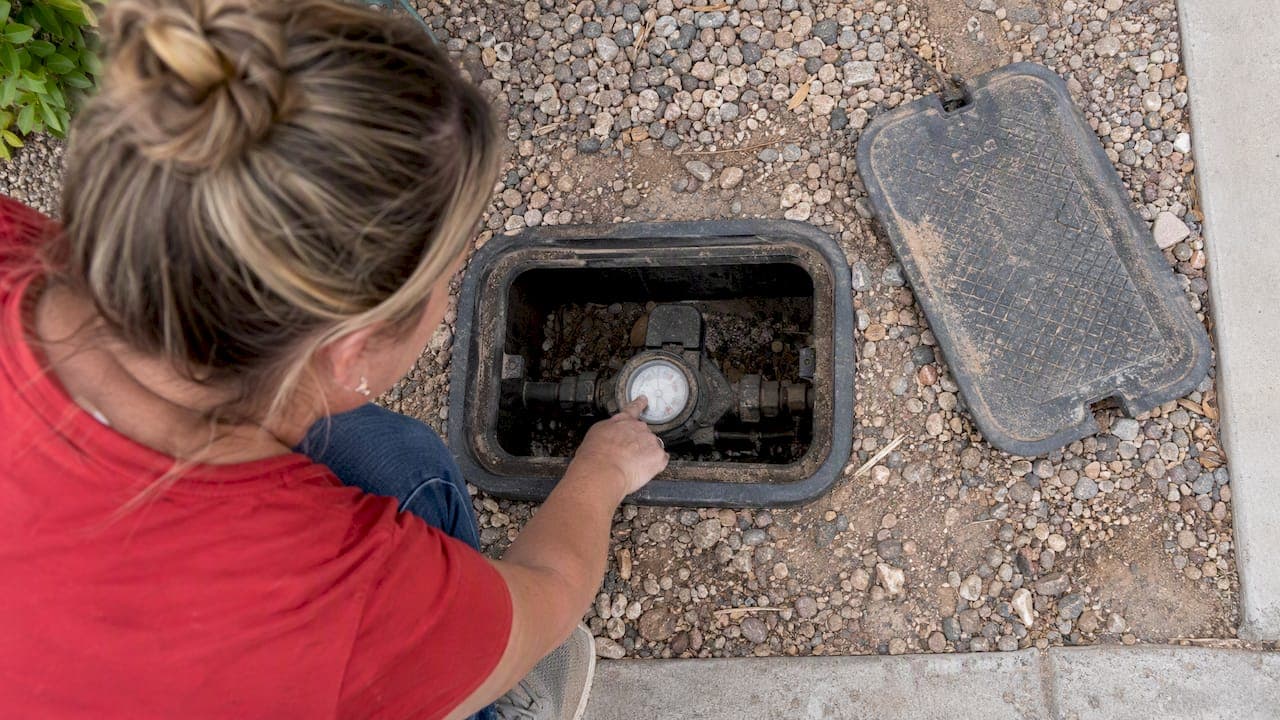
If your water meter is spinning while every tap, appliance and sprinkler is off, water is moving through your pipes and you very likely have a leak on your side of the meter. The meter is not broken. It is counting real water. The fix is to confirm the leak with a short test, shut off the water at your own valve if it is bad, and have a licensed plumber find and repair the source.
We are USA Plumbing and Septic LLC, and we answer these calls in Bullhead City, Fort Mohave, Mohave Valley and Laughlin every week. This guide walks you through the test, what the results mean, who pays, and what to do next.
TL;DR
- A meter that moves when all water use is off means water is flowing somewhere. A moving flow indicator or sweep hand confirms a leak on the customer side.
- Do the test in order: stop all water use, read the meter, wait 15 to 20 minutes, read it again. Any change means a leak.
- Lift the meter box lid with a tool, never your hand. Desert meter boxes can hold scorpions, spiders and snakes.
- Never touch the utility's valve on the street side of the meter. Use your own shut-off valve, or have a plumber install one.
- Leaked water that passes the meter is billed. Keep your plumber's invoice, because it is usually your proof of repair if you ask for a bill adjustment.
Table of Contents
- What a spinning meter is telling you
- How to run the water meter leak test
- What the results mean
- Check the easy suspects first
- Signs of a water main or service line leak
- Who is responsible for the leak
- What to do right now if the meter is spinning fast
- How plumbers find a hidden leak
- Our view: why we say act on the first spin
- Need a leak found and fixed in Bullhead City?
- FAQ
- Sources
What a spinning meter is telling you
A residential water meter counts every gallon that passes through it. When nothing in the home is using water, the numbers should sit still. If the dial, the small triangle, star or gear, or the sweep hand keeps moving, water is leaving your plumbing somewhere.
People often hope the meter is running fast. It almost never is. The meter registers actual flow, so the real job is not questioning the meter. The real job is finding where the water goes. The source can be a toilet flapper that leaks silently, or it can be a broken pipe underground.
That is why a spinning meter deserves attention the same day you notice it. Leaks do not stay small. In sandy or porous ground, water can travel and disappear without ever showing at the surface, and a minor underground leak can worsen and damage foundations or paving long before you see a wet patch.

How to run the water meter leak test
You need a pen, your phone camera, and about 20 minutes. Plan the test for a time when nobody is showering or running laundry.
Before you start
- Turn off every faucet, shower and hose bib.
- Stop the dishwasher and washing machine.
- Switch off the ice maker if you can, and make sure no toilet is mid-fill.
- Turn off irrigation timers and pause any pool auto-fill. In Mohave County, pool top-offs and drip lines are common hidden users.
- Check that a softener or filtration system is not in the middle of a regeneration cycle.
Open the meter box safely
Most meters sit in a ground-level box near the curb or property line. In our desert climate, these boxes are shelter for wildlife. Lift the lid with a tool from a safe distance and never reach into the box with your hand. Look inside before you lean in. If you see a snake or a nest of spiders, back away and call the utility or us.
Read the meter twice
- Find the flow indicator, the small triangle, star or gear that spins at low flow. Note whether it moves at all.
- Photograph the full reading, the odometer-style numbers.
- Wait 15 to 20 minutes with all water still off.
- Photograph the meter again.
If the indicator moved or the numbers went up, you have a leak. If you want a deeper walkthrough, our 15 to 20 minute meter test guide covers it step by step for owners and managers.
Digital and smart meters
Many Bullhead City customers are on newer metering. The city took over its water utility and moved toward advanced metering and digital portals that can show near real-time usage and send alerts for continuous flow, according to city council materials. If you have portal access, look at the hourly usage chart. Water use that never drops to zero overnight is a strong sign of a leak. For account questions or to report a leak, Bullhead City Utilities lists a leak line at (928) 763-0166 and an after-hours dispatch number on its utilities page.
What the results mean
| What you see | What it likely means | Next step |
|---|---|---|
| Indicator still, numbers unchanged after 15 to 20 minutes | No steady leak right now | If your bill is still high, look at intermittent use or schedule a leak inspection |
| Indicator spins slowly | Small leak: running toilet, dripping faucet, irrigation valve | Do the toilet dye test below, then call us if it is not the toilet |
| Indicator spins fast | Large leak: broken line, failed water heater connection, underground rupture | Shut off your private valve and call for emergency service |
| Meter moves only now and then | Intermittent leak, such as a toilet fill valve or a pressure-related release | Repeat the test at different times, consider flow monitoring |
The EPA is candid that no single leak test works for every property. A meter check is a good first screen, but very slow or intermittent leaks can slip through it. The same guide points to flow-monitoring products certified to the ANSI/CAN/IAPMO Z1349 standard as a more precise option.
Check the easy suspects first
Before you call anyone, spend ten minutes on the usual culprits.
- Toilets. Put a few drops of food coloring in each tank. Wait 15 minutes without flushing. Color in the bowl means a worn flapper. This is the most common silent leak and often a quick repair.
- Faucets and showerheads. Look for drips, including outdoor hose bibs.
- Water heater. Check the base of the tank and the connections for moisture or mineral crust.
- Irrigation and pool lines. Valves that stick open leak constantly.
- Water softener. A stuck valve can send water to the drain nonstop.
If you shut off a suspect (say you close a toilet's supply valve) and the meter stops, you have found it. If the meter keeps moving after all the easy checks, the leak is probably in a wall, under the slab or in the service line between the meter and the house.
Signs of a water main or service line leak
People search for "water main leak signs" when the meter spins and nothing inside the house is wet. In most homes, the line from the meter to the building is what fails. Watch for:
- Wet, soft or unusually green patches in the yard or driveway with no irrigation nearby.
- Sinking or cracked pavement, or soil that has washed out.
- Low water pressure throughout the house.
- Sound of running water when everything is off.
- Warm spots on a floor, which can point to a leaking hot line under a slab. Our guide to common slab leak warning signs lists what to look for indoors.
- A bill that jumps with no change in how you live.
In sandy desert soil, water may sink straight down and leave no pool at all. A yard leak is best confirmed with the meter test first, and then located with equipment. Our overview of underground water leak repair explains the repair options.
Who is responsible for the leak
Responsibility is usually split at the meter. Utilities generally maintain the main up to and including the meter. The property owner is responsible for the pipes, fixtures and service line from the meter to the building and everything inside. That example comes from another Arizona water district, so confirm the exact boundary for your address with Bullhead City Utilities or your water provider.
If the leak is on your side, the repair is yours to pay for. That is true for homeowners and, depending on the lease, for landlords. Renters should read their lease and tell the property manager right away. If you manage rentals, this explainer on apartment utility billing for U.S. renters helps tenants understand who is billed for water.

Will the utility forgive the bill?
Not automatically. Water that goes through the meter is recorded as usage, even if it never reaches the house. Some utilities offer a one-time adjustment, and they typically ask for proof of repair such as a plumber's invoice. Ask your provider what it offers, and keep every receipt and date.
What to do right now if the meter is spinning fast
- Find your private shut-off valve. It sits between the meter and the building, often near the house wall or in a garage. Our guide to finding and closing your main water shut-off takes five steps.
- Leave the utility valve alone. The valve on the street side of the meter belongs to the utility. Tampering can lead to fines or damage to equipment you do not own.
- No private valve? A missing shut-off is a real risk in an emergency. A licensed plumber can install one so you are never stuck.
- Retest. With the valve closed, the meter should stop. If it still moves, the leak is on the utility's side of your valve, and you should call the utility.
- Call a plumber. If it stopped, the leak is on your side. Do not wait on a large leak.
How plumbers find a hidden leak
Guessing means digging, and digging costs money. A professional approach goes in steps:
- Isolation. The plumber shuts off sections of the system to see which branch drives the meter.
- Pressure testing. Water or gas lines are pressurized and watched for drops.
- Acoustic detection. Specialized acoustic equipment pinpoints hidden breaks so repair means one small opening, not a trench the length of your yard.
- Confirmation. The spot is verified before anyone cuts concrete or digs.
We explain this in more detail in how leak detection works. If your home has copper pipes that keep failing, read repair or repipe after pinhole leaks. If you smell gas instead, that is a different emergency, and this guide on who fixes gas leaks applies. Leave the building and call your gas utility or 911.
Our view: why we say act on the first spin
We see the same story often. A homeowner notices the meter moving, tells themselves they will look at it on the weekend, and three weeks later the bill is the problem. Or worse, a section of driveway has sunk.
Our advice is simple.
- Test the day you notice. The test takes 20 minutes. Waiting costs far more.
- Know your shut-off. Every property should have a working private valve you have actually turned. If it is stuck or missing, fix that before an emergency, not during one.
- Fix the cause, not the symptom. A patched pipe in a line that is failing everywhere will leak again. We tell you honestly when a repair is enough and when replacement of a line makes more sense.
- Treat commercial properties the same way. For landlords, hotels and property managers, a spinning meter in an empty building is a leak running for days. Our hotel plumbing guide shows what managers should check on a schedule.
We work on water lines, sewer lines, gas lines, water heaters, fixtures, toilets, drains, well equipment, softeners and septic systems, for homes and businesses, around the clock.
— JOHN
Need a leak found and fixed in Bullhead City?
If your meter is spinning and the easy checks did not solve it, call USA Plumbing and Septic LLC. We offer 24/7 emergency plumbing, water line leak detection, repair and replacement, and water heater and fixture work for residential and commercial customers in Bullhead City, Fort Mohave, Mohave Valley and Laughlin. Tell us what the meter test showed, and we will send a licensed plumber. Call now or book online.
We also serve nearby communities, including Kingman and Golden Valley. For local background, see our page on plumbing essentials in Mohave County.
FAQ
Why does my water meter keep spinning when nothing is on?
Water is flowing through it, which almost always means a leak on your side of the meter. Common causes are a running toilet, a dripping fixture, an irrigation or pool line, a water heater connection, or a broken buried pipe. Run the 15 to 20 minute test and the toilet dye test to narrow it down.
Can a water meter be wrong and spin without a leak?
It is unlikely. A meter that moves with no water in use is registering real flow. Occasionally a softener, an ice maker or a toilet that refills in short bursts explains the movement, so check those before assuming a buried leak.
Who pays for a leaking water meter or the water lost?
The utility generally maintains the meter itself, while the owner pays for leaks in the lines and fixtures beyond it. The water you lose is billed because it passed the meter. Ask your provider whether it has a one-time adjustment, and keep your plumber's invoice as proof of repair.
How do I check a digital water meter for a leak?
Turn off all water use and look at the display or flow icon. A flow indicator that stays on, or a leak alert in your utility portal, points to continuous flow. You can also compare two readings 15 to 20 minutes apart. Increasing numbers mean water is moving.
Is it safe to shut off the water at the meter?
Only use your own private shut-off valve. The utility's valve on the street side is not yours to operate. If you do not have a private valve, a licensed plumber can install one.
Sources
- Water 101: Water Meters and Leaks (MyWater.us)
- Frequently Asked Questions, Misty Mountain Domestic Water Improvement District
- City of Bullhead City council materials on metering
- Bullhead City Utilities
- EPA: Know Your Flow and Curb Water Waste, Leak Detection Guide
- Portland Water Bureau: Find a Leak
- High Utility Bill Investigation Checklist, Fort Wayne City Utilities
- Apartment Utility Billing Explained for U.S. Renters