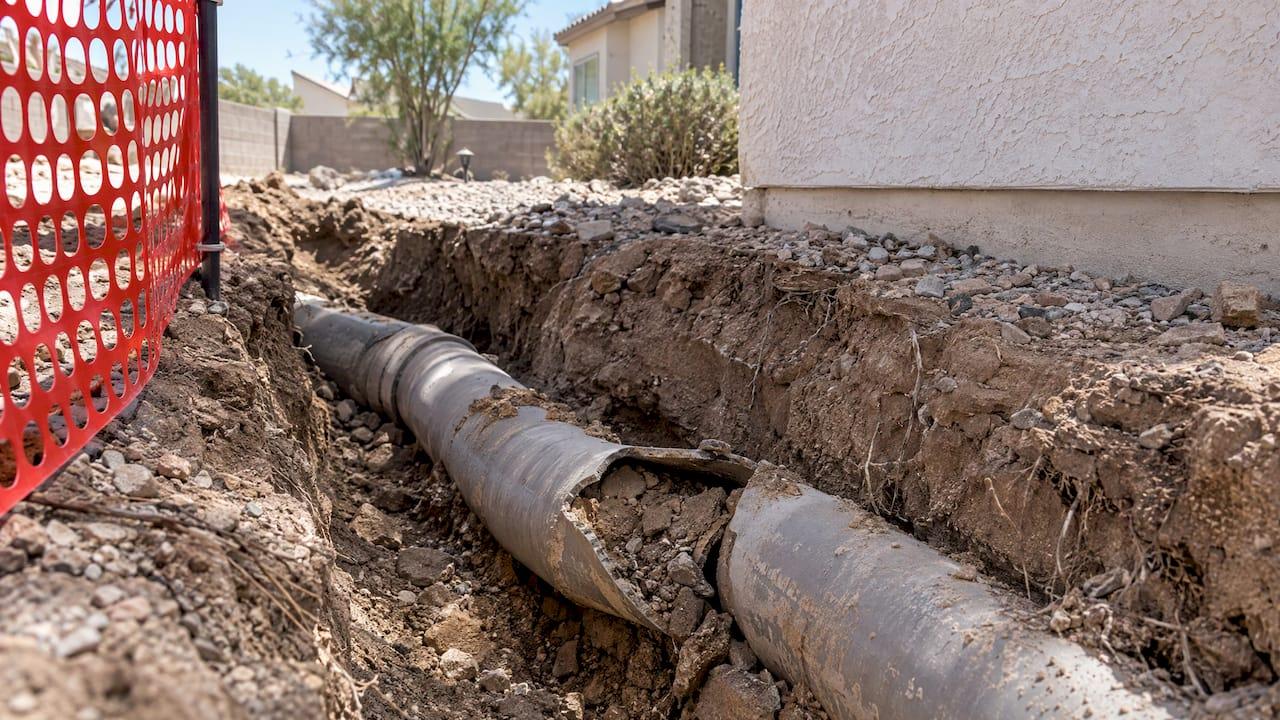
The clearest symptoms of a collapsed sewer line are wastewater backing up in more than one drain, gurgling toilets, sewage odors indoors or out, and wet, sunken or unusually green ground over the line. One slow sink is usually a clog. Several fixtures acting up together usually mean the main line is blocked or broken. If you see these signs in Bullhead City, Fort Mohave, Mohave Valley or Laughlin, stop using water and call a licensed plumber. Our team at USA Plumbing and Septic handles sewer line repair and replacement for homes and commercial properties, and we answer emergencies 24/7.
TL;DR
- Backups in more than one drain, gurgling, and sewage smells are the strongest signs of a main sewer line problem.
- Wet, sunken or oddly lush patches in the yard, new foundation cracks, and more pests can show a break underground.
- Stop running water, stay out of standing sewage, and call a licensed plumber right away.
- A camera inspection is how a plumber confirms whether the pipe is clogged, cracked or collapsed.
- Standard homeowners policies often exclude sewer line repair, so find out what you carry before you need it.
Table of Contents
- What a collapsed sewer line actually is
- The symptoms, from early warning to emergency
- Clog or collapse: how to tell the difference
- What causes a sewer line to collapse
- Why raw sewage is a health issue, not just a mess
- What to do the moment you see the signs
- Who is responsible: you, or the city?
- How a collapse is confirmed
- Repair or replace: the choices once it is confirmed
- If you have a septic system
- Does insurance pay for a collapsed sewer line?
- Why a local licensed plumber is the right call
- Need a plumber for a suspected collapse?
- FAQ
- Sources
What a collapsed sewer line actually is
Your sewer line (also called the lateral or building sewer) is the buried pipe that carries wastewater from your building out to the public sewer main or to your septic tank. A collapse means that pipe has cracked, crushed, shifted, separated at a joint or caved in, so waste can no longer flow through it freely.
DC Water's backup guide explains that a broken or collapsed private lateral cannot effectively carry waste and drainage to the public sewer, and that fixing it may mean digging up and replacing the broken section. That is why this is not a problem you can plunge away.
A break does not always happen overnight. Many lines fail slowly: a small crack lets soil in, soil builds up, flow slows, and the pipe finally gives way. The symptoms below usually show up in a rough order, from mild to severe.
The symptoms, from early warning to emergency
1. Slow drains in more than one fixture
A single slow sink points to a clog in that sink's trap or branch line. Slow drains in the shower, the toilet and the kitchen at the same time point to the shared line they all feed. This is often the first sign of a partial collapse or heavy blockage, and it is easy to dismiss.
2. Backups and standing water
Wastewater coming up through the lowest drain in the house, often a floor drain, a shower or a tub, is a classic sign. The lowest opening is where the water has nowhere else to go. If this is happening to you, our guide on what to do when sewage backs up in the bathtub covers the first steps.
3. Gurgling sounds
When you flush a toilet and hear gurgling from the shower drain, or run the washer and the toilet bubbles, air is being pushed through a line that is not draining properly. Gurgling that repeats, in different rooms, is worth a professional look.
4. Sewage smells indoors or in the yard
A steady sewer odor in the house, the garage or near one spot in the yard can mean the pipe is open or leaking underground. Sewer gas should stay in the pipe. When you smell it, something has broken the seal.
5. Toilets that bubble or will not flush right
If plunging helps for a minute and the problem returns, the obstruction may be farther down the line than your plunger can reach. Repeat clogs after professional snaking are a red flag for a damaged pipe, not just debris.
6. Wet, soggy or sunken ground
A leaking sewer line saturates the soil above it. Look for a patch that stays wet when the rest of the yard is dry, a puddle with a sewage smell, or a dip in the lawn or driveway where the soil has washed into the pipe. In the Mohave County desert, a spot that stays damp with no irrigation nearby deserves attention.
7. A lush green patch of grass or plants
Sewage is fertilizer. A strip of unusually thick, bright growth over the line, in a dry yard, can show where wastewater is escaping.
8. Foundation cracks or slab changes
Water leaving a broken line can wash away soil under a slab or footing. New cracks in walls or floors, doors that suddenly stick, or tile that has shifted can all be linked. Not every crack is a sewer problem, but a crack combined with other symptoms on this list is a reason to have the line checked.
9. More pests than usual
Rodents and insects follow moisture and waste. A sudden increase in roaches, flies or rats around the house or in the yard can point to a break that gives them a path and a food source.
Clog or collapse: how to tell the difference
| What you notice | More likely a local clog | More likely a main line problem |
|---|---|---|
| Which fixtures | One sink, tub or toilet | Several fixtures at once |
| Where water backs up | The same fixture you are using | The lowest drain in the house |
| After clearing it | Stays clear | Returns within days or weeks |
| Outside | Nothing unusual | Wet, sunken or very green ground over the line |
| Smell | Faint, at the drain | Persistent, indoors or in the yard |
Three or more entries in the right-hand column is a strong reason to stop treating this as a drain clog. Use of chemical drain openers on a suspected collapse is a bad idea: the liquid just sits in the pipe, and it can splash on whoever opens it next.
Tree roots are one of the most common causes of this pattern. They enter through small cracks and joints, grow, and eventually crush or clog the pipe. Our article on why tree roots need more than sewer line snaking explains why clearing the roots once often does not fix the crack that let them in.
What causes a sewer line to collapse
The U.S. EPA lists the usual culprits for sewer failures: roots growing in through defects, grease and some household products that cause blockages, leaky pipes, inadequate maintenance and equipment breaks. The same page notes that stormwater and groundwater entering through cracks, faults or leaky joints can overload a sewer.
In practical terms for our area, the common causes are:
- Age and material. Older clay, cast iron and Orangeburg (bonded fiber) pipes crack, corrode or deform with time.
- Roots. Any tree or large shrub near the line can send roots into a joint.
- Ground movement. Shifting soil, heavy vehicles driving over a shallow line, or nearby digging can crush or offset pipe.
- Grease and wipes. These build up, force repeated snaking, and put stress on already weak spots.
- Poor original installation. A line with a sag or "belly" holds water and solids, and the pipe wears faster there.
Why raw sewage is a health issue, not just a mess
This is the reason to act quickly. The EPA states that raw sewage may contain bacteria, viruses, protozoa, helminths, molds and fungi, and that illnesses can range from mild gastroenteritis to life-threatening conditions. The agency lists direct contact in basements and lawns among the exposure routes.
So keep children, pets and anyone with a weakened immune system out of the affected area. If someone has been exposed to sewage and becomes ill, call a doctor. Do not try to clean large amounts of sewage yourself without protective gear.
What to do the moment you see the signs
The City of Madison's engineering department advises homeowners with a backup to stop water use, stay out of standing water and contact their insurer if they have backup or service-line coverage. That is sound advice anywhere. Here is the routine we would follow at home:
- Stop using water. No flushing, no showers, no dishwasher, no laundry. Every gallon you send down has to go somewhere.
- Keep people and pets away from standing sewage and wet areas.
- Turn off the power to any area where sewage is near outlets or appliances, only if you can do it safely without standing in water. Otherwise, leave it and tell the responder.
- Take photos and notes of what you saw, where and when. They help with the plumber's diagnosis and with any insurance claim.
- Call a licensed plumber. Do not wait to see whether it clears on its own. Our emergency plumbing checklist lists what to have ready, and our page on examples of emergency plumbing situations shows which problems cannot wait for the morning.
- Call your insurer if you have water backup or service-line coverage, and ask what documentation they need.
If your building is on a public sewer, also find your cleanout, the capped pipe access, usually outside near the house. Our guide to finding the cleanout on a main sewer line clog explains what to look for and why the city may need to hear from you early.
Who is responsible: you, or the city?
In general, the public main under the street belongs to the utility, and the lateral from the building to that main is the property owner's. The line between the two varies by city. Portland's building bureau, for example, says suspected sewer damage can be inspected and responsibility determined using site inspection and plumbing records. The City of Madison recommends that a recurring lateral problem may call for a televised inspection, and that the city determine whether the main or the private lateral is at fault.
For you, that means two things. First, if several neighbors on your street have backups, the problem may be in the public main, and your utility should hear about it. Second, if your building is on a septic system instead, the whole system is your responsibility, and the signs are a little different (see below).
Because rules differ between Bullhead City, Mohave County and neighboring communities, ask your sewer provider where its responsibility ends. Our team can tell you what we find on your side of that line.

How a collapse is confirmed
Symptoms only tell you something is wrong. They do not tell you where the pipe is broken, how far the damage goes, or whether the pipe can be repaired in one section or needs replacing. DC Water recommends that a plumber use a remotely operated TV camera to inspect the lateral and determine whether it is clogged or collapsed.

In plain terms, a small waterproof camera on a flexible cable is fed into the line through the cleanout. It shows cracks, offset joints, roots, bellies and breaks, and it can record the footage. The OrO Loma Sanitary District's homeowner guide recommends keeping a copy of the inspection report and the camera footage. That record protects you: it supports an insurance claim, a conversation with the city, and any later comparison of repair options. We explain the process in how sewer camera inspections work for homeowners.
Repair or replace: the choices once it is confirmed
The right fix depends on what the inspection shows.
- Spot repair. When one section is cracked or offset and the rest of the pipe is sound, that section can be dug out and replaced.
- Full replacement. When the pipe is crushed in several places, badly rooted or built of failing material, replacing the line is often the lasting answer.
- Clearing and monitoring. If the camera finds only a blockage and a sound pipe, clearing may be all that is needed.
We do sewer line repair and replacement for residential and commercial customers, so the same company that finds the problem can fix it. For a property manager, a backup in a commercial building brings added urgency: tenants, health codes and downtime. Our field guide to fixing a sewer backup in a commercial building covers that case.
If you have a septic system
Many properties around Bullhead City, Fort Mohave and Mohave Valley run on septic, and the warning signs overlap. Cochise County's environmental guidance says septic failure is usually shown by sewage backing up into the home or effluent surfacing in the leach field area. A septic tank also needs regular pumping, which that county recommends every 3 to 5 years under normal household use, and solids reaching the leach field shorten its life.
Because we handle both plumbing and septic systems, we can tell whether your backup comes from a broken line between the house and tank, from the tank, or from the leach field. That saves a lot of guessing.
Does insurance pay for a collapsed sewer line?
Often not, at least not for the pipe itself. GEICO's homeowner guide says standard policies typically do not cover sewer line replacement caused by wear and tear, gradual deterioration or root intrusion, though coverage may apply if the damage is sudden, accidental and caused by a covered peril. It adds that an optional water or sewer backup endorsement may cover the resulting water damage but not the pipe repair, and that some insurers sell separate endorsements for underground pipes.
Policies differ, and commercial property policies differ again. Read your policy or call your agent, and ask three questions: Is the buried line covered? Is sewage backup covered? What is the limit? Do this before there is a problem if you can. For water damage, our guide on the first 60 minutes after a bathroom flood shows how to document damage so a claim has a chance.
Why a local licensed plumber is the right call
A collapsed sewer line is a diagnosis and a dig. It needs the right inspection, a correct read of the footage, and a repair that meets local requirements. Waiting makes everything worse, because sewage keeps washing soil from around the pipe and into your house.
Here is what working with us gives you:
- 24/7 emergency availability, since sewer backups do not wait for business hours.
- Licensed plumbers who handle sewer line repair and replacement, drain cleaning, water line and gas line leak detection, and septic work in one place.
- Local coverage across Bullhead City, Fort Mohave, Mohave Valley and Laughlin, serving residential and commercial customers.
Our perspective
Most sewer line collapses we hear about began as a "slow drain" that someone put off. The first symptom is rarely dramatic. It is a second fixture that starts to gurgle, or a smell by the side of the house that comes and goes. People snake it, pour something down it and hope.
Our view is simple: when more than one drain is acting up, treat it as a main line question and get a licensed plumber on it early. A line caught as a cracked section can often be handled as a focused repair. A line left until it is fully collapsed and flooding a home or a business costs more, takes longer and puts your family or tenants near sewage.
That is why we offer emergency service around the clock and handle sewer line repair and replacement, drain cleaning and septic work under one roof. You should not need to chase three companies while water is coming up through your floor.
JOHN
Need a plumber for a suspected collapse?
If your drains are backing up, your yard is wet over the line, or you smell sewage, we can help. We provide emergency plumbing and sewer line repair and replacement for homes and businesses around Bullhead City, Fort Mohave, Mohave Valley and Laughlin.

To book a visit or request emergency service, go to USA Plumbing and Septic. If you are in Kingman or Lake Havasu City, see our pages for Kingman plumbing and Lake Havasu plumbing.
FAQ
What are the first signs of a collapsed sewer line?
The earliest signs are usually slow drains in several fixtures, gurgling noises from toilets or tubs, and a sewer smell. Later signs include sewage backing up in the lowest drain, wet or sunken ground in the yard, and a patch of unusually green grass over the line.
Can a collapsed sewer line fix itself?
No. A collapsed or broken pipe does not heal, and the damage spreads as soil washes into it and roots find the opening. A temporary improvement after snaking does not mean the pipe is sound. A camera inspection shows what is really happening.
How do I know if the problem is the city's sewer main or my line?
If only your building has symptoms, the lateral is most likely the issue. If neighbors have backups too, the public main may be involved. Your sewer provider decides where its responsibility ends, so ask it. A plumber's camera footage helps show where the problem is.
Is a collapsed sewer line an emergency?
Yes, when sewage is backing up into the building or pooling in the yard. Stop using water, keep people and pets away, and call a licensed plumber. Raw sewage carries disease-causing organisms, so quick action protects your health as well as your property.
Does homeowners insurance cover a collapsed sewer line?
Usually the pipe itself is not covered when it fails from age or roots. Some policies cover sudden, accidental damage, and an optional backup endorsement may pay for resulting water damage. Check your policy or ask your agent what applies.
Sources
- U.S. EPA: Sanitary Sewer Overflow Frequent Questions
- DC Water: Preventing Sewer Backups
- City of Madison Engineering: Sewer Backups
- City of Portland: Broken Sewer and Drain Lines
- Oro Loma Sanitary District: Got Sewer Trouble? (2022)
- Cochise County: Septic Systems
- GEICO: Does Homeowners Insurance Cover Sewer Line Replacement?