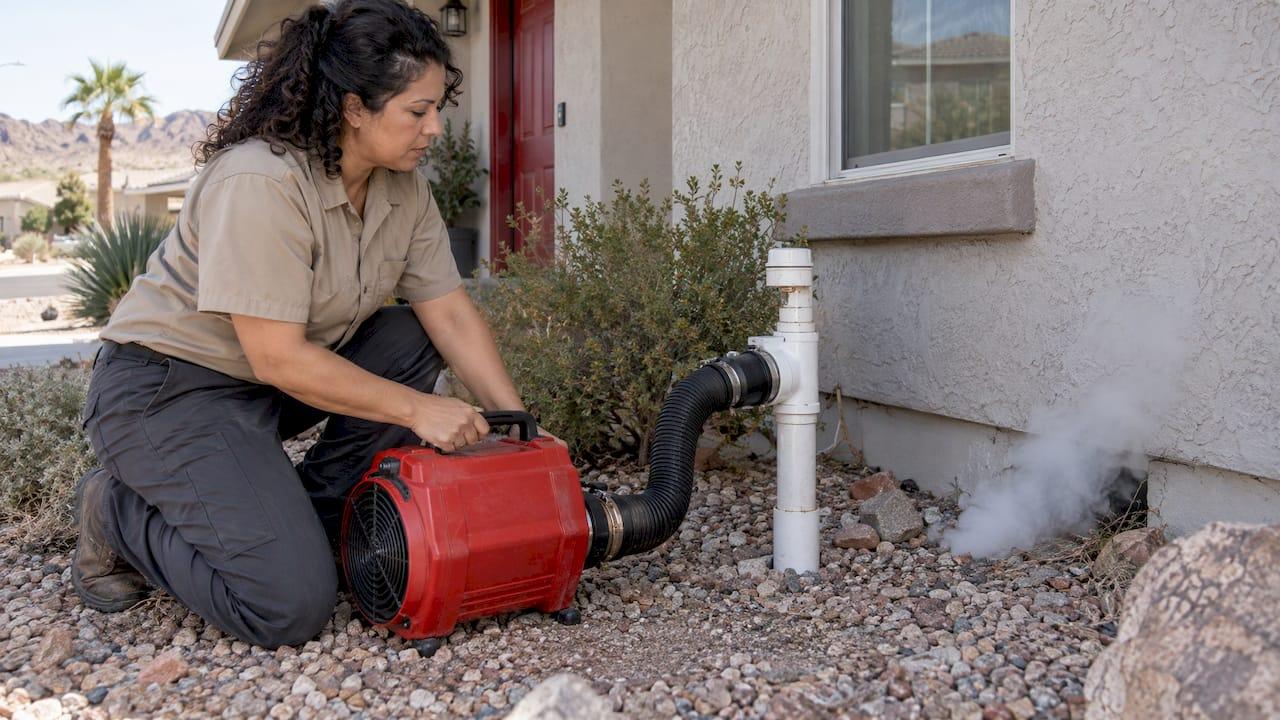
A plumbing smoke test pushes harmless, visible smoke into your drain, waste and vent system and watches where it escapes. Smoke that shows up where it should not, such as a yard, a crawl space, a wall or a room, marks a leak, an open connection or a venting problem. It is one of the quickest ways to track down a sewer smell you cannot place. Below we explain how the test works, how to get ready, what the results mean and what to do next.
TL;DR
- A smoke test sends non-toxic smoke through the drain-waste-vent system. Wherever smoke escapes, the pipe has a defect or an open connection.
- Before the test, fill every drain trap with water. Dry traps let smoke into the house and give false alarms.
- A typical test takes about 15 to 20 minutes, plus setup and walk-through time.
- Smoke in the house means an open fault. Open windows and doors and step outside until it clears.
- Smoke testing finds the problem area. Camera inspection or other checks may be needed to pin down the cause before repair.
Table of Contents
- What a plumbing smoke test is
- What smoke testing can find
- How a smoke test is done, step by step
- How to prepare your property
- What you should see, and what it means
- How long a smoke test takes
- What smoke testing cannot do alone
- What smoke testing costs
- Our perspective
- Get help with a sewer smell or a leak
- FAQ
- Sources
What a plumbing smoke test is
Your home's drain system is a network of pipes that carries wastewater out and vents sewer gas up and away through the roof. Every fixture has a trap, the curved section that holds a water seal and blocks odor. In a sound system, gas travels only one way: up the vent stack and out.
A smoke test makes that gas path visible. A technician introduces artificial smoke into the system, commonly at a cleanout or the roof stack, and the smoke travels to the leak or open connection and exits at the defect. The smoke is designed to be non-toxic and leaves little residue. It is not a fire, and it does not damage pipes.
People also call it a plumbing smoke test, or a smoke test on sewer lines. All three names describe the same idea. The difference is scale. A city may test a long stretch of public sewer main. A homeowner or property manager usually wants the lateral line and the building's own plumbing checked.
What smoke testing can find
Professional guidance from NASSCO, a sewer industry body, explains that smoke testing confirms system connectivity, identifies defects, and helps locate cross-connections and odor sources. The same guideline lists the kinds of defects it can reveal:
- Broken or missing sewer cleanout caps
- Leaks in the house lateral, the pipe running from your building to the main
- Foundation drain connections
- Storm drain cross-connections
- Faulty manholes
- Missing or abnormal venting
For a homeowner, the typical findings are simpler. A cracked section of pipe under the yard. A cleanout cap that no longer seals. A vent that was cut or capped during a remodel. A dry or defective trap. Each one can leak sewer gas into your living space.
Why it helps with sewer smells
A smell that comes and goes is hard to trace by nose. You can walk the house all day and not know whether the source is a drain, a wall cavity or the yard. Smoke gives you something you can see. If smoke curls up out of the ground near the foundation, the lateral has an opening there. If it appears at a fixture, that fixture's seal or connection needs attention.
If you are chasing an odor right now, our guides on fixing a sewer smell inside your house and on why drains smell bad cover the common causes that do not need a test at all. If the smell is outdoors, start with five safe checks for a sewer smell outside.
How a smoke test is done, step by step
The exact method varies with the building, but the sequence is consistent.
- Notify everyone. Occupants are told the test is happening. The standard procedure is to vacate the building except for the inspection personnel during the test. People with disabilities and pets that cannot get away from smoke should not be on site.
- Fill the traps. Every trap needs a water seal so smoke does not enter through normal fixtures. Building code guidance on testing describes filling all traps with water before smoke goes in.
- Isolate the system. The technician plugs or closes openings so smoke has only one way out: through a defect. Roof vent stacks are among the openings handled.
- Check airflow. A good procedure runs the blower with no smoke first. If the line is restricted, smoke testing may be ineffective and can blow smoke back at the blower. A blockage has to be cleared first.
- Introduce the smoke. Smoke goes in at a cleanout or another suitable attachment point.
- Watch and record. The technician walks the yard, checks roof vents, and looks inside the building for visible smoke. Locations of any leaks are noted.
- Ventilate. The building is aired out as needed before everyone comes back in.
The code version of the test
The International Plumbing Code answers a common question about a smoke test on a drainage system. Per the ICC's Q&A on the 2009 code, the procedure is to fill the traps with water, introduce pungent, thick smoke into the entire system, then close the roof stack openings once smoke appears. The system is then held at a pressure equal to 1 inch of water column for at least 15 minutes. Local code in your area may adopt a different edition, so ask your building department which one applies to a permitted job.

How to prepare your property
Good preparation is the difference between a clean result and a confusing one. City and utility guidance for property owners is consistent on this.
Fill every trap
The most important step is topping off drains that rarely get used. Municipal guidance says to pour water into basement floor drains and seldom-used sink or shower drains, and flush seldom-used toilets. Sonoma Water gives a specific amount: about 1 gallon of water into any drain not frequently used so the trap is full.

Think about spare bathrooms, a utility sink, a laundry standpipe, a garage floor drain and a basement drain. In a vacation home or a rental that sits empty between guests, these traps dry out quickly. Many Laughlin and Bullhead City properties sit unused for weeks, so this step matters.
Plan for the people and pets
- Tell everyone in the building and any tenants in advance.
- Plan to be outside or away during the test.
- Arrange for pets to be somewhere else.
- Anyone with respiratory sensitivity should stay out of the building, and out of the smoke, until the technician says it is clear.
Clear access
Make sure the technician can reach the cleanout, the roof access point if needed, and the main fixtures. Move stored items away from basement or crawl space drains. For commercial buildings, tell the property manager and tenants early. Our article on why drain venting matters for commercial buildings explains why vents are a frequent trouble spot in larger properties.
What you should see, and what it means
Some smoke is normal. Some is not. Here is how to read it.
| What you see | What it usually means |
|---|---|
| Smoke from the roof vent stacks | Normal. The vents are doing their job. |
| Smoke rising from the yard or near the foundation | A break, crack or open joint in the lateral or a damaged cleanout |
| Smoke at a cleanout cap | A cap that is missing, cracked or not sealing |
| Smoke inside the building | An open fault, such as defective venting, dry or defective traps, or damaged or missing plugs |
| Smoke from a storm drain or an unexpected location | A possible cross-connection between systems |
The homeowner guidance is direct on the in-house case. Smoke in the home indicates an open fault in the plumbing, not normal output from roof vents. If smoke does come inside, the advice is to open doors and windows and leave until it dissipates, which reduces exposure.
A false alarm to watch for
Overpressure can mislead. A plumbing trade article notes that if the system is pressurized, smoke can be forced through traps and create misleading indications. A careful technician uses only the pressure the test needs. This is one reason full traps and an experienced operator matter.
How long a smoke test takes
The test itself is short. A plumbing industry account puts a typical smoke test at about 15 to 20 minutes, with a brief warm-up for the machine. Plan on more for the whole visit. Setup, plugging openings, walking the property, recording findings and ventilating all add time. A small house is quicker than a multi-unit or commercial building with several stacks.
If the findings point to a repair, that is a separate job. We scope it with you before work starts.
What smoke testing cannot do alone
Smoke testing is a strong first step, not the last word. NASSCO's guideline is plain that smoke testing should not be the only test used to evaluate a collection system. Further investigation, such as dye flooding and CCTV, is commonly used to establish the cause and location of defects.
Soil matters too. The same guideline notes that saturated or frozen soil does not let smoke migrate well, so testing is recommended in dry conditions. Smoke tells you that something is open. A sewer camera shows what the break looks like, how deep it is, and whether roots or a collapsed section are involved. Read how that works in our guide to sewer camera inspections for homeowners. If roots are the suspect, see our article on tree roots in sewer lines.
Water leaks are a different case. Smoke follows the path of air, not water, so a pressurized supply line is checked another way. Our overview of how leak detection works walks through those methods.
What smoke testing costs
Prices vary with the size of the building, access to cleanouts and roof vents, and how much of the system needs testing. We do not publish a flat price for this work. The right number depends on your property, so we quote after learning what you need. Call us with the address, the type of building and the symptom, and we will tell you what to expect before anyone is dispatched.
Our perspective
Most of the sewer odor calls we hear about start the same way. A property owner has smelled something for weeks, tried a few cleaners, and still cannot say where it is coming from. Guessing costs time. A visible test cuts the guessing short.
What matters to us is what happens after the smoke clears. A finding is only useful if the pipe gets fixed properly. We work on sewer lines, water lines, gas lines, drains and septic systems for homes and commercial properties across Bullhead City, Fort Mohave, Mohave Valley and Laughlin. That means the person who sees the problem can also repair or replace the failed section, with no handoff between trades.
Our advice is simple. Fill your traps, plan to be out of the building, and do not ignore a smell that keeps coming back. Sewer gas is not something to live with. If you suspect a break, call early. Small openings become larger repairs when they are left alone. We are available 24/7 for emergencies, and we will explain your options in plain words before work begins.
JOHN
Get help with a sewer smell or a leak
If you smell sewer gas, see wet ground over a sewer line, or have a drain system that has failed, we can help. USA Plumbing and Septic LLC provides sewer line repair and replacement, drain cleaning, water line and gas line leak detection and repair, and septic system solutions for residential and commercial customers within about a 60 mile radius of Bullhead City. We also take emergency calls around the clock.
Ready to get it sorted? Call or book a visit with USA Plumbing and Septic and tell us what you are seeing and smelling. If you have a gas smell, leave the building first. Our guide on what to do if you smell gas lists the steps to take before technicians arrive. For other urgent problems, keep our 24 hour plumbing emergency checklist handy.
FAQ
Is the smoke used in a plumbing smoke test safe?
The smoke used is designed to be non-toxic and is not from a fire. Even so, guidance for property owners says people should minimize exposure, especially anyone with respiratory sensitivity. If smoke enters your home, open doors and windows and step outside until it clears.
Do I need to leave my home during the test?
Yes, the standard procedure is to vacate the building except for the inspection personnel. Make sure pets are away too. You can return once the technician has ventilated the building and says it is clear.
Why did smoke come into my house?
It usually means there is an open fault. Common causes are dry or defective traps, damaged or missing plugs in pipes, or a venting problem. Filling the traps beforehand rules out the simplest cause, so a result after that is a real finding.
Can a smoke test find every leak?
No. It shows where air escapes from the drain-waste-vent system, so it works best for odors, open connections and vent faults. Wet or frozen soil can keep smoke from reaching the surface. A camera inspection or other tests are often used to confirm the cause and exact location.
What happens after the test finds a problem?
We explain what was found, where it is, and the repair options. Depending on the finding, that could be a cleanout repair, a venting fix, a section of sewer line repair or a full replacement. You will know the scope before work starts.
Sources
- 2009 IPC, IMC and IFGC Q&A series (ICC)
- NASSCO Specification Guideline: Smoke Testing (May 2021)
- Smoke Testing: What Property Owners Need to Know (Fuquay-Varina)
- Sonoma Water: Smoke Testing
- Plumbing Contractor Goes to Smoke Machine to Find the Leaks (Plumber Magazine, 2017)
- How to Smoke Test DWV Plumbing Systems