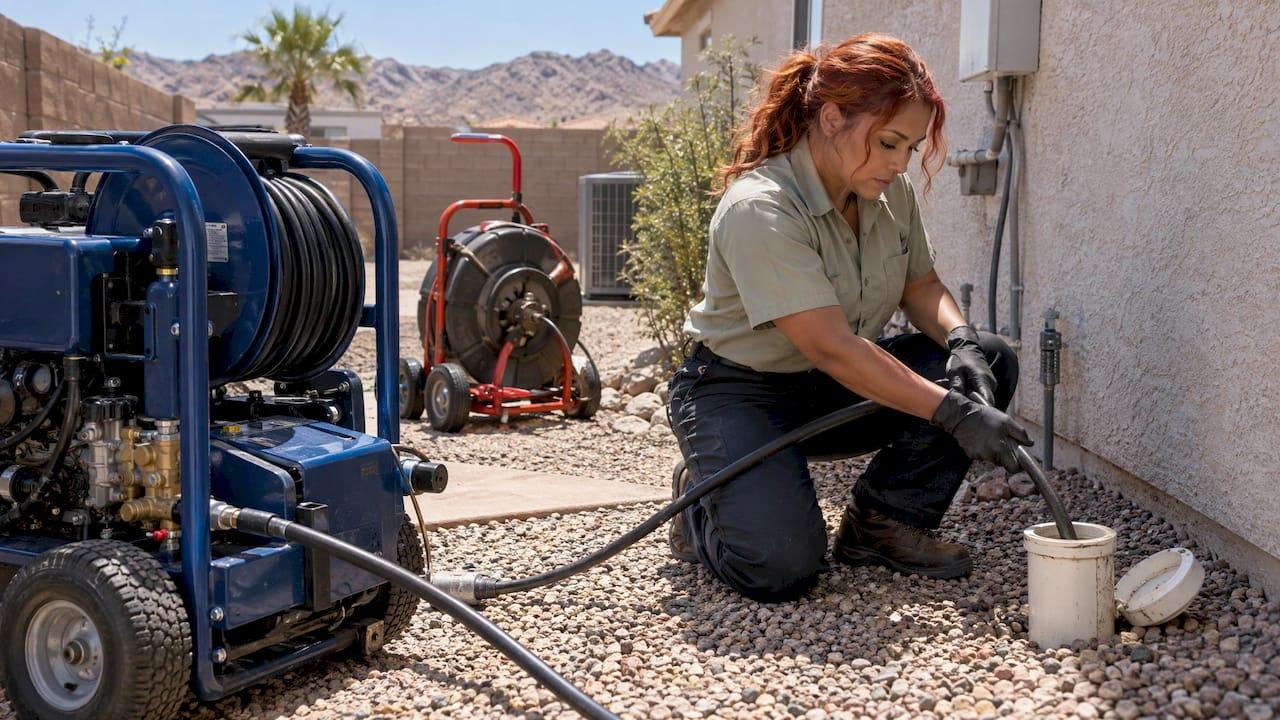
Snaking breaks through or pulls out a blockage with a cable. Hydro jetting blasts the pipe clean with high-pressure water. Snaking is usually the right call for a simple, one-time clog. Hydro jetting is usually the right call for grease, scale, roots and clogs that keep coming back. The pipe's material and condition decide which one is safe, and that is a call for a licensed plumber after looking at your line.
We are USA Plumbing and Septic LLC. We clear drains for homeowners, landlords and property managers in Bullhead City, Fort Mohave, Mohave Valley and Laughlin. Below is how we explain the choice to customers, in plain terms.
TL;DR
- Snaking uses a rotating cable to break up or hook a clog. It suits a single blockage close to the drain opening, such as hair in a tub or a stubborn sink stoppage.
- Hydro jetting uses a high-pressure water stream to scour the pipe walls. It suits grease, scale, sludge, roots and clogs that return.
- The wrong pressure can damage a pipe. Pipe material, age and condition set the limit, so a plumber should inspect before jetting.
- Jetting costs more per visit. Whether it pays off depends on how often the clog comes back. Our drain cleaning cost guide breaks down the factors.
- Slow drains in several fixtures at once, or sewage backing up, call for a professional right away.
Table of Contents
- How snaking works
- How hydro jetting works
- Side-by-side comparison
- Which clogs suit which method
- Pipe condition: the limit on hydro jetting
- Is hydro jetting worth it?
- What affects the price of either method
- Common mistakes with drain clogs
- Perspective
- Need a drain cleared in Bullhead City?
- Signs you should call a plumber instead of waiting
- Keeping drains clear between visits
- FAQ
- Sources
How snaking works
A drain snake, also called an auger, is a long, flexible steel cable with a tip designed to bore into or grab a blockage. Small hand-crank versions exist for sinks. Professionals use motorized machines that spin the cable and feed it much deeper into the line.
The cable travels down the pipe until it meets resistance. Then the tip does one of two things:
- It punches a hole through the clog so water can flow again.
- It hooks and pulls out material such as a hair mass, a wad of paper or a fibrous tangle.
The result is a pipe that drains. The key word is drains. A snake opens a channel. It does not necessarily clean the walls around that channel. If the clog was a thick layer of grease and soap scum, the cable can bore a hole through the middle and leave much of the coating where it was. That is why the same drain can slow down again a few weeks or months later.
Snaking has real strengths. The equipment is compact, it reaches tight spots, and it is fast. For a clog that is a single object or a compact mass, it is often exactly the right tool. It also works well for locating where a blockage sits, because the technician feels the cable meet resistance.
We cover the basics of both methods in our homeowner guide to how drain cleaning works.
How hydro jetting works
Hydro jetting uses a hose with a specially designed nozzle connected to a pump that pushes water at high pressure. The plumber feeds the hose into the line, usually through a cleanout. Jets on the nozzle do two jobs. Forward-facing jets break through the blockage. Rear-facing jets pull the hose forward and spray backward against the pipe walls, flushing debris toward the main sewer line.
The point of the method is that it cleans the whole inside circumference of the pipe, not just one channel through it. Grease, sludge, silt, scale and fine roots get stripped from the walls and washed out of the system.
Before a jetting job, a good plumber does not just start the pump. The usual sequence is:
- Locate the access point, normally a cleanout. If you are unsure where yours is, our guide on what a cleanout is will help.
- Inspect the line, often with a camera, to see the pipe material, the condition and the type of blockage.
- Choose a nozzle and set the pressure and flow for that pipe.
- Run the hose through the line, working forward and then pulling back while the jets clean the walls.
- Re-check the line to confirm it is clear.
Hydro jetting is common on commercial lines too, where kitchens and restrooms put heavy loads on drains. See our article on how hydro jetting clears commercial drains for that side of the work.
Side-by-side comparison
| Factor | Snaking | Hydro jetting |
|---|---|---|
| How it clears | Cable bores through or hooks the clog | High-pressure water scours the whole pipe wall |
| Best for | Single, localized clogs: hair, a wad of paper, a small object | Grease, sludge, scale, roots, repeat clogs, long lines |
| What it leaves behind | Can leave residue on the pipe walls | Aims to remove buildup along the pipe |
| Typical visit cost | Lower | Higher, because of the equipment and setup |
| Pipe considerations | Cable can scratch fragile or old pipe if forced | Pressure must match the pipe material and condition |
| Access needed | Often a sink, tub or cleanout | Usually a cleanout or a removed fixture |
| Good as prevention | Not really | Can be part of a maintenance schedule for problem lines |
Which clogs suit which method
The clog tells you most of what you need to know. Here is how we sort them.
Clogs where snaking is usually the right tool
- Hair and soap in a bathtub or shower drain. The blockage sits close to the opening, and a cable can hook it.
- A single-fixture clog in a sink or lavatory with no other symptoms in the house.
- A recent, sudden stoppage in a drain that has otherwise run fine for years.
- Locating a blockage when you are not sure what or where it is.
In these cases the cable is quick, effective and economical. Many service calls end right there, and the drain runs normally afterward.
Clogs where hydro jetting usually makes sense
- Grease buildup. Kitchen lines, especially in restaurants and busy households, coat their walls with fat that hardens as it cools. Water at high pressure removes that coating where a cable tends to punch through it.
- Tree roots in a sewer line. Roots work into joints and thicken. Jetting can clear root masses and fine root hairs along the line. Our article on tree roots in sewer lines explains why a cable alone often is not enough.
- Scale and mineral buildup. Bullhead City's drinking water comes from wells that draw groundwater from an aquifer, and the city's water quality report notes that the water picks up naturally occurring minerals as it moves through the ground. Mineral-rich water is one reason local homeowners often ask us about scale in pipes and fixtures, and scale along a drain wall is the kind of deposit a scouring water stream is designed to address.
- Repeat clogs. If you have snaked the same line more than once, there is probably buildup on the walls that the cable is not removing.
- Slow drains in several fixtures. That points to a problem in the branch or main line, not a single trap.
- Long runs of pipe where a cable would have a hard time reaching the whole length.
The gray area
Some situations fall in between: a kitchen sink that clogs every few months, or a main line that backs up once after years of no trouble. In these, a camera inspection is the tiebreaker. It lets us see whether the pipe has a coating, roots, a belly or a break, and choose the method on evidence rather than guesswork.
If a blockage shows up in your main line, check our guide on a main sewer line clog and one on a clogged sewer cleanout for what to look at first.
Pipe condition: the limit on hydro jetting
Hydro jetting is powerful, and that is exactly why the pipe matters. Industry guidance is direct about this: all sewer pipe can be damaged by water jetting. The same trade article gives pressure ceilings that depend on the material:
- Plastic gravity sewer pipe should not exceed 1,400 psi at the tool.
- Fiberglass pipe should be limited to a range of 870 to 1,450 psi.
- Cured-in-place pipe (a lining installed inside an existing pipe) should not be jetted above 2,000 psi, and should never be mechanically cleaned.
The pressure is only part of the picture. A sewer industry technical paper lists what a professional should consider before choosing equipment: sewer classification, pipe diameter and length, structural condition, pipe material and debris type. It adds that an older, deteriorated pipe might need lower pressure. It also notes that smaller, shallow sewers with laterals at the 3 and 9 o'clock positions should use around 1,000 psi and 30 gpm, to reduce the risk of blowing a toilet.
What this means for you in practical terms:
- Do not rent a jetter and guess. The right pressure and nozzle depend on the pipe, and the wrong settings can harm it.
- Tell the plumber what you know. If your home is older, say so. If the line was relined, say so. If you have had previous breaks or repairs, mention them.
- Ask for a camera look first on older or unknown lines. It shows the material and condition and lets the plumber set the job up properly.
- Expect a plan, not a promise. A careful plumber may recommend a repair, a lower-pressure approach or a different method if the pipe calls for it.
This is the real answer to "is jetting safe?" It is safe when it is matched to the pipe and done by someone trained to set it up. That is a big part of why homeowners pay a licensed plumber for it.
Is hydro jetting worth it?
It is worth it when the problem is buildup, roots or repetition, because you are paying to clean the pipe and not only to open it. It is not necessary for a simple, one-time clog close to the drain, where a cable does the job.
Think in terms of cost per year, not cost per visit. A lower-priced visit that has to be repeated several times can add up to more than one thorough cleaning. A thorough cleaning on a line that never needed it does not add much. The question to ask is how often the drain has been a problem.
Here is a simple way to decide:
| Your situation | Likely best fit |
|---|---|
| First clog in a tub, sink or shower | Snaking |
| Same drain clogs two or more times a year | Hydro jetting, after inspection |
| Kitchen line with heavy grease use | Hydro jetting |
| Roots suspected or confirmed in the sewer line | Hydro jetting, with camera inspection |
| Several fixtures slow at once | Inspection first, then the method that fits the finding |
| Sewage backing up from a floor drain or cleanout | Call a plumber promptly |
| Older home with unknown pipe material | Camera inspection before any high-pressure work |
Pricing varies with the type of clog, access, line length and whether it is a home or a business. We lay out the factors in our guides to U.S. drain cleaning costs and hydro jetting costs for homeowners. We give a price for your specific job after we see the line, so you know the number before work begins.
What affects the price of either method
Whatever method you need, the same handful of factors move the quote:
- Access. A clean, reachable cleanout makes the job quicker. A line without a cleanout, or with one buried or painted over, takes more time. Modern plumbing codes call for cleanouts at set intervals, and the 2024 International Plumbing Code sets a maximum spacing on smaller building sewers, so a house built before that kind of access was standard can mean more labor to reach a blockage.
- Location of the clog. A blockage a few feet from a sink is a different job from one 80 feet out in a sewer line.
- Severity. A soft film of soap is easier than a hard grease plug or a mass of roots.
- Equipment needed. Jetting requires a pump unit, hoses and nozzles, and a plumber trained to run them.
- Camera inspection. Looking inside the line adds a step, and it often saves a repeat visit.
- Timing. After-hours and emergency calls differ from scheduled visits.
- Residential or commercial. Larger lines and heavier use in commercial buildings change the scope.
Common mistakes with drain clogs
Pouring chemical cleaners down a stubborn drain. They can sit in the pipe and make it harder and less safe for a plumber to work on the line. If a cleaner has already gone in, tell the technician.
Forcing a hand snake on a toilet. Toilets have a curved built-in trap, and the right tool matters. If a toilet will not clear with a plunger, call us for toilet repair.
Ignoring a recurring slow drain. A drain that slows a little every month is telling you the walls are narrowing. That is the cheapest time to deal with it.
Assuming one method is always better. Online, you will see people insist that one method always wins. In practice, the right method is the one that matches the clog and the pipe.

Skipping the inspection. Without knowing what is in the pipe, you are guessing at both the method and the pressure.
Perspective
Our view on snaking and hydro jetting
We run both methods, and we do not treat them as rivals. Each one has a job. When a customer calls with a clog, our goal is to match the tool to the pipe and to the problem, so the drain stays clear and the line stays healthy.
Here is what we see in the field around Bullhead City, Fort Mohave, Mohave Valley and Laughlin. Homes with older lines, mature trees near the sewer and kitchens that see heavy daily use tend to have the same drain problems come back. For those lines we lean toward a thorough cleaning, and we like to look inside the pipe first so we are not working blind.
For a simple clog, we say so. A quick snake job is often all that is needed, and we would rather fix the problem in front of us than sell you more than it calls for.
Our licensed plumbers carry the equipment for both methods, for homes and for commercial properties, and we are available 24/7 for emergencies. When a backup will not wait, we respond quickly. We are your trusted local partner for drains, sewer lines and septic systems.
JOHN
Need a drain cleared in Bullhead City?
If your drain is slow, gurgling or backed up, we can send a licensed plumber to find out what is in the line and clear it with the method that fits. We serve homes and businesses across Bullhead City, Fort Mohave, Mohave Valley, Laughlin and the surrounding area, and we handle emergencies around the clock. Drain cleaning is one of our core services, alongside sewer line repair and replacement, water line and gas line leak detection, water heaters and septic system solutions.
Book your drain cleaning visit with USA Plumbing and Septic and tell us what the drain is doing. We will tell you what we recommend before the work starts.
Signs you should call a plumber instead of waiting
Some drain symptoms are more than a nuisance. Call promptly if you notice:
- Water backing up in a tub, shower or floor drain when you run the washer or flush a toilet.
- Gurgling from drains or toilets.
- Slow drainage in more than one fixture.
- Sewage odors in the house or yard.
- Wet or unusually green patches over the sewer line or septic area.
- A cleanout that is full or overflowing.
These point to a problem in a branch or main line, not a single fixture. If you also notice a damp area or an unexplained rise in your water bill, the cause may be a leak and not a clog. Our guide to how leak detection works explains how we track those down.
For general background on how the pipes in your home connect, see our guide to residential plumbing systems.
Keeping drains clear between visits
Whichever method clears your line, a few habits help it stay clear:
- Keep grease, oil and food scraps out of kitchen drains. Wipe pans with a paper towel first.
- Use drain strainers in showers, tubs and sinks to catch hair.
- Flush only toilet paper and human waste. "Flushable" wipes do not belong in the line.
- Run hot water for a short time after washing dishes.
- Know where your cleanout is and keep it accessible.
- Pay attention to slow drains and have them looked at early.
- If your property has trees near the sewer line, have the line inspected from time to time.
- If your home uses a septic system, keep up with scheduled maintenance. Our team handles septic system solutions as well.
FAQ
Is hydro jetting better than snaking?
Neither is better in every case. Hydro jetting cleans the full pipe wall, so it fits grease, scale, roots and repeat clogs. Snaking fits a simple, localized blockage. A plumber picks based on the clog and the pipe.
Is hydro jetting worth the cost?
It tends to be worth it when a line keeps clogging or has heavy buildup, because it removes the buildup and not only the blockage. For a one-time clog near the drain, snaking is usually enough. Ask for a quote based on your specific line.
Can hydro jetting damage my pipes?
Any high-pressure water can damage a pipe if the pressure is wrong for the material or its condition. Trade guidance gives different pressure limits for plastic, fiberglass and lined pipes. That is why we inspect the line and set the pressure to match before we jet.
Can I hydro jet a drain myself?
We do not recommend it. Professional jetting equipment, nozzle choice and pressure settings are matched to the pipe, and a mistake can harm the line or cause a backup into the house. Call a licensed plumber and let us handle it.
How do I know which one I need?
Start with the symptoms. One slow fixture and a recent change point toward snaking. Several slow fixtures, repeat clogs, grease or suspected roots point toward a camera inspection and likely jetting. Call us and describe what the drain is doing, and we will help you sort it out.
Sources
- Avoiding Damage, Plumber magazine
- Understanding the science of jetting sewers, NASSCO
- Water Quality Report, City of Bullhead City
- When to Call a Plumber for Drain Problems, Plumbing By The Book